2024-07-30 06:07
LITTLETON, Colorado, July 30 (Reuters) - The power sector is the only major consumer of natural gas that has shown consistent demand growth in recent years, and has become the driving force behind natural gas demand in the United States as consumption from other sectors declines. Natural gas use by power generators has expanded by around 3.5% a year over the past three years, and is by far the largest single source of gas use in the U.S., data from LSEG shows. However by volume, growth in natural gas use by the power sector was outweighed by declines in others. Average gas consumption by power firms grew by 70 billion cubic feet per day in 2023, while average combined consumption by industry, households and commercial users fell by 114 billion cf/day. Power firms accounted for around 44.4% of total domestic gas use in 2023, compared to around 29% by industry, 15.5% by households and 11% by commercial users. Industrial gas demand has declined by around 0.3% a year over the past three years, while residential and commercial gas demand has shrunk by around 0.5% and 0.7% annually respectively, according to LSEG's gas demand models. The growing concentration of gas use within the power sector poses a potential risk to the U.S. gas production sector, as further rapid decarbonization of power systems could trigger a swift decline in gas demand for power while other major consumption sources are already in decline. ELECTRIC PUSH A broad push to electrify certain heating and power systems across homes and businesses has accounted for much of the cuts to gas use outside power generation. Electricity-powered heat pumps and boilers have replaced gas-fired furnaces in scores of homes and businesses in recent years, although the pace of heat pump sales has slowed due to high electricity prices and interest rates. A record 4.3 million heat pumps were sold in the United States in 2022, which was the first year that heat pump sales surpassed sales of gas-powered furnaces in the country, according to the Air-Conditioning, Heating, and Refrigeration Institute (AHRI). Heat pump sales slowed to 3.6 million in 2023, and through May of 2024 totalled 1.564 million units compared to 1.643 million units during the same months of 2023, AHRI data shows. Despite the slowing sales pace, the cumulative impact of the installed pumps on gas demand has expanded, as each unit has displaced some quantity of direct gas consumption. POWER SWITCH Estimates on the exact volumes of natural gas displacement by heat pumps are scant, as most assessments made by industry tend to be in terms of cost savings rather than in terms of the volume of fossil fuel consumption that is cut. Further complicating the gas-impact calculus is the fact that many heat pump installations often substitute one type of energy consumption for another - from the direct burning of gas in on-site boilers to electricity supplied by power firms. And as that additional quantity of electricity must in turn be generated mainly by power firms, the net effect on overall gas use in the United States remains hard to discern. That said, high-level demand data reveal clear trends. Total U.S. natural gas consumption during the first half of 2024 was up 2.3% from the same months in 2023. Gas demand from power producers was up 5.2% from the first half of last year, while demand from all other major gas users was up just 0.5%, LSEG data shows. Among non-power uses, gas demand was 3.1% higher among industrial users during the first half of 2024 from the same period last year, but down 2.5% among residences and 1.2% lower among commercial users. That wide divergence in usage trends suggests that gas consumption may be close to peaking among non-power users, while continuing to expand in the power generation sector. GAS GROWTH A steady increase over the past five years in the proportion of electricity generated from natural gas further illustrates the importance of the power sector to the natural gas industry. Natural gas generated 42.41% of utility-scale electricity production in 2023, according to energy think tank Ember. That share compares to 35% in 2018 and 24% in 2010, and reveals how power firms have beefed up their reliance on natural gas for electricity generation while steadily reducing generation from coal. Coal's share of U.S. electricity generation was 16% in 2023, down from 27% in 2018 and 45% in 2010, Ember data shows. Electricity generation from solar and wind farms was 15.6% in 2023, compared to 9% in 2018 and 2.3% in 2010. A further steady expansion in renewable electricity generation is expected over the coming years, which may help power firms make further cuts to output from coal-fired plants as part of emissions reduction goals. But power producers look set to remain heavy users of natural gas for electricity generation, as gas plants can be easily throttled up and down to match the ebbs and flows of power demand needs and to plug any generation shortfalls during periods of low output from renewable sources. DEMAND TRENDS Total U.S. electricity demand looks set to expand as more energy end-uses become electrified and as overall power consumption climbs from data centres and due to artificial intelligence computations. Over the near to medium term, that higher power demand outlook bodes well for the natural gas production sector, even if direct gas use in households and commercial buildings continues to contract. But over the longer run, the continuing concentration of gas demand among the power sector poses a potential risk for the gas industry. Several utility systems have plans to phase out gas-fired generation and replace that power with a combination of renewable energy generation alongside battery storage systems that can store surplus renewable power for later use. Over the coming years, battery systems look set to remain far too small to pose any significant risk to gas demand. But if utility-scale battery systems continue their recent rapid growth while dropping in cost, goals for wholesale renewables + battery systems could become a reality and start to squeeze out gas from power systems in a decade or so. And if that occurs while other sources of gas demand also shrink, a major gas supply surplus could materialize. Sign up here. https://www.reuters.com/business/energy/power-sector-drives-growth-us-natural-gas-demand-maguire-2024-07-30/

2024-07-30 06:07
NEW YORK, July 30 (Reuters) - MSCI's global equities gauge lost ground on Tuesday as investors were jittery ahead of major corporate earnings reports and central bank meetings, while concern about the global economy pushed oil prices lower. U.S. Treasury yields drifted lower in choppy trading as investors geared up for the outcome of the U.S. Federal Reserve meeting, which ends on Wednesday. The Fed is expected to hold interest rates steady for now but flag a rate cut in September. Investors are also awaiting earnings reports from market heavyweights Microsoft (MSFT.O) , opens new tab and chipmaker AMD (AMD.O) , opens new tab due after the bell and reports scheduled for later in the week from Apple (AAPL.O) , opens new tab and Amazon.com (AMZN.O) , opens new tab. "Markets are on watch for earnings and what the Fed will say on Wednesday," said John Praveen, managing director at Paleo Leon. Praveen said some investors also worried about escalation in the Middle East after an Israeli air strike targeted a senior Hezbollah commander in Beirut's southern suburbs late on Tuesday in what Israeli military said was retaliation for a cross-border attack that killed 12 children and teenagers. On Wall Street, the Dow Jones Industrial Average (.DJI) , opens new tab rose 203.73 points, or 0.50%, to 40,743.66, the S&P 500 (.SPX) , opens new tab lost 27.12 points, or 0.50%, to 5,436.42 and the Nasdaq Composite (.IXIC) , opens new tab lost 222.78 points, or 1.28%, to 17,147.42. MSCI's gauge of stocks across the globe (.MIWD00000PUS) , opens new tab fell 2.40 points, or 0.30%, to 801.95. Earlier, Europe's STOXX 600 (.STOXX) , opens new tab index closed up 0.45%. In currencies, the Japanese yen gained on news reports that the Bank of Japan is considering raising rates to 0.25% when it concludes its two-day meeting on Wednesday. The dollar index , which measures the greenback against a basket of currencies including the yen and the euro, fell 0.03% to 104.55. The euro fell 0.09% to $1.0809. Against the Japanese yen , the dollar weakened 0.56% to 153.14. Sterling weakened 0.22% to $1.2831. Traders have been pricing in a roughly even chance for a Bank of England rate cut at its policy meeting on Thursday. In U.S. Treasuries, the yield on benchmark U.S. 10-year notes fell 3.5 basis points to 4.143%, from 4.178% late on Monday. The 30-year bond yield fell 3.2 basis points to 4.4013% from 4.433% late on Monday. And the 2-year note yield, which typically moves in step with interest rate expectations, fell 2.6 basis points to 4.3606%, from 4.387% late on Monday. "The whisper expectation is for the Fed to acknowledge softness in inflation and the labor market and maybe acknowledge the potential for policy adjustment in September," said Thomas Urano, co-chief investment officer and managing director at Sage Advisory in Austin, Texas. "Absent that, the market would be short-term disappointed. Ultimately, we think the data will continue to show a much normalized labor market, if not weak, along with an inflation that's running in the Fed's target zone," Urano said. In energy markets, oil prices fell more than 1% to settle at a seven-week low as investors worried that demand from China could be weakening while OPEC+ seems likely to stick to plans to increase supplies. U.S. crude settled down 1.4% at $74.73 a barrel and Brent ended its session at $78.63 per barrel, down 1.4% on the day. In precious metals, gold prices gained on investor optimism the Fed will drop clues on Wednesday about lowering interest rates in September. Spot gold added 1.04% to $2,408.32 an ounce. U.S. gold futures gained 1.15% to $2,405.20 an ounce. Sign up here. https://www.reuters.com/markets/global-markets-wrapup-1-2024-07-30/
2024-07-30 06:03
MOSCOW, July 30 (Reuters) - Russia's navy began planned exercises involving most of its fleet in the Arctic and Pacific oceans as well and the Baltic and Caspian seas, the defence ministry said on Tuesday. Russia is considered by most military analysts to have the world's third most powerful navy after those of the United States and China, and Russia has a significant ballistic-missile nuclear submarine fleet. The Russian drills, which include 20,000 personnel and 300 ships, will test the readiness and capabilities of the navy at all levels, the ministry said. The drills will include over 300 combat exercises including practicing the use of anti-aircraft missiles, artillery, anti-submarine weapons and "passive interference, it added. "Units and formations of the Russian Navy have begun conducting planned exercises in the operational zones of the Northern, Pacific and Baltic Fleets, as well as in the area of responsibility of the Caspian Flotilla," the ministry said. "The main purpose of the exercises is to check the actions of the military authorities of the navy at all levels, as well as the readiness of the crews of ships, units of naval aviation and coastal troops of the Russian navy to perform tasks." About 300 surface ships and boats, submarines and support vessels, some 50 aircraft and more than 200 units of military and special equipment will be involved in the combat training, the ministry said. Since President Vladimir Putin sent thousands of troops into Ukraine in February 2022, the Russia's Black Sea fleet - the only Russian fleet formation not taking part in the drills - has struggled to adapt to dynamic modern drone warfare and the chief of the navy was replaced earlier this year. At celebrations of Russian navy day on Sunday, Putin warned the United States that if Washington deployed longer range missiles in Germany then Russia would station similar missiles in striking distance of the West. Since launching an invasion on Ukraine in February 2022, Russia has conducted numerous military exercises on its own or with other countries, including China or South Africa. In the past two months, Russia has also conducted a series of mobile nuclear missile launcher drills and tactical nuclear weapons deployment exercises. It has also increased military training with Belarus, which borders both Russia and Ukraine, conducting a series of comprehensive drills. Sign up here. https://www.reuters.com/world/europe/russian-navy-starts-drills-involving-20000-personnel-300-ships-2024-07-30/

2024-07-30 06:02
MUMBAI, July 30 (Reuters) - India's gold demand in the June quarter fell 5% from a year ago, but consumption in the second half of 2024 is set to improve due to a correction in local price following a steep reduction in import taxes, the World Gold Council (WGC) said on Tuesday. Higher purchases in the world's second-biggest gold consumer could support global benchmark prices , which are trading near record highs. The recent 9 percentage point reduction in import duty on gold, implemented before the main festival season beginning in September, is expected to revive gold demand, further supported by good monsoon rains, said Sachin Jain, CEO of WGC's Indian operations. India last week slashed import duties on gold to 6% from 15%, a move industry officials said could lift retail demand and help cut smuggling. The duty cut brought down domestic prices of gold last week to 67,500 rupees ($806.20) per 10 grams, their lowest in four months, from a record high of 74,777 rupees earlier this month. Good monsoon showers boost food grain production and improve farmers' income. Two-thirds of India's gold demand usually comes from rural areas, where jewellery is a traditional store of wealth. "Strong gross domestic product forecasts and rural sector recovery are all likely to support demand in the second half of the year," WGC's Jain said. India's gold consumption in the April-June quarter fell 5% to 149.7 metric tons, as a 17% fall in jewellery demand offset a 46% rise in the investment demand during the quarter, the WGC said. Demand for gold from India could stand between 700 metric tons and 750 metric tons in 2024, the lowest in four years, it said. The Reserve Bank of India continued its gold buying spree in the June quarter, adding 19 tons, which brought its total purchases for the first half of the year to 37 tons, more than double the total purchased in all of 2023, the WGC said. ($1 = 83.7260 Indian rupees) Sign up here. https://www.reuters.com/markets/commodities/indias-duty-cut-revive-gold-demand-after-weak-june-quarter-world-gold-council-2024-07-30/

2024-07-30 05:53
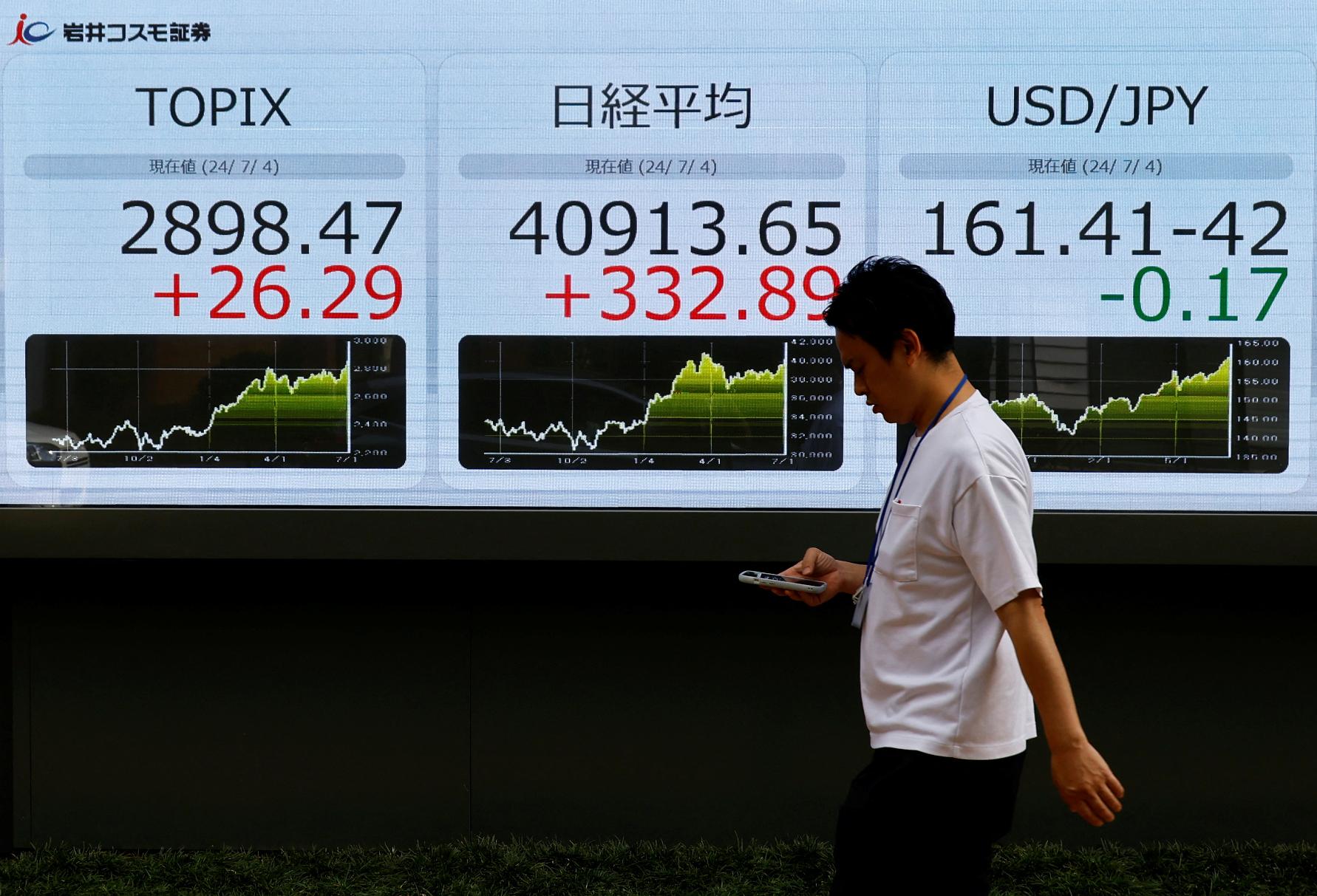
BOJ decision expected 0300-0430 GMT Wednesday Board to debate rate hike timing, July move likely close call BOJ seen halving bond buying in 1.5-2 years' time in QT plan Board to project inflation staying around 2% in coming years Governor Ueda likely to hold briefing 0630 GMT Wednesday TOKYO, July 30 (Reuters) - The Bank of Japan will detail plans to taper its huge bond buying and debate the timing of a next interest rate hike on Wednesday, signalling its resolve to steadily unwind a decade of massive monetary stimulus. The decision comes as the U.S. Federal Reserve looks to cut interest rates, possibly as early as September, reversing an aggressive rate-hike cycle that drove up the dollar and caused a painful yen sell-off for Japan. Expectations of narrowing U.S.-Japan interest rate differentials have pulled the yen off 38-year lows, taking some pressure off the BOJ to slow the currency's drop by combining a rate hike with an ambitious bond-tapering plan. But the yen's rebound also gives the central bank a chance to hike rates without giving markets the impression it is directly targeting yen moves through monetary policy, analysts say. "The BOJ can move either way. If it wants to hike rates now, it can say consumption will rebound due to higher wages," said Yoshiki Shinke, senior executive economist at Dai-ichi Life Research Institute. "If it wants to play it safe, it can await more data. Either way, the consumption outlook holds the key." While the BOJ insists it does not use monetary policy to affect currency moves, rising concern over a weak yen has prompted some calls from government and business leaders for the central bank to speed up its shift away from near-zero rates. At the two-day meeting ending on Wednesday, the BOJ will decide on a quantitative tightening (QT) plan that will likely halve monthly bond buying in 1-1/2 to two years' time - a pace roughly in line with dominant market forecasts. The board will also debate whether to raise short-term rates from 0-0.1%, which could be a close call as policymakers remain split on how long they should scrutinise data before pulling the trigger. More than three-quarters of economists polled by Reuters on July 10-18 expect the BOJ to stand pat. Money markets are pricing in a 64% chance of a 10 bps hike . The BOJ's decision will come hours before that of the Fed, which is likely to hold rates steady before cutting rates as soon as September. RECOVERY DOUBTS Japan's economy is at an inflection point with core inflation holding above the BOJ's 2% target for well over two years and workers getting their biggest base pay hikes in three decades. But rising living costs have hurt consumption, pushing the economy into contraction in the first quarter and casting doubt on whether households can swallow further price increases. Still, with inflation keeping real borrowing costs low, the BOJ will likely drop signs that it is on course for a steady rate hike path through 2026 to remove what it sees as excessive monetary support. Such clues, or guidance on the future rate hike path, will likely come from Governor Kazuo Ueda's post-meeting briefing or a quarterly outlook report due after the meeting. In the report, the BOJ will likely roughly maintain its projection made in April that inflation will stay around its 2% target in coming years, sources have told Reuters. Ueda has said the central bank will hike rates further if it becomes convinced that rising wages will prop up services inflation, and keep inflation durably around its 2% target. Such projections are not without pitfalls. The yen has surged from around 162 per dollar in mid-July to roughly 153 per dollar , its biggest two-week gain of the year. If yen rises continue, that could ease inflationary pressure from import costs in coming months. There is also uncertainty on whether one-off tax cuts and rising wages will change households' frugal spending, as the BOJ projects. Household spending unexpectedly fell in May and service sector sentiment worsened to levels unseen in nearly two years. "On the surface, inflation may appear to be overshooting. But the underlying factors driving price moves aren't very strong," said former BOJ board member Takahide Kiuchi, who is currently an economist at Nomura Research Institute. "I don't see evidence that backs up the BOJ's view that demand-driven inflation is accelerating steadily towards 2%." Sign up here. https://www.reuters.com/markets/asia/boj-debate-rate-hike-timing-fed-opens-door-cuts-2024-07-30/

2024-07-30 04:47
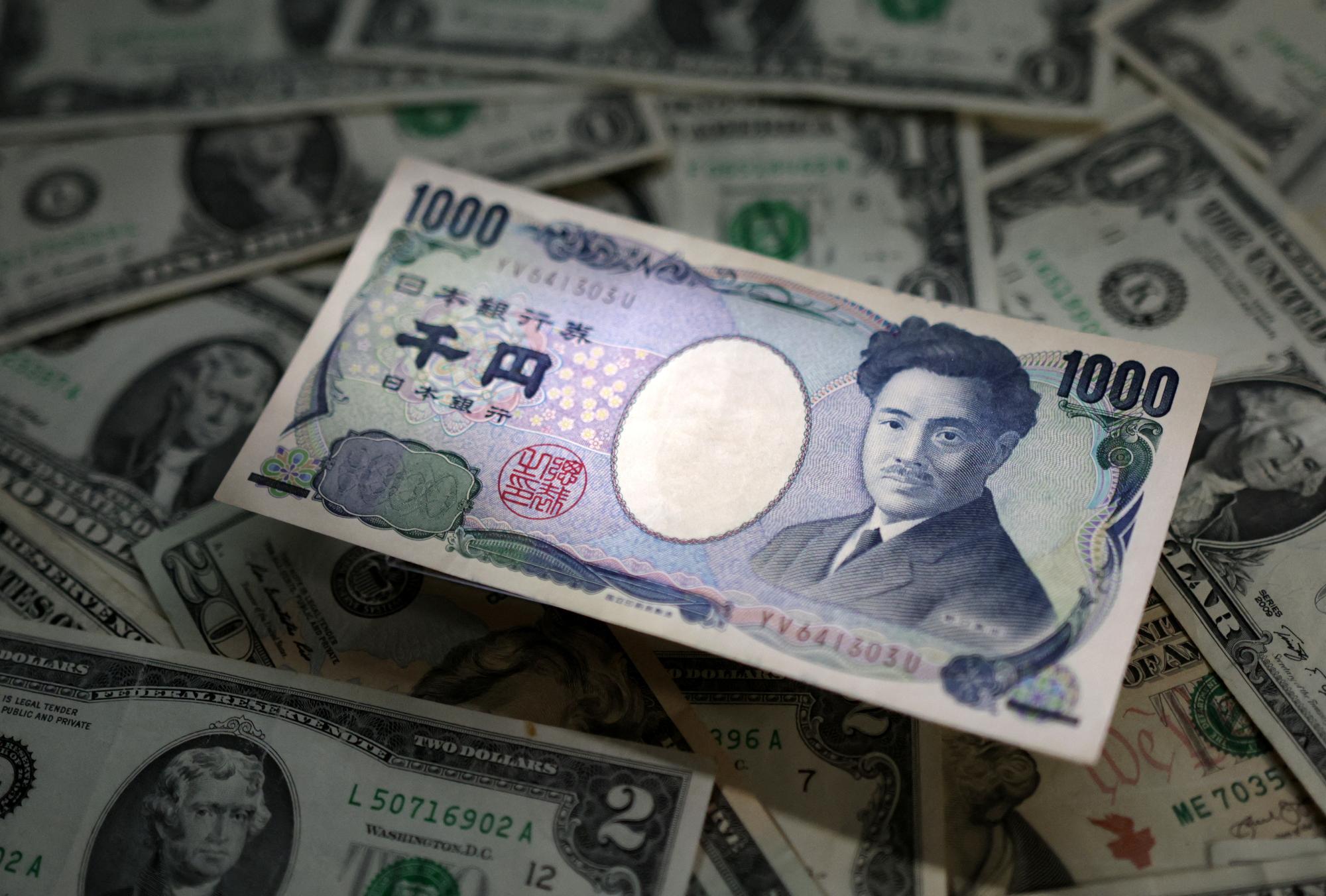
July 30 (Reuters) - The Japanese yen gained on Tuesday on news reports that the Bank of Japan is considering raising rates to 0.25% when it concludes its two-day meeting on Wednesday. That would be an increase from the current 0-0.1% and more than the market is currently pricing in, with a 10 basis-point increase still seen as only a 55% probability. The Japanese central bank will also detail plans to taper its huge bond buying as it steadily unwinds a decade of massive monetary stimulus. "We've seen quite a move in the yen on the day," said Shaun Osborne, chief foreign exchange strategist at Scotiabank in Toronto. "Some people were thinking that this move had probably already played out, but I think there's still the potential for some of these carry trades and some of the positioning to unwind a little bit further." The dollar was last down 0.47% at 153.29 yen . The dollar has fallen against the Japanese currency since hitting a 38-year high of 161.96 on July 3. Osborne sees the yen having a fair value of around 145 against the dollar, saying that "there's a way to go before the short yen trade is fully cleaned out and maybe even reversed." The greenback has lost around 4.7% against the Japanese currency this month. The yen had weakened earlier on Tuesday as investors closed positions before Wednesday's interest rate decision. “We've obviously had a very big move in the month of July,” said Brad Bechtel, global head of FX at Jefferies in New York. Bechtel sees further yen gains as likely temporary, with the currency expected to continue to suffer from the wide differential between U.S. and Japanese interest rates. “The yen is going to ultimately resolve weaker over time. It's just a question of how long that time period is,” Bechtel said. “There's no point in being long the yen because nobody wants to pay carry when they can earn carry in a myriad of other ways in the FX market.” The dollar fell 0.03% to 104.55 against a basket of currencies , after earlier hitting 104.79, the highest level since July 11. The Federal Reserve on Wednesday is expected to hold rates steady, but possibly give stronger clues that it is closer to rate reductions. Traders see a rate cut in September as certain and are also pricing in a second and possibly third cut by year-end. The U.S. central bank is wary of hinting at cuts too soon in case inflation rebounds, however, which may make a signal more likely at the U.S. central bank’s economic symposium in Jackson Hole, Wyoming, next month. U.S. data on Tuesday showed that U.S. job openings fell modestly in June and data for the prior month was revised higher. Consumers' perceptions of the labor market, meanwhile, are deteriorating. The euro fell 0.06% to $1.0812 and earlier reached $1.0798, the lowest level since July 8. The euro zone's economy grew slightly more than expected in the three months to June, though a mixed underlying picture and a string of pessimistic surveys cloud the outlook for the rest of the year. The German economy unexpectedly contracted in the second quarter after skirting a recession at the beginning of the year and July's inflation rose. Sterling weakened 0.2% to $1.2833 before the Bank of England's Thursday meeting. Market pricing sees it as roughly a coin toss whether the BoE cuts rates. In cryptocurrencies, bitcoin fell 2.64% to $65,586. Sign up here. https://www.reuters.com/markets/currencies/dollar-yen-hold-tight-ranges-ahead-boj-fed-2024-07-30/