2024-07-29 10:28
July 29 (Reuters) - Shares of New York-listed crypto firms fell on Monday as bitcoin dipped after breaching the $70,000-mark for the first time since mid-June. The sell-off erased gains from earlier in the session, when optimism fueled by Republican presidential candidate Donald Trump's pro-crypto speech lifted stocks. The volatile cryptocurrency has often seen pullbacks after reaching key milestones as investors book profits. The industry, however, cheered Trump's promise of friendlier regulation. "Any 'Trump trade' into U.S election should include greater allocation to bitcoin and bitcoin-linked stocks," Bernstein analysts wrote in a note. The former president has projected himself as the pro-bitcoin candidate ahead of the election in November. His return could be a huge win for the industry, which has often complained of excessive oversight and a hostile regulatory environment under President Joe Biden. Still, Securities and Exchange Commission Chair Gary Gensler, the Biden administration's top cop for crypto enforcement, has cautioned investors about the wild volatility and speculative nature of tokens like bitcoin. On Saturday, Trump said he would fire Gensler "on day one". He added that his administration would create a national "stockpile" of bitcoin using the crypto the U.S. government currently holds that was largely seized in law enforcement actions. But some warned against excessive optimism. "The bitcoin strategic reserve for the U.S. is a major milestone for bitcoin, however, it will still require Trump to win," said CoinCorner CEO Danny Scott. Crypto exchange Coinbase's (COIN.O) , opens new tab shares closed 3.6% lower after climbing as high as 5% earlier in the session. Miners Bitfarms , Riot Platforms (RIOT.O) , opens new tab and CleanSpark (CLSK.O) , opens new tab ended down between 4.9% and 5.2% after rising earlier. Top bitcoin backer Michael Saylor's MicroStrategy (MSTR.O) , opens new tab also closed 3.9% lower. Global sentiment towards bitcoin, however, was "incredibly positive this year," he added. "This is setting the scene for what many believe is the next bull run for 2024-25." Crypto has rapidly moved from the fringes of the financial world to the mainstream, helped by institutional investors' backing and the approval of exchange-traded funds tied to spot price of bitcoin and ether. Sign up here. https://www.reuters.com/technology/us-listed-crypto-stocks-jump-after-trumps-pro-bitcoin-speech-2024-07-29/
2024-07-29 10:21
A look at the day ahead in U.S. and global markets by Alun John, EMEA breaking news correspondent, finance and markets Things are feeling calmer on Monday morning, though we will see how long that lasts as it's going to be an action-packed week. Shares in Europe and Asia are trading higher and Nasdaq futures were up 0.3% at the time of writing (0900 GMT, 0500 ET)- a change of tone after a stumble by megacap tech stocks saw the tech-heavy benchmark shed 5.6% in the past two weeks. This week will go a long way towards deciding whether that's it for the sell-off, and the rotation into small cap stocks, or whether it is the start of something big. Geopolitics aren't having much of an effect on markets, at least so far, and concerns that Israel and the Iran-backed Lebanese group Hezbollah could be sucked into a full-scale war have done little to move oil prices, let alone broader markets. Monday's main potentially market-moving event is the U.S. Treasury's quarterly refunding announcement. It's one of those that can sometimes pass without notice. But investors were surprised by the larger auction sizes in the equivalent announcement a year ago, which sent long-dated Treasury yields higher due to fears about how the additional supply would be absorbed. We might get through this one unscathed, as the Treasury indicated in May it will keep most auction sizes steady. But it does mean a surprise could generate a larger reaction, and certainly investors remain worried about the U.S. fiscal trajectory. We'll rattle through the rest of the week's big events quickly so we aren't here all day, as there are a lot of them. Earnings are due from Microsoft on Tuesday, Meta on Wednesday and Apple and Amazon on Thursday, which will be interesting after Tesla, and to a lesser extent Alphabet, which disappointed last week. In central banks, the Federal Reserve meets on Wednesday - no change is expected, but it'll be interesting to see whether they do anything to disrupt market bets on a September rate cut - as well as the Bank of Japan, while the Bank of England will convene on Thursday. Market pricing sees a first BoE cut of the cycle as a coin toss, and a second small rate hike as more likely than not from outlier Bank of Japan. On top of that, there are all the back-and-forths in opinion polls ahead of November's U.S. presidential election to follow. As if that's not enough, we've got jobs data scattered through the week, building up to Friday's non-farm payrolls data. Traders always say this is important, but this one really is. Signs, though not definitive ones, that the labour market is slowing mean that Friday's data could even tell us more about the likely rate trajectory for the Fed than the central bank's Wednesday meeting. Markets are currently pricing around 70 basis points of Fed cuts this year. It would be at least a bit satisfying for some of the Fed's policymakers if the three 25 bp moves this implies come to pass, as that's what Fed rate setters said they expected to do back in December 2023. Since then, of course, there have been moments when markets have swung between pricing nearly seven rate cuts this year to pricing almost zero. Key developments that should provide more direction to U.S. markets later on Monday: * Earnings: McDonalds, Chesapeake Energy * U.S. Treasury announces quarterly borrowing estimates * Dallas Fed manufacturing activity Sign up here. https://www.reuters.com/markets/us/global-markets-view-usa-2024-07-29/
2024-07-29 10:21
MUMBAI, July 29 (Reuters) - The Indian rupee fell to a record low on Monday, pressured by month-end corporate dollar demand, although likely intervention from the Reserve Bank of India helped avert further losses. The rupee closed at 83.7275 against the U.S. dollar, unchanged from its close on Friday, after hitting an all-time low of 83.74 earlier in the session. Factors such as outflows from local equities, volatility in the Chinese yuan and tepid risk appetite have contributed to weakness in the rupee in recent sessions. The currency has hit all-time lows in five out of the last six trading sessions. The dollar index was up slightly at 104.5 while most Asian currencies gained between 0.1% and 0.8%. The RBI likely sold dollars via state-run banks, in order to cap weakness in the rupee, traders said. While the central bank has been intervening to support the rupee, the dollar sales have been "passive," suggesting that it wants depreciation to occur gradually instead of pushing the currency higher, a foreign exchange salesperson at a private bank said. Meanwhile, dollar-rupee forward premiums jumped, with the 1-year implied yield up 5 basis points (bps) at 1.83%, its highest level since February, aided by the decline in U.S. bond yields. The 1-year U.S. Treasury yield was little changed at 4.81% in Asia trading, after falling 4 basis points on Friday in light of data that signalled inflationary pressures in the U.S. are moderating. Policy decisions from the U.S. Federal Reserve, the Bank of England and Bank of Japan are in focus this week. The Fed is expected to keep rates unchanged on Wednesday, but investors will pay attention to remarks from Chair Jerome Powell for cues on the future path of policy rates. "We have a bearish bias on (the dollar index) this week, and wouldn’t be surprised to see a move below 104.0," ING Bank said in a note. Sign up here. https://www.reuters.com/markets/currencies/rupee-hits-record-low-month-end-dollar-demand-rbi-helps-cap-losses-2024-07-29/
2024-07-29 10:17
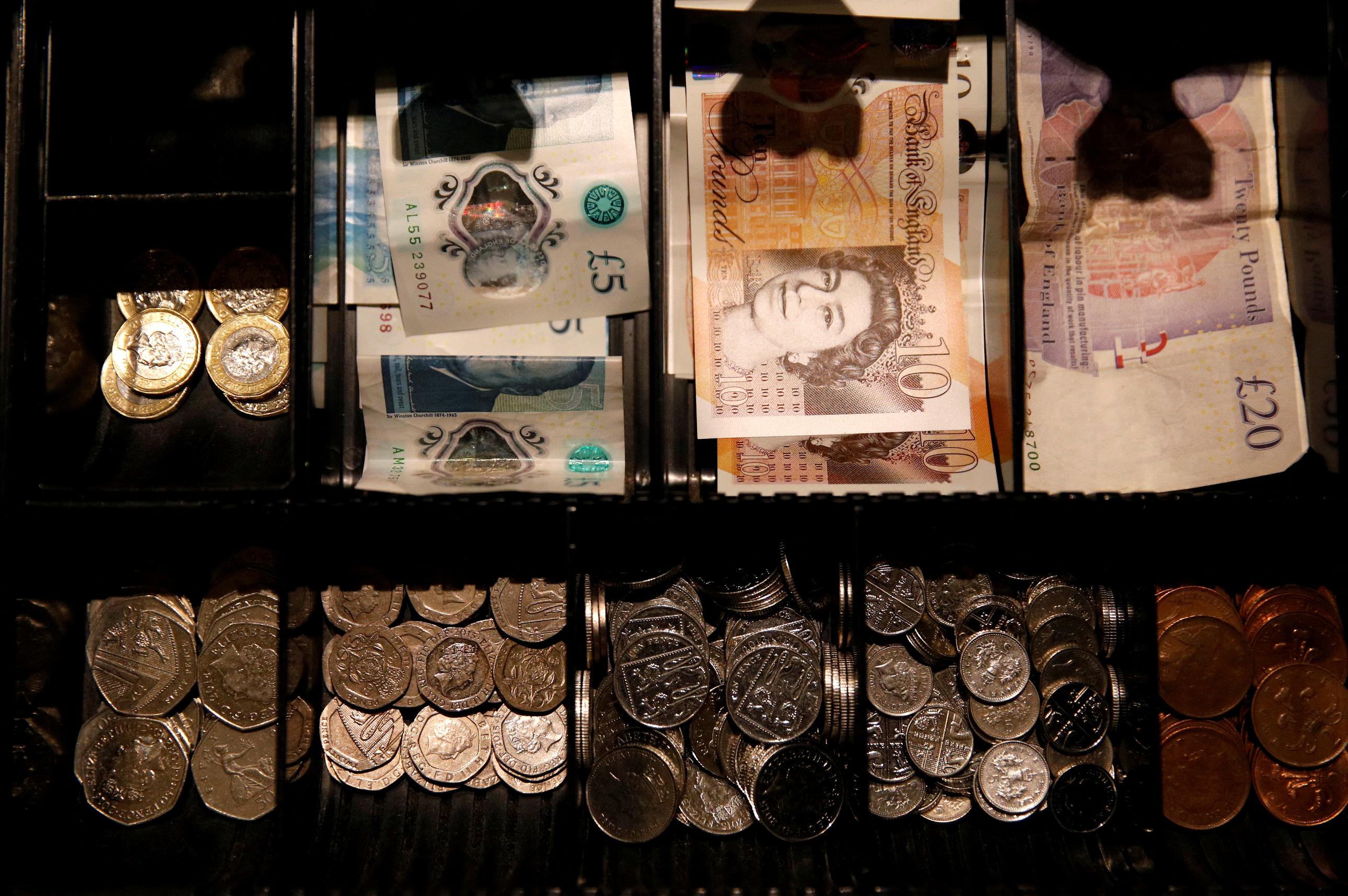
LONDON, July 29 (Reuters) - The pound fell to its lowest level in two weeks on Monday as investors looked ahead to the Bank of England's interest rate decision on Thursday and a key speech by British Finance Minister Rachel Reeves later in the day. Sterling was last down 0.25% at $1.2834 after falling to $1.2807 earlier in the session, the lowest since July 10. The euro rose against the pound , up 0.11% at 84.46 pence, after hitting a two-week high of 84.59. Traders increased their wagers on BoE rate cuts and were pricing in an almost 60% chance of a reduction on Thursday, up from just over 50% late on Friday, according to derivative market pricing. The shift in rate expectations pulled British bond yields lower, weighing on the pound. "The pricing of the Bank of England rate cut continues to creep higher," said Francesco Pesole, FX strategist at lender ING. "The FX market may be catching up a little bit (with bond markets)... There's a bit of pre-positioning." Pesole said Britain's relatively high interest rates have pulled money towards the pound but that advantage could be "cut quite substantially" if the BoE lowers borrowing costs. Investors were also waiting for a speech by Chancellor Rachel Reeves later on Monday, in which she will accuse the former Conservative government of leaving a shortfall in the public finances of around 20 billion pounds ($26 billion). Neil Jones, a senior FX salesperson at TJM Europe, said sterling's fall reflected investor nerves about Reeves' announcements. "If she points to tax increases, this will represent a U-turn and tarnish current positive global investor sentiment," he said. Politics has added to the uncertainty about the BoE's decision this week: many key policymakers have not spoken publicly for more than two months due to rules about speeches in the run up to July 4's election. British inflation has fallen back to the 2% target but services prices and wages are still growing strongly, causing some BoE officials to want to hold rates at 5.25% for a while longer. Sign up here. https://www.reuters.com/markets/currencies/sterling-slides-ahead-boe-decision-reeves-speech-2024-07-29/
2024-07-29 10:05
RIO DE JANEIRO, July 29 (Reuters) - The global economic uncertainties that led Brazil's central bank to halt its monetary easing cycle have persisted, preventing an interest rate cut this week, a Finance Ministry official told Reuters. In a Friday interview on the sidelines of the G20 finance leaders' meetings in Rio de Janeiro, Guilherme Mello said Brazil's interest rates are far above the level considered neutral for the economy. Nonetheless, he noted that the environment has not significantly improved since June, when the central bank held borrowing costs at 10.5% following seven consecutive rate cuts. Mello's comments echo the central bank's unanimous call for increased caution when it decided to pause the easing cycle due to an "uncertain global and domestic scenario," amid the prospect of prolonged high interest rates in the U.S. and a stronger-than-expected economy in Brazil, where inflation expectations have risen. They contrast with leftist President Luiz Inacio Lula da Silva, who repeatedly criticized the level of interest rates and the monetary policy decisions of the central bank. The central bank's Monetary Policy Committee (Copom) will meet again on July 30-31. "Copom decided in the last meeting that in light of these growing uncertainties — which evidently also unanchor domestic expectations and have affected the price of some assets, such as the exchange rate — they preferred to pause," Mello said. "What I observe is that this set of uncertainties still exists," he said, highlighting doubts about when monetary easing will kick off in the U.S. and the possibility of a policy shift in Japan. Since the latest Copom meeting, the Brazilian real has weakened more than 6% from the 5.30 per U.S. dollar that the central bank used in its inflation projections. Market concerns about leftist Lula's commitment to controlling public finances have also weighed on local assets, impacting the exchange rate and interest rate futures. Amid the impasse over a lack of compensation for payroll tax relief passed by Congress, Mello said that the impact of the measure is significant enough to jeopardize the government's goal of eliminating the primary budget deficit this year. However, he said that the ministry continues to support Congress in seeking compensatory measures. "We would like to balance the budget this year, but we face these difficulties. We have not yet resolved a significant amount of the revenue we were counting on, but we intend to solve this soon," he said. "We will continue to make progress step by step to dispel these uncertainties and create an environment that will eventually allow us to resume the cycle of rate cuts." Sign up here. https://www.reuters.com/world/americas/economic-uncertainties-still-prevent-rate-cut-brazil-official-says-2024-07-29/

2024-07-29 07:31
JOHANNESBURG, July 29 (Reuters) - South Africa's rand slipped against a stronger dollar on Monday as markets looked towards a U.S. policy decision later this week, while concerns grew over a possible escalation in conflict in the Middle East. At 1542 GMT, the rand traded at 18.48 against the dollar , about 1% weaker than its previous close. The dollar last traded around 0.2% stronger against a basket of global currencies. "The start of the week has brought new concerns, with geopolitical tensions again at the forefront," said Wichard Cilliers, head of market risk at TreasuryONE. The likelihood of widening conflict in the Middle East has weighed on sentiment, after the U.S. and Israel blamed a rocket strike in the Israeli-occupied Golan Heights on the Iran-backed Lebanese militant group Hezbollah. "Israel, considering an attack in Lebanon, is fuelling the safe-haven U.S. dollar," Cilliers said. "The market will only get more volatile as the week progresses with significant data releases and events," Cilliers added. Investors will turn their attention to the U.S. Federal Reserve later this week for insights into the future interest rate path of the world's biggest economy. The Fed is expected to keep interest rates unchanged on Wednesday, but markets are betting on a cut at the following meeting in September. Like other risk-sensitive currencies, the rand often takes cues from global drivers like U.S. monetary policy and geopolitical tensions in addition to local factors. On the Johannesburg Stock Exchange, the Top-40 (.JTOPI) , opens new tab index closed over 0.2% weaker. South Africa's benchmark 2030 government bond was weaker, with the yield up 2.8 basis points to 9.505%. Sign up here. https://www.reuters.com/markets/currencies/south-african-rand-edges-higher-with-eyes-fed-2024-07-29/