2024-07-22 06:52
Production in Brazil down 5% EBITDA drops, but still beats expectations In preliminary talks with potential partners for Namibia find LISBON, July 22 (Reuters) - Portugal's Galp Energia (GALP.LS) , opens new tab reported on Monday a 16% rise in second-quarter net profit, beating expectations as higher oil prices and lower production costs offset reduced output and the refining margin held steady. The company also confirmed ongoing preparations for a second drilling phase of four wells in Namibia's Mopane field, where it has an 80% stake, starting in the fourth quarter. It said it was in preliminary talks with possible partners. Galp shares, up more than 40% so far this year, rose more than 1%. It booked an adjusted net profit of 299 million euros ($325.34 million), above the 236 million euros expected by 18 analysts polled by the company. Adjusted earnings before interest, taxes, depreciation and amortisation (EBITDA) fell 7% to 849 million euros, compared with the 821-million consensus. Galp has estimated Mopane could contain at least 10 billion barrels of oil, making it one of the largest discoveries in the nascent basin following successful exploration by TotalEnergies (TTEF.PA) , opens new tab and Shell (SHEL.L) , opens new tab. Reuters reported earlier that more than 12 oil companies, including Exxon, Shell and Brazil's Petrobras, had expressed interest in buying a 40% stake in Mopane. "We're having preliminary discussions with potential partners, but you will understand there is nothing much we can say at this stage," Chief Executive Filipe Silva told a conference call with analysts. He said Galp would give priority to a partner keen to develop quickly and that would provide the capital expenditure. The timing of any farmout agreement would depend on the development needs and on when Galp can get the most for the stake, he added. After completing the sale of assets in Angola and agreeing to sell those in Mozambique, Galp has unprecedented financial strength and can keep delivering long-term growth from "high return projects," he said. Galp maintained its guidance for average annual net capex of 1 billion euros over 2023-25. Galp's share of oil and gas production from upstream projects in Brazil fell 5% on the year to 106,000 barrels of oil equivalent per day (boepd). It did not book production in Mozambique in the quarter after booking 5,000 boepd a year ago. ($1 = 0.9190 euros) Sign up here. https://www.reuters.com/business/energy/portugals-galp-second-quarter-profit-jumps-16-beats-expectations-2024-07-22/
2024-07-22 06:49
JOHANNESBURG, July 22 (Reuters) - South Africa's Anglo American Platinum (Amplats) (AMSJ.J) , opens new tab expects its demerger from Anglo American (AAL.L) , opens new tab to be completed next year, its chief executive said on Monday. The platinum group metals (PGMs) producer is being spun off from Anglo American, which has embarked on a wider restructuring plan to combat a takeover bid from BHP Group (BHP.AX) , opens new tab. Johannesburg-based Amplats plans to have a secondary listing in London as part of the plan, its CEO Craig Miller said, adding that it has brighter prospects as a standalone business. "The planned demerger will create a more focused, independent global leader in the PGM industry," Miller said. "We are in the process of potentially doing a secondary listing on the London Stock Exchange," he added on a conference call, adding this would result in "a diverse group of shareholders" for Amplats. The miner has cut about 3,700 jobs to reduce spending as it positions itself to remain profitable ahead of the demerger. Meeting the cost targets as well as its demerger plans are key to efforts by Anglo American CEO Duncan Wanblad to trim the group by exiting platinum, selling coal assets and divesting from its diamonds unit to focus on copper, iron ore and its fertilizer assets. Amplats said its profit dipped 18% to 6.5 billion rand ($355.4 million) in the six months to June 30 and it declared a dividend of 9.75 rand per share, amounting to a total of 2.6 billion rand, in the first-half. ($1 = 18.2898 rand) Sign up here. https://www.reuters.com/markets/commodities/anglo-platinum-cuts-jobs-save-costs-it-readies-spinoff-2024-07-22/
2024-07-22 06:37
SALMON-CHALLIS NATIONAL FOREST, Idaho, July 22 (Reuters) - The only U.S. cobalt mine sits fallow in the northern Idaho woods, a mothballed hunk of steel and dirt that is too expensive for its owner to operate because Chinese rivals have flooded global markets with cheap supplies of the bluish metal used in electric vehicle batteries and electronics. Jervois Global (JRV.AX) , opens new tab, which dug the mine into the side of a nearly 8,000-foot (2,400-meter) mountain, watched helplessly last year as cobalt prices plunged after China's CMOC Group (603993.SS) , opens new tab opened the Kisanfu mine in the Democratic Republic of Congo, pushing global production of the metal to an all-time high. The Idaho site, which Jervois bought in 2019, was idled in June 2023 just weeks before it was set to open. More than 250 workers lost their jobs. A skeleton crew now rotates unused rock crushing equipment weekly to keep it from flattening under its own weight. "We were straightforward with our staff and told them: 'This is all about the price of cobalt,'" site manager Matthew Lengerich told Reuters during a visit to the facility. Jervois says cobalt prices need to reach at least $20 per pound for the site to open. But prices sat near $12.17 in July. A similar quandary faces BHP (BHP.AX) , opens new tab, Albemarle (ALB.N) , opens new tab and other Western mining companies trying to compete with metals produced by Chinese-linked companies, some of which use coal-generated electricity, child labor or other practices not meeting the standards set by many governments and manufacturers. Western miners say their competitors have inherent cost advantages that enable rapid production expansions even as prices for cobalt, lithium and nickel have plunged more than a third in the past 18 months. Operational costs for many of these Western companies have, as a result, been exceeding what market prices will cover. That has fueled growing calls from some policymakers and miners, including Jervois and Albemarle, for a two-tier pricing system with a premium for sustainably produced metals, according to interviews with more than three dozen traders, investors, executives, purchasing agents, and pricing agencies. The plan is to charge more for a metal that is produced sustainably, whether that is through direct transactions or via multiple prices for a metal listed through futures exchanges, depending on production methods. For example, there would be one price for standard nickel and another for green nickel. "Western miners simply can't compete with China, and China has shown the willingness to drive market prices way, way down," said Morgan Bazilian, director of the Payne Institute for Public Policy at the Colorado School of Mines. Two-tier pricing could radically shift how metals needed for energy transition have been bought and sold for centuries yet also reduce market transparency as miners could bypass metals exchanges to negotiate directly with customers. It could also, two analysts told Reuters, lead to multiple definitions of what exactly constitutes "green metal." 'COMMITMENTS HAVE A COST' Industry leaders have pushed for two pricing structures for several years, but the call for change started gaining more attention from investors, policymakers and customers last fall as Western governments grew more concerned about Chinese competition. In meetings across Washington and Brussels, mining executives have been pleading with governments for some kind of intervention until two-tiered pricing is more widely embraced, suggesting that tariffs, supply chain transparency requirements, or government insurance for mines could be potential remedies, three industry sources said. U.S. and E.U. officials have privately expressed sympathy with the mining industry, according to two of the sources, but have so far been loath to inject themselves into the mechanics of how prices are set by exchanges and others. "I don't want to say what the markets should or shouldn't do to ensure strong ESG practices," said the U.S. State Department's Jose Fernandez, who oversees a program designed to facilitate metals supply deals. "But it is true that all of those commitments have a cost." As a result, mining industry customers such as automakers are in the uncomfortable position of trying to keep their costs low while maintaining secure and diverse metals supplies. Some deals are taking shape, prodded in part by regulations tied to emissions. The European Union by 2027 will require EV manufacturers to show where they procure metals and the carbon footprint for their production. Refusal to comply would mean an EV can't be sold in the region, a step not yet taken by the United States but one widely seen as the most aggressive globally to boost supply chain transparency and likely to fuel premium metals contracts. In Canada last year, Northern Graphite (NGC.V) , opens new tab started successfully demanding a premium from customers wanting guaranteed North American supplies of the battery metal. Teck Resources (TECKb.TO) , opens new tab earlier this year started selling a lightly processed type of copper known as concentrate to Aurubis (NAFG.DE) , opens new tab, a source with direct knowledge said. The transaction does not rely on exchange pricing and guarantees Aurubis a steady supply of ESG-compliant concentrate that it turns into copper for sale to the auto industry. Teck declined to comment. Aurubis said it sees "the way to a green-friendly copper industry as a joint task for the entire value chain, which needs to be honored from the raw material supplier to the end consumer." Customers for now do not face a penalty if they do not source sustainable metals, but they increasingly face a reputational risk. "The question is really for car companies: Are you OK with something that might be priced lower or are you willing to pay premiums knowing that this is sourced sustainably in the correct way?" said Michael Scherb, CEO of Appian Capital Advisory, a private equity firm that invests in mining companies. 'WEATHER THE STORM' BHP, the world's largest mining company, said this month it would suspend operations at its Australia nickel mines due to "the substantial economic challenges driven by a global oversupply of nickel." The move was a blow to a company that had unsuccessfully bet its customers would be willing to pay a premium for nickel produced in a country that mines sustainably. BHP warned that nearly two-thirds of Australia's nickel market is in danger of closing amid low market prices fueled by a 153% increase in Indonesia's nickel from 2020 through the end of last year due to Huayou Cobalt (603799.SS) , opens new tab and others - production that environmentalists say has partly come by tearing up the country's vast rainforests. U.S. officials are encouraging Jakarta to improve the country's mining standards. Huayou Cobalt did not respond to a request for comment. Australia's nickel industry is among the cleanest in the world largely due to how it handles carbon emissions, according to data from ESG consultancy Skarn Associates. Nickel processed in Indonesia emits more than five times the amount of carbon as production in Australia, the data show, with emissions from China's nickel industry nearly seven times worse than Australia. Albemarle, the top global producer of lithium, laid off staff in January amid low prices caused in part by ramped up production from Yongxing Special Materials Technology (002756.SZ) , opens new tab and others in China. "If there isn't an incentive above current prices, you're not going to get the investment you need to build the domestic (U.S.) supply chain," said Eric Norris, who oversees Albemarle's lithium operations. Fernandez, the U.S. State official, expects rising minerals demand to offset current "global oversupplies," but acknowledged that miners, for now, are in a bind. "We have to find ways to weather the storm," Fernandez said. TRANSPARENCY Since January, world leaders have taken a range of steps to offset China's market control. President Joe Biden imposed tariffs in May on critical minerals produced in China, saying "(metals) prices are unfairly low because Chinese companies don't need to worry about a profit." Jim Chalmers, Australia's treasurer, in February said governments should consider support for "a differentiated international trading market for resources produced to higher ESG standards." Chrystia Freeland, Canada's deputy prime minister, in April said Ottawa would fight the dumping of critical minerals by China, Indonesia and others. The Chinese mission to the United Nations did not respond to a request for comment. China has in the last year banned exports of graphite and other metals. Multiple U.S. senators from both parties have said they are considering legislation to offer price insurance for metals, similar to a government insurance program for crops, according to Senate aides. Such a move would guarantee miners a price for their metals, regardless of market conditions. Automakers have been moving cautiously as this trend for green pricing premiums evolves, conscious that consumers are reluctant to pay more for EVs. General Motors (GM.N) , opens new tab, the largest U.S. automaker, believes critical minerals should be produced sustainably but does not want to pay a premium out of concern that it will be unable to compete with Chinese rivals, according to a source directly involved in the company's minerals procurement. GM told Reuters it requires suppliers to comply with high standards, a stance echoed by Volkswagen, BMW and Stellantis. Tesla (TSLA.O) , opens new tab and Ford (F.N) , opens new tab, which is building an Indonesian nickel processing plant with Huayou Cobalt and PT Vale Indonesia (INCO.JK) , opens new tab, did not respond to requests for comment. EXCHANGES The London Metal Exchange (LME) said it has received "positive market feedback" regarding its move to price sustainable nickel. Its partner Metalshub, a German online metals auction platform, sold 144 metric tons of low-carbon nickel in May and plans to publish a corresponding price when there are more transactions. Benchmark Mineral Intelligence, a UK-based provider of critical minerals pricing and data, has launched green metals pricing contracts, with each price derived from how a mining company adheres to 79 criterion that Benchmark said reflect high production standards. "You will not be able to guarantee by any stretch of the imagination a non-China supply of certain metals unless you're willing to pay some degree of a premium for that product," said Benchmark's Daniel Fletcher-Manuel. That's the message that Jervois has been pushing, unsuccessfully. "Ultimately, ESG has a cost," said Bryce Crocker, the company's CEO. "It's a worthwhile cost." Sign up here. https://www.reuters.com/markets/commodities/western-miners-push-higher-metals-prices-ward-off-chinese-rivals-2024-07-22/

2024-07-22 06:22
July 22 (Reuters) - South African petrochemicals company Sasol (SOLJ.J) , opens new tab increased coal exports by 5% in the year to June 30, driven by improved freight rail performance and higher production at its Thubelisha colliery, it said on Monday. A production update from the world's biggest producer of fuels and chemicals from coal and gas said that it exported 2.1 million tons of coal during its financial year, up from 2 million tons previously. The company, however, reported a 2% dip in coal production to 30.2 million metric tons from 30.8 million tons the previous year, mainly owing to a reduction to its mining operations. Output from Sasol's Secunda operations, where the company produces synthetic fuels and chemicals from coal, was flat at 7 million tons. Revenue from the chemicals business declined 13% to $7.86 billion, mainly because of lower prices. Sasol releases its financial results on Aug. 20. Sign up here. https://www.reuters.com/markets/commodities/sasol-coal-exports-up-5-despite-production-dip-2024-07-22/

2024-07-22 06:07
CANBERRA, July 22 (Reuters) - A plan by Australia's federal opposition that would slow the roll-out of renewable power and build a network of nuclear reactors has set the scene for a divisive confrontation on climate policy ahead of an election expected next year. The opposition policy, unveiled last month, would replace the current government's emphasis on accelerating construction of solar, wind and batteries with one that envisages a greater role for fossil fuels while seven state-owned nuclear plants are built. Energy analysts say this would lead to significantly higher emissions for at least two decades before significant nuclear power could come onto the grid - a claim the opposition rejects. The governing Labor Party says the idea threatens investment in wind and solar and is a costly, environmentally damaging fantasy for a vast, sparsely populated and sunny country whose laws currently prohibit nuclear generation. "It is a ploy to keep coal running longer, at a massive cost to reliability and emissions," energy minister Chris Bowen said last week. "It is a betrayal of those Australians who have suffered from bushfires, floods and cyclones in the critical decade for climate action." The opposition Coalition of Liberal and National Parties is betting on anger among people who do not want wind or solar farms near their land or coastline and polls that show around half of Australians support nuclear power. Labor is under pressure amid a cost of living crisis, and the Coalition promises its nuclear plan will achieve net-zero by 2050 more cheaply and safely than Labor can. Many analysts say that is unlikely even with Australia being a major producer of uranium needed for fuel, given the huge cost of nuclear plants. Weakening Australia's momentum towards renewables appears to be a key goal of the nuclear policy, according to some political and energy analysts. While supported in some areas, the plan is not popular enough in marginal seats to sweep the Coalition to power, said Kos Samaras at political consultants RedBridge. But it offers a clear alternative that could easily gain support if the renewables rollout does not go smoothly, he said. "If Labor doesn't get it right, that's when the coalition walks right in." CLIMATE WARS The widening policy divide between Labor and the opposition has echoes of the so-called climate wars of the 2010s, when scepticism of climate change fuelled by some Coalition politicians became a key election issue. Labor sought to end that era since coming to power in 2022, positioning Australia as a climate leader and bidding to host the COP international climate conference in 2026. By 2030, Labor aims to have 82% of Australia's power coming from renewables - up from around 40% now - and to reduce emissions by 43% from 2005 levels. Longer term, it envisions a mostly renewable system anchored by batteries and flexible gas generation. The Coalition says it still wants net zero emissions by 2050 but would target a lower share of renewables in the grid, without yet saying what level that would be. Opposition energy spokesman Ted O'Brien told Reuters Labor was alienating local communities and failing to meet its renewables targets while limiting generation from coal and gas that will be needed to anchor power supply. "The problem to solve is not to get the maximum amount of renewables on the grid but to reduce emissions, keep prices low and the lights on," he said. He said Labor would sooner or later have to resort to non-renewable generation to keep the grid functioning. "There is no credible pathway to net zero without some nuclear energy in the mix," he added. NUCLEAR OPTION Many countries are using nuclear power, with India, South Korea, and Britain among those building new reactors. But energy analysts said high construction costs, plus Australia's lack of nuclear expertise and abundant land and sunshine, make nuclear a less logical choice here. Seven nuclear plants would only supply around 15-20% of Australia's energy in 2050 - if they can be built on time or at all, said Tony Wood, an energy analyst at the Grattan Institute think tank. More wind and solar will inevitably be built, analysts said. The Australian energy market operator expects all the aging coal plants that now provide most of the country's power to close in the next 15 years. States and private companies have their own emissions targets, which they would likely keep. Renewables are also the cheapest form of generation, encouraging investment, said David Dixon at consultants Rystad Energy. The threat of major, interventionist policy changes that could pit renewables against taxpayer-funded nuclear plants now looms over the industry, renewables firms and investors said. While none were currently reconsidering investments, there were concerns the federal government could limit offshore wind or abandon a federal scheme that guarantees minimum revenue for solar, wind and battery facilities and aims to triple the amount of renewable capacity committed to between 2024 and 2027. O'Brien did not say whether the Coalition would scrap the investment scheme but said its current design would not provide energy security without more gas-powered power plants. He did not say whether he would block offshore wind but said Labor should stop pushing for an offshore wind zone north of Sydney and "start a proper community engagement process." The opposition's rhetoric under leader Peter Dutton echoes that of a previous Coalition leader, Tony Abbott, who won election in 2013 with a pledge to abolish a carbon tax, said Wood. "Climate was the weapon Abbott chose," he said. "It was incredibly effective. Dutton's going to try it again." Sign up here. https://www.reuters.com/business/environment/nuclear-wildcard-reignites-australias-climate-wars-2024-07-22/

2024-07-22 06:03
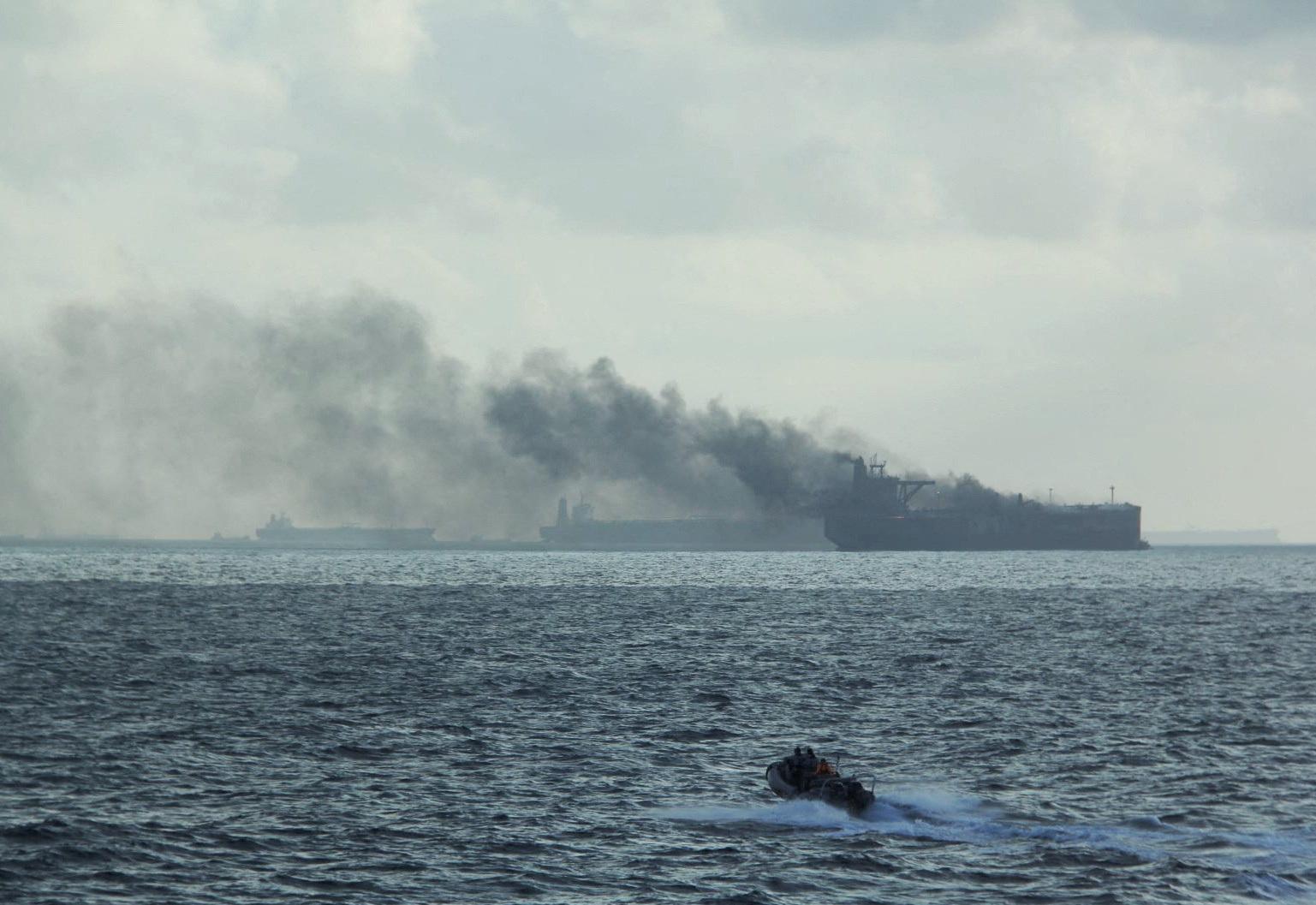
Supertanker Ceres I fled after collision off Singapore on Friday Tanker tracked down in Malaysian waters and seized Ceres I previously discharged Iranian crude ship-to-ship SINGAPORE, July 22 (Reuters) - A tanker that fled the scene of a fiery Friday collision off Singapore entered the area of Malaysia's Bertam floating oil terminal on Monday after being tracked down and intercepted by Malaysian authorities, shipping data from LSEG and Kpler showed. The Sao Tome and Principe-flagged supertanker Ceres I had left the scene of the collision with the Singapore-flagged tanker Hafnia Nile about 55 km (35 miles) northeast of the Singaporean island of Pedra Branca without explanation. The Ceres I, which was believed to have turned off its tracking system after the accident, was then found in Malaysian waters with two tugboats towing it, Malaysia's coast guard said. Industry experts say the Ceres I is known to have carried Iranian oil in the past, and LSEG and Kpler data showed the supertanker discharged Iranian crude via ship-to-ship transfers in Malaysia's Linggi transhipment hub in April. However, AIS data on LSEG indicated that the Ceres I, a very large crude carrier (VLCC) capable of carrying around 2 million barrels of oil, was empty at the time of the collision. Ship-to-ship transfers are often used to mask the origins of sanctioned oil. Aerial surveys of the scene found minor traces of an oil spill. "For further action, the two tankers involved will be towed to a safe location to enable further investigation and the cause of the incident will be investigated by the marine department," Kama Azri Kamil, acting maritime director of Johor state, said in a statement, without saying where the ships would be taken. The exact circumstances leading to the incident are unknown. All 26 crew members who had remained aboard the Ceres I to fight fires are safe, he added. Fourteen crew previously evacuated from the Ceres I and the Hafnia Nile's 22 crew were safe in Singapore. The Bertam terminal is located in the South China Sea off the east coast of Peninsular Malaysia. Shanghai Prosperity Ship Management is the manager of the Ceres I, according to LSEG data. It could not immediately be reached for comment. Hafnia, the manager of Hafnia Nile, has said it is in discussions with Malaysian authorities to move its vessel. The Hafnia Nile, a Panamax tanker, was carrying about 300,000 barrels of naphtha for Japan, according to ship-tracking data from Kpler and LSEG. Naphtha is a raw material for making petrochemicals. Singapore is Asia's biggest oil-trading hub and the world's largest bunkering port. Its waters are among the busiest sea lanes in the world. Sign up here. https://www.reuters.com/world/asia-pacific/fire-hit-oil-tanker-enters-malaysia-fpso-bertam-terminal-area-data-shows-2024-07-22/