2024-07-17 06:25
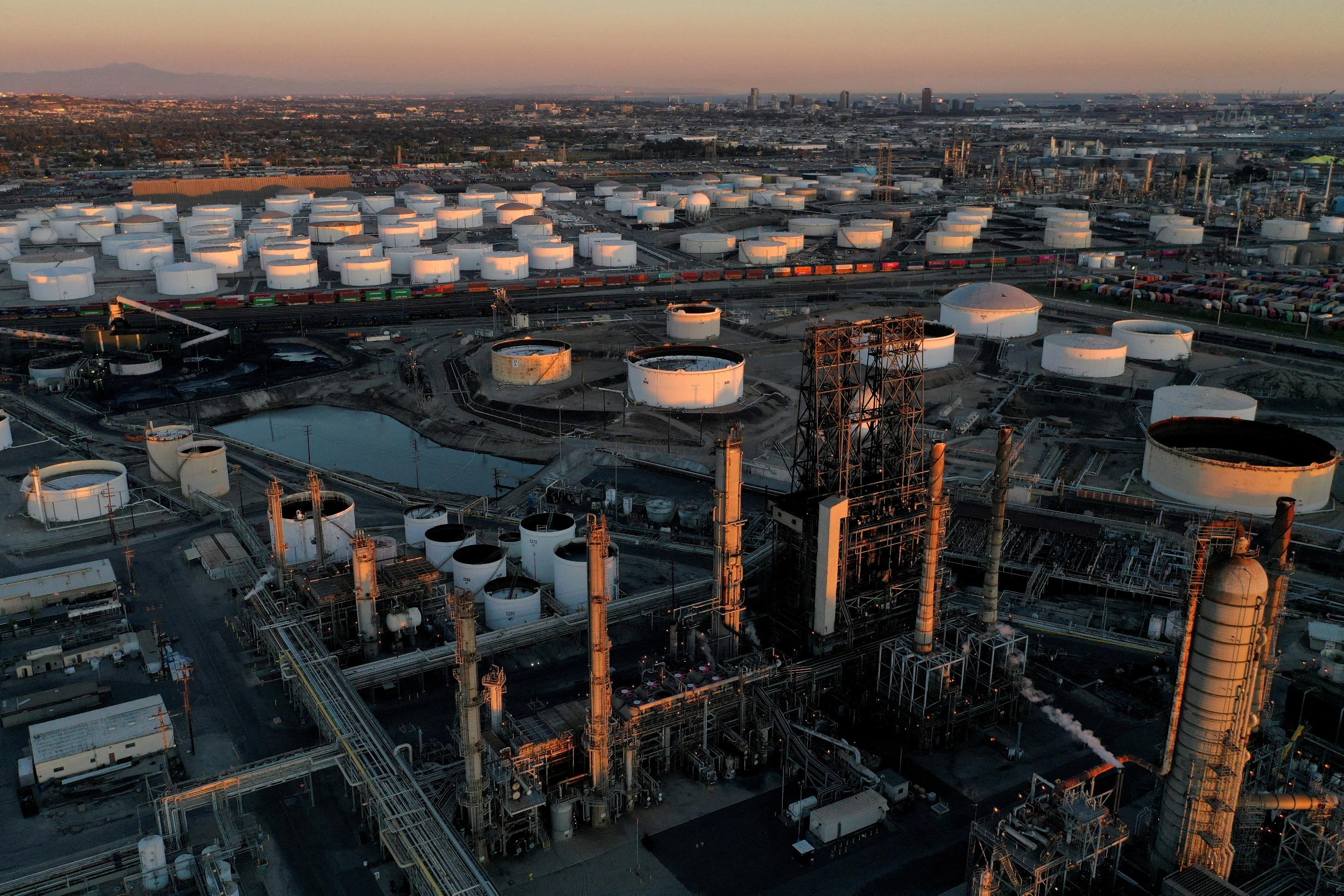
NEW YORK, July 17 (Reuters) - Oil prices climbed about 2% on Wednesday on a bigger-than-expected weekly drop in U.S. crude stockpiles and as a weaker U.S. dollar overshadowed signs of lower economic growth in China. Brent futures rose $1.35, or 1.6%, to $85.08 a barrel by 1:33 p.m. EDT (1733 GMT), while U.S. West Texas Intermediate (WTI) crude rose $2.09, or 2.6%, to settle at $82.85. On Tuesday, Brent closed at its lowest level since June 14 and WTI at its lowest since June 21. The premium of Brent over WTI narrowed to around $3.65 a barrel, the lowest since October 2023. The narrowing spread means energy firms have less reason to spend money to send ships to the U.S. to pick up crude for export. In the U.S., the Energy Information Administration said energy firms pulled 4.9 million barrels of crude from storage during the week ended July 12. That compares with the 30,000-barrel decline analysts forecast in a Reuters poll and a drop of 4.4 million barrels in a report from the American Petroleum Institute trade group , . In U.S. refining news, the diesel and 321- crack spreads, which measure refining profit margins, fell to their lowest levels since December 2021 and January 2024, respectively. A weaker U.S. dollar (.DXY) , opens new tab, also helped support oil prices after the dollar hit a 17-week low against a basket of major currencies. A weaker dollar can boost demand for oil by making greenback-denominated commodities like oil cheaper for holders of other currencies. SLOWER GROWTH IN CHINA China, the world's top oil importer, saw its economy grow 4.7% in the second quarter, official data showed earlier this week, the slowest growth since the first quarter of 2023, capping crude price gains. "Recent data have signaled a slowing of growth in the United States, the euro area, and China," analysts at Citigroup's Citi Research unit said in a report. "Central banks," they added, "are getting closer to a point where they will have scope to cut rates in earnest." In the U.S., single-family homebuilding fell to an eight-month low in June amid higher mortgage rates, suggesting the housing market was likely a drag on economic growth in the second quarter. Top U.S. Federal Reserve officials said on Wednesday the central bank is "closer" to cutting interest rates given inflation's improved trajectory and a labor market in better balance, remarks that set the stage for a first reduction in borrowing costs in September. The Fed hiked rates aggressively in 2022 and 2023 to tame a surge in inflation. Borrowing costs rose for consumers and businesses, slowing economic growth and reducing demand for oil. Lower interest rates could boost oil demand. Sign up here. https://www.reuters.com/business/energy/oil-prices-steady-slowing-demand-offsets-tightening-supply-2024-07-17/
2024-07-17 06:16
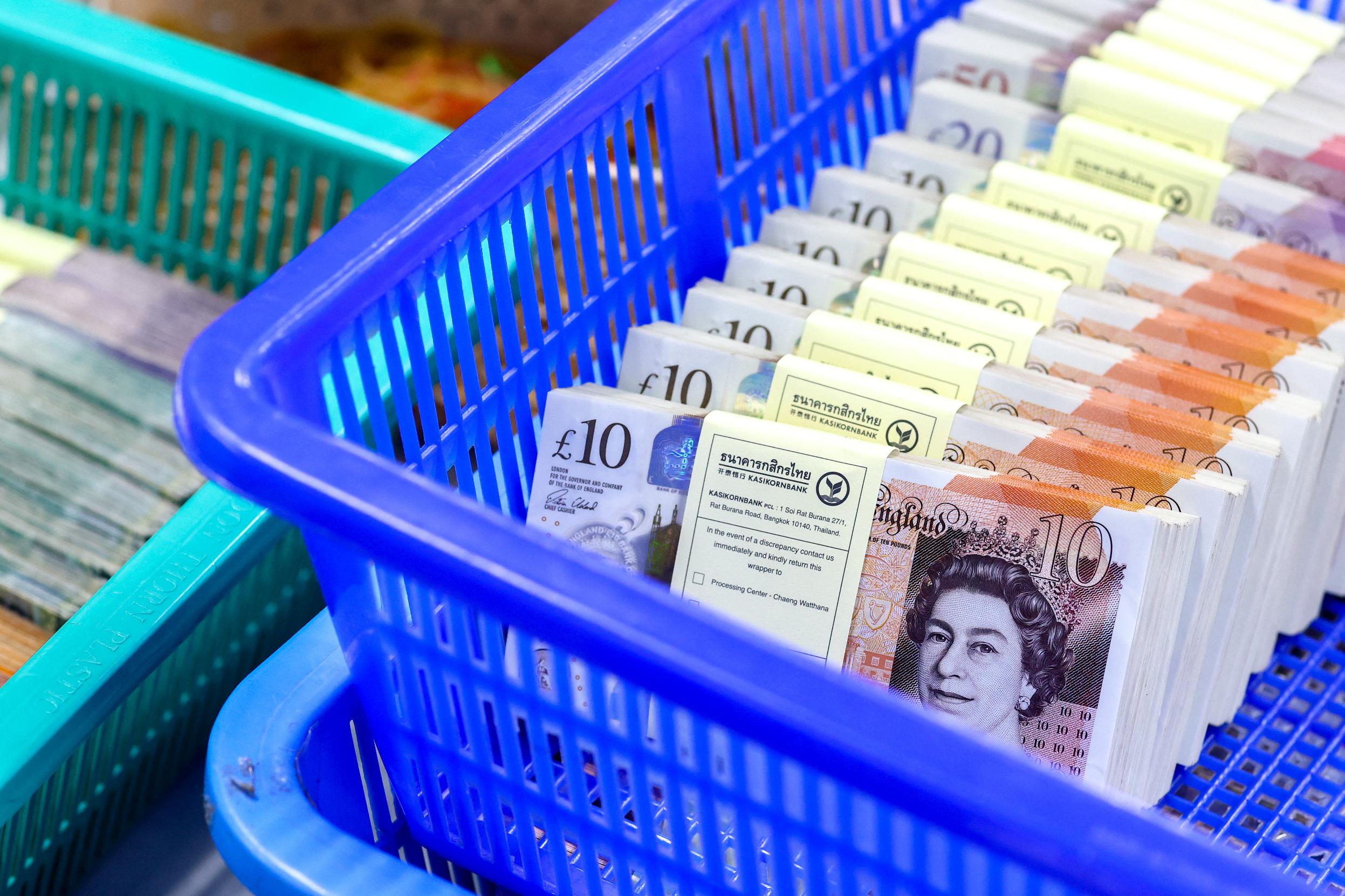
LONDON, July 17 (Reuters) - The pound hit its highest for nearly two years against the euro and around one year against the dollar on Wednesday after stronger than expected UK services inflation data for June led markets to reduce expectations for an August rate cut. The euro dropped 0.1% to 83.92 pence, its lowest since August 2022 , and the pound also firmed against the dollar, gaining 0.13% to $1.299. British inflation held at 2.0% year on year last month, official data showed, above the 1.9% expected by analysts polled by Reuters, and closely-watched services inflation was at 5.7% year on year, compared to the expected 5.6%. Strong increases in hotel prices were partly to blame for the higher than expected reading, underscoring the Bank of England's concerns about price pressures in the services sector. "Today’s inflation data won’t be what the doctor ordered... This marked a third consecutive month where services CPI beat expectations," said Sanjay Raja, chief UK economist at Deutsche Bank. "Undoubtedly, today’s services print raises the bar for an August rate cut," he said. Pointing to the rise in live music and accommodation prices, however, Raja noted that "it’s certainly very possible that some Taylor Swift effects were at play here" and that BoE rate setters could look past some of the inflation upside. Taylor Swift has been touring in Britain. Nonetheless, after the data rate futures showed investors saw a roughly one in three chance of a BoE rate cut on Aug. 1, the date of its next scheduled monetary policy announcement, down from almost 50-50 before the inflation data. Sign up here. https://www.reuters.com/markets/currencies/sterling-rises-after-higher-than-expected-uk-services-inflation-2024-07-17/
2024-07-17 06:14
Trade curb prospects weigh on tech stocks Treasury yields, dollar hit four-month lows on rate cut talk Yen surges on possible intervention Dow hits third straight record closing high NEW YORK, July 17 (Reuters) - Global equity indexes mostly fell on Wednesday as possible U.S. trade curbs on chip equipment pulled tech stocks lower, while Treasury yields and the dollar both hit four-month lows as Federal Reserve officials indicated the central bank was getting closer to cutting interest rates. The Japanese yen rose sharply, in a move suspected to be the result of the latest in a series of interventions from Tokyo to boost the long-depressed currency. A U.S. interest rate reduction by September is seen as having a 98% probability, according to CME Group's FedWatch tool. Lowering rates is generally seen as a way to stoke economic growth. "We are hearing a choral change in Fed speakers preparing the markets for a rate cut beginning in the later part of Q3," said Peter Cardillo, chief market economist at Spartan Capital Securities in New York. Among the comments, Fed Governor Christopher Waller and New York Fed President John Williams both noted the shortening horizon toward looser monetary policy. The benchmark S&P 500 equity index (.SPX) , opens new tab lost 78.93 points, or 1.39%, to 5,588.27 and the tech-heavy Nasdaq Composite (.IXIC) , opens new tab lost 512.41 points, or 2.77%, to 17,996.93. The Dow (.DJI) , opens new tab, which has underperformed the other two major U.S. stock indexes this year, ended higher on Wednesday and notched its third straight record closing high. Chipmaker stocks slumped on a report that the United States is mulling restricting imports of technology to China, coupled with Republican presidential candidate Donald Trump saying key production hub Taiwan should pay the U.S. for its defense. MSCI's gauge of global stocks (.MIWD00000PUS) , opens new tab fell 7.47 points, or 0.90%, to 823.78. Shares of artificial intelligence chipmaker Nvidia (NVDA.O) , opens new tab, fell more than 6% after a rocky Asian session for Taiwan's TSMC (2330.TW) , opens new tab, which closed 2.4% lower. Investors earlier this week had formed a cautiously optimistic view of a second U.S. presidency for Trump, who is running against incumbent Democrat Joe Biden. "Many strategists have suggested (Trump) is bullish for equities, and I'm just not sure about that," said Benjamin Melman, global chief investment officer at Edmond de Rothschild Asset Management. YEN JUMPS The yen has posted several outsized moves in recent days, appreciating sharply on Thursday and Friday from 38-year lows of 161.96 per dollar, sudden rallies that market participants said had the signs of Japanese government intervention. Bank of Japan data released on Tuesday suggested Tokyo may have spent 2.14 trillion yen ($13.5 billion) intervening on Friday. Combined with the estimated amount spent on Thursday, Japan is suspected to have bought nearly 6 trillion yen via intervention last week. The dollar index (.DXY) , opens new tab, which measures the greenback against a basket of currencies, fell 0.43% at 103.76, having hit a four-month low of 103.64 earlier in the session. The euro was up 0.34% at $1.0934. Against the yen , the dollar weakened 1.33% to 156.23, after falling to as low as 156.09, a level last seen on June 12. The softer dollar boosted demand for precious metals. Spot gold lost 0.45% to $2,457.54 an ounce due to profit taking after hitting an all-time high of $2,482.29 earlier in the session. Gold, priced in dollars, has a strong inverse relationship with the U.S. currency, as well as Treasury yields. The yield on U.S. 10-year notes dipped 1.5 basis points to 4.152%, from 4.167% late on Tuesday. During the session, the yield hit 4.146%, its lowest since March 13. Softer jobs data and easing inflation has brought Treasury yields down this month by boosting the odds of an impending rate cut. Oil prices gained, with U.S. crude settling at $82.88 a barrel, up 2.63% on the day, while Brent rose to $85.01 per barrel, up 1.53% on the day. Sign up here. https://www.reuters.com/markets/global-markets-wrapup-1-2024-07-17/
2024-07-17 06:07
ISIOLO, Kenya, July 17 (Reuters) - At least five people were killed and several others injured when an informal gold mine caved in and buried them alive in northern Kenya, a local official said. Authorities closed the Hillo subsistence gold mine near the Ethiopian border in March after several people were killed in clashes between local communities over access to the area, but miners have continued to dig at the site. Around 1,000 people overpowered security forces and invaded the area on Monday evening, said David Saruni, Marsabit County deputy commissioner. "They dug an abandoned site which collapsed and buried five bodies that were recovered," Saruni said late on Tuesday. Village elder Alio Guyo said nine bodies had been recovered from the rubble, which included five Kenyans and four Ethiopians. Five miners died under similar circumstances in Hillo in May. Sign up here. https://www.reuters.com/world/africa/least-five-killed-gold-mine-collapse-northern-kenya-2024-07-17/

2024-07-17 06:05
LONDON, July 17 (Reuters) - In all the hubbub about election uncertainty and the dash for the most lucrative financial trades to exploit it, creeping doubts about the resilience of the world economy are re-emerging. To be sure, you won't see much of that in the International Monetary Fund's latest global growth forecasts on Tuesday. They look serene, if unspectacular, at 3.2% for this year and the Fund even nudged up 2025 a notch to 3.3% from April's call. Global stock market indexes (.MIWD00000PUS) , opens new tab at record highs seem blissfully unperturbed - lapping up a diet of this "soft landing" for the U.S. and major economies and viewing unfolding interest rate cuts across the G7 as a safety net. But given the prospect of seismic changes to the global economic and geopolitical landscape from a reelection of Donald Trump to the White House in November - and in light of the boost to his chances of victory following Saturday's failed assassination attempt - the picture seems a little too perfect. For a start, the IMF forecasts were compiled before news of a big miss in China's second-quarter growth reading - which, at 4.7%, came in well below the 5% rate economists had expected and which Beijing now targets. Even though the IMF had lifted 2024 China expectations to 5% for the first time, its chief economist Pierre-Olivier Gourinchas admitted the new numbers pose a "downside risk" to that scenario already. Goldman Sachs and JPMorgan already moved to pare back their views on Monday. With China still suffering deflation due to a property bust in which house price drops are still deepening, inflation-adjusted Chinese nominal growth is actually closer to 4%. And presumably that forecast for the world's second-largest economy does not yet include what Trump pledges is in store on trade tariffs if he is elected - a sweeping 60% on Chinese imports alongside 10% universal tariffs. What's more, assuming Chinese demand problems directly affect slow-growing Europe and other emerging markets more than the United States, due to greater direct trade exposure, then the ripple effects increase. Even before the Trump shooting catapulted betting odds further in his favor, global investors were already experiencing gnawing doubts about the growth outlook at large. While most stick to a "soft landing" scenario overall, Bank of America's global fund manager survey for July showed the net percentage of those seeing a weaker world economy over the next 12 months surged 21 points to a six-month high of 27%. And "geopolitical conflict" replaced higher inflation as the most-cited "tail risk" for the first time in five months. TROUBLE AHEAD Of course, Trump's trade plans - which merely supercharge trade tariffs and curbs introduced under President Joe Biden - are in part intended to balkanize the world economy and bias domestic U.S. firms and workers. That aspect of "U.S. exceptionalism" is also at play this week with a significant stock market shift toward small-cap U.S. stocks (.RUT) , opens new tab and away from mega-cap global giants. But if a second Trump administration were to face gridlock in Congress, Pictet's head of macro research, Fred Ducrozet, thinks the resulting inability to offset promised tariff rises and immigration curbs with tax cuts could produce a net negative U.S. growth near term. Even if the U.S. economy at large can somehow sidestep a ratcheting of world trade tensions and likely retaliation against U.S. goods, some worry the domestic inflation impact of tariff hikes could tear the interest rate safety net protecting against any slowdown. JPMorgan economists estimate a 60% tariff on all Chinese imports would raise the U.S. price level 1.1%, while a 10% universal tariff would raise the price level by 1.5%. And they reckon it could lead to 5% appreciation of the dollar - another growth headwind for emerging markets around the world. The extent to which this new price pulse limits scope for Federal Reserve easing is then open to question. On the other hand, both Trump and his newly appointed running mate J.D. Vance have repeatedly opposed a "strong dollar" policy and blamed it for hollowing out U.S. manufacturing by cheapening imports. If they are elected, this take may simply manifest in increased political pressure on the Fed to cut interest rates and keep them low - even if the Fed has the institutional armor to resist. Even the perception of a compromised Fed along with mounting fiscal worries may irk long-term inflation concerns by lifting Treasury borrowing rates at the back end of the curve. What's more, Apollo Global Management chief economist Torsten Slok this week outlined how once highly correlated U.S. and Chinese business cycles were already decoupling due to the latter's property bust and dire demographics. But he posits that if there is any slowdown in the United States it will simply "magnify the ongoing slowdown in China." None of these scenarios make for clean lines of course. Back in 2016, Wall Street juddered ahead of the election on the risks it then associated with a Trump presidency - only to surge on tax-cut promises and reflation trades when he won. But his ensuing trade war with China back then did eventually sap world growth - dragging it below 3% in 2019 for the first time in 10 years, even though China was growing significantly faster then than it is now. For what appears to be a slightly nervy global investment community hogging record-high stocks, that may be an increasingly uncomfortable thought. For all calm waters ahead suggested by the IMF's new forecasts, the IMF's Gourinchas knows the risks of unilateral trade curbs. "It will distort trade and resource allocation, spur retaliation, weaken growth, diminish living standards, and make it harder to coordinate policies that address global challenges," he concluded in a blog on Tuesday. The opinions expressed here are those of the author, a columnist for Reuters. Sign up here. https://www.reuters.com/markets/political-fog-world-growth-doubts-creep-back-mike-dolan-2024-07-17/

2024-07-17 05:43
LONDON, July 17 (Reuters) - Pernod Ricard (PERP.PA) , opens new tab said on Wednesday it agreed to sell the majority of its wine portfolio to the owners of Australia's Accolade Wines, disposing of a dragging division to focus on its core business of spirits. The world's No.2 Western spirits maker plans to sell its wine brands from Australia, New Zealand and Spain, including well-known labels like Jacobs Creek, Stoneleigh and Campo Viejo, subject to regulatory approvals. It did not disclose a price. The move will see Pernod hone its portfolio further towards spirits like Absolut Vodka and Martell cognac, especially liquors with a higher price tag. It will also continue to own champagne brands like Mumm and its U.S. and French wine brands, as well as labels in Argentina and China. Pernod said in a statement the deal would allow it to direct its resources to brands that drive growth, while its former wine brands would belong to a dedicated wine player with global sales. "(They) will benefit from the focus required to achieve their potential, reinforce their position and seize opportunities around the world," the spirits maker said. Wine sales made up just 4% of Pernod's sales in the financial year that ended in June 2023, when they declined by 2%. The company has increasingly focused on expensive liquors as wine has lost drinkers to beer and spirits in Western markets. Consumption in China, a former high-growth wine market, is now shrinking. The wine industry globally is grappling with a supply glut, forcing some producers to destroy vines, and recent years' harvests have also been hit by poor weather. The consortium of investors that owns Accolade, Australian Wine Holdco Limited (AWL), comprises funds backed by U.S. private equity giant Bain Capital and others. AWL said it would combine Pernod's assets with Accolade. "(The deal) will create a more certain and financially sustainable future for the business," AWL spokesperson Joshua Hart said, adding the combined business would be better able to adapt to changing consumer tastes and meet the challenges facing the industry. Pernod said the transaction is expected to close in the second half of 2025. The spirits maker said last year it was "continuously exploring" options, including divestments, in response to a report by the Australian Financial Review on a possible sale of some of its wine business. The newspaper, citing unnamed sources, reported in May that Pernod's Australian wine assets could be worth about A$500 million ($336.75 million). ($1 = 1.4848 Australian dollars) Sign up here. https://www.reuters.com/markets/commodities/pernod-ricard-sell-chunk-wine-portfolio-accolade-wine-owners-2024-07-17/