2024-07-12 10:12
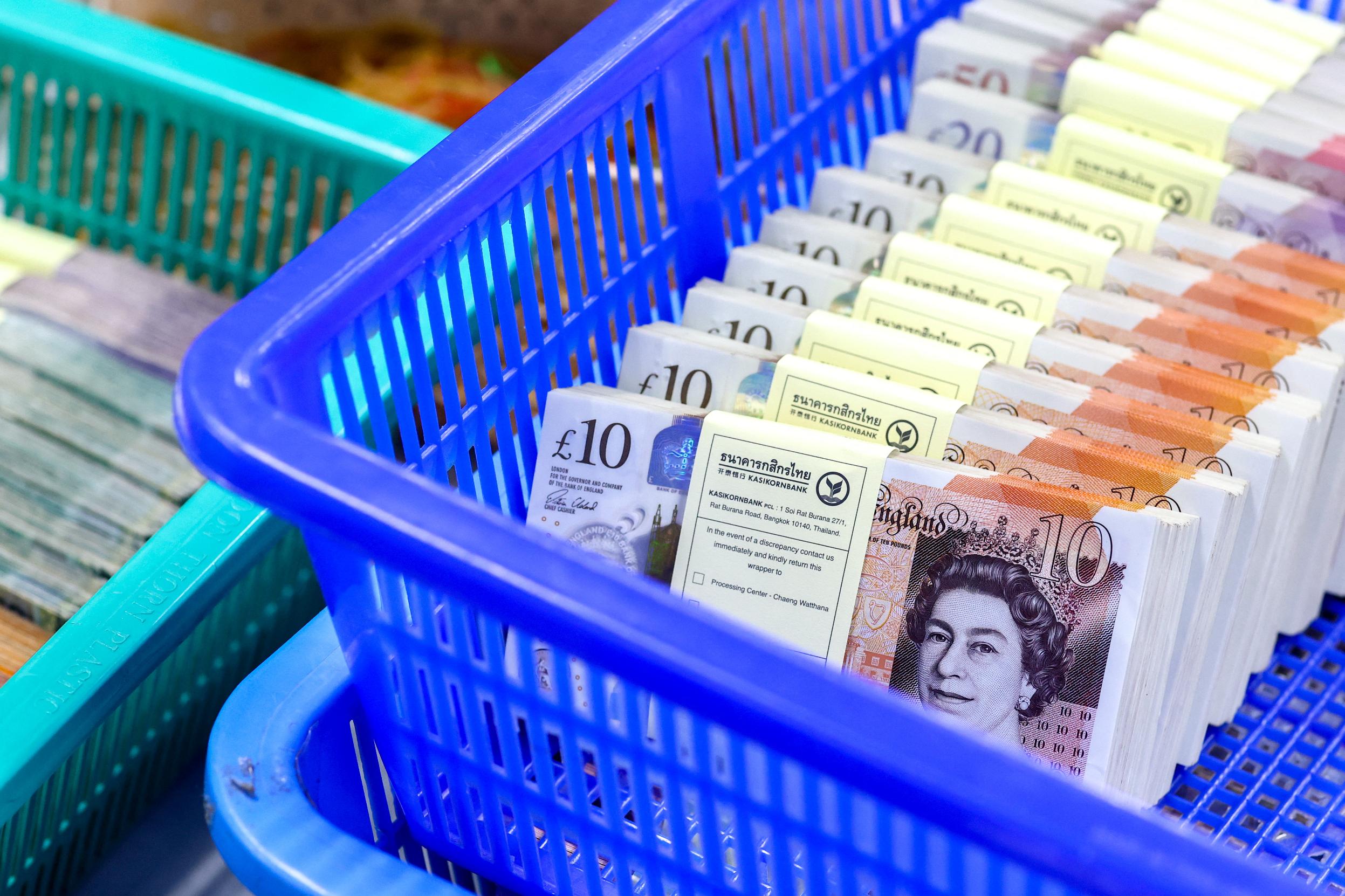
LONDON, July 12 (Reuters) - The pound coursed towards its best two-week performance against the dollar in eight months on Friday, after data pointed to an improvement in UK growth, while the U.S. economy shows signs of fatigue. Action in the foreign exchange market in the last 24 hours has been dominated by the yen, which rose by the most since early May on Thursday after the Bank of Japan likely intervened to prop it up, just as the dollar weakened following a softer U.S. inflation report. The pound dropped by over 1% against the yen on Thursday, as the Japanese currency strengthened broadly. It was last up 0.3% at 205.65 yen , near its highest since early 2008. Sterling has gained 2.4% against the dollar in the last two weeks, its biggest two-weekly rise since November last year. It was last up 0.3% at $1.2949, making it one of the best performing major currencies of the day. Data on Thursday showed the UK economy grew more quickly than expected in May, which prompted traders to chop back their bets on an August rate cut from the Bank of England. BoE Chief Economist Huw Pill gave the pound an extra boost this week by saying services inflation and wage growth showed "uncomfortable strength" despite headline inflation falling to the BoE's 2% target in May, and it was unlikely that June inflation figures due next week would change the big picture. "Our August BoE rate cut call, already very close, is in doubt, with the market pricing 50%," Bank of America strategists said in a note. The futures market attaches a 52% chance of an August cut from the BoE and an 88% chance of a September one. A week ago, those chances were at 61% and 92%. "Interest rate differentials are a key fundamental driver of currencies, and right now they are supportive of the pound. The real interest rate in the UK is 3.25%, this compares with 2.5% for the U.S.," XTB research director Kathleen Brooks said. "The larger real interest rate in the UK versus the U.S. is driving the pound right now, and it may only get larger." Sign up here. https://www.reuters.com/markets/currencies/sterling-heads-best-two-week-run-since-november-2024-07-12/
2024-07-12 10:09
July 12 (Reuters) - A look at the day ahead in U.S. and global markets from Mike Dolan A violent rotation from Big Tech into small cap stocks followed the surprisingly benign June U.S. inflation report, while U.S. borrowing rates and the dollar plunged and Japan's yen stole the currency show. What's now become almost traditional market volatility on U.S. CPI day didn't disappoint on Thursday. Although there's been some steadying of the ship early on Friday as major U.S. banks prepare to kick off the second-quarter earnings season in earnest, confirmation of a resumption of disinflation has left its mark. Seeded by a withering recoil in AI and EV giants Nvidia (NVDA.O) New Tab, opens new tab and Tesla (TSLA.O) New Tab, opens new tab, the Nasdaq (.IXIC) New Tab, opens new tab turned tail from record highs and plunged almost 2% after the CPI report, even as small caps in the Russell 2000 (.RUT) New Tab, opens new tab surged more than 3% to three-month highs on their best day of the year so far. Less extreme but also dragged down by the heavyweights, the S&P 500 (.SPX) New Tab, opens new tab lost almost 1%, though futures have held the line overnight. At least Tesla, which tumbled 8.4% for its biggest drop since January, had some excuse after a Bloomberg report claimed the firm is delaying the launch of robotaxi by about two months. But the wild rotation of stock sectors seemed more like a spontaneous reaction to the positive inflation news, where headline prices actually fell during the month for the first time in four years and annual inflation dipped below 3% for the first time in 12 months. The runes of the report were similarly impressive, with core inflation below forecast at 3.3% - its lowest in three years - and irksome services and shelter components also moderating. A big drop in weekly jobless claims in the background provided a pleasing mix, despite the confusing stock market volatility. And producer price updates on Friday will hold the picture up to the light again. Federal Reserve officials were quick to applaud the piece. St Louis Fed President Alberto Musalem called the June report "encouraging", San Francisco Fed boss Mary Daly talked of "relief" and the Chicago Fed's Austan Goolsbee called it "excellent" news that puts inflation back on track to its 2% target. The International Monetary Fund said it continues to believe the Fed can start cutting interest rates later this year. Rate futures agreed, with a first Fed cut now fully priced for September and as much as 60 basis points seen over the remainder of the year. Ten-year Treasury yields plunged to their lowest in four months, though they popped back above 4.2% early on Friday. The dollar (.DXY) New Tab, opens new tab, predictably, was a casualty. And there was almost consternation in the dollar/yen pair, which plunged almost 2% amid some suspicion and various reports the Japanese authorities used the opportunity to intervene to buy yen and maximise the move. No official confirmation was forthcoming overnight, with the dollar regaining a foothold back above 159 yen, still almost three yen below the recent 38-year high. The follow-through from all the upheaval in world markets through early Friday has been messy. Hit by the tech swoon and the yen spike, Japan's Nikkei (.N225) New Tab, opens new tab skidded 2.5% and other tech-heavy Asia bourses in South Korea (.KS11) New Tab, opens new tab and Taiwan (.TWII) New Tab, opens new tab fell sharply. While Hong Kong shares (.HSI) New Tab, opens new tab surged, Chinese mainland stocks (.CSI300) New Tab, opens new tab were more mixed as the June trade report from China threw up conflicting signals. While Chinese exports beat forecasts for the month, imports fell again raising more concerns about domestic demand in the world's second-largest economy. In Europe, the stock reaction was mostly positive on Friday, with only Britain's midcap FTSE250 (.FTMC) New Tab, opens new tab taking a small step back from its best level in more than two years after the CPI report. But the dollar retreat provided a boon to both the euro and sterling , with the post-election buzz in the latter sending it to its highest in a year. Elsewhere, attention remained on politics. Pressure on U.S. President Joe Biden to step aside from November's White House race continued after a series of verbal gaffes during his latest appearance at the NATO summit in Washington. Key developments that should provide more direction to U.S. markets later on Friday: * US June producer price index, July University of Michigan consumer survey * US corporate earnings: JPMorgan, Citi, Wells Fargo, Bank of New York Mellon, Fastenal Sign up here. https://www.reuters.com/markets/us/global-markets-view-usa-pix-2024-07-12/

2024-07-12 10:04
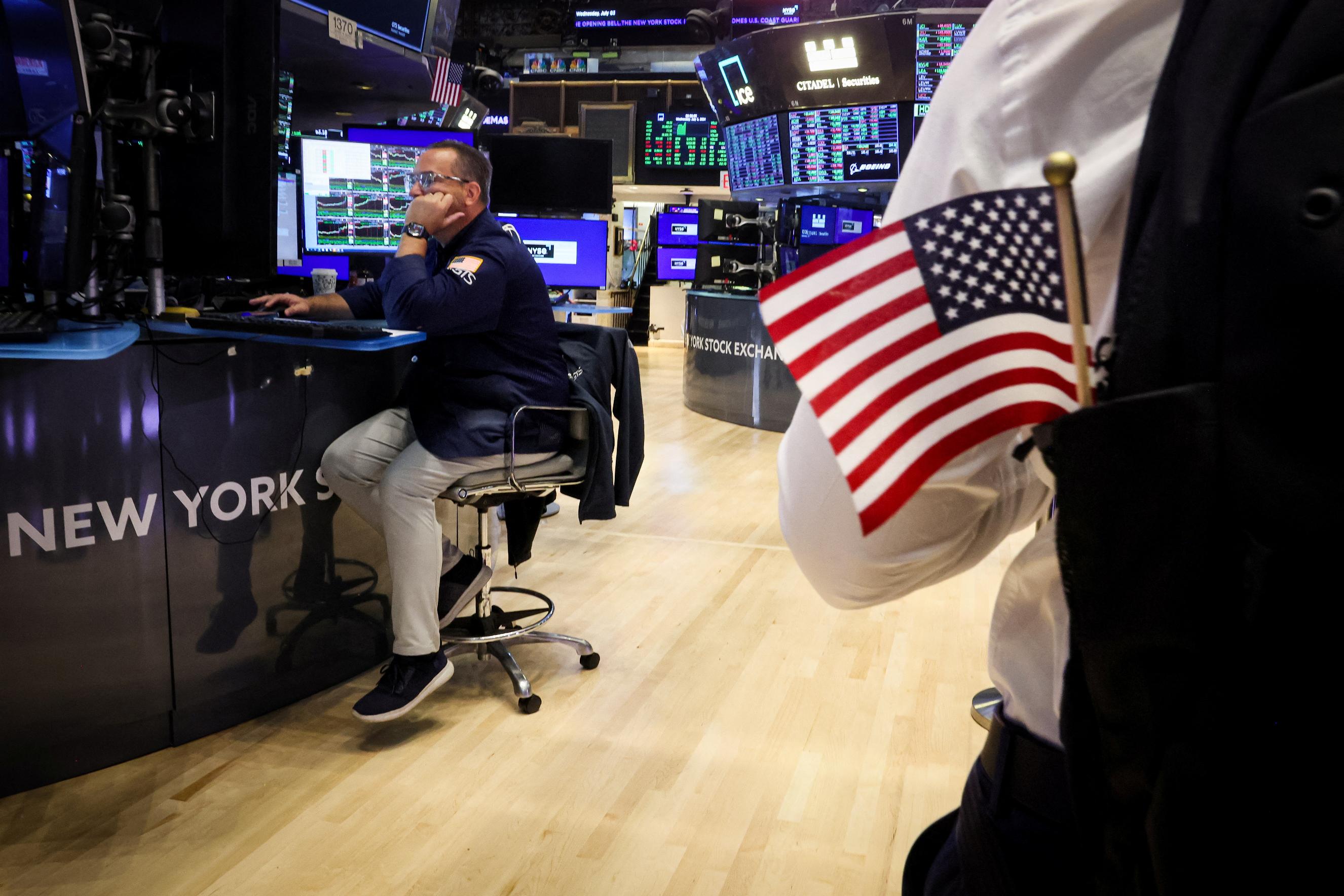
NEW YORK, July 12 (Reuters) - U.S. companies releasing quarterly results in the coming weeks face investors who expect no less than stellar growth, with estimates particularly high for Wall Street technology heavyweights such as Nvidia (NVDA.O) New Tab, opens new tab and Microsoft (MSFT.O) New Tab, opens new tab. Stocks have rallied in recent weeks, partly on the view that tech-related megacaps and other U.S. companies can deliver earnings strong enough to support valuations. The S&P 500 (.SPX) New Tab, opens new tab and Nasdaq (.IXIC) New Tab, opens new tab fell from record highs on Thursday, however, with investors selling megacap names including Nvidia and favoring real estate (.SPLRCR) New Tab, opens new tab, utilities (.SPLRCU) New Tab, opens new tab and small-cap companies after a softer-than-expected U.S. inflation reading. Second-quarter earnings for S&P 500 companies are expected to have jumped 10.1% year-over-year, based on LSEG data as of Friday, accelerating from 8.2% growth in the first quarter. That aggregate second-quarter forecast is down just slightly from a 10.4% forecast at the start of April. S&P 500 earnings growth has been improving since a year-over-year decline in the second quarter of 2023, largely because of growth in tech-focused companies and optimism over artificial intelligence. Among the upbeat outlooks, AI chipmaker Nvidia in May forecast quarterly revenue above estimates, while Microsoft in April forecast intelligent cloud revenue mostly ahead of Wall Street targets. "We're walking into an optimistic earnings season," said Peter Tuz, president of Chase Investment Counsel in Charlottesville, Virginia, pointing to earnings estimate increases from some of the AI-driven companies. Companies frequently give conservative quarterly forecasts in a bid to soften investor expectations. S&P 500 companies have been slightly less pessimistic this time around, with negative outlooks outpacing positive ones by 2 to 1 compared with 3 to 1 for the first quarter and the 2.5 to 1 long-term average, LSEG data shows. To some strategists, the only slight decline in forecasts since April 1 could bode well for this earnings season since the majority of companies will still likely beat analysts' forecasts. On average, nearly 80% of S&P 500 companies have beaten analyst earnings expectations in the past four reporting periods, per LSEG data. It could also mean less impressive beats by companies this season given the higher bar, according to Goldman Sachs strategists and others. BofA Securities strategists have said S&P 500 estimates typically fall 4% in the three months before a reporting season, based on the average since 2000. With second-quarter estimates holding up, they expect a "2% beat," which they said would be the smallest since the fourth quarter of 2022. Estimates for the S&P 500 communication services (.SPLRCL) New Tab, opens new tab, consumer discretionary (.SPLRCL) New Tab, opens new tab and technology (.SPLRCT) New Tab, opens new tab sectors have increased since April 1. Reports from heavily weighted megacaps are expected to be critical to the earnings season. The S&P 500 technology sector index is up 32% so far in 2024, leading gains among sectors, followed by communication services, which is up 27%. The S&P 500 is up 17% since Dec. 31. The S&P 500 index is trading at 21.2 times its estimated earnings for the next 12 months, well above the index's historic average of 15.7, according to LSEG Datastream. To be sure, some investors are watching this earnings season to see whether profit growth from companies outside of the megacap names may be starting to catch up to the tech-related leaders. "The sectors that have been given up for dead, like energy and financials, will start to have much better year-over-year comparisons, and we think it's a reasonable bet that we will see a broadening out of this rally," said Phil Orlando, chief equity market strategist at Federated Hermes. One other key focus this earnings period could be whether consumer demand is holding up. Also supporting stocks have been investor expectations that the economy has cooled enough to allow the U.S. Federal Reserve to start cutting interest rates this year. Second-quarter estimates may have held up partly because of consumer demand, said Oliver Pursche, senior vice president, advisor for Wealthspire Advisors in Westport, Connecticut. "A lot of investors and analysts had expected a deeper slowdown in consumer spending, and that has not materialized," Pursche said. Sign up here. https://www.reuters.com/business/us-companies-head-into-earnings-facing-high-expectations-2024-07-12/
2024-07-12 07:56
MOSCOW, July 12 (Reuters) - Russia's Federal Antimonopoly Agency (FAS) wants to reinstate a gasoline export ban from Aug. 1 to help meet fuel demand during harvesting season and safeguard price stability, the agency said on Friday. Russia initially partially banned gasoline exports for six months from March 1, but exempted a Moscow-led economic union and some countries with which it has direct inter-governmental agreements on fuel supplies, such as Mongolia. The ban was introduced to pre-empt fuel shortages and stem a rise in prices after a spate of Ukrainian drone attacks on refineries and technical outages. The restrictions were suspended in May until June 30 and that suspension was then extended until the end of July. FAS said it supported a return to the ban on gasoline exports from Aug. 1. The government, with input from FAS, is due to take a decision on whether to reintroduce the ban by July 31. The office of Deputy Prime Minister Alexander Novak and the energy ministry did not immediately respond to requests for comment. "Restrictions on fuel exports will help saturate the domestic market during the period of increased demand, including that linked to (harvest) and scheduled repairs of oil refineries, as well as ensure price stability and availability of fuel for all categories of consumers," FAS said in a statement. Sign up here. https://www.reuters.com/markets/commodities/russias-cartel-body-supports-reinstating-gasoline-export-ban-august-2024-07-12/

2024-07-12 07:14
BEIJING, July 12 (Reuters) - China's yuan-denominated exports to Russia grew 4.76% in June from a year earlier, faster than the 0.92% pace in May, but still much slower than double-digit export growth at the beginning of the year, customs data showed on Friday. China's outbound shipments to Russia fell in March and April before swinging back to growth in May. Even though the United States imposed sanctions in June on the only Russian bank branch in China, President Vladimir Putin visited China in May and helped ensure the two countries have payment alternatives, Reuters reported last month, citing sources. However, China's overall imports from Russia fell 6.7% in June in yuan terms, a bigger pace than the 2.2% fall in May, customs data showed. Two-way trade value between the two countries continues to grow, rising to 143.9 billion yuan ($19.81 billion) last month, up 2.3% from 140.7 billion yuan in May. The close neighbours have been pushing for closer economic cooperation particularly in the energy sector, and Russia's Gazprom (GAZP.MM) New Tab, opens new tab will start pipeline gas exports to China of 10 billion cubic metres a year in 2027, Gazprom CEO Alexei Miller told an annual shareholders' meeting on June 28. ($1 = 7.2640 yuan) Sign up here. https://www.reuters.com/markets/chinas-june-exports-russia-rise-more-quickly-than-previous-month-2024-07-12/
2024-07-12 06:46
U.S. consumer sentiment fell in July Producer price index rose 0.2% in June U.S. active oil rig count fell by one to 478 this week NEW YORK, July 12 (Reuters) - Oil futures prices settled slightly lower on Friday as investors weighed weaker U.S. consumer sentiment against mounting hopes for a Federal Reserve rate cut in September. Brent crude futures settled 37 cents lower to $85.03 a barrel. U.S. West Texas Intermediate crude futures fell 41 cents, or 0.5%, to close at $82.21 a barrel. For the week, Brent futures fell more than 1.7% after four weeks of gains. WTI futures posted 1.1% weekly decline. A monthly survey by the University of Michigan showed U.S. consumer sentiment fell to an eight-month low in July, although inflation expectations improved for the next year and beyond. The U.S. Labor Department said the producer price index (PPI) rose 0.2% in June, slightly more than expected, as the cost of services climbed. Still, investors expect the Fed could start cutting rates in September. "The market isn't afraid of the Fed at this point," said Phil Flynn, an analyst at Price Futures Group. Lower rates are expected to boost economic growth, which could boost fuel consumption. "Cooling U.S. inflation numbers may support the case for the Fed to kick-start its policy easing process earlier rather than later," said Yeap Jun Rong, market strategist at IG. "It also adds to the series of downside surprises in U.S. economic data, which points to a clear weakening of the U.S. economy," he added. Oil prices have drawn some support from U.S. gasoline demand, which government data showed on Wednesday was at 9.4 million barrels per day (bpd) in the week ended July 5, the highest since 2019 for the week that includes the Independence Day holiday. Jet fuel demand on a four-week average basis was at its strongest since January 2020. The strong fuel demand encouraged U.S. refiners to ramp up activity and draw from crude oil stockpiles. U.S. Gulf Coast refiners' net input of crude rose last week to more than 9.4 million bpd for the first time since January 2019, government data showed. Signs of weaker demand from China, the world's biggest oil importer, could counter the outlook from the United States and weigh on prices. "The recent downside correction is evidently over, although the speed of further ascent might be hindered by falling Chinese crude oil imports, which plummeted 11% in June from the previous year," said Tamas Varga of oil broker PVM. U.S. active oil rig count, an early indicator of future output, fell by one to 478 this week, the lowest since December 2021, energy services firm Baker Hughes (BKR.O) New Tab, opens new tab reported on Friday. Money managers raised their net long U.S. crude futures and options positions in the week to July 9, the U.S. Commodity Futures Trading Commission (CFTC) said on Friday. Sign up here. https://www.reuters.com/business/energy/oil-rises-cooling-us-inflation-strong-summer-demand-2024-07-12/