2024-07-03 06:06
LITTLETON, Colorado, July 3 (Reuters) - The month of July kicks off the annual peak period for power emissions in the United States, as higher nationwide temperatures ratchet up use of energy-intensive air conditioners and spur power firms to crank up output from fossil fuels. The July-to-September quarter has marked the quarterly high point for fossil fuel power output over the past three years, with fossil-fired generation rising by an average of 37% from the previous quarter since 2021, data from LSEG shows. Resulting emissions during the third quarter of the calendar year have jumped by a similar degree, according to energy think tank Ember, and have again have historically scaled their annual peak during the July-September period. U.S. power emissions through the first half of 2024 have already climbed by 5.2% from the same period last year, to 790 million metric tons of carbon dioxide (CO2) and equivalent gases, according to Ember. If power firms follow their normal practice and rely on fossil fuels to plug most of any power supply shortfalls during this year's peak demand period, 2024's emissions toll will likely climb even further above last year's total. GASSING UP Power firms traditionally rely on natural gas to supply the majority of any incremental rise in power usage during the third quarter, with gas-fired output rising by an average of 36% since 2021 during that time window from the second quarter. However, coal-fired power generation also tends to climb sharply during the July to September period, and in 2023 rose by more than 50% from the second quarter as power firms struggled to meet the higher power consumption during that period. A key driver behind the heavy reliance on fossil fuels during the height of summer is the tendency for clean power supplies to hold flat or even contract slightly during that period. Clean power generation tends to slump during the summer due to lower wind speeds at turbine level and reduced hydro dam generation during the driest months of the year. In 2023, clean power generation expanded by just 0.4% during the third quarter from the second quarter, LSEG data shows. In 2022 and 2021, clean generation declined by 4.3% and 1.7% respectively during that quarter from the previous quarter. TOUGH CHOICES The mixed track record of clean power generation right when total power demand reliably peaks leaves U.S. power firms with little scope but to boost output from fossil fuels despite ongoing commitments to decarbonize power production. Power sector emissions tend to undergo significant jumps whenever power firms raise the share of fossil fuels in the overall generation mix. Between 2019 and 2023, average power sector emissions during the third quarter have been 532 million tons, according to Ember. That compares to 401 million tons for each of the other quarters of the year, and highlights the scale of the environmental impact from greater fossil fuel use. However, the July to September window is also when the U.S. power system tends to come under strain from heat waves and heavy storms that historically cluster during the hottest time of year. To ensure round-the-clock power availability and meet higher baseload requirements from greater commercial and residential air conditioner use during summer, most power systems are obligated to boost overall output by whatever means necessary. Fossil fuels have formed the backbone of that additional power generation in recent years, and have resulted in a jump in associated emissions which may worsen the climate-warming trends that have lifted air conditioner demand in the first place. But if power firms continue to build out clean generation and battery storage capacity at the record pace seen over the past decade or so, clean power sources may be able to replace some fossil fuels in power generation mixes in the years ahead. Sign up here. https://www.reuters.com/business/energy/us-peak-power-pollution-season-gets-underway-maguire-2024-07-03/

2024-07-03 06:03
LONDON, July 3 (Reuters) - Some might wonder why it took so long, but the risk that this year's key elections exaggerate rather than rein in bloated public debt is finally seeing long-term sovereign bonds rear up. In a year packed with elections, the past week has marked a critical juncture for polls in the United States and France at least - with Britain's arguably less controversial election set for Thursday too. America ultimately has to wait for November, but a dire televised debate for U.S. President Joe Biden last week against Republican challenger Donald Trump has seen betting markets break decisively for the latter after months of equivocation. Emboldened further by this week's Supreme Court ruling on Trump's partial immunity from prosecution, the former President is now clear favorite at bookmakers for the first time to retake the White House. With Trump's opinion poll lead widening, most notably in some key marginal states, a range of betting sites now ascribe more than a 60% chance of him winning the Presidency. Compromised further by speculation about him being replaced on the Democrat ticket, Biden's odds have widened to 4/1 in many. So as the second half of 2024 gets underway, financial markets are starting to stake their own bets on Trump's return - taking on board his pledges to extend 2017's tax cuts, impose severe import tariffs and slash immigration and what that means for the economy and already precarious public finances. The first real reactions this week seem clearest in the Treasury market - not only in modest gains in long-term borrowing rates but in a steepening yield curve that saw the still-inverted gap between short-dated debt yields and lower long bond ones at their narrowest in five months. The curve shift is remarkable given the resumption of disinflation and futures markets that remain priced for 90 basis points of Federal Reserve rate cuts over the coming year. If long-term yields are rising even as the Fed eases, anxiety about rising bond supply is one of main culprits. Morgan Stanley, for one, thinks the klaxon on a Trump presidency - either in conjunction with a Democrat-led Congress or with a clean sweep for Republicans - has now sounded loudly. And they see "curve steepeners" as logical fixed income trade to express that view. "Markets may no longer go totally undecided into the November election," the U.S. investment bank told clients this week. "The sharp shift of probabilities towards a President Trump presidency is a unique catalyst that makes curve steepeners attractive." The argument they posit is that in either a gridlock scenario or a clean sweep for the Republicans, the curve could steepen either way. That would involve either a so-called "bull steepening", where all yields fall but by a larger amount at the short end, or "twist steepening", where long rates climb even if short rates fell. Even if Trump were constrained on fiscal policy, White House control of his radical plans to curb immigration and start deportations while ratcheting up trade tariffs worldwide could damage growth to a degree that actually ups Fed easing chances. On the other hand, the fiscal implications of a tax-cutting clean sweep in Congress on top of already worrisome public deficits and debt piles would just put upward pressure on long-term bond market premia. FISCAL CASSANDRAS To be sure, a record two-year inversion of the 2-to-10 year curve - whose traditional signal on recession ahead seems to have been bamboozled in this cycle so far - has shown remarkably little disturbance to date in those long-term risk premia. But debt concerns have been repeatedly flagged by agitated fiscal and financial watchdogs home and abroad. Only last month, the bipartisan Congressional Budget Office updated its alarming long-term deficit and debt forecasts. Even assuming Trump's 2017 tax cuts are allowed to expire next year as planned, this year's eye-watering deficit of 7% of national output remains almost at that level in 10 years time. As a result, the CBO said debt held by the public at the end of 2034 would total $50.7 trillion, or 122% of gross domestic product, compared to a February forecast of 116% of GDP and this year's 99%. What's more, the forecast assumes an annual average Fed funds rate of 3% in 2029-34 period - 228bps below current levels - but with a 10-year yield equivalent at 4%, just 50bps below today's rate. And the United States is no outrageous outlier. With France in the middle of a surprise two-legged parliamentary election that's seen a surge in support for far-right and far-left parties - and both promising additional fiscal boosts of either tax cuts or new spending sprees - budget worries seep across the Atlantic. Although the European Central Bank is already in easing mode, French bond markets have taken fright at the budget risks, with Paris already clocking annual deficits close to 5% of GDP and a showdown with European Union budget rules into the mix. The French equivalent 2-to-30 year yield curve - which, unlike the U.S. one, is already in positive territory to the tune of more than 60bps - has steepened to twice its level a month ago and is at its highest for the year. Italy's curve steepened likewise in sympathy. And despite commitments from Britain's opposition Labour Party - the likely landslide winner at Thursday's UK election - the UK 2-to-30 yield curve hit its widest in more than a year. Yet again this weekend the Bank for International Settlements warned about the financial stability risks of untamed fiscal positions across the world. "Consolidation is an absolute priority," it said. "The window of opportunity to take decisive action is narrowing." "It is important to scale back discretionary measures, by terminating those enacted during the pandemic and refraining from new fiscal stimulus in the absence of compelling macroeconomic justifications." Credit rating firm S&P Global seemed less hopeful governments would oblige without markets getting restive. "For the U.S., Italy, and France-- the primary balance would have to improve by more than 2% of GDP cumulatively for their debt to stabilize - this is unlikely to happen over the next three years," it said. "In our view, only a sharp deterioration of borrowing conditions could persuade G7 governments to implement more resolute budgetary consolidation at the present stage in their electoral cycles." A steep learning curve indeed. The opinions expressed here are those of the author, a columnist for Reuters Sign up here. https://www.reuters.com/business/finance/steep-learning-curves-election-heat-bonds-mike-dolan-2024-07-03/

2024-07-03 05:51
S&P 500, Nasdaq advance US dollar weakens Crude prices climb Benchmark 10-year yields dip Safe haven-gold rises to near two-week high NEW YORK, July 3 (Reuters) - World equities rose while the U.S. dollar fell on Wednesday following soft labor market data that buoyed investor expectations of Federal Reserve interest rate cuts later this year. U.S. Labor Department data on Wednesday showed that initial claims for unemployment rose to 238,000 the week that ended June 29, slightly above expectations and indicating a softening in labor market conditions. MSCI's gauge of stocks across the globe (.MIWD00000PUS) New Tab, opens new tab rose 0.60% to 811.63, while Europe's broad STOXX 600 (.STOXX) New Tab, opens new tab index added 0.81%. "We have slowing growth but closer to trend, with the potential for the Fed to start cutting rates by maybe September, and earnings which have been still pretty good, that's a pretty good backdrop still," said Jack Janasiewicz, lead portfolio strategist at Natixis Investment Managers in Boston. On Wall Street, the benchmark S&P 500 and Nasdaq were advancing with technology, utilities and materials stocks among the top gainers. Healthcare equities were pushing the Dow lower. The Dow Jones Industrial Average (.DJI) New Tab, opens new tab fell 0.19% to 39,259.90, the S&P 500 (.SPX) New Tab, opens new tab gained 0.24% to 5,521.98 and the Nasdaq Composite (.IXIC) New Tab, opens new tab gained 0.50% to 18,119.62. The dollar index , which measures the greenback against a basket of currencies including the yen and the euro, fell 0.43% at 105.21, with the euro up 0.5% at $1.0798. "From a seasonality perspective, the first two weeks of July tend to be good and we're kind of following those seasonal patterns in that the economic numbers continue to point to a slowing economy, not a slow economy, and everything else is still pretty supportive in here," Janasiewicz added. Benchmark 10-year Treasury yields dipped following the jobless claims data as well as signs of weakness in manufacturing, as the ISM Non-Manufacturing index came in below expectations. The yield on benchmark U.S. 10-year notes fell 8.5 basis points to 4.351%. The dollar index , which measures the greenback against a basket of currencies including the yen and the euro, fell 0.45% at 105.19, with the euro up 0.53% at $1.0801. The yen sank to a fresh 38-year low against the U.S. dollar and a record trough versus the euro ahead of the July 4 holiday in the United States. The yen fell to 161.96 per dollar for the first time since December 1986. Oil prices steadied after trading higher on a bigger than expected drawdown in U.S. crude stockpiles, while economic headwinds from China and the euro zone capped gains. Brent crude futures edged up 0.16% to $86.40 a barrel, while U.S. West Texas Intermediate (WTI) crude futures gained 0.11% to $82.94. Gold prices rose more than 1% to a near two-week high as the U.S. dollar weakened. Spot gold added 1.42% to $2,362.46 an ounce, while U.S. gold futures gained 1.66% to $2,361.60 an ounce. Sign up here. https://www.reuters.com/markets/global-markets-wrapup-1-2024-07-03/
2024-07-03 04:49
MOSCOW, July 3 (Reuters) - Russia's Black Sea port of Novorossiisk was operating as normal on Wednesday after an attempted Ukrainian maritime drone attack, the Interfax news agency reported on Wednesday, citing the local administration. "There are no restrictions. Shipping goes as normal," Interfax quoted a statement from the local administration. Novorossiisk is Russia's largest Black Sea port and a key outlet for crude oil and oil products exports and transit in Russia's south. It also loads oil coming from Kazkahstan and Azerbaijan and handles grain, coal, fertilizers, timber, containers, food and chemical cargoes. The mayor of Novorossiisk, Andrei Kravchenko, earlier on Wednesday restricted access to the beaches. He later said all the restrictions were lifted, adding that two commercial properties and one residential apartment were "insignificantly" damaged in the attacks, while no one was injured. The Russian defence ministry said its forces destroyed two sea drones heading in the direction of Novorossiisk. Russia has repeatedly said that Ukraine has attacked its port cities on the Black Sea coast, but Russian officials often give few details about the extent of damage inflicted by Ukrainian attacks. The port was also attacked by drones last May, forcing the authorities to temporarily shut the outlet. Loadings of Urals, KEBCO and Siberian Light grades from Novorossiisk are scheduled at 1.7-1.8 million metric tons in July. The Russian defence ministry said also its air defence systems destroyed 10 air drones Ukraine launched at Russia's territory, including one over the Moscow region. Reuters could not independently verify the reports. There was no immediate comment from Ukraine. Kyiv has said attacks on Russia's military, transport and energy infrastructure are in response to Moscow's continuous attacks on Ukraine's territory since the start of Russia's invasion of Ukraine in 2022. Sign up here. https://www.reuters.com/world/europe/russias-novorossiysk-authorities-limit-beach-access-after-sea-drones-attacks-2024-07-03/

2024-07-03 04:34
A look at the day ahead in European and global markets from Ankur Banerjee It was a risk-on session in Asia, with European bourses poised for a similar start in the wake of comments by Fed Chair Powell, with investors buoyed by reinforced expectations that rate cuts are just around the corner in the U.S. The fallout of the French election will remain in the spotlight as opponents of France's National Rally stepped up their bid to block the far-right party from power in Sunday's run-off election. The euro , which lurched to a two-week high on Monday after RN did not score an outright majority, was steady at $1.074475, while futures indicated the pan-European STOXX 600 index (.STOXX) New Tab, opens new tab could move away from the two-month low it touched on Tuesday. Powell stating that the U.S. is back on a "disinflationary path" was enough to put the dollar on the defensive, with Treasury yields lower even though he cautioned that more data is needed before policymakers could consider cutting rates. ""We just want to understand that the levels that we're seeing are a true reading on what is actually happening with underlying inflation," Powell said at a conference in Portugal sponsored by the European Central Bank. So, the Fed is still data-dependent, making the next few inflation readings crucial in dictating where U.S. rates are headed by the end of the year. Traders are clinging to as much as two rate cuts this year from the Fed. Minutes from the Fed's June meeting are due later in the day and could offer clues on the central bank's thinking on U.S. rates. Meanwhile, the ECB remains in no hurry to lower borrowing costs further after cutting rates last month, with data on Tuesday showing the crucial services component in euro zone inflation staying stubbornly high. The ECB's Christine Lagarde and Philip Lane are due to take the stage in Portugal and may have comments that could swing the markets on rate expectations. Traders are currently pricing in 43 basis points of cuts this year from the ECB. In corporate news, Tesla (TSLA.O) New Tab, opens new tab reported on Tuesday a smaller-than-expected 5% drop in vehicle deliveries in the second quarter, as the electric car maker's price cuts and incentives helped mitigate cooling demand. Although EV makers, not just Tesla, still face a bumpy road ahead. Key developments that could influence markets on Wednesday: Economic events: June PMI for France, German, UK and euro zone Speakers: Fed's John Williams, ECB's Christine Lagarde and Philip Lane at ECB forum in Portugal Sign up here. https://www.reuters.com/markets/europe/global-markets-view-europe-2024-07-03/
2024-07-03 04:16
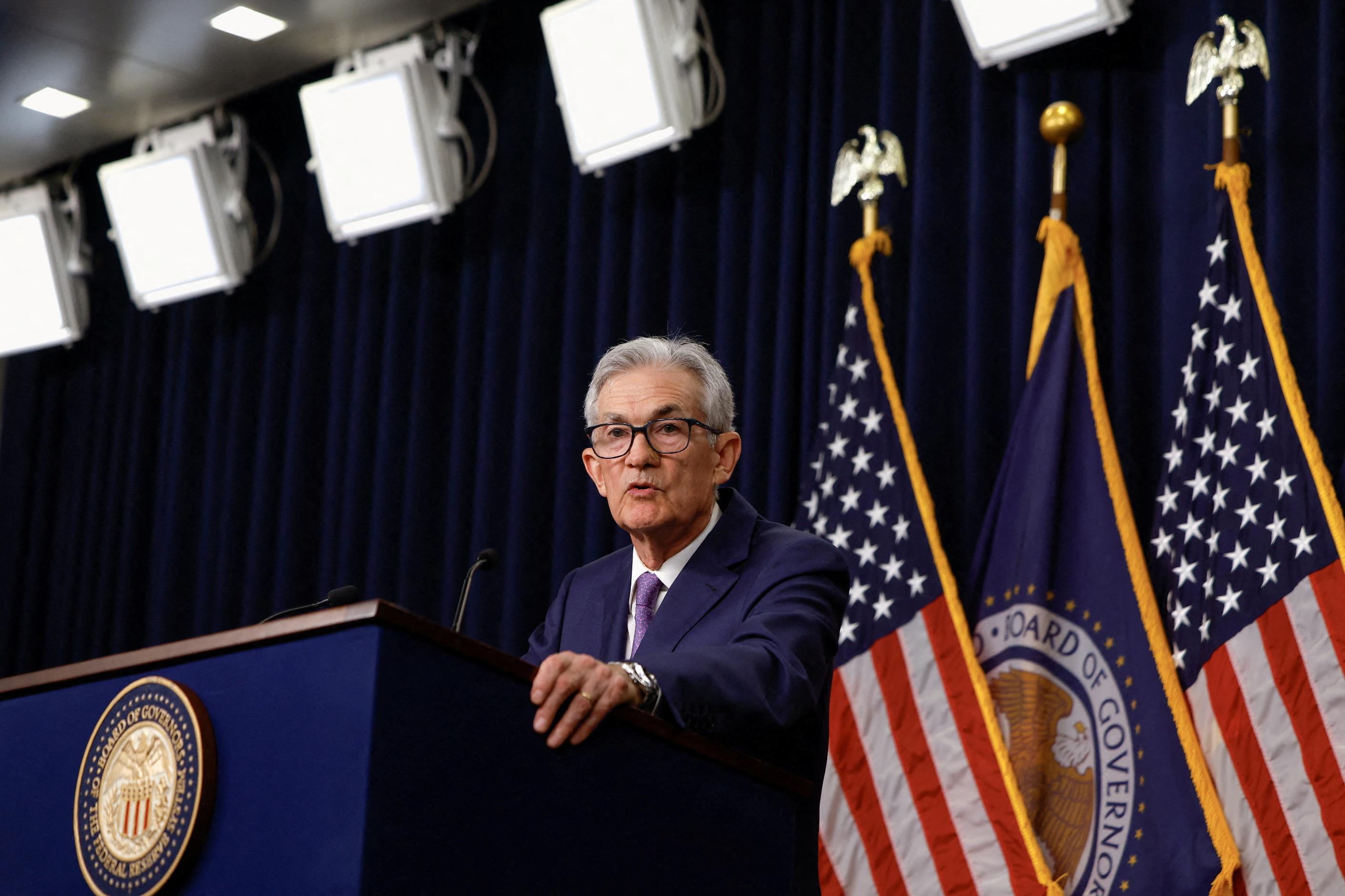
Fed's Powell says U.S. on 'disinflationary path' Fed minutes due out at 1800 GMT U.S. non-farm payrolls report due on Friday July 3 (Reuters) - Gold prices strengthened on Wednesday as the dollar eased after dovish comments from Federal Reserve Chair Jerome Powell, with investors now turning to minutes from the U.S. central bank's latest policy meeting to gauge future interest rate cuts. Spot gold rose 0.7% to $2,345.00 per ounce by 1156 GMT. U.S. gold futures gained 0.9% to $2,354.60. "Today's price gains are related to the softening of the U.S. dollar that came after the chairman of the Fed acknowledged in public that inflation in the U.S. is finally starting to move in the right direction," said Ricardo Evangelista, senior analyst at ActivTrades. A weaker dollar makes bullion more attractive for other currency holders. Fed Chair Jerome Powell on Tuesday noted that the U.S. central bank still needs more data before cutting interest rates to ensure that recent weaker inflation readings give a true picture of what is happening to underlying price pressures. Data on Tuesday showed U.S. job openings rose in May after two months of declines, indicating softening labour market conditions potentially prompting Fed interest rate cuts this year. The market now sees a 65% chance of the Fed cutting interest rates in September as well as another cut in December. Lower rates reduce the opportunity cost of holding non-yielding bullion. Next in line for investors will be the ADP employment and weekly jobless claims data due later in the day, and the non-farm payrolls report due on Friday. "There's a clear path for gold to outperform from here, likely fuelled by Western flows. Conversely, in the event that central bank demand drops drastically, rates remain high for longer and Asian investor sentiment flips, we could see a pullback in the second half," the World Gold Council said in its mid-year outlook report. Spot silver rose 2.2% to $30.17 per ounce, a more than one-week high. Platinum climbed 0.7% to $998.25 and palladium gained 1.2% to $1,034.50. Sign up here. https://www.reuters.com/markets/commodities/gold-flat-investors-focus-fed-minutes-2024-07-03/