2024-06-13 21:04
BOJ keeps short-term rate target unchanged at 0-0.1% Board keeps bond buying pace at 6 trln yen per month BOJ to lay out details on bond-taper plan at July meeting Ueda signals chance of July rate hike Yen, Japan yields fall on view BOJ cautious on policy TOKYO, June 14 (Reuters) - The Bank of Japan said on Friday it would start trimming its huge bond purchases and announce a detailed plan next month on reducing its nearly $5 trillion balance sheet, taking another step toward unwinding its massive monetary stimulus. Governor Kazuo Ueda also said he would not rule out raising interest rates in July as weakness in the yen pushes up import costs, suggesting the BOJ was retaining a hawkish stance despite recent signs of weakness in consumption and the broader economy. "Depending on economic and price data that become available at the time, of course there is a possibility we could decide to raise interest rates and adjust the degree of monetary support in July," Ueda told a news conference. As widely expected, the BOJ kept its short-term policy rate target in a range of 0-0.1% by a unanimous vote. It also left unchanged the pace of monthly bond buying at roughly 6 trillion yen ($38 billion). But the bank decided to lay out details of its bond tapering plan for the coming one to two years at its next meeting on July 30-31, after collecting views from market participants. Some market watchers had expected it to drop more definitive clues on Friday. "In trimming bond buying, it's important to leave flexibility to ensure market stability, while doing so in a predictable form," Ueda said. He said the size of the reduction would likely be "significant," but offered few clues on the pace and degree of the buying cutbacks. "The BOJ probably wanted to lay the groundwork so that the tapering doesn't turn into a surprise," said Katsuhiro Oshima, chief economist at Mitsubishi UFJ Morgan Stanley Securities. "It's similar to how the U.S. Federal Reserve disclosed a medium- to long-term guidance on tapering beforehand, to avoid heightening uncertainty at each policy meeting," he said. Some market players, however, took the decision to wait until July as an indication the central bank will be cautious in adjusting monetary policy going forward. Such dovish market interpretation sent the yen to a more than one-month low of 158.255 to the dollar, and pushed down the yield on the benchmark 10-year Japanese government bond (JGB) to 0.92%. "Today's decision suggests that the BOJ is very careful about reducing the bond buying amounts, which means the central bank is also cautious about raising rates," said Takayuki Miyajima, senior economist at Sony Financial Group. WEAK YEN A CONCERN The BOJ exited negative rates and bond yield control in March in a landmark shift away from a decade-long, radical stimulus programme. With inflation exceeding its 2% target for two years, it has also dropped signs that it will keep raising short-term rates to levels that neither cool nor overheat the economy - seen by analysts as being somewhere between 1-2%. Many market participants expect the BOJ to raise rates again some time this year. In a poll taken by Reuters on June 3-7, nearly half of economists projected a hike in the July-September period, while another 43% saw it happening in October-December. The central bank has also been under pressure to embark on quantitative tightening (QT) and scale back its huge balance sheet to ensure the effects of future rate hikes smoothly feed into the economy. The BOJ's efforts to normalise monetary policy come as other major central banks, having already tightened monetary policy aggressively to combat soaring inflation, look to cut rates. The Fed held rates steady on Wednesday and signalled the chance of a single cut this year. The European Central Bank cut interest rates last week for the first time since 2019. But the normalisation of Japan's still-loose monetary policy is clouded by weak consumption, which has cast doubt over the BOJ's view that robust domestic demand will keep inflation on track to durably hit its 2% target. Ueda acknowledged recent weak signs in consumption, but said spending was likely to increase as scheduled tax breaks, summer bonus payments and rising wages boost household income. He also warned that recent yen falls could have a bigger inflationary effect through higher import costs, as they come at a time when companies were already steadily hiking prices for goods and services. "Exchange rate moves would have a big impact on the economy and prices," Ueda said. "Recent yen falls have an effect of pushing up prices, so we are closely watching the moves in guiding policy." Japan's battered currency, down roughly 10% on the dollar so far this year, has become a headache for policymakers by inflating import prices, which in turn boosts living costs and hurts consumption. ($1 = 157.9400 yen) Sign up here. https://www.reuters.com/markets/rates-bonds/bank-japan-keep-ultra-low-rates-may-signal-bond-taper-2024-06-13/
2024-06-13 20:57
ABUJA, June 13 (Reuters) - The World Bank has approved a total of $2.25 billion loan for Nigeria to help stabilise its economy following reforms and scale up support for the poor, it said in a statement on Thursday. In April, Finance Minister Wale Edun said Nigeria was seeking up to $2.25 billion in World Bank loans and expects the bank's board to approve the request in June. Nigeria President Bola Tinubu last year in May initiated the country's boldest reforms in decades, scrapping a popular but costly petrol subsidy and sharply devaluing the currency twice to try to kick-start growth. But the moves stoked inflation and worsened a cost of living crisis. With the devaluation, the International Monetary Fund forecast that fuel subsidies could cost up to 3% of GDP this year as the increases in pump prices have not kept up with their dollar cost. Labour unions also have been pressuring Tinubu to roll back reforms. The World Bank said it approved a $1.5 billion loan to back Nigeria's reforms and another $750 million to accelerate revenue mobilisation. It added that Nigeria has embarked on critical reforms to address economic distortions and strengthen its fiscal outlook, saying that the country has taken "initial critical steps to restore macroeconomic stability, boost revenues, and create the conditions to reignite growth and poverty reduction have been taken." The loan will support Nigeria's effort to raise non-oil revenues and promote fiscal sustainability, which will help the West African nation deliver quality public services, the World Bank said. Sign up here. https://www.reuters.com/world/africa/world-bank-approves-nigerias-225-billion-loan-request-2024-06-13/

2024-06-13 20:38
TSX ends down 1.2% at 21,698.11 Posts its lowest closing level since April 17 Energy falls 3.1% Financials end 1.2% lower June 13 (Reuters) - Canada's main stock index fell to a near two-month low on Thursday, weighed by declines for financial and commodity-linked shares, as investors worried that the Federal Reserve would keep interest rates elevated for longer than previously expected. The Toronto Stock Exchange's S&P/TSX composite index (.GSPTSE) New Tab, opens new tab ended down 263.44 points, or 1.2%, at 21,698.11, its lowest closing level since April 17. The Federal Reserve on Wednesday trimmed the number of rate cuts expected this year and raised the long-run "neutral" rate needed to keep inflation in check while maintaining steady growth. The U.S. central bank is trying to communicate that "we're going to revert back to a more normalized interest rate environment as opposed to the 'la-la land' we've been living in prior to the rate hikes," said Michael Sprung, president at Sprung Investment, referring to the colloquial term for a dream world. Interest rates had been at historically low levels in the years after the global financial crisis until major central banks began hiking aggressively in 2022 to tame inflation. Higher interest rates reduce the value to investors of the expected cash flows that companies are expected to produce. "The world has got to adjust to a more normalized valuation regime. It think it's going to be a tough adjustment for people to make," Sprung said. Interest rate sensitive sectors such as utilities, real estate and financials account for 35% of the weighting on the Toronto market. Financials (.SPTTFS) New Tab, opens new tab fell 1.3% and energy (.SPTTEN) New Tab, opens new tab was down 3.1%, with a decline of 3.8% for shares of Cenovus Energy Inc (CVE.TO) New Tab, opens new tab. The materials group (.GSPTTMT) New Tab, opens new tab, which includes metal miners and fertilizer companies, lost 1.8% as gold and copper prices fell. BlackBerry Ltd (BB.TO) New Tab, opens new tab was among the biggest decliners, with shares of the software company falling 9.2% to its lowest in nearly three months. Sign up here. https://www.reuters.com/markets/tsx-futures-dip-investors-digest-us-feds-rate-outlook-2024-06-13/
2024-06-13 20:36
ACCRA/LONDON/NEW YORK, June 13 (Reuters) - Ghana and its bondholders will restart talks next week to hash out a debt restructuring deal on $13 billion of international bonds, four sources told Reuters, on the heels of a deal finalised with official creditors earlier this week. Ghana, a gold and cocoa producer, defaulted on most of its $30 billion in external debt in 2022, weighed by the COVID-19 pandemic, the war in Ukraine and rapid global interest rate hikes that boosted borrowing costs. It had kicked off formal talks with two groups of bondholders in mid-March - a group of Western asset managers and hedge funds and another one including regional African banks. But negotiations stalled in April after the proposed deal failed to meet the International Monetary Fund's debt sustainability analysis (DSA) requirements, and both sides are under pressure to finalise an agreement before December elections. The sources familiar with the situation told Reuters that government advisors had reached out to their counterparts at the bondholder group hours after the government and official creditors concluded their deal on Tuesday. The government advisors shared information on the official creditor deal as well as details from the new debt sustainability assessment from IMF, the sources said, speaking on condition of anonymity. "People are incentivized," one of the sources said. "Things can happen quickly." Ghana's Finance Ministry did not respond to a request for comment. The information shared will form the basis for discussions next week, two of the sources said, adding that financial advisors are currently reviewing the information. Discussions with two groups holding roughly $13 billion in Ghana's overseas bonds previously failed to reach a deal that met the IMF's debt-sustainability targets as set out in the first review of the fund's $3 billion loan programme with the country. However, Ghana's economic situation has improved since then, and two sources said they expected the deal to be compliant with the fund's adjusted DSA on the back of the second review which concluded in early April, two of the sources said. Sign up here. https://www.reuters.com/world/africa/ghanas-bondholders-re-engage-government-next-week-debt-rework-2024-06-13/
2024-06-13 19:52
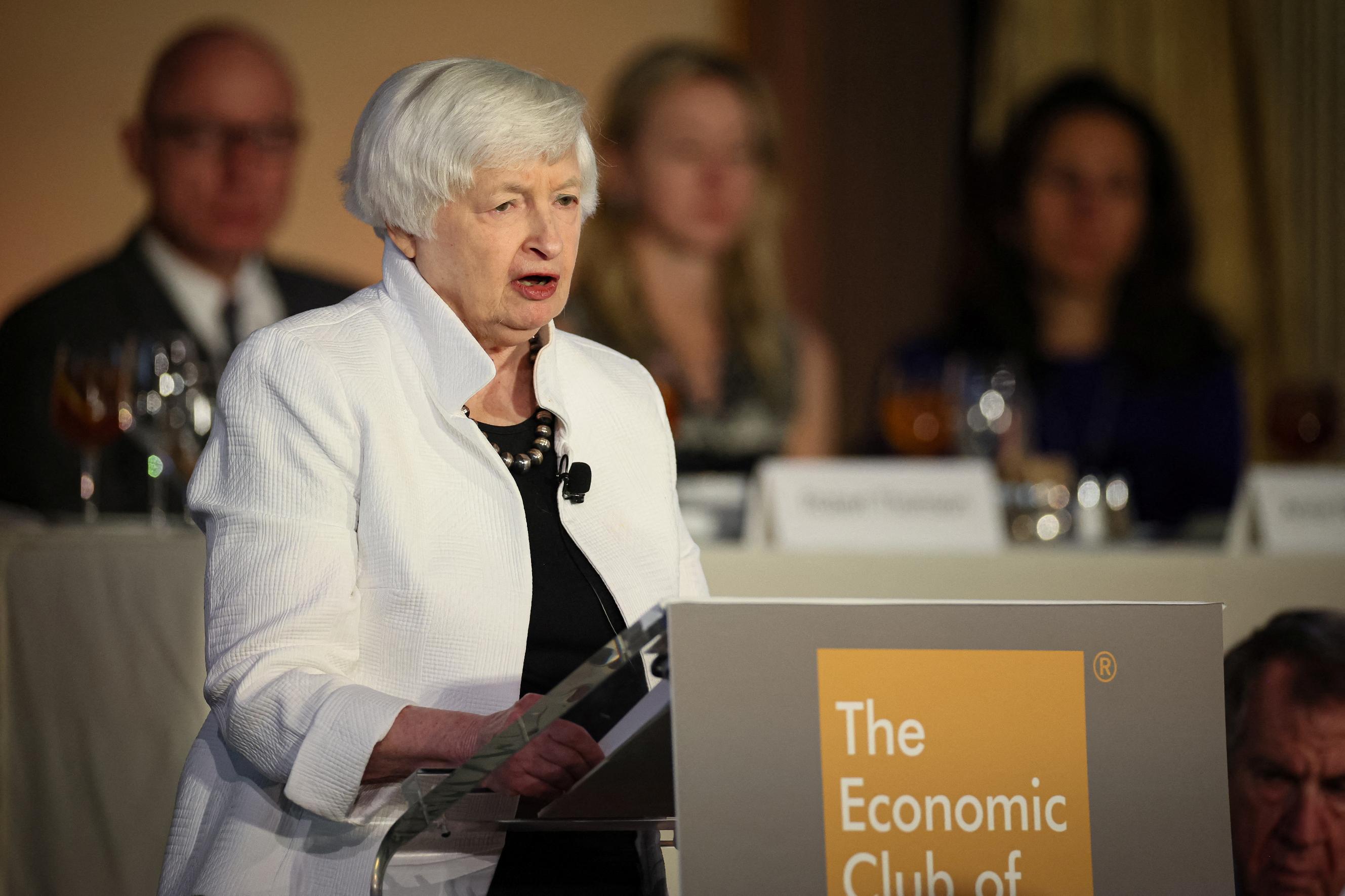
NEW YORK/WASHINGTON, June 13 (Reuters) - U.S. Treasury Secretary Janet Yellen said on Thursday that U.S. public investments that attract private capital are crucial to promote sustainable and inclusive growth over the long term, but warned that China's model of massive state industrial subsidies were unacceptable to the world. Yellen said in prepared remarks to the Economic Club of New York that the traditional Republican model of "supply-side economics" relies too heavily on tax cuts to spur investment and has failed to benefit enough workers. Yellen's speech to top business executives and Wall Street leaders marked a rebuttal of sorts to a presentation that Republican presidential candidate Donald Trump delivered on his economic vision to top U.S. CEOs in Washington, including Apple CEO Tim Cook and JP Morgan Chase CEO Jamie Dimon. The Business Roundtable event in Washington also was expected to feature a presentation by White House Chief of Staff Jeff Zients, representing President Joe Biden, who is attending a summit of G7 leaders in Italy. Trump's campaign has been light on specifics about his economic plans, but his message to CEOs emphasized tax cuts for businesses and reduced business regulation, according to Trump economic adviser Stephen Moore. Trump has pledged to continue tax cuts that he signed into law in 2017 and has said he wants to offer tax relief to the middle class, reduce regulations and expand fossil-fuel energy production while reversing Biden's clean energy initiatives. In Nevada on Sunday, he floated a plan to stop taxing service workers' tip income. "We have learned through experience that heavy-handed central planning through government dictates is not a sustainable economic strategy," Yellen said in prepared remarks. "But neither is traditional supply-side economics, which ignores the importance of public infrastructure, education and workforce training and government-supported basic research." Tax cuts for the wealthy and deregulation have not fueled "growth and prosperity for the nation at large," she added. Yellen highlighted the Biden administration's major legislative initiatives to invest in the U.S. economy with a 2021 infrastructure law and semiconductor investments and clean energy tax credits passed in 2022. These included provisions to train workers and have resulted in $850 billion worth of new private-sector manufacturing investments in the U.S. since Biden took office in 2021, she said. "It's been clear to President Biden and me that our economic strategy cannot be driven by either the public or private sector alone," she said. The doctrine she calls "modern supply-side economics" requires public interventions to "create a supportive environment for business and fuel private sector investments." She said that a strong U.S. economy was helping to drive global growth, with falling inflation and high investment returns, and was optimistic that these trends would continue. CHINESE SUBSIDIES Yellen also sought to contrast the Biden approach with that of China, saying that excessive government subsidies for strategic industries have fueled excess manufacturing capacity far above weak domestic demand. A flood of exports resulting from this overinvestment now threatens jobs around the world and is leading to new trade barriers in the U.S. and elsewhere. "China cannot assume that the rest of the world will rapidly absorb huge quantities of excess production to the detriment of domestic industries in other countries," Yellen said. "If China continues on this path, I fear that its policies may interfere significantly with our efforts to build a healthy economic relationship," Yellen said. But she repeated her view that decoupling the world's two largest economies would be detrimental to U.S. interests. Asked by reporters later about the possibility the Treasury could impose secondary sanctions on a Chinese bank for violating U.S. sanctions on Russia through processing transactions that aid Moscow's war production, Yellen said she believed the largest Chinese banks were wary of such deals. "I’m certainly not going to say that we would not be willing to designate a large bank if we saw systematic violations,” Yellen said, adding: "The largest banks in China really, really value their correspondent banking relations." Sign up here. https://www.reuters.com/markets/us/yellen-says-public-private-investments-needed-sustain-us-growth-2024-06-13/
2024-06-13 19:46
June 13 (Reuters) - Washington imposed new sanctions on Wednesday on the Moscow Exchange (MOEX.MM) New Tab, opens new tab and its clearing agent, the National Clearing Centre (NCC), leading to an immediate trading halt in dollars and euros on Russia's largest bourse. The U.S. Treasury said it was "targeting the architecture of Russia's financial system, which has been reoriented to facilitate investment into its defense industry and acquisition of goods needed to further its aggression against Ukraine". Russia shrugged off the move, pointing to the reduced role of the dollar and euro since Moscow's February 2022 full-scale invasion of Ukraine led to sweeping Western sanctions. But the U.S. move took the market by surprise and it may take days, if not weeks, for it to settle into the new reality. TRADING HALT The central bank said Moscow Exchange trading in dollars, euros and Hong Kong dollars would stop. The sanctions, particularly the inclusion of the NCC, prevent traders from settling spot and futures contracts with dollars through MOEX infrastructure. "The sanctions were imposed only by the U.S., but EU countries also observe them," the central bank said. "Therefore, exchange trading was also stopped in the euro." MOEX will likely face reduced trading volumes, which could squeeze its profits. Its shares sank 15% at the market opening in Moscow, before settling around 4.8% lower. The fact that no clear indicator of the rouble-dollar rate emerged at the start of the banking day suggests that Russia's financial system was not 100% ready for this move, said Yevgeny Nadorshin, chief economist at PF Capital. SILVER LININGS Crucially, around 60% of Moscow-based FX trading is now conducted over-the-counter (OTC). The central bank said it would calculate the official rouble rate based on OTC trading. Since it started calculations in this way, the bank has only observed "insignificant deviations" from the official exchange-traded rate for the dollar and euro. The exchange rate will remain market-based - it is only the data used for calculating it that has changed. Another benefit for Russia is that burgeoning trade with China as Moscow redirects trade flows east has made the yuan the most traded currency in Moscow, with 54% of the market in May, up from a negligible pre-war share. "To determine where the fair rate is, market participants will be able to rely on the cross rate of rouble-yuan and yuan-dollar and yuan-euro," said Alfa Capital. ROUBLE PROSPECTS Short-term volatility is unavoidable, but a strengthening of the rouble is possible in the medium-term. When payment difficulties hampered imports early this year, the rouble gained, said Raiffeisen Bank analysts. "Over the longer horizon, the rouble could even strengthen further. As it becomes more difficult to withdraw foreign currency ... this could lower demand for it," said Alfa Capital. "Let's remember 2022: the rouble initially weakened strongly due to market panic, but then began to strengthen." The central bank said the rouble rate was determined by the balance of supply and demand for foreign currency received from foreign trade activities and did not depend on how transactions were carried out. Russian exporters that are obliged to sell a portion of their foreign currency revenues as part of capital controls supporting the rouble would continue to do so in dollars, directly through authorised banks, the central bank said. WIDE SPREADS, OTHER RISKS Brokers were offering wide buy-sell spreads and many were not conducting transactions at all, further evidence of the market's general lack of preparedness for the sanctions. "In the future, the difference between U.S. dollar and euro buying and selling rates will become larger than before, however the emergence of additional transaction costs and more complex access to buying major world currencies will to some extent limit domestic demand for foreign assets," said Oleg Kuzmin and Andrei Melaschenko of Renaissance Capital. Washington has clearly signalled its intent to clamp down on banks in third countries that enable Russia to sustain its war effort. "The new restrictions increase the level of risk in terms of possible secondary sanctions," said Alfa Bank. Sign up here. https://www.reuters.com/world/europe/what-next-after-new-us-sanctions-russias-financial-system-2024-06-13/