2024-06-13 10:54
SINGAPORE, June 13 (Reuters) - Singapore is offering refiners and petrochemical companies rebates of up to 76% for its planned carbon tax for 2024 and 2025 to help them ease cost stress and remain competitive versus rivals elsewhere, four sources familiar with the matter said. The tax concessions will provide a significant buffer for refiners' profit margins amid growing competition with newer plants in China and the Middle East. Carbon tax costs are estimated at between 80 cents and $1 per barrel of crude input basis for refineries based on the $25 per ton of emission rate, according to consulting firms FGE and Wood Mackenzie. That would be close to a quarter of refiners' current margins in Singapore. Under Singapore's new taxation rate for carbon emissions, which took effect on Jan. 1, businesses that emit more than 25,000 metric tons of carbon annually pay $25 per ton until 2025, compared with $5 per ton in 2019-2023. The rate will subsequently go up to $45 per ton in 2026-2027 and $50-80 per ton by 2030, the government announced in 2022. Major companies in the refining and downstream sectors have been given rebates on a transitional basis to soften the added tax burden, lowering the final costs to between $6 and $10 per ton of emissions, three of the sources said. These refineries and downstream businesses will still have to pay an outright $25 per ton of carbon emission tax and subsequently apply for the rebates, according to the terms and conditions set out by the government, a fifth source said. Singapore has three refineries of a combined capacity of 1.119 million barrels per day, currently operated by Shell (SHEL.L) New Tab, opens new tab, Exxon Mobil Corp (XOM.N) New Tab, opens new tab, and Singapore Refinery Co (SRC), a joint venture between Chevron (CVX.N) New Tab, opens new tab and Singapore Petroleum Co, wholly owned by PetroChina (601857.SS) New Tab, opens new tab. While the disruption of Russian oil trade post-Ukraine war and post-COVID demand boosted refining margins between 2020 and 2022, these profits have halved from peak levels reached in February. Shell declined to comment, while an ExxonMobil spokesperson said: "As a matter of practice, we do not discuss confidential matters." "The Singapore Refining Company remains committed to support the Singapore government's policies through close partnership and continued dialogue," an SRC spokesperson said. The concessions will likely be in place at least for 2024 and 2025, one of the sources said, adding that the "discounted" rate will be back on the table for discussion in 2026 or after. Singapore introduced a transition framework last year to support companies in Emissions-intensive trade-exposed (EITE) sectors such as chemicals, electronics and biomedical manufacturing in their energy transition. "The allowances will only be provided for a proportion of the companies' emissions, and are based on internationally recognised efficiency benchmarks where available, or the ambition and robustness of companies' decarbonisation plans," a spokesperson at Ministry of Trade & Industry told Reuters in an email. "Their remaining emissions will continue to be subject to the prevailing headline carbon tax rates." The duration of this transition framework will depend on the development of carbon prices internationally and the progress of decarbonisation technologies, he said, adding that companies will be given sufficient notice in advance of changes to facilitate business planning. In general, the carbon tax would have to be paid in the year following the reporting year "because of the time needed to compile the emissions data and independently verify the total emissions of the reporting year", a spokesperson from the city state's National Environmental Agency (NEA) said earlier. Companies currently have the option to also offset up to 5% of their taxable emissions using international carbon credit - either bought or accumulated elsewhere in the world, according to the NEA. This hefty increase in carbon taxes has been a hot topic in Singapore's refining sector, following the sale of Shell's flagship Bukom and Jurong Island refinery and petrochemical facilities amid stiff competition. Sign up here. https://www.reuters.com/sustainability/climate-energy/singapore-offers-carbon-tax-rebates-refiners-near-term-sources-say-2024-06-13/
2024-06-13 10:48
June 13 (Reuters) - U.S. liquefied natural gas (LNG) provider NextDecade (NEXT.O) New Tab, opens new tab has signed a non-binding agreement with Saudi Aramco (2222.SE) New Tab, opens new tab to supply 1.2 million tonnes per annum (MTPA) of LNG for 20 years, the companies said on Thursday. The deal comes at a time when Aramco is seeking to strengthen its position in the LNG market, which is set to grow globally by 50% by 2030, especially in the United States, where LNG capacity is set to almost double over the next four years. Aramco said the deal was part of its efforts to expand its "presence in international energy markets." Under the terms, LNG will be supplied from the fourth liquefaction train at NextDecade's Rio Grande LNG Facility at the Port of Brownsville, Texas, USA. Earlier this month, Reuters reported that Aramco was in talks with NextDecade, as well as U.S. firm Tellurian (TELL.A) New Tab, opens new tab on two separate liquefied natural gas (LNG) projects as the Saudi firm seeks to boost its gas trading and production. Aramco and NextDecade said they were in the process of negotiating a binding agreement, effective subject to a positive final investment decision on Train 4, which NextDecade said it expects in the second half of 2024. In May, Abu Dhabi National Oil Company (ADNOC) said it had acquired 11.7% stake in phase 1 of NextDecade's LNG project, which included the first three liquefaction trains, and agreed to a 20-year supply agreement for the fourth train. Sign up here. https://www.reuters.com/business/energy/nextdecade-saudi-aramco-sign-20-year-lng-supply-deal-2024-06-13/
2024-06-13 10:40
Russian attacks damage half of Ukraine power infrastructure Minister warns defence systems needed within weeks BERLIN, June 13 (Reuters) - Ukraine needs more air defences within weeks to allow repairs to the half of its power infrastructure destroyed by Russian attacks, or it will not be able to meet demand in the winter, the country's energy minister told Reuters. German Galushchenko said Russia was intensifying its attacks on power systems, making repairs difficult and choking supplies. Russian missile and drone attacks on Ukraine's energy sector have intensified since March, cutting out half of its generating capacity, resulting in rolling blackouts, including in the capital Kyiv. "We have five months before the winter. If we won't be able to protect now ... we cannot do repairing. 50% alone is not enough to get through the winter," said Galushchenko. "They still have time to attack us again and again before the winter," he added. "Even to repair something or to restart some units without air defence, it doesn't help you a lot because they will destroy it again." The winter is when power demand in Ukraine is at its highest as temperatures drop far below zero. Ukraine has been lobbying in particular for U.S.-made Patriot missile defences which have proved vital for Kyiv's chances of shooting down Russia's ballistic and hypersonic missiles. Galushchenko said Ukraine needed seven to nine such systems and they were needed within weeks. "We're living with restrictions now, even in the summer, because we cannot cover ... this destroyed generation," he said. "We cannot cover this by imports." Galushchenko said Russia had also struck renewable energy sites, including a solar station. He made his remarks on the sidelines of a conference in Berlin, where Ukraine sought to reinvigorate flagging Western support. Switzerland hosts a summit this weekend to seek a path to peace in Ukraine, but it has been shunned by China and dismissed as a waste of time by Russia, which was not invited. Ukrainian President Volodymyr Zelenskiy, who attended the Berlin conference, also addressed the German parliament, where his speech was boycotted by two parties including the far-right Alternative for Germany (AfD), whose support surged in recent European elections. Galushchenko said Europeans who voted for pro-Russian parties had failed to grasp the threat posed by Russia. "There is probably the expectation that would allow you to feel safe and peaceful here," he said. "But that's a big mistake. Sometimes, it appears that it's ... far from us. Be sure that you will be next. The aggressors ... would never stop." So far this year, Ukraine has been on the back foot as it faced delays in military aid from the United States, intensified attacks on its infrastructure and Moscow’s push to expand the frontline, 27 months after its full-scale invasion. Sign up here. https://www.reuters.com/world/europe/ukraine-says-without-more-air-cover-there-wont-be-enough-power-winter-2024-06-13/

2024-06-13 10:04
June 13 (Reuters) - A look at the day ahead in markets from Dhara Ranasinghe. It's back to the markets versus the U.S. Federal Reserve. While the central bank on Wednesday pushed out the start of rate cuts to perhaps as late as December, markets (and many economists) beg to differ. Traders price a roughly 65% chance of a quarter point move in September and more or less fully price in a move by the November meeting -- which falls two days after the U.S. presidential election. The latest inflation numbers offer some explanation as to why the markets are ignoring the Fed's own take on when a first rate cut is likely to come. U.S. consumers prices were unexpectedly unchanged in May - a sign that price pressures are easing even if overall annual inflation is still running high at just over 3%. Most economists continued to expect two rate cuts, starting in September, arguing that inflation had turned the corner after surging in the first quarter. So, world markets -- it appears -- have chosen to take their cue from the inflation data, released just hours before the Fed's monetary policy statement, rather than the Fed messaging. To be fair, though, Fed policy makers have said - once or twice - that they will react to the incoming data. Stock market futures point to a positive start for Wall Street, a day after the S&P 500 and Nasdaq posted record closing highs for a third straight day. U.S. Treasury yields are higher, but only modestly so. For some, signs of falling inflation could be a positive sign for the large swathes of the stock market that have languished in a rally led by Big Tech. Yes, the S&P 500 is up about 14% this year, but around 60% of the return has been driven by six companies whose shares have an outsized weighting in the index: Nvidia (NVDA.O) New Tab, opens new tab, Microsoft (MSFT.O) New Tab, opens new tab, Apple (AAPL.O) New Tab, opens new tab, Meta Platforms (META.O) New Tab, opens new tab, Alphabet (GOOGL.O) New Tab, opens new tab, and Amazon.com (AMZN.O) New Tab, opens new tab, data from S&P Dow Jones Indices showed. TRADE TENSIONS Global trade tensions meanwhile are likely to remain in focus. Beijing hopes the European Union will reconsider tariffs on Chinese electric vehicles (EVs) and stop going further in the "wrong direction" to shield its auto industry from competition, state news agency Xinhua said. The EU's steps, announced on Wednesday, come less than a month after Washington revealed plans to quadruple duties for Chinese EVs to 100%. Beijing has rejected the EU and U.S. argument that China's EV industry is running at a degree of overcapacity that threatens overseas automakers through subsidized exports. Not surprisingly, given the uncertainty, European auto stocks (.SXAP) New Tab, opens new tab are down 2% on Thursday, but major Chinese electric car makers such as BYD rebounded. Group of Seven (G7) leaders meanwhile will start their annual summit looking to buttress support for Ukraine in its war with Russia and offer a united face in confronting China's political and economic ambitions. Also in Europe, the spotlight has fallen on campaigning in Britain for the July 4 national election, with main opposition Labour leader Keir Starmer set to unveil his party's agenda for government. Opinion polls suggest Labour will win the election. Key developments that should provide more direction to markets on Thursday: - Bank of Japan kicks off two-day meeting - US May PPI - Auctions: US 30-year bonds Sign up here. https://www.reuters.com/markets/us/global-markets-view-usa-pix-graphics-2024-06-13/
2024-06-13 09:00
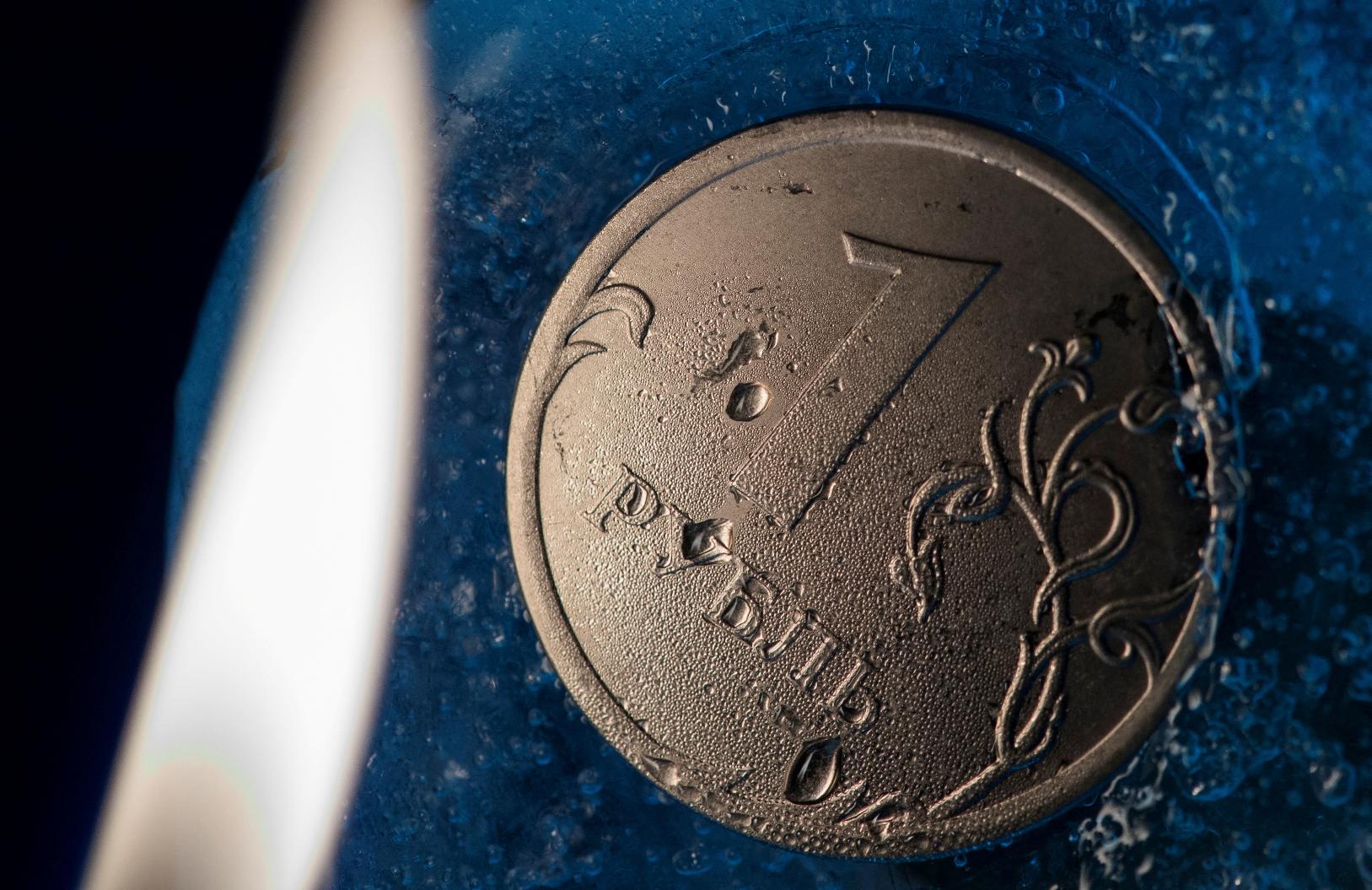
Sanctions dent MOEX stocks, stir volatility Rouble firms despite MOEX halting dollar, euro trade OTC market to replace function of stock exchange Impact on rouble in longer term unclear MOSCOW, June 13 (Reuters) - New U.S. sanctions that forced Russia's leading exchange to halt dollar and euro trading led to a range of varying prices and spreads as trading moved over-the-counter (OTC) on Thursday, obscuring access to reliable pricing for the Russian currency. The Russian central bank set its official rouble-dollar rate for Friday at 88.21, implying a strengthening of about 0.9% from the previous close. But the sanctions caused confusion in how to determine accurately the currency's exact value. On the interbank market, the rouble traded between a 10-day low of 90.25 and a near one-year high of 86.28, eventually settling 0.4% higher at 88.62. The central bank calculated its official rate based on OTC trading, instead of its previous method of mostly using trades on Moscow Exchange (MOEX.MM) New Tab, opens new tab, Russia's leading financial market place. Washington's sanctions on MOEX, and crucially its clearing agent, the National Clearing Centre (NCC), have been expected since Russia's full-scale invasion of Ukraine in February 2022, but the move still took the market by surprise. The sanctions led to a suspension of trading in U.S. dollars, euros and Hong Kong dollars on MOEX. The U.S. said it was aiming to cut the flow of money and goods used to sustain Russia's war in Ukraine. MOEX is part of Russia's critical financial infrastructure, but the latest sanctions are seen having limited impact on Russia's ability to continue selling its oil and gas internationally as Moscow has already diverted much of its trade flows towards China and other Asian countries. "Over the past two years, the role of the US dollar and the euro in the Russian market has been consistently declining," the central bank said on Thursday. The yuan has surpassed the dollar to become the most traded currency with the rouble in Moscow, accounting for a 54% share of the FX market in May. The rouble steadied at 12.22 against the yuan and touched a near one-year high of 11.8430 earlier in the session. Russia's rouble-based MOEX Russian index (.IMOEX) New Tab, opens new tab plunged to a near six-month low in early trading, before paring losses to close unchanged at 3,171.7 points. Shares in MOEX slumped around 15%, before settling around 3.1% lower. VOLATILITY, WIDE SPREADS "The sanctions against the key institutions of the Russian financial sector are the most serious in the last 1-1/2 years after the introduction of the oil embargo and oil price cap," said BCS World of Investments analysts. About 60% of FX trading from January to April had been on the OTC market, BCS said, so it offers a sufficient basis for forming the official exchange rate. "At the same time, the lack of a single trading floor will lead to an increase in spreads on FX operations from banks." Banks, companies and investors are no longer able to trade either the U.S. dollar or the euro via the central exchange, which provides benefits such as liquidity, clearing and oversight. Instead, the opaque OTC market, where deals are conducted directly between two parties, will dominate. "The new sanctions should not affect the rouble rate in the medium term," said Yuri Popov, SberCIB Investment Research strategist. "In the short term, there may be high volatility and wide spreads at exchange counters." Some major brokers blocked accounts in dollars, euros and Hong Kong dollars, with deposits and withdrawals unavailable. Sberbank (SBER.MM) New Tab, opens new tab, Russia's dominant lender, said it was not seeing increased demand for foreign currency at its branches and its FX rates had not changed since yesterday. Sign up here. https://www.reuters.com/markets/currencies/rouble-swings-opaque-trading-territory-after-new-us-sanctions-2024-06-13/
2024-06-13 08:17
OSLO, June 13 (Reuters) - Norwegian companies expect overall activity to increase somewhat in the time ahead, a central bank business survey showed on Thursday. "The share of contacts reporting full capacity utilisation has increased and contacts are planning for some growth in employment," Norges Bank said in the quarterly survey, a key input for its June 20 rate decision. Output growth expectations were revised up in most sectors of the economy, although companies in the construction industry expected a further fall in activity, the central bank said. "Contacts are planning for a slight increase in investment in 2024 and for rising growth in 2025," it added. Sign up here. https://www.reuters.com/business/norwegian-companies-see-improved-outlook-central-bank-survey-shows-2024-06-13/