
2024-06-07 15:00
June 7 (Reuters) - A U.S. job market scorecard that exceeded all forecasts has undercut confidence over when, or even if, the Federal Reserve will begin easing policy this year, putting the focus for the policy outlook on next week's Fed meeting and Fed Chair Jerome Powell's own guidance. The latest monthly Labor Department report did break the economy's 2-year string of below-4% unemployment, a run not seen since the 1960s. But it hardly seemed to matter: Hiring across the economy was broad, and the 272,000 jobs added in May topped even the highest-guessing economist in a Reuters poll. Wage growth accelerated. All that flew in the face of growing expectations that the labor market had begun to cool, which would help the Fed reach its 2% inflation goal faster and pave the way for a reduction in borrowing costs before summer's end. After the report, traders slashed bets on an initial Fed interest-rate cut by September, taking the probability down to just a bit stronger than a toss of the coin, from about a 70% chance seen previously. A second rate cut by December is also now seen as only barely more likely than not. U.S. central bankers meeting next Tuesday and Wednesday are still widely expected to leave the policy rate in the current 5.25%-5.5% range, where they have kept it since last July. Most analysts have also predicted that Fed officials' quarterly projections published at the end of next week's meeting will reflect expectations for fewer rate cuts this year than the three that policymakers had penciled in in March. The jobs data raises new questions over that outlook. "We had been anticipating the start of rate cuts in September, totaling 50 basis points of cuts this year, but the persevering strong employment gains raises the likelihood of later rate cuts,” wrote Nationwide chief economist Kathy Bostjancic. U.S central bankers have said they do not plan to cut rates until they are more confident that inflation is declining toward their 2% goal. Friday's data suggests pressures are pushing prices the other way, with average hourly earnings up 4.1% in May from a year earlier, after an upwardly revised 4% rise in April. Still, Bostjancic and other analysts pointed to weaknesses in part of Friday's report that cloud the picture. One of the report's two surveys showed a massive 408,000 drop in employment in May, which helped push the U.S. unemployment rate to 4%, from 3.9% in April. The rate had been below 4% for more than two years. On Wednesday the Labor Department will publish the consumer price index data for May, giving policymakers fresh insight on whether inflation data is breaking lower after disappointingly high readings in the first several months of the year. "The ambiguity on the May labor market front will place even more attention on next week’s CPI inflation data and how Jay Powell and the FOMC (Federal Open Market Committee) are factoring in the latest numbers into their rate-cut expectations," wrote BMO Capital Markets economist Scott Anderson. Sign up here. https://www.reuters.com/markets/us/fed-may-wait-cut-rates-job-market-stays-strong-2024-06-07/

2024-06-07 14:43
Unemployment rate rises to 6.2% from 6.1% Wage growth jumps to four-month high of 5.2% Canadian economy adds 26,700 jobs in May OTTAWA, June 7 (Reuters) - Canada's jobless rate edged up to a more than two-year high in May and wage growth accelerated, data showed on Friday, giving two diverging signals on how the Bank of Canada will digest the reading for its next rate decision in July. The unemployment rate was up to 6.2% from 6.1% in April, matching forecasts. The jobless rate, on an upward trend over the past year, has risen 1.1 percentage points since April 2023, Statistics Canada said. However, the average hourly wage growth for permanent employees accelerated to an annual rate of 5.2% from 4.8% in April, Statscan data showed. That growth rate was the highest since January's 5.3% rate. Rising unemployment is a sign in part of the economy buckling under the pressure of high interest rates. But quicker wage growth, especially when growing faster than inflation, complicates the fight to rein in consumer price increases. Annual inflation in April stood at 2.7%. "Little bit of an ugly job report," said Jules Boudreau, senior economist, Mackenzie Investments. "The biggest worry is that the wages have gone up and that's a problem for the Bank of Canada," he said, adding that in the past the bank was hesitant to cut rates because wages were rising too quickly. Money markets, which had been betting for an over-50% chance of a rate cut in July, trimmed bets to 44% after the jobs data. The BoC had warned on Wednesday that if wage growth remains high it could slow progress on taming inflation and economists cautioned the bank should move slow with rate cuts. The BoC cut its key policy rate to 4.75% and indicated that further easing would be gradual and dependent on data. The bank will have another month's job data before its next rate decision announcement on July 24. The Canadian dollar was trading 0.36% lower at 1.3717 to the U.S. dollar, or 72.91 U.S. cents, as investors also weighed stronger-than-expected U.S. jobs data. The jobs gains in the economy were marginal at 26,700 but surpassed the numbers forecast by analysts in a Reuters poll by over 18%. This was primarily because a continued increase in population offset the economy's ability to absorb people coming into the labor market. Economists had said that with no slowdown in population growth seen in the short-term, any job additions below 45,000 people would push the unemployment rate higher. "It's a weak enough increase in employment, given the unemployment rate change, for the BoC to feel comfortable cutting rates again at the next meeting," said Andrew Kelvin, head of Canadian and global rates strategy at TD Securities. However, he said wage growth above 5.2% could be a concern for the BoC. The jobs data came at the same time as U.S. employment data which showed that non-farm payrolls increased by 272,000 jobs last month, which bolstered expectations of a hold on rate cuts by the Federal Reserve till September. The Canadian employment gains in May were driven by part-time work, which more than offset full-time positions lost in the month, StatsCan said. It noted that the proportion of part-time workers who could not find a full-time job or worked part-time due to poor business conditions was 18.2% in May, the highest since December 2021. In May, employment in the goods sector decreased by a net 20,700 jobs, mainly in construction, while the service sectors gained a net 47,400 positions, led by healthcare and social assistance as well as finance-related jobs. Sign up here. https://www.reuters.com/markets/canadas-may-job-gains-exceeds-forecasts-wage-growth-accelerates-2024-06-07/

2024-06-07 13:09
June 7 (Reuters) - U.S. job growth accelerated far more than expected in May, keeping the Federal Reserve on track to hold off starting to cut interest rates. The Labor Department said on Friday that the unemployment rate ticked up to 4.0% for the first time since January 2022, while nonfarm payrolls increased by 272,000 jobs last month, much more than the 185,000 forecast by economists polled by Reuters. Revisions showed 15,000 fewer jobs created in March and April combined than previously reported. read more MARKET REACTION: STOCKS: S&P 500 e-mini futures turned 0.29% lower, pointing to a soft open on Wall Street BONDS: The U.S. Treasury 10-year yield jumped and was last at 4.414%; Two-year yields surged to 4.855% FOREX: The dollar index turned 0.61% higher, while the euro turned 0.62% lower COMMENTS: PADHRAIC GARVEY, REGIONAL HEAD OF RESEARCH, AMERICAS, ING, NEW YORK “It's really quite difficult for the Fed to be anywhere near a rate cut…We see the odd weak reading in terms of activity, but then we come to the big numbers like payrolls and okay, the unemployment rate rose, I get that, it's up to 4%, but that's not high.” “There's no urgency for the Fed to cut if the labor market is firm…we got a whole lot of stuff pointing to future weakness in the labor markets, but the reality is this is the most important employment print that we get. We just had it, it's bang up to date, and it's pretty strong.” QUINCY KROSBY, CHIEF GLOBAL STRATEGIST, LPL FINANCIAL, CHARLOTTE, NORTH CAROLINA "The report suggests continued resiliency in the labor market despite the rise in the unemployment rate... The market responded immediately with the Treasury yield inching higher and the equity futures market pulling back. The Fed may see these numbers as an obstacle for cutting rates in September because what a strong labor market leads to is a stronger consumer, a consumer that can continue to spend and fuel inflation." BRIAN NICK, SENIOR INVESTMENT STRATEGIST, THE MACRO INSTITUTE, NEW YORK "It's the type of report that's not going to cause the Fed to want to change the course that it has been on, which is to describe the need for higher interest rates and the potential for strong job creation to keep upward pressure on inflation. But they're not going to like the fact that the unemployment rate went up to 4%. That's their year-end forecast and here we are with the May report that it's already there." "The fact that you have these two numbers (payrolls and unemployment rate), are saying such different things, makes it very hard for investors and even harder for central bankers to know exactly what's going on." "It is likely that we still get three interest rate cuts, because if the Fed is cutting in September because the unemployment rate is at 4.2% or 4.3%, then they're probably going to start having to cut at every meeting." CHRIS ZACCARELLI, CHIEF INVESTMENT OFFICER, INDEPENDENT ADVISOR ALLIANCE, CHARLOTTE, NORTH CAROLINA (emailed note) "The headline unemployment number is likely to get a lot of attention because it now has a 4-handle, but the greater-than-expected number of jobs created is the more important datapoint, in our opinion. "To those who are worried about inflation – especially the Federal Reserve – the report should raise concerns that wage pressure and sticky inflation is more likely to persist than be transitory. "We believe that the Fed is on hold at least until the election and may very well skip rate cuts for the entire year (our base case is still one 25 bps rate cut in December)." EUGENIO ALEMAN, CHIEF ECONOMIST, RAYMOND JAMES, FLORIDA "(The NFP) were surprising on the upside, but the unemployment numbers narrate a different view; there are discrepancies between the two. We will have to wait and see what the next couple of months look like because the Fed is not going to relent to lowering interest rates with such a strong labor market." BRIAN JACOBSEN, CHIEF ECONOMIST, ANNEX WEALTH MANAGEMENT, MENOMONEE FALLS, WISCONSIN “So much for slowing. The headline payrolls number is eye popping. The details? A little less so. There’s a chasm between the payrolls number being up 272,000 and the household survey’s employment number being down 408,000. There was also an outsized jump in the number of people working part time for non-economic reasons. It’s easy to poo-poo the strong headline number by saying it’s mostly driven by the non-cyclical health care and government segments, but the aggregate weekly payrolls gains across industries is pretty strong. "The Fed will take this to mean that they can still focus squarely on inflation without worry much about growth.” PETER CARDILLO, CHIEF MARKET ECONOMIST, SPARTAN CAPITAL SECURITIES, NEW YORK “This is a hot number, and of course the part that is most interested to the Fed is the hourly wages, which rose more than expected on a year-to-year basis to over 4%.” “But this is a strong report, and it suggests that there are no signs of any cracks in the labor market.” “It’s a plus for economy and a plus for corporate earnings but it’s a negative in terms of the prospects of a rate cut perhaps as early as September.” “This report probably erases the hope of a September rate cut and pushes it back to maybe December.” “We have CPI next week and this is only one report but the fact that hourly wages went up on a year-to-year basis that is not good news for the Fed.” Sign up here. https://www.reuters.com/markets/us/view-eye-popping-may-us-payrolls-jump-may-set-back-fed-ease-2024-06-07/
2024-06-07 13:00
Gold shed 3.5% on Friday, the most since November 2020 US CPI data due on Wednesday Federal Reserve policy meeting starts on Tuesday China buying is a key market focus, analyst says June 10 (Reuters) - Gold prices rebounded on Monday after the precious metal's biggest daily drop in three and a half years in the last session, as investors awaited U.S. inflation data and the Federal Reserve's decision on interest rates later this week. Spot gold was up 0.8% at $2,310.81 per ounce as of 1817 GMT. U.S. gold futures settled about 0.1% higher at $2,327. The sell-off on Friday seemed a bit excessive and "bargain hunters are surfacing at this lower price point," said Phillip Streible, chief market strategist at Blue Line Futures. "There's so much data and so many events coming out ... so there's going to be more volatility and more fireworks this week." Bullion lost about $83 an ounce on Friday, declining 3.5% in its biggest one-day drop since November 2020 after a stronger-than-expected U.S. jobs report dented hopes for a September interest rate cut and reports that China's central bank was holding off gold purchases put off investors betting on Chinese demand. "People's Bank of China (PBOC) has never been a constant buyer. There have been distinct phases of buying followed by multi-month breaks. But as long as the PBOC doesn't resume buying, gold prices could trade sideways because the China buying topic is a key market focus," said Carsten Menke, an analyst at Julius Baer. Gold's tentative recovery occurred despite a rise in the dollar and U.S. Treasury yields, with the market's focus shifting to the release of the U.S. consumer price index report on Wednesday, the same day as the Fed's policy decision. The U.S. central bank is not expected to make any change to its policy rate this week, but the focus will be on policymakers' updated economic projections and Fed Chair Jerome Powell's news conference after the end of the two-day meeting. Higher rates increase the opportunity cost of holding non-yielding bullion. Spot silver rose 1.9% to $29.72 per ounce and platinum was up 0.8% at $973.60, while palladium fell about 0.9% to $904.25. Sign up here. https://www.reuters.com/markets/commodities/gold-prices-dip-china-central-bank-holds-off-buying-2024-06-07/

2024-06-07 12:50
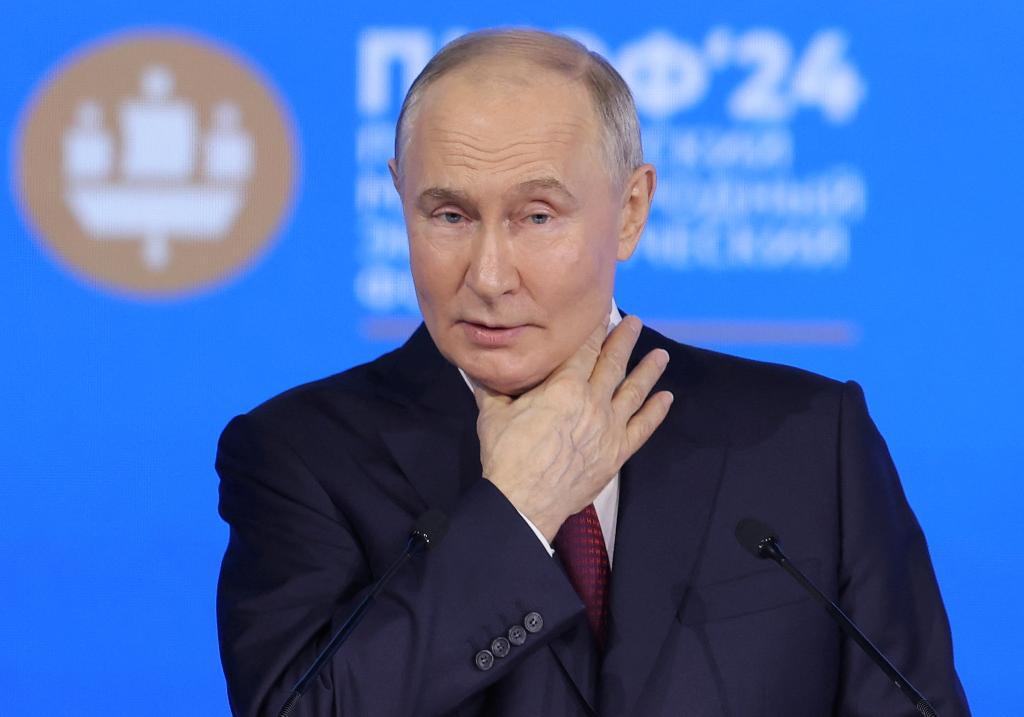
Putin says no need for nuclear strike Putin does not rule out changes to nuclear doctrine Russian leader also does not rule out nuclear test Comments come amid Russian battlefield gains in Ukraine ST PETERSBURG, Russia, June 7 (Reuters) - President Vladimir Putin said on Friday Russia had no need to use nuclear weapons to secure victory in Ukraine, the Kremlin's strongest signal to date that Europe's deadliest conflict since World War Two will not escalate into a nuclear war. Since Putin ordered troops into Ukraine in February 2022, he has said on several occasions that Russia would use such weapons if necessary to defend itself - comments the West says are nuclear sabre-rattling. Asked at the plenary session of the St Petersburg International Economic Forum by moderator Sergei Karaganov, an influential Russian analyst, if Russia should hold a "nuclear pistol to the temple" of the West over Ukraine, Putin said he did not see the conditions for using such weapons. "The use is possible in an exceptional case - in the event of a threat to the sovereignty and territorial integrity of the country. I don't think that such a case has come. There is no such need," Putin said. Moscow considers Crimea - which it seized from Ukraine in 2014 - and four other Ukrainian regions now as integral parts of its own territory, raising the possibility of a nuclear strike if Kyiv appeared poised to retake them. Ukraine has stepped up drone and missile attacks on Russian targets, including in Crimea, and has vowed to drive all Russian forces from its territory. Putin said he did not rule out changes to Russia's nuclear doctrine, which sets out the conditions under which such weapons could be used. He also said that if necessary Russia could test a nuclear weapon, though he saw no need to do so at the present time. The public debate about nuclear strikes on a stage at Russia's premier economic forum appeared to be a Kremlin attempt to reduce nuclear fears just as the Ukraine war escalates towards what both Russian and U.S. diplomats say is its most dangerous phase yet. Russia and the United States hold nearly 90% of the world's nuclear weapons. NUCLEAR WAR? Last year Karaganov proposed a limited nuclear strike New Tab, opens new tab on a NATO member in Europe to force the West to back off in the conflict over Ukraine and thus avert World War Three. On Friday Karaganov invoked the Biblical story of how God destroyed the cities of Sodom and Gomorrah for their wickedness as he pressed Putin on whether Russia should escalate in Ukraine to teach the West "a lesson". Putin said he prayed that the world would never witness a nuclear confrontation, adding: "And we don't have that need. Because our armed forces are not just gaining experience, they are increasing their effectiveness." Russian troops are advancing along the front line in Ukraine, Putin said, adding they had taken 880 square km of territory since the start of the year, including 47 villages and towns. Putin said Russia had increased ammunition production by more than 20 times and was outproducing Ukraine and the West on a whole series of measures. Russia's published 2020 nuclear doctrine sets out the conditions under which a Russian president would consider using a nuclear weapon: broadly as a response to an attack using nuclear or other weapons of mass destruction, or to the use of conventional weapons against Russia "when the very existence of the state is put under threat". "But this doctrine is a living tool and we are carefully watching what is happening in the world around us and do not exclude making some changes to this doctrine. This is also related to the testing of nuclear weapons." "If necessary, we will conduct tests. So far, there is no need for this either...," he added. U.S. President Joe Biden has relaxed some restrictions on Ukraine's use of U.S. weaponry inside Russia, prompting warnings from Moscow of a potentially dangerous escalation in the conflict, now well into its third year. Putin said on Wednesday he could deploy conventional missiles within striking distance of the United States and its European allies if they allowed Ukraine to strike deeper into Russia with long-range Western weapons. Biden, speaking in France on Friday where he has been attending celebrations of the 80th anniversary of the D-Day landings, reaffirmed the United States' commitment to support Ukraine and again drew a comparison between the fight against Nazi Germany and the threats posed by dictators today. Sign up here. https://www.reuters.com/markets/europe/putin-calls-major-expansion-russian-financial-markets-cutting-use-western-2024-06-07/
2024-06-07 12:38
MOSCOW, June 7 (Reuters) - Russia said on Friday it was declaring a federal emergency in 10 regions because of damage to crops resulting from frosts in May. The move had been expected, after the agriculture minister said this week that she hoped it would be introduced and that it would pave the way for insurance claims by farmers. The emergencies ministry said it applied to 10 regions including Luhansk, a part of eastern Ukraine that Russia claimed as its own territory in 2022, months after launching its invasion. The ministry said commissions had been created in the affected regions to assess damage. Russian Deputy Agriculture Minister Andrei Razin said earlier on Friday that the impact of weather problems on agricultural output would be minimised and that Moscow would fulfil all of its export commitments, the state TASS news agency reported. Agricultural consultancy IKAR has cut its forecast for Russia's wheat crop this year to 81.5 million metric tons, a drop of 12% since mid-March. Last year's harvest was around 93 million tons. "It is a question of speeding up the procedure for farmers to receive compensation, as well as knocking out additional money for them," IKAR head Dmitry Rylko said this week before the emergency was introduced. Andrey Sizov of the Sovecon consultancy said rapidly deteriorating prospects for the crop, combined with rising domestic prices, meant the risk of additional restrictions on grain exports had, however, increased. "I don’t think the Ministry of Agriculture itself wants such restrictions," he added. Sovecon this week cut its wheat crop forecast to 80.7 million tons. Back in March, it was projecting a crop of 94 million tons. Russia banned grain exports in 2010 after drought and wildfires devastated its harvest, leading to a surge in global prices. The wheat crop that year, however, totalled just 41.5 million tons, according to the U.S. Department of Agriculture, around half the projected total for this season. Sign up here. https://www.reuters.com/world/europe/russia-declares-federal-state-emergency-10-agricultural-regions-2024-06-07/


