2024-06-05 06:24
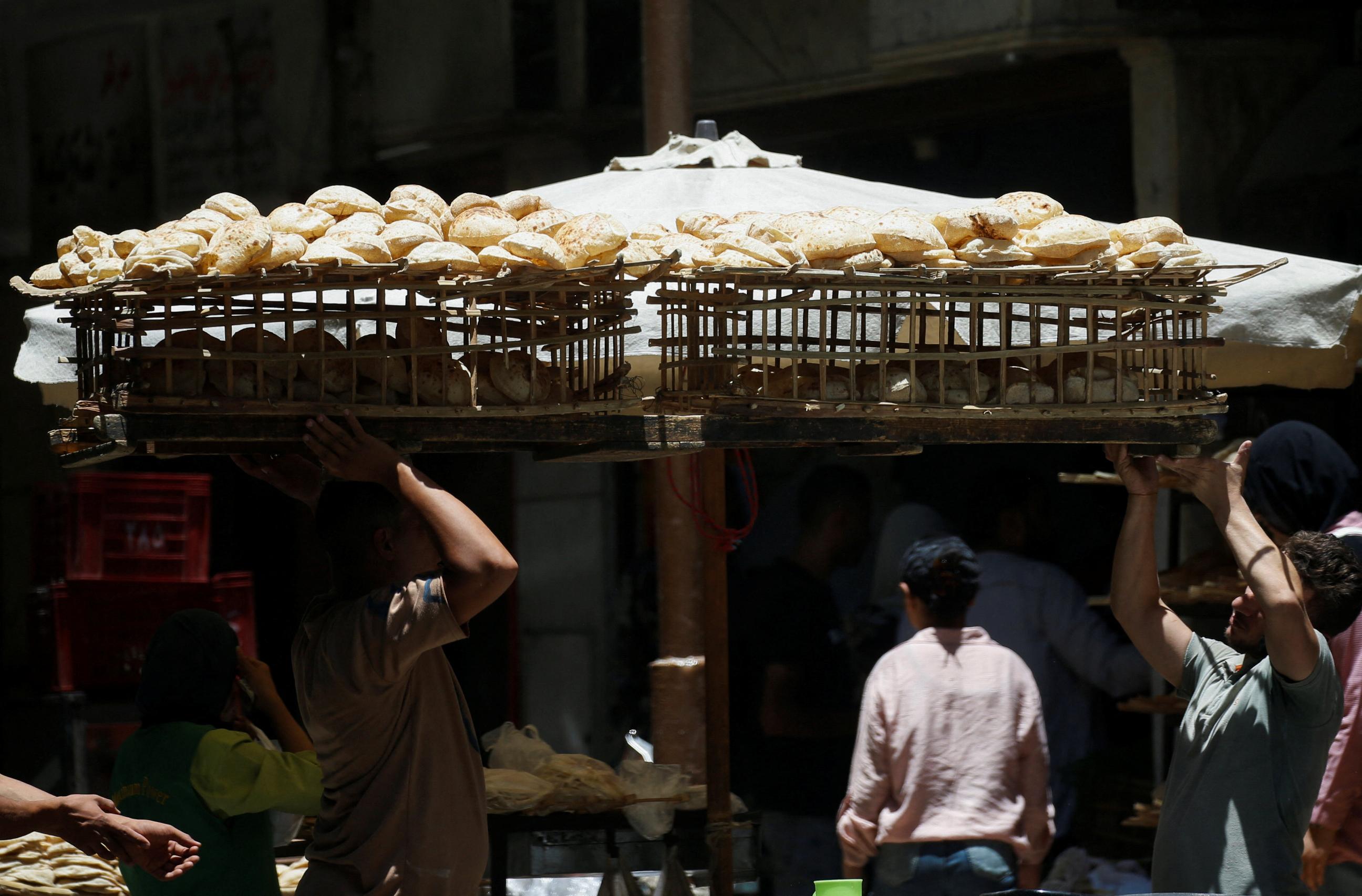
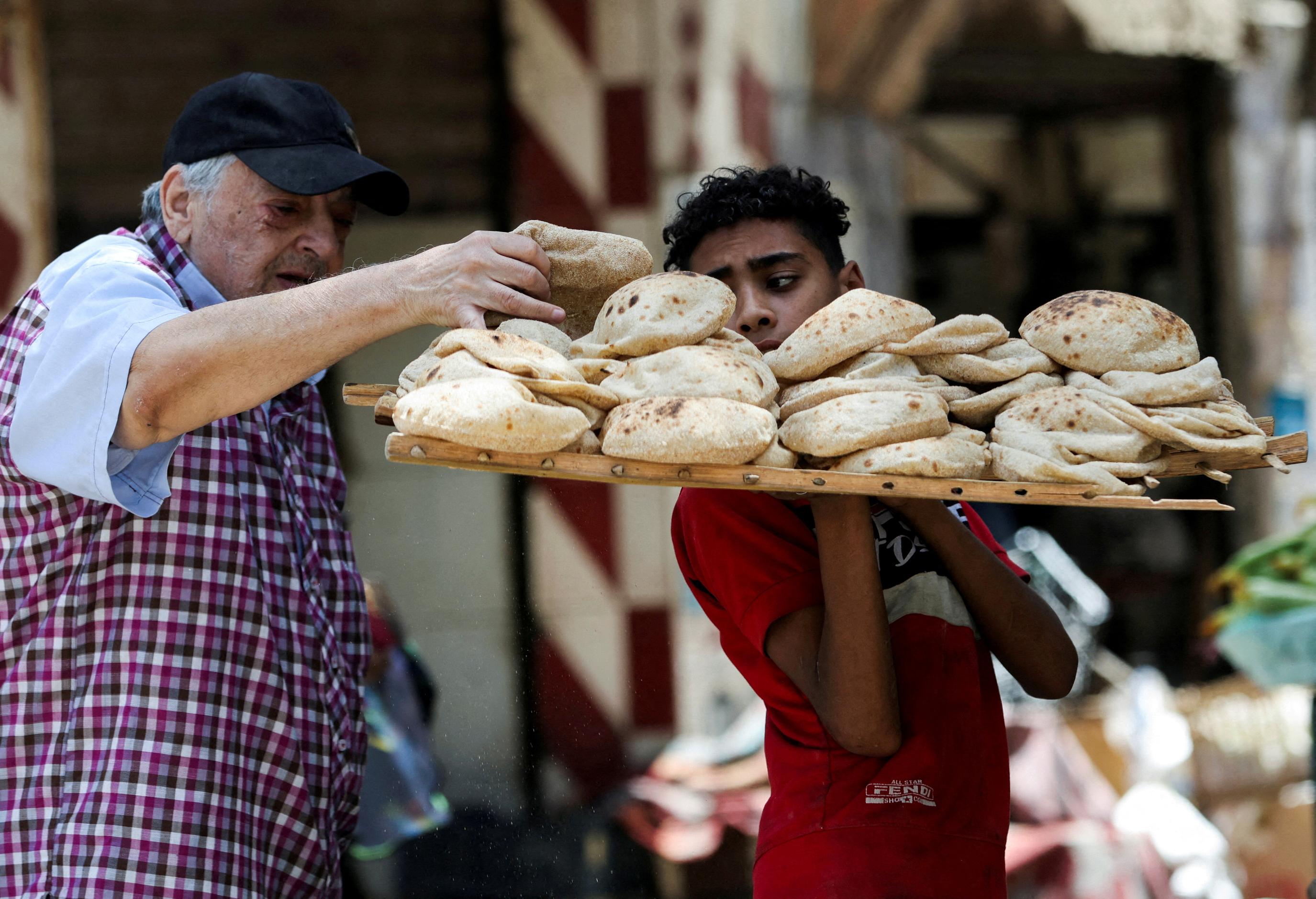
Price of subsidised loaves quadruples Government's subsidy bill on the rise Egyptians struggling with high inflation CAIRO, June 5 (Reuters) - A quadrupling of the price of subsidised bread has made it harder than ever for Gamal Ahmad and millions of other Egyptians to get by. The 64-year-old pensioner was struggling to make ends meet even before Eqypt's government, facing a rising wheat import bill, increased the price of subsidised small loaves of flatbread for the first time in decades on June 1. The loaves are available to more than 70 million people and are vital for the poorest. Even though they are still heavily discounted, the increase to 20 piasters ($0.0042) per loaf from five piasters is one that many households can ill afford. "We can't handle any more [price increases]," said Gamal, who is also worried about cuts to subsidised utilities that the government has announced. "There's still gas, electricity and water bills. All prices are rising," he said. The impact of the price increase will be felt by millions because the subsidised loaves are a staple for much of the population of about 106 million. "Of course, the price hike impacts me," pensioner Mohamed Abdelaziz said as he shopped for subsidised bread in central Cairo. "We are barely getting by." He said he had to keep on working to supplement his 2,000-pound ($42.46) monthly state pension and take care of three unmarried children. Increasing the price of the subsidised bread was a politically sensitive decision that had been put off for years in a country where cheap bread is important for many because poverty is widespread. The price had been kept steady since the 1980s despite repeated rounds of austerity reforms, with the government wary of facing a public backlash. An attempt to change the subsidy system sparked riots in 1977. Instead of increasing the price, the government had previously tried to restrict eligibility and reduced the weight of the loaves. About two-thirds of the population benefit from bread subsidies, which are based on income and include an allowance of five loaves per day. The monthly bill for a family of four could now rise to 120 pounds from 30 pounds in a country where the minimum monthly wage is 6,000 pounds following a 50% rise in March. HIGH INFLATION The government acted now with annual inflation running at 32.5% in April after hitting 38% last September. Egypt also faces a large debt servicing bill and allowed a sharp currency devaluation in March, when it shifted to a flexible exchange rate system. Egypt is often the world's largest importer of wheat, and traders say the price change is not expected to change the quantity of state purchases in the short term. The collapsing currency and rampant inflation have caused the cost to the government of procuring wheat from abroad to surge. Supply Minister Ali Moselhy says the new price represents just 16% of the cost of making the bread, which has been driven up by the weakening of Egypt's currency and rising global wheat prices. The government is allocating about 125 billion Egyptian pounds ($2.65 billion) for bread subsidies in its 2024/25 state budget, up from 91 billion last year, according to Moselhy. Moselhy said the ministry had not received any complaints from citizens following the price increase. The government says it is expanding the social safety net, but some of its critics question cuts to bread subsidies after the government has spent heavily on mega-projects, incurring more debt. The state should instead prioritise cutting exemptions for military-owned companies that have long enjoyed financial privileges, said Timothy Kaldas, deputy director of the Tahrir Institute for Middle East Policy. The subsidised bread price increase will be "a significant hit for poor households," he said. Even if the move does not spur people to stage demonstrations following a crackdown on dissent and a ban on most public protests, it could fuel popular frustration over the economy, he said. On Saturday, local TV host Lamis El Hadidy asked Moselhy why debt repayments took up 62% of budget spending while subsidies accounted for 11.5%. Egypt had to repay its debts and "we are talking about our current reality and what to do tomorrow," Moselhy replied. ($1 = 47.1000 Egyptian pounds) Sign up here. https://www.reuters.com/world/middle-east/egyptians-struggle-with-first-bread-subsidy-cut-decades-2024-06-05/
2024-06-05 06:21
CAIRO, June 5 (Reuters) - Egypt's government has raised the price of its most widely consumed subsidised bread for the first time in decades. Here are some facts about Egypt's bread consumption and wheat imports. BREAD SALES Bread is a staple of the national diet in Egypt, which has a population of 106 million, about 60% of whom are estimated to live under or close to the poverty line. Many rely on bread for nourishment. Subsidised bread is supplied under a decades-old programme that combines food subsidies and bread allowances. Subsidy card holders receive an allowance of five flat, round 'baladi' bread loaves per day per family member per loaf. The price was increased from 0.05 Egyptian pounds ($0.0011) to 0.20 pounds per loaf on June 1. Subsidy card holders also receive 50 pounds per family member per month to buy other food items at subsidised prices including vegetable oils, sugar and flour. Those who do not hold subsidy cards buy commercially sold, unsubsidised bread from private bakeries. The price has risen in the last two years. WHEAT IMPORTS Egypt's government produces about 100 billion loaves of bread annually under the subsidy programme -- around 250 million a day, the supply ministry says. This requires about 8.5 million metric tons of wheat a year. The government imports between 5 and 5.5 million metric tons a year via competitive tenders by the state buyer, the General Authority for Supply Commodities (GASC). The private sector imports 5 million tons annually. The government also procures about 3.5 million metric tons of wheat from local farmers during Egypt's harvest. Supply Minister Ali Moselhy said GASC would import the same quantities of wheat after the subsidised bread price increase. GASC traders said they did not expect wheat imports to be affected unless the government moves to conditional cash subsidies for bread. Used with other subsidised products, these are cash payments for spending on specific goods. If this happened, Egypt could still import the same quantities but shift more to reliance on the private sector instead of GASC. WHAT'S THE COST? Because of rising global wheat prices and successive currency devaluations, Egypt's food subsidy bill has increased with time. The finance ministry said in March it would allocate about 125 billion pounds for bread subsidies in its 2024/25 state budget, after 91 billion pounds last year, according to the supply minister. The new price of a subsidised loaf represents 16% of the cost of making the bread. SUBSIDY REFORM In 1977, President Anwar Al Sadat tried to raise the prices of bread and other subsidised goods. Riots began soon afterwards and he backtracked. Sadat's successor, Hosni Mubarak, increased the price of bread to 0.05 piasters in 1988. The price had not changed since although officials at times tinkered with the food subsidy scheme, trying to restrict eligibility as the population grew, increase prices of some subsidised goods, and reduce the weight of the subsidised loaf. ($1 = 47.1200 Egyptian pounds) Sign up here. https://www.reuters.com/world/africa/why-egypts-price-rise-subsidised-bread-matters-2024-06-05/
2024-06-05 06:10
LONDON/NEW YORK, June 5 (Reuters) - Indian voters' tepid endorsement of Prime Minister Narendra Modi leaves a weakened mandate for business-friendly reforms and has foreign money managers thinking twice about unleashing another wave of investment in the world's fastest-growing economy. Modi's Hindu nationalist Bharatiya Janata Party (BJP) secured a third term in government but without a majority of its own for the first time since sweeping to power a decade ago. India's stock market weathered its heaviest selling since the onset of the pandemic as the votes were tallied and net foreign selling was a record $1.5 billion on Tuesday. Stocks recovered some ground on Wednesday. With the party losing most ground in rural areas, investors say land and labour reforms, that had been expected to unlock value and growth, will probably fall by the wayside while leaders focus on shoring up rural support which had faltered. For global fund managers, who despite strong buying last year are generally underweight on India according to HSBC research, the uncertainty is reason enough for caution. "You have the feeling that while the government was really geared towards business, there are other parts of the country that felt left behind," said Alessia Berardi, head of emerging macro strategy at Amundi Investment Institute - the research arm of Europe's biggest asset manager. "So a more inclusive economy, a more efficient economy is important," she said. In the market, stocks trading richly in anticipation of growth driven by infrastructure and manufacturing spending fell heaviest and those exposed to rural demand, such as Nestle India (NEST.NS) New Tab, opens new tab and in motorcycle maker Hero MotoCorp (HROM.NS) New Tab, opens new tab, rose. Bonds weakened as traders priced risks that welfare spending goes up and budget consolidation is delayed. The tightly-managed rupee skidded to a seven-week low. "Over the past decade, India has been rewarded with a valuation premium for government stability...some of that valuation premium came out today," said Vikas Pershad, who manages India and Asia equities portfolios for M&G Investments. "I think priorities might shift a little in the short-term...so more benefits for the rural consumer, the rural working poor." DEFENSIVE Investors have prospered under Modi, 73, as India's equity benchmarks have more than tripled since he started as leader in May 2014. Earnings growth drove annualised total return for the MSCI India index (.dMIIN00000PUS) New Tab, opens new tab to 7.1% over the period, against 1.3% for MSCI's Asia ex-Japan index (.MIAPJ0000PUS) New Tab, opens new tab. To be sure, investors say the election outcome - with Modi's alliance winning 293 of 543 lower-house seats - is unlikely to derail this trajectory, nor is India's broadly stable currency and attractive debt market likely to be unduly ruffled. "We're still seeing strong growth coming from India...I think it's a buying opportunity," said Kristina Hooper, chief global market strategist at Invesco in New York. But few are talking about adding overall exposure and many are adjusting their portfolio following the result. M&G's Pershad, for instance, who is positive on the market, was on Tuesday a modest seller of defence stocks and a buyer in healthcare. Analysts at CLSA turned defensive, dumping infrastructure conglomerate Larsen & Toubro from their focus portfolio in favour of IT outsourcing firm HCL Tech (HCLT.NS) New Tab, opens new tab. Next year's budget due in July is shaping as the next test of policy commitments, with expectations that India will use a recent windfall surplus from the central bank to reduce the deficit quicker below the targeted 5.1% for the year. "Typically the budget is used to announce the five-year policies, so we should get a clearer idea of what the game plan is," said Sonal Varma, chief economist for India at Nomura in Singapore. Foreign money is also sensitive to relative market moves, and gushed into India last year as managers with mandates to invest in Asia took down positions in China's tumbling markets and bought up in India - something that is beginning to reverse. And uncertainty never helps. "I'm telling clients don't be in a hurry to invest in India," said Paul Christopher, head of global market strategy at Wells Fargo Investment Institute in St. Louis, Missouri. "It's still a pretty chaotic place." Sign up here. https://www.reuters.com/markets/asia/modi-premium-indias-financial-markets-set-erode-after-weak-victory-2024-06-05/

2024-06-05 06:10
NEW DELHI, June 5 (Reuters) - Indian airlines are expected to post a bigger industry-wide loss in fiscal 2025 as higher costs outweigh rising demand and costlier tickets, a top aviation consultancy said on Wednesday. CAPA India estimated losses for the year ending March 2025 at between $400 million to $600 million. The industry reported a loss of $300 million - $400 million the previous year, helped by market leader IndiGo's (INGL.NS) New Tab, opens new tab record profit. Overall airline costs are expected to rise 3.8% in the fiscal year 2025, the consultancy added. It did not say how much they rose last year. India is currently the world's fastest-growing aviation market with demand surpassing the supply of planes. That has helped the industry report record yields as carriers charge higher fares due to a capacity crunch, resulting in more packed planes, measured in passenger load factor (PLF). CAPA said it expects the trend of record yields – the average amount paid by a passenger to fly one kilometre – to continue in the short term and sees a roughly 1% rise for fiscal 2025. It pegged PLF at 85% for the same period. However, the crunch would be eased with an addition of 84 aircraft in the current year, taking airlines' overall fleet – including grounded jets – to 812 from 728 as of March, CAPA India CEO Kapil Kaul said at the consultancy's annual summit. Airlines' fleet size will more than double by 2030, he said. India's skies are dominated by low-cost carrier IndiGo (INGL.NS) New Tab, opens new tab, which holds a 60% market share. The Air India group, which houses two budget carriers and two full-service carriers in Air India and Vistara, have a roughly 30% share. Together, they have over a thousand aircraft on order from Airbus and Boeing. CAPA India estimated domestic passenger traffic to grow to 161 million to 164 million from about 154 million. The consultancy sees international traffic growing to 75 million to 78 million. Sign up here. https://www.reuters.com/business/aerospace-defense/india-airline-industry-report-wider-loss-fy25-consultancy-says-2024-06-05/

2024-06-05 05:52
World shares, dollar gain ECB policy meeting on Thursday Canada cuts rates by 25 bps for first time in 4 years India stocks bounce after vote selloff Muted US private payrolls data bolster rate cut bets NEW YORK/MILAN, June 5 (Reuters) - World shares rose and U.S. Treasury yields fell on Wednesday as investors focused on an upcoming European Central Bank policy meeting and soft U.S. labor market data firmed bets of a September Federal Reserve interest rate cut. Canada's central bank cut interest rates by 25 basis points for the first time in four years, bolstering investor hopes that stocks would soon get a boost from lower interest rates elsewhere. A U.S. labor report showed private payrolls increased by 152,000 jobs last month, less than forecast. "The labor market should not be seen as a risk for inflation any longer," analysts at TD Securities said. "It is also supportive of the Fed beginning to ease policy in September if inflation continues to gradually normalize as we expect by then." The MSCI world equity index (.MIWD00000PUS) New Tab, opens new tab, which tracks shares in 49 countries, jumped 0.9%, supported by gains in Asia, Europe and on Wall Street. The S&P 500 index (.SPX) New Tab, opens new tab climbed 1.2% to a record high, the Dow Jones Industrial Average (.DJI) New Tab, opens new tab rose 0.3% and the Nasdaq Composite Index leapt 2%, also to an all-time high. Boosting the Nasdaq, Nvidia (NVDA.O) New Tab, opens new tab hit a record high, lifting the AI chipmaker's stock market valuation to $3 trillion as it passed Apple (AAPL.O) New Tab, opens new tab to become the world's second-most valuable company. The ECB meets on Thursday, and markets price in an almost certain chance of a first rate cut. "I have a positive view on tomorrow's cut because it marks the end of an era of rate hikes that began two years ago," said Carlo Franchini, head of institutional clients at Banca Ifigest. "Now, we'll need to see the impact that rate cuts will have on domestic demand and the economic recovery". Data showed euro zone business activity expanded in May at its quickest rate in a year as growth in services outpaced a contraction in manufacturing. The pan-European STOXX 600 (.STOXX) New Tab, opens new tab index was up 0.8% and the MSCI's broadest index of Asia-Pacific shares outside Japan (.MIAPJ0000PUS) New Tab, opens new tab rose 1%. The Nikkei (.N225) New Tab, opens new tab in Tokyo fell 0.9% as renewed strength in the Japanese yen weighed. On Tuesday, data showed U.S. job openings fell more than expected in April to the lowest in more than three years. Markets now are pricing in 45 basis points of easing this year from the Fed. Traders are pricing in a 65% chance of a U.S. rate cut in September, up from 46% a week earlier, the CME FedWatch tool showed. "Economic data in America are frankly weakening. In the past, such data caused a robust repricing and then nice rallies in the stock market. Now, this is somewhat less so," said Giuseppe Sersale, portfolio manager at Anthilia. "The market seems to be shifting from a phase where it celebrated bad data to being a little afraid that the slowdown will be a little more pronounced. This explains why stocks have been moving sideways for several weeks now," he added. In keeping with expectations of lower U.S. rates, benchmark 10-year Treasury yields fell to 4.2832%, the lowest in more than two months. Germany's 10-year government bond yield , the benchmark for the euro zone, nudged lower to 2.527%, a day after its sharpest two-day drop since March. The dollar index , which measures the U.S. currency against six peers, was 0.14% higher at 104.3, just above the near two-month low of 103.99 it hit on Tuesday. The dollar's recent strength will ebb over the next 12 months, according to a Reuters poll of strategists. The yen weakened to 156.09 per dollar, a day after it had strengthened to a more than two-week high of 154.55. In Asia, Indian markets stayed in focus, with stocks jumping over 3% after key allies pledged their support to form a new government following a narrow win for PM Narendra Modi. India's Nifty 50 (.NSEI) New Tab, opens new tab rose 3.4% in volatile trading after sliding nearly 6% on Tuesday, a day in which foreign investors sold roughly $1.5 billion of shares. In commodities, oil prices were above four-month lows as traders weighed an OPEC+ decision to boost supply later this year and an increase in U.S. crude and fuel stockpiles. Brent crude futures were last at 78.46 per barrel, up 1.2%, while U.S. West Texas Intermediate crude futures traded at $74.1 a barrel, also up 1.2%. Sign up here. https://www.reuters.com/markets/global-markets-wrapup-1-2024-06-05/

2024-06-05 05:10
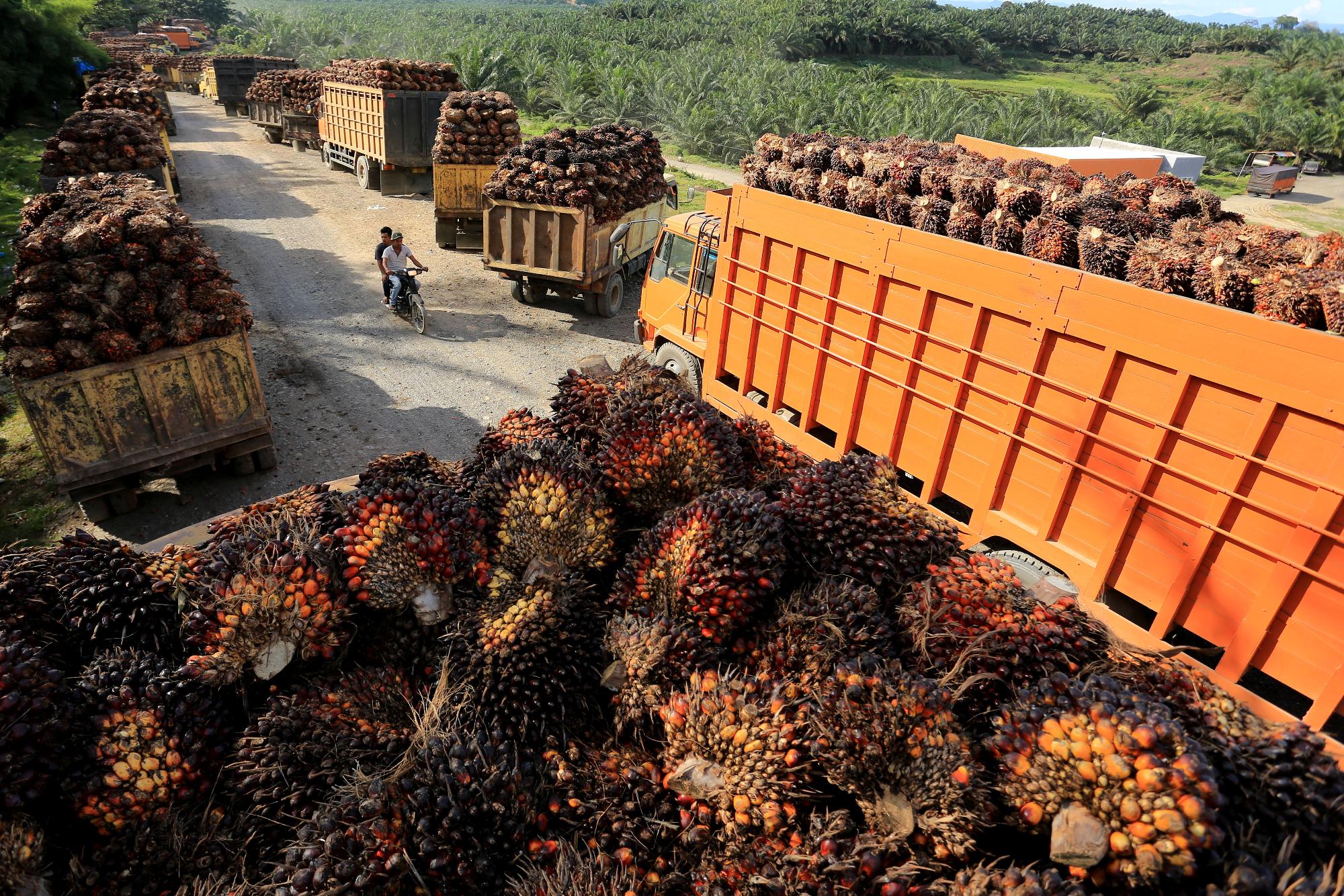
JAKARTA, June 5 (Reuters) - Indonesia plans to set up a digital dashboard by August to track its agricultural commodities, its economics ministry said, as the world's top palm oil exporter looks to monitor $6.5 billion worth of products that face a new EU anti-deforestation rule. The dashboard aims to increase the transparency of the supply chain of agriculture commodities such as palm oil, coffee and rubber, and better promote sustainability standards in the country, the ministry said in a statement on Wednesday. It said that would help Indonesian exports navigate the European Union Deforestation-free Regulation (EUDR), set to be implemented at the end of 2024, which will ban imports of commodities linked to deforestation. Indonesian exports of palm oil, cocoa, coffee, rubber and timber worth 6 billion euros ($6.5 billion) will be affected by the EUDR, Jakarta has previously estimated. "We must be able to track goods that we trade so that we can improve trading going forward," said Musdhalifah Machmud, deputy minister with the Coordinating Ministry of Economic Affairs. Indonesia plans to start running the dashboard ahead of a meeting of a joint task force with the EU and Malaysia in September, during which the three will discuss the implementation of the EUDR. Indonesia and Malaysia have said the EUDR is a discriminatory policy targeting their palm oil. The EU said the rules are to ensure the bloc does not contribute to forest degradation worldwide. ($1 = 0.9194 euros) Sign up here. https://www.reuters.com/markets/commodities/indonesia-designs-agricultural-commodities-digital-tracker-sustainability-push-2024-06-05/