2024-05-29 17:47
BUENOS AIRES, May 29 (Reuters) - Argentine analysts expect the country's central bank to again cut its benchmark interest rate following a bond tender set for Wednesday that is worth billions of dollars and signs that sky-high inflation could slow again this month. Analysts expect a 10-percentage-point cut that would bring the rate down to 30% from the current 40%. If realized, it would mark the seventh rate cut since libertarian President Javier Milei took office last December, when it stood at 133%. WHY IT IS IMPORTANT Argentina is battling its worst economic crisis in decades with annualized inflation hovering near 300% - the highest in the world - and over half its population in poverty, while the new government pushes a harsh austerity drive. As part of its bid to shore up liquidity, Argentina's treasury is expected later on Wednesday to tender three so-called "Lecaps" bonds for up to 3.5 trillion pesos ($3.92 billion). KEY QUOTES "I think a rate cut could happen after the accelerated transfer of liabilities to Lecaps," said Gustavo Ber, an independent economist. "It would be an additional incentive to ensure interest-bearing liabilities quickly disappear, as part of the central bank's strategy to clean up its balance sheet." Romano Group analyst Salvador Vitelli predicted the benchmark rate would stabilize around 30%, though Adcap's Sebastian Azumendi warned a cut would be "a bit risky." "It is good for lowering monetary liabilities, but at the same time they are left defenseless in the event of a run on the dollar," he said. Sign up here. https://www.reuters.com/markets/rates-bonds/argentina-market-analysts-see-chance-another-rate-cut-2024-05-29/

2024-05-29 17:40
Canadian dollar falls 0.5% against the greenback Trades in a range of 1.3642 to 1.3717 Price of U.S. oil decreases 0.7% 10-year yield rises to near 4-week high TORONTO, May 29 (Reuters) - The Canadian dollar weakened against its U.S. counterpart on Wednesday as concern that central banks could leave interest rates at elevated levels longer than previously thought raised demand for the safe-haven greenback. The loonie was trading 0.5% lower at 1.3710 to the U.S. dollar, or 72.94 U.S. cents, after moving in a range of 1.3642 to 1.3717. "Really, it's a (U.S.) dollar move. The Canadian dollar has fallen today in line with the rest of the G10 complex," said Erik Nelson, a currency strategist at Wells Fargo in London. "Equities are off their (recent) highs, and rates in general are creeping up again, so concerns are resurfacing over the higher for longer theme and central banks not cutting as much as thought." U.S. government bond yields pushed to a near four-week peak, lifting their global counterparts and pressuring stocks, as data sowed new doubts about the timing and extent of Federal Reserve rate cuts. The U.S. dollar (.DXY) New Tab, opens new tab rose against a basket of major currencies and the price of oil, one of Canada's major exports, gave back some recent gains. U.S. crude oil futures were down 0.7% at $79.26 a barrel. Investors were awaiting Canadian gross domestic product data on Friday, expected to show the economy expanding at an annualized rate of 2.2% in the first quarter. The data could provide clues on the timing of expected Bank of Canada interest rate cuts. The swaps market sees a 60% chance the BoC begins an easing campaign at a policy decision next Wednesday. Canadian government bond yields moved higher across the curve, tracking moves in U.S. Treasuries. The 10-year was up 5.9 basis points at 3.761%, after earlier touching its highest level since May 2 at 3.782%. Sign up here. https://www.reuters.com/markets/currencies/c-weakens-rise-global-bond-yields-spooks-investors-2024-05-29/

2024-05-29 12:59
COPENHAGEN, May 29 (Reuters) - A volcano in southwestern Iceland erupted on Wednesday, live video from the area showed, making it the fifth outbreak since December. The new outburst happened as another eruption on the Reykjanes peninsula recently ended after spewing fountains of molten rock for almost eight weeks. Authorities had warned of the risk of renewed volcanic activity in the area just south of the capital Reykjavik as studies showed magma accumulated underground. The fiery spectacle underlines the challenges the island nation of almost 400,000 people face as scientists have warned eruptions could happen over and over in Reykjanes for decades or even centuries. The eruption was the eighth on the peninsula, home to some 30,000 people, since 2021 when geological systems that were dormant for some 800 years again became active. Previous incidents had disrupted district heating, closed key roads and even razed several houses in the Grindavik fishing town, where only a few residents have since returned. In an attempt to prevent further damage man-made barriers have been built to steer lava away from infrastructure including the Svartsengi geothermal power plant, the Blue Lagoon outdoor spa and Grindavik. Icelanders often refer to their country as the "Land of Fire and Ice" as a tribute to its otherworldly landscape forged by glaciers and volcanoes which is positioned between the Eurasian and North American tectonic plates, making it a seismic hotbed. While a 2010 eruption in a different part of Iceland grounded some 100,000 flights internationally due to huge ash clouds, Reykjanes is typically home to fissure outbreaks which do not reach into the stratosphere. Sign up here. https://www.reuters.com/business/environment/volcano-iceland-erupts-again-2024-05-29/
2024-05-29 12:54
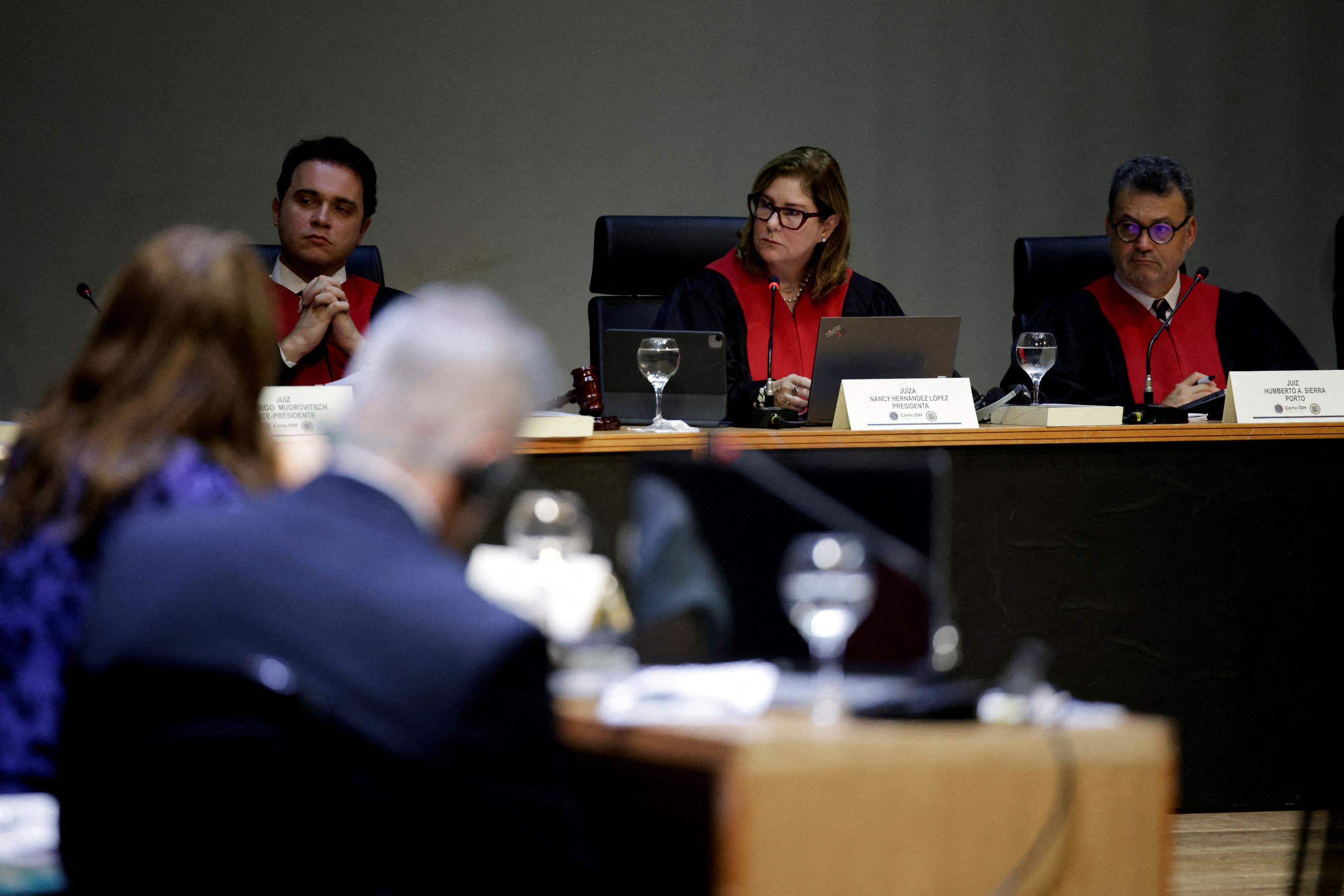
SAO PAULO, May 29 (Reuters) - Latin America's human rights court holds a final hearing in Brazil on Wednesday in a case that's part of a global wave of climate litigation, as several international courts prepare first-time opinions on what countries must do to combat climate change. The rulings could also set off a wave of new litigation brought by citizens, businesses and governments. Enforcement of such decisions is largely untested, however. A Swiss parliamentary committee last week rejected a ruling for example by a top European court that said Switzerland had violated the human rights of its citizens by not doing enough to prevent climate change. The Inter-American Court of Human Rights (IACHR), which holds jurisdiction over 20 Latin American and Caribbean countries, hopes to issue its advisory opinion by year's end, top justice Nancy Hernandez Lopez told Reuters. The final hearing on Wednesday is being held in the Amazon rainforest city of Manaus. Already last week, the international tribunal set up under the U.N. Law of the Seas decided that carbon emissions amount to marine pollution and that countries must go beyond the Paris Agreement New Tab, opens new tab to protect oceans. Next year, the International Court of Justice (ICJ) is expected to have its say and could attempt to draw the earlier court decisions into one global ruling applicable to all U.N. members. "The reason for (the wave of litigation) is people's deep frustration that their elected representatives are not taking rapid and fair climate action," said Lucy Maxwell, co-director of the nonprofit Climate Litigation Network. "The climate litigation landscape is really broad and diverse and massively growing." SETTING PRECEDENTS While multilateral court opinions apply only to the states under their jurisdiction, they are all grappling with the same central question: Are governments obligated to protect people from climate change? And if so – to what degree? That question is taking courts into uncharted territory, as there is little legal precedent on climate change. In deliberating, court judges have been reviewing climate science, holding hearings and digging through a tangle of laws, treaties and U.N. proceedings. That process has made the case before the Inter-American Court the largest to date – with more than 600 participants at hearings held in Brazil and Barbados, as well as 262 written submissions to the court from Indigenous groups, civil society, scientists and one company. Such inclusivity helps give the court its reputation among the world's most progressive, lawyers said. By comparison, the International Court of Justice has restricted submissions in its case mostly to countries and authorities like the World Health Organization. The Latin American court might also borrow arguments from earlier national climate cases, even if they are outside its jurisdiction, said senior lawyer Sophie Marjanac at the legal charity ClientEarth. "The judges do read each other's opinions," Marjanac said, though whatever influence one ruling has on another might be "more psychological and social than legal." As such, the Latin American court could influence the ICJ ruling, expected next year. LEGAL SCOPE Globally, most past court decisions on climate have focused on countries causing harm by failing to sufficiently cut greenhouse gas emissions, including last month's ruling against Switzerland. But the opinion from the Inter-American Court could go further by ruling on whether states also must adapt to climate change or pay for damages already caused by climate extremes, Maxwell said. The court could address protections for environmental defenders, given Latin America accounts for the vast majority New Tab, opens new tab of such activists who are murdered, said climate litigation expert Joana Setzer at the London School of Economics. It could also address fossil fuels, the main cause of climate change, or spell out the extent to which countries must regulate polluting companies, said climate justice attorney Nikki Reisch at the Center for International Environmental Law. WHAT COMES NEXT? The multinational court decisions, once released, should provide clarity and guidance for national judges hearing climate cases. But they could also touch off a new wave in climate litigation, lawyers and judges told Reuters. Major differences between international court decisions could trigger fragmentation where climate change rules differ between regions. For the ICJ to declare that greenhouse gas emissions contribute to harming other countries "would be already a huge victory," given the court's wide jurisdiction, Setzer said. Following the Inter-American court's decision, the governments under its jurisdiction will need to align their laws with the ruling or risk being sued, said Ciro Brito, a lawyer at Brazil's Instituto Socioambiental, an environmental and Indigenous rights nonprofit in Brazil. It could give an immediate boost to a handful of legal cases already filed against governments in the region, including one filed by Mexican youths and another demanding more action from Brazil to fight Amazon deforestation. Globally, Maxwell counted at least 100 cases pending in national courts accusing governments of failing to meet climate obligations, among many more filed against companies and other defendants. Other lawyers said they were poised to take action once the Inter-American Court issues its opinion. "We will use this opinion not only to knock on the government's door and say, 'You have to do this,'" said Guilherme Lobo Pecoral, a lawyer for children's rights nonprofit Alana Institute in Brazil. "We will also knock on judges' doors and say, 'We have this internationally defined obligation and the state isn't following it.'" Sign up here. https://www.reuters.com/business/environment/wave-climate-lawsuits-builds-court-hears-largest-case-ever-2024-05-29/
2024-05-29 12:49
WASHINGTON, May 29 (Reuters) - The Biden administration on Wednesday proposed expanding tax credits that have for years boosted U.S. solar and wind energy projects to cover a wider range of clean energy technologies including nuclear fission and fusion. The Treasury Department announced its guidance for Clean Electricity Production Credits and Clean Electricity Investment Credits, created under the 2022 Inflation Reduction Act, that will be available in 2025 as the previously available wind and solar production and investment tax credits sunset. "The Inflation Reduction Act’s new technology-neutral Clean Electricity credits, which will come into effect in 2025, are one of the law’s most significant contributions to tackling the climate crisis,” John Podesta, Senior Advisor to the President for International Climate Policy, said in a statement. He said they will help the U.S. meet its goal to achieve a net-zero emission power sector by 2035. The proposal identifies a half-dozen technologies that may be eligible to qualify for the lucrative tax credits, including marine and hydrokinetic energy, nuclear fission and fusion, hydropower, geothermal and some forms of waste energy recovery. The credits were as high as 30% for wind and solar projects if all conditions were met. Treasury Secretary Janet Yellen told reporters that the IRA has already driven over $850 billion in clean energy and manufacturing investment from the private sector and led to record additions of renewable energy capacity. The new program is "the next key step," she said. "These credits ... make an unprecedented long-term commitment to the clean energy sector to ensure the U.S. is a major market for new clean power generation over the next decade and beyond," she said. Research firm the Rhodium Group estimated that credits could result in a reduction of 300-400 million tonnes of GHG emissions compared to no tax credits in 2035, a cut of 29%-46%. Some environmental groups flagged concerns that the tax credits for zero greenhouse gas emissions technology could end up supporting controversial energy sources, such as burning waste or methane biogas captured from landfills. "The Biden Administration must prevent dirty energy from co-opting billions in taxpayer dollars," said Sarah Lutz, a campaigner for Friends of the Earth. Sign up here. https://www.reuters.com/business/energy/biden-administration-expands-tax-credits-beyond-wind-solar-2024-05-29/

2024-05-29 12:40
LONDON, May 29 (Reuters) - Shell (SHEL.L) New Tab, opens new tab and Exxon Mobil (XOM.N) New Tab, opens new tab are nearing an agreement to sell their jointly-owned gas fields in the southern North Sea to independent British producer Viaro Energy, three industry and banking sources said. The potential deal is valued around $500 million, one of the sources said. The sale of the Clipper and Leman Alpha field clusters would mark the latest step in a steady retreat of major oil and gas companies from the ageing basin in recent decades as they focus on newer and more profitable prospects. For Texas-based Exxon, it would complete the exit from the North Sea, where it has been present since 1964. It sold most of its assets in the central and northern North Sea to Neo Energy in 2021. U.S. rival Chevron is also selling its last remaining assets in the British North Sea. The deal is close to being agreed but there are no guarantees that it will be signed, one of the sources said. Shell, Exxon and Viaro Energy declined to comment. Viaro Energy acquired RockRose Energy in 2020 and has since then made several other deals in the British and Dutch North Sea. The company produces around 30,000 barrels of oil equivalent per day and has interests in over 30 fields, according to its website. The sale of the Clipper and Leman Alpha fields would also mark the dissolution of the Esso joint venture between Shell and Exxon, which joined forces in the North Sea in 1965. Shell remains one of the main producers in the North Sea, operating several fields including the Penguins redevelopment and holding a stake in the BP-operated Clair field. Sign up here. https://www.reuters.com/markets/deals/shell-exxon-near-deal-sell-north-sea-assets-viaro-sources-say-2024-05-29/