2024-05-29 05:06
May 29 (Reuters) - A European private wealth manager in Hong Kong told me last week he recently got the catalyst he needed to land a Taiwanese billionaire's account: geopolitics. The billionaire was down to two major wealth managers -- UBS and JPMorgan Chase -- after Credit Suisse’s demise last year. He wanted a third bank but did not want to increase exposure to the Americans. The Taiwanese tycoon's worry, the banker said, stemmed from the uncertainty caused by China-U.S. tensions: What if the Americans turned against people like him, or U.S. banks came under pressure to pull back from business there? In recent years, as the Sino-U.S. saber rattling has increased, I have repeatedly heard from sources in the United States about how companies and investors are de-risking from China, building resiliency in their supply chains, reducing their exposure and putting a higher risk premium to business there. China is still too big a market to ignore or abandon, they say, but they need a backup, a ‘China plus 1’. Over the past few days in Hong Kong and Singapore, conversations with more than a dozen senior bankers, officials and investors show the same de-risking is happening on the other end of the world with equal urgency. People are asking what’s their 'America plus 1.' Wealthy people like the Taiwanese billionaire are diversifying their assets and exposure away from the United States. Companies are looking for additional funding sources from other parts of the world, such as the Middle East, and building factories in places like Southeast Asia. And they are thinking about how to reduce their dependence on the dollar, these sources said. The sources requested anonymity to speak freely because of the sensitivity of the subject. These conversations provide a window into how geopolitics is impacting investment decisions in the East. And as these worries lead to actions, they highlight the risks of further fragmentation of the global economy, with attendant consequences, such as inflationary pressures. It is also clear from these conversations, however, that any such decoupling is unlikely to be complete and will take years, if not decades, given the dollar’s dominant position. One top banker in the region said companies and investors in Asia still want access to the United States as the deepest, most liquid market in the world. But there appears to be new urgency around these conversations as people see tensions escalate with measures such as tariffs and sanctions. One Singapore-based banker said in the past when people talked about replacing the U.S. dollar, they would talk in terms of 20-30 years; now, they talk about 10-15 years. U.S. sanctions following Russia’s invasion of Ukraine have brought home the realization that Western authorities can seize assets in a conflict. That has been compounded by worries about sustainability of U.S. debt levels and the impact on the dollar, the banker said, leading people to ask “why do I have to hold U.S. dollar assets?” The conundrum can be seen in data. The U.S. dollar still accounts for nearly 60% of forex reserves, but there has been a gradual diversification of away from it, according to the International Monetary Fund. And while SWIFT data shows the dollar dominating trade finance with an 84% share, the yuan last year became the most widely used currency for cross-border transactions in China for the first time. In Asia, discussions with sources show more efforts afoot to chip away at that reliance on the U.S. dollar. The central banks of China, Hong Kong, Thailand and the United Arab Emirates, for example, are developing a cross-border settlement system that would allow participating banks to settle transactions in local currency. More central banks are expected to be invited to join as it is further developed. A search for alternatives to the United States is also happening among some companies. Chinese companies, for example, were looking to places like the Mideast for funding, one China-focused investment banker at a global lender said. He pointed to electric vehicle maker Nio's $2.2 billion deal with an Abu Dhabi investor. “This would have gone to the U.S. in the past,” the banker said. A top banking executive said companies still wanted to go to the United States, but those such as fast fashion retailer Shein -- forced to look for an initial public offering in London after running into hurdles in New York -- were being pushed away. The geopolitics is making everyone think "do I have to have" an alternative, the banker said, adding it had "propelled people to make conscious choices." While there is little one can do about it in the near term, the banker said thinking a decade out, people are beginning to ask, "How much do I lean on the dollar?" Sign up here. https://www.reuters.com/business/finance/market-asia-people-ask-how-do-i-derisk-america-2024-05-29/
2024-05-29 04:33
A look at the day ahead in European and global markets from Kevin Buckland Soaring bond yields continued to unnerve equity investors on Wednesday, with benchmark U.S. Treasuries pushing further above 4.5% in Tokyo hours and their Japanese counterparts hitting levels not seen since 2011. Concerns that stubborn inflation will keep interest rates high for longer or even spur additional near-term hikes is at the heart of that movement, with a particular focus on the U.S. Federal Reserve. Unexpected improvement in U.S. consumer confidence has seen bets pared back for a Fed cut come September, helping lift Treasury yields, which in turn lifted the dollar, especially against the rate-sensitive yen. That is feeding inflationary worries at the Bank of Japan, as the yen, at its weakest for 34 years, forces policymakers into a more hawkish posture. Market participants have reacted by bringing forward bets for additional Japanese rate hikes and a start to quantitative tightening. The benchmark yield in Australia surged some 15 basis points after a hotter-than-expected consumer price index (CPI) added to the risk, albeit small, that the country's next rate move is a hike instead of a cut. The string of upward data surprises ups the ante ahead of today's release of preliminary German CPI figures for May and consumer confidence surveys for Germany, France and Italy. The upshot in Asia was stock markets under water pretty much everywhere except mainland China. And while high-flying Nvidia (NVDA.O) New Tab, opens new tab may have pulled the Nasdaq out of bonds' gravitational pull to reach record heights on Tuesday, futures point to a weaker restart. With equity indexes in many places sitting at or close to all-time peaks, there's plenty of room to fall. That makes the stakes particularly high for the week's main macro event on Friday: the PCE deflator, the Fed's preferred inflation measure. Key developments that could influence markets on Wednesday: -Germany preliminary CPI (May) -Germany, France, Italy consumer confidence (May) -Fed's Beige Book Sign up here. https://www.reuters.com/markets/europe/global-markets-view-europe-2024-05-29/
2024-05-29 00:49
NEW YORK, May 29 (Reuters) - Oil prices eased about 1% on Wednesday on worries over weak U.S. gasoline demand and economic data that could cause the U.S. Federal Reserve to keep interest rates higher for longer. High interest rates used to tackle lingering inflation can weigh on economic growth and reduce demand for oil. Brent futures fell 62 cents, or 0.7, to settle at $83.60 a barrel, while U.S. West Texas Intermediate (WIT) crude fell 60 cents, or 0.8%, to settle at $79.23. The premium of the Brent front-month over the second month , known in the industry as backwardation, fell to its lowest since January. When a market is in backwardation, energy firms are more likely to pull oil out of storage and use it now rather than wait for prices to decline in the future. If the market switches to contango, with future contracts worth more than the front-month, energy firms could start storing oil for the future, which could depress prices. U.S. consumer confidence unexpectedly improved in May after deteriorating for three straight months amid optimism about the labor market, but worries about inflation persisted and many households expected higher interest rates over the next year. "Hopes of (Fed) rate cuts ... continue to be pushed back further out into the year," analysts at energy consulting firm Gelber and Associates said in a note. Worries about U.S. gasoline demand, meanwhile, have kept gasoline futures prices near a recent two-month low, cutting gasoline and 321- crack spreads, which measure refining profit margins, to their lowest levels since February. "Gasoline demand (is) still surprisingly weak in keeping supplies near normal levels as bullish seasonals diminish," analysts at energy advisory firm Ritterbusch and Associates said. Looking ahead, investors are waiting for the release on Friday of the U.S. personal consumption expenditures (PCE) price index report for April. The PCE, which is the Fed's preferred inflation barometer, is expected to hold steady on a monthly basis. Expectations for the timing of rate cuts have see-sawed, with policymakers wary of sticky inflation. BULLISH FACTORS The market is also looking for U.S. oil storage data from the American Petroleum Institute (API) trade group later on Wednesday and the U.S. Energy Information Administration (EIA) on Thursday. That data will be released a day later than usual due to the U.S. Memorial Day holiday on Monday. In a forecast that should support crude prices, analysts projected U.S. energy firms pulled 2.0 million barrels of crude out of storage during the week ended May 24. That compares with a build of 4.5 million barrels in the same week last year and an average increase of 1.1 million barrels over the past five years (2019-2023). Traders and analysts also said they expect OPEC+, which includes the Organization of the Petroleum Exporting Countries (OPEC) and allies including Russia, to keep voluntary production cuts of about 2.2 million barrels per day (bpd) in place at its meeting on Sunday. In China, the world's second biggest economy after the U.S., the economy is set to grow 5% this year after a "strong" first quarter, the International Monetary Fund said, upgrading its earlier forecast of a 4.6% expansion. The IMF, however, said it expects slower growth in China in the years ahead. Heightened tensions in the Middle East also held back the crude price decline. Israel sent tanks on raids into Rafah and predicted its war on Iran-backed Hamas militants in Gaza would continue all year. The Iran-aligned Houthis in Yemen, meanwhile, launched attacks on six ships in three different seas and Iran's semi-official Tasnim news agency said Tehran's sea-launched ballistic missile Ghadr was made available to the Houthis. Sign up here. https://www.reuters.com/business/energy/oil-rises-major-producers-expected-keep-output-cuts-place-2024-05-29/
2024-05-29 00:48
SEOUL, May 28 (Reuters) - United Arab Emirates President Sheikh Mohammed bin Zayed Al Nahyan arrived in South Korea on Tuesday, where his plane was met by an honorary escort of four fighter jets before he landed for his first state visit to Asia's fourth-biggest economy. Defence industry cooperation, business and investment, and energy initiatives are on the agenda for a summit scheduled for Wednesday with President Yoon Suk Yeol of South Korea, which has become one of the world's biggest arms exporters. The two will discuss deepening their "special strategic partnership," Yoon's office said in a statement. Four F-15K Air Force fighter jets escorted Sheikh Mohamed's plane as it entered the South Korean defence identification zone and landed at a military airfield just south of the capital, Seoul, Yoon's office said. Sheikh Mohammed is reciprocating after Yoon's state visit to Abu Dhabi early last year, when the UAE pledged $30 billion in investment in South Korean businesses in areas spanning nuclear power, defence, hydrogen and solar energy. He met on Tuesday the leaders of some of South Korea's top business conglomerates including Jay Y. Lee of Samsung Electronics, SK Group's Chey Tae-won and Euisun Chung of Hyundai Motor Group. South Korea already has deep business ties with the UAE going back more than a decade, having previously won contracts to build nuclear reactors in the Gulf state. The country has also signed massive defence contracts as part of plans to become the world's fourth-largest defence exporter by 2027. Recent deals include one with Poland, which is seeking to bolster its defences as a close neighbour of Ukraine, which is at war with Russia. Earlier this year, South Korea also reached an agreement with Saudi Arabia to expand defence cooperation with a view to increase arms sales in the region. South Korea's weapons exports to the Middle East grew nearly tenfold between 2013 and 2022, according to the Korea Chamber of Commerce and Industry. Market analysts cited the UAE state visit for driving up South Korean defence stocks on Tuesday, with Hanwha Aerospace (012450.KS) New Tab, opens new tab and LIG Nex1 (079550.KS) New Tab, opens new tab rising more than 5% and Korea Aerospace Industries (047810.KS) New Tab, opens new tab climbing 7.1%. (This story has been refiled to correct the name to say Euisun Chung, not E.S. Chung, in paragraph 6) Sign up here. https://www.reuters.com/world/uae-president-visits-south-korea-with-defence-energy-agenda-2024-05-28/
2024-05-29 00:34
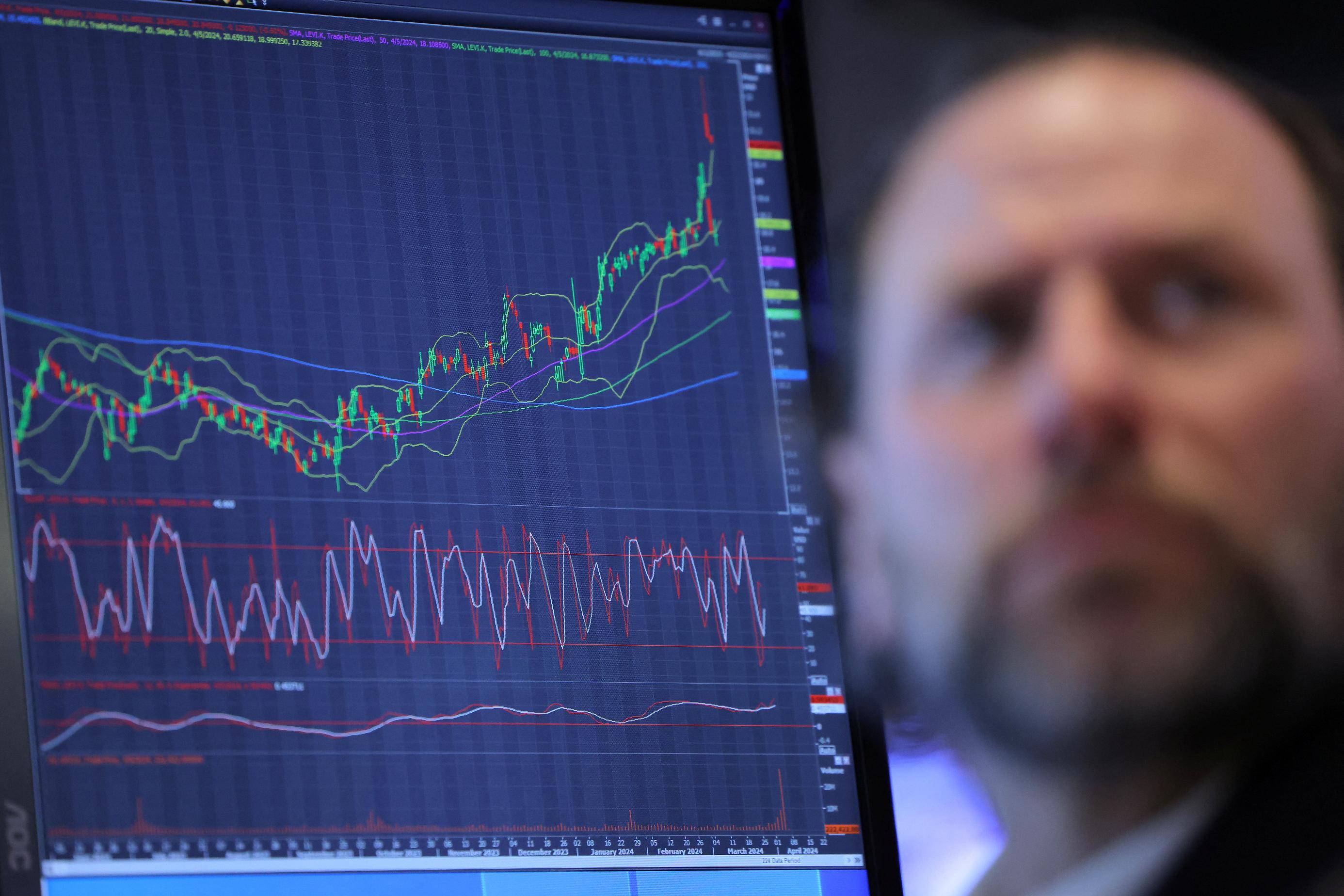
US moves towards faster stock settlement Apple near flat despite strong iPhone sales in China Dow fell 0.55%, S&P 500 gained 0.02%, Nasdaq gained 0.59% NEW YORK, May 28 (Reuters) - The Nasdaq crossed 17,000 for the first time ever on Tuesday, boosted by gains in Nvidia, while the S&P 500 closed barely higher and the Dow ended lower as Treasury yields rose. Nvidia (NVDA.O) New Tab, opens new tab jumped 7% and boosted shares of other chip stocks as traders returned from a holiday-extended weekend. An index of semiconductors (.SOX) New Tab, opens new tab rose 1.9%. S&P 500 technology (.SPLRCT) New Tab, opens new tab led gains among sectors, while healthcare (.SPXHC) New Tab, opens new tab was the biggest decliner along with industrials (.SPLRCI) New Tab, opens new tab. Stocks lost ground in afternoon trading as U.S. Treasury yields climbed to multi-week highs after weak debt auctions. "We had two disappointing results and we saw yields climb and the (stock) market respond negatively," said Quincy Krosby, chief global strategist, LPL Financial in Charlotte, North Carolina. "The market doesn't want to see yields edging up... to a level that perhaps threatens the economy and the consumer and thwarts the (Federal Reserve)'s time table for easing." Investors awaited U.S. inflation data this week that could sway expectations for Fed rate cuts. The U.S. core Personal Consumption Expenditures Price Index report for April is due later this week. The Fed's preferred inflation barometer is expected to hold steady on a monthly basis. The Dow Jones Industrial Average (.DJI) New Tab, opens new tab fell 216.73 points, or 0.55%, to 38,852.86, the S&P 500 (.SPX) New Tab, opens new tab gained 1.32 points, or 0.02%, to 5,306.04 and the Nasdaq Composite (.IXIC) New Tab, opens new tab gained 99.09 points, or 0.59%, to 17,019.88. Wall Street has been hitting records recently as investors bet the U.S. central bank could kick off interest-rate cuts this year. Expectations for the timing of rate cuts have see-sawed, with policymakers wary as data still reflects sticky inflation. Odds of a rate reduction of at least 25 basis points stand above the 50% mark only for the months of November and December this year, according to the CME FedWatch Tool. The odds of a September rate cut fell to around 46% from over 50% a week ago. The retail sector will also be in focus this week, with several retailers like Dollar General (DG.N) New Tab, opens new tab, Advance Auto Parts (AAP.N) New Tab, opens new tab and Best Buy (BBY.N) New Tab, opens new tab due to report results. U.S. trading moves to a shorter settlement on Tuesday, which regulators hope will reduce risk and improve efficiency, but is expected to temporarily increase transaction failures for investors. Apple (AAPL.O) New Tab, opens new tab shares rose after iPhone sales in China surged 52% in April from a year earlier, Reuters calculations based on industry data showed. But the stock pared gains late and closed only slightly higher at $189.99. GameStop (GME.N) New Tab, opens new tab shares shot up about 25.2% and closed at $23.78. Late on Friday, the videogame retailer said it had raised $933 million by selling 45 million shares as part of an "at-the-market" offering. Hess (HES.N) New Tab, opens new tab shareholders approved the $53 billion merger with Chevron (CVX.N) New Tab, opens new tab. Hess shares closed up 0.4%, while Chevron shares closed up 0.8% and Exxon Mobil (XOM.N) New Tab, opens new tab shares closed up 1.3%. On the Nasdaq, declining issues outnumbered advancers by a 1.34-to-1 ratio and by a 1.75-to-1 ratio on the NYSE. The S&P 500 posted 24 new 52-week highs and 11 new lows while the Nasdaq Composite recorded 93 new highs and 107 new lows. Volume on U.S. exchanges was 11.91 billion shares, compared with the 12.32 billion average for the full session over the last 20 trading days. Sign up here. https://www.reuters.com/markets/us/futures-inch-up-markets-await-inflation-data-2024-05-28/
2024-05-28 23:39
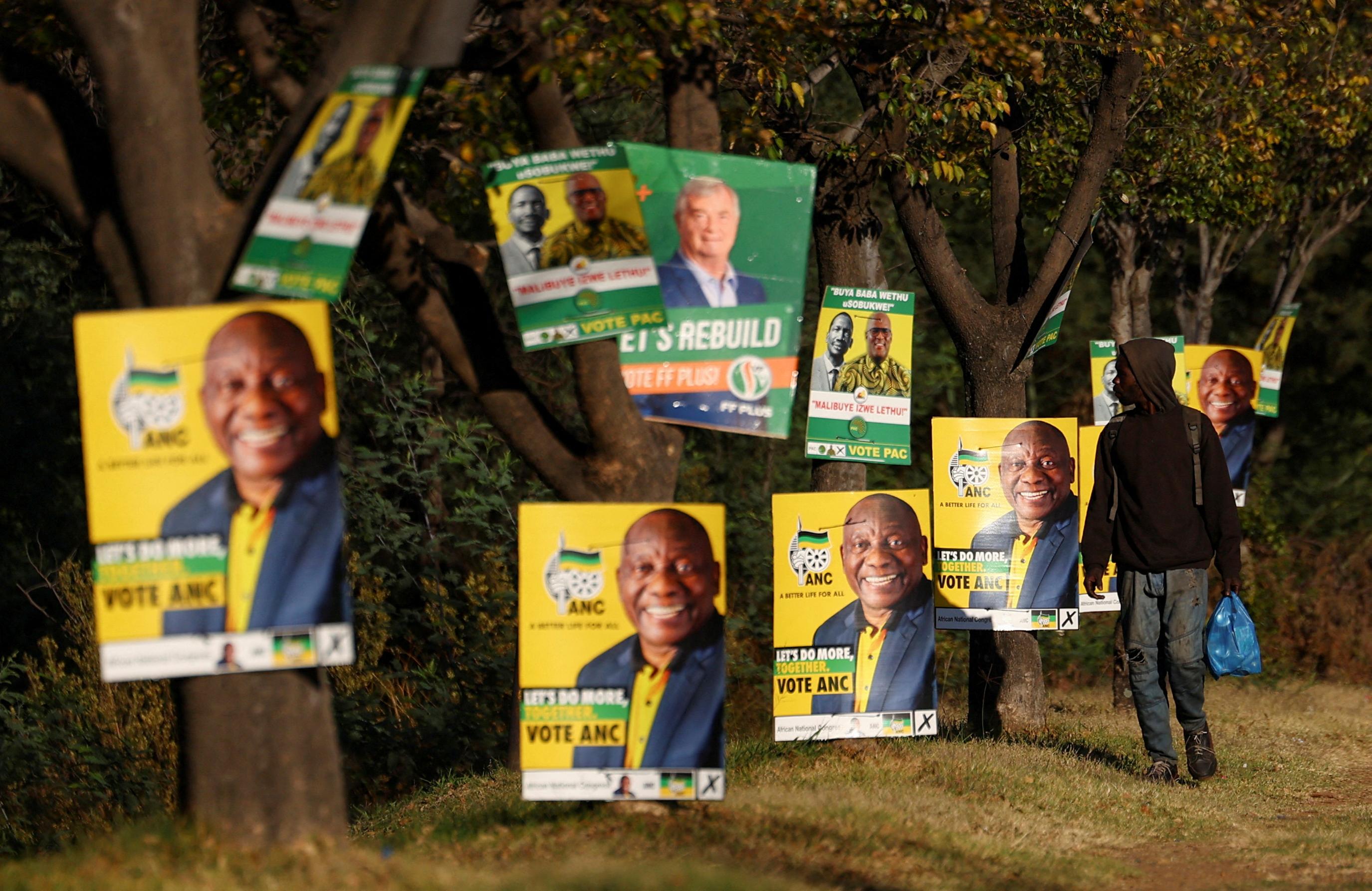
ANC could lose its majority, opinion polls show Voters angry about high unemployment and crime, power cuts Early indications point to higher turnout than in 2019 KWAMASHU, South Africa, May 29 (Reuters) - South Africans voted on Wednesday in the most competitive election since the end of apartheid, amid high turnout and with opinion polls suggesting the African National Congress may lose its parliamentary majority after 30 years in government. Well after dark, voters were still forming miles-long queues to cast their ballots. Chief Electoral Officer Sy Mamabolo told a news conference that turnout "will be well beyond the 66% we had in 2019". The Electoral Commission said polling stations would stay open for anyone who was in line at the closing time at 9 p.m. (1900 GMT). Two hours later, only 55% of polling stations nationwide had closed. "We are experiencing a late surge and are processing a large number of votes in certain areas, particularly the metropolitan areas," Mamabolo said. Voters cited high rates of unemployment and crime, frequent power blackouts and corruption in ANC ranks as reasons why they would vote for opposition parties. "I grew up loving the ANC because of how they fought for the freedom we have today. That is why I voted for them all these years," said business owner Skhumbuzo Mnyandu, 48, who came out to vote in KwaMashu, a township close to Durban. But this time Mnyandu said he was voting for uMkhonto we Sizwe (MK), a new party backed by former president Jacob Zuma. Others however were wary of change. Pensioner Charles Louw, 62, said he would remain loyal to the ANC as he distrusted the promises made by opposition parties to create jobs, end power cuts or crack down on crime. "The ANC have been trying to do it, they are there, they have got experience, they know how to accommodate everything. But the new parties, where will they start?" he said after voting in Alexandra, a sprawling township east of Johannesburg. Then-led by Nelson Mandela, the ANC swept to power in South Africa's first multi-racial election in 1994 and has won a majority in national elections held every five years since then, though its share of the vote has gradually declined. Young voters who did not live through apartheid were particularly disillusioned with the ANC and the country's economic prospects. "There's no jobs for the youth. We have degrees, but there's no getting jobs," said Nosipho Mkhize, a 28-year old - the median age in South Africa - explaining why he was voting MK. If the ANC falls short of 50% this time, it will have to make a deal with one or more smaller parties to govern - uncharted and potentially choppy waters for a young democracy that has so far been dominated by a single party. Voters are electing provincial assemblies in each of the country's nine provinces, and a new national parliament which will then choose the next president. With the ANC still on course to win the largest share of the vote, its leader President Cyril Ramaphosa is likely to remain in office. More than 27 million South Africans are registered to vote at more than 23,000 polling stations, with voting due to end at 9 p.m. (1900 GMT). Turnout has steadily fallen since the start of the democratic era and is one of the key variables this time. The election appeared to be going smoothly in most places, with 93% of polling stations opening on time, according to Masego Sheburi, a senior official at the electoral commission. Reuters reporters witnessed isolated incidents, such as voters being turned away from a Johannesburg polling station because they were not registered to vote there, and in one Alexandra location voting was delayed for hours due to the late arrival of ballot papers. 'MOST CONSEQUENTIAL ELECTION' After voting in Soweto, a huge township outside Johannesburg, Ramaphosa said the ANC had run a strong campaign. "I have no doubt whatsoever in my heart of hearts that the people will invest their confidence in the African National Congress," he said. John Steenhuisen, leader of the pro-business Democratic Alliance (DA) party which won the second-largest share of the vote in the last election in 2019, urged voters to turn out in large numbers to bring change to South Africa. "This is the most consequential election since 1994," he said after casting his ballot in Durban. Other opposition parties hoping to loosen the ANC's grip on power include the Economic Freedom Fighters (EFF), founded by Julius Malema, a firebrand former leader of the ANC's youth wing. The EFF wants to nationalise mines and banks and seize land from white farmers to address racial and economic disparities. "We see ourselves overtaking the ANC, not the DA. The DA is small boys. We have no time for small boys," a typically combative Malema told reporters as he arrived to cast his ballot in Seshego, in the northern province of Limpopo. "We're going for the real giant, which is the ANC. We are in an election to remove the ANC," he said. Opinion polls suggest EFF support has been hovering between 10% and 12%, far short of the ANC on 37%-44%, but Malema could find himself in position to be a kingmaker depending on the election results. Zuma's new MK party looks set to eat into both ANC and EFF support, especially in his home province of KwaZulu-Natal where he has enduring influence despite being forced to quit as president in 2018 after a string of scandals. The election commission is expected to start releasing partial results within hours of polling stations closing and final results within three or four days at most. Sign up here. https://www.reuters.com/world/africa/south-africans-vote-most-competitive-election-since-end-apartheid-2024-05-28/