2024-05-27 02:34
May 26 (Reuters) - Texas' daily power consumption set a record for the month of May for the sixth time this month, the state grid operator said on Monday, as homes and businesses fired up air conditioners during a heat wave. The Electric Reliability Council of Texas (ERCOT), which operates most of the state's power grid for 27 million customers, said demand soared to a preliminary 77,126 megawatts (MW) on Monday. This broke the former record for the month of May of 74,997 MW set earlier in the day. Analysts expect electricity consumption will hit an all-time high this summer amid economic and population growth in Texas and rising demand for power from data centers, artificial intelligence and cryptocurrency mining. The grid's all-time peak was 85,508 MW on Aug. 10, 2023. On Friday, ERCOT said the system was operating normally with enough supply available to meet expected demand all week. The increased demand has pushed prices higher with day-ahead power for one hour on Sunday evening rising to $1,518 per MWh, from $42.19 per MWh for the same hour on Saturday. Power demand broke the daily record for the month of May on May 20, when it hit a preliminary 72,261 megawatts (MW), which topped the previous record for the month of May, 71,645 MW set in 2022. High temperatures in Houston, Texas's biggest city, will reach 93 degrees Fahrenheit (34 degrees Celsius) on Sunday and rise to 99 F (37 C) on Memorial Day, according to AccuWeather meteorologists. The normal high in Houston at this time of year is 88 F (31 C). One megawatt can usually power about 800 homes on a normal day but as few as 250 on a hot summer day in Texas. Sign up here. https://www.reuters.com/business/energy/texas-daily-power-demand-sets-record-may-consumption-2024-05-27/

2024-05-27 00:49
HOUSTON, May 27 (Reuters) - Oil prices rose over 1% in muted trade owing to public holidays in Britain and the United States after a downbeat week characterised by the outlook for U.S. interest rates in the face of sticky inflation. The Brent crude July contract settled $1, or 1.2% higher at $83.12 a barrel. The more active August contract rose $1.04 to $82.88. U.S. West Texas Intermediate (WTI) crude futures were up 93 cents at $78.65. Brent lost about 2% last week and WTI nearly 3% after Federal Reserve minutes showed some officials would be willing to raise interest rates further if it were deemed necessary to control stubbornly high inflation. "Sentiment in the oil complex ... has been skittish as investors are constantly recalibrating expectations for the Federal Reserve’s monetary policy trajectory," said Vandana Hari, founder of oil market analysis provider Vanda Insights. Recent data emanating from Western economies has shifted rate cut expectations depending on geography. On Monday, key European Central Bank (ECB) policymakers said the bank has room to cut interest rates as inflation slows but must take its time in easing policy. Figures for inflation in the euro zone are due on Friday and economists believe an expected tick up to 2.5% should not stop the ECB from easing policy next week. The U.S. personal consumption expenditures index expected this week will be in the spotlight for further signals about interest rate policy. The index, due to be released on May 31, is viewed as the U.S. Federal Reserve's preferred measure of inflation. German inflation data on Wednesday and euro zone readings on Friday will also be watched for signs of a European rate cut that traders have pencilled in for next week. Eyes will also be trained on the coming meeting of the OPEC+ group of oil producers comprising the Organization of the Petroleum Exporting Countries (OPEC) and allies including Russia. The meeting is to take place online on June 2. An extension to output cuts of 2.2 million barrels per day is the likely outcome, OPEC+ sources have said this month. Goldman Sachs raised its global oil demand forecast for 2030 on Monday and expects consumption to peak by 2034 on a potential slowdown in electric vehicle adoption, keeping refineries running at higher-than-average rates till the end of this decade. Sign up here. https://www.reuters.com/markets/commodities/oil-prices-little-changed-markets-look-opec-meeting-2024-05-27/

2024-05-27 00:24
May 27 (Reuters) - There will be no global markets report during U.S. hours on Monday, May 27, as markets are closed for a public holiday. Reuters will resume the report in Asian trading hours on Tuesday, May 28. Sign up here. https://www.reuters.com/markets/global-markets-wrapup-1-2024-05-27/
2024-05-26 23:45
Landslide hits six villages in remote province Government says 2,000 people buried Tribal warfare and tough terrain impede aid SYDNEY, May 27 (Reuters) - Papua New Guinea's massive landslide three days ago buried more than 2,000 people, the government said on Monday, as treacherous terrain impeded aid and lowered hopes of finding survivors. The National Disaster Centre gave the new number in a letter to the U.N., which had put possible deaths at more than 670. The variance reflects the remote site and the difficulty in getting an accurate population estimate. The Pacific island nation's last credible census was in 2000 and many people live in isolated mountain villages. Defence Minister Billy Joseph said 4,000 people had been living in the six remote villages in the Maip-Mulitaka area in Enga province, where the landslide occurred in the early hours of Friday while most were asleep. More than 150 houses were buried beneath debris almost two storeys high. Rescuers heard screams from beneath the earth. "I have 18 of my family members being buried under the debris and soil that I am standing on, and a lot more family members in the village I cannot count," resident Evit Kambu told Reuters. "But I cannot retrieve the bodies so I am standing here helplessly." More than 72 hours after the landslide, residents were still using spades, sticks and bare hands to try and shift debris. Only five bodies had been found, according to the provincial authority. FUNERAL Villagers held one funeral on Monday: mourners walked behind the coffin weeping, according to U.N. official's video. Heavy equipment and assistance have been slow to arrive due to the remote location while tribal warfare nearby has made aid workers travel in convoys escorted by soldiers and return to the provincial capital, 60 km (37 miles) away, at night. Eight people were killed and 30 houses burnt down on Saturday in the violence, a U.N. agency official said. Aid convoys on Monday passed the still smoking remains of houses. The first excavator only reached the disaster site late on Sunday, according to a U.N. official. Many people are still unsure whether loved ones were caught as villagers often move between homes of friends and relatives, according to Matthew Hewitt Tapus, a pastor in the PNG capital Port Moresby whose home village is close to the disaster. "It's not like everyone is in the same house at the same time, so you have fathers who don’t know where their children are, mothers who don’t know where husbands are, it's chaotic," he told Reuters by phone. 'CHANCES SLIM' Joseph said the defence operations chief was sent to the disaster scene within 24 hours with assistance from the Australian Defence Force, and a PNG defence engineering team was on site, as well as a military helicopter for evacuations. The government has requested a New Zealand Defence Force geotechnical team to assess possibly unstable land nearby which would making heavy earth-moving equipment dangerous, he said. The province needs to build capacity for disaster warnings, the minister added, saying the government would rebuild the villages and reopen the main highway to the town and gold mine at Porgera. Australia announced an initial A$2.5 million ($1.66 million) aid package late on Monday and said it would send technical experts to help rescue and recovery. China, which has been wooing Pacific island nations, also said it would provide assistance. Rain, unstable ground and flowing water was making it extremely dangerous for residents and rescue teams to clear debris, according to Serhan Aktoprak, the chief of the U.N. migration agency's mission in PNG. More than 250 homes have been evacuated, he said, with more than 1,250 people displaced. Some residents do not want heavy machinery interrupting mourning, the U.N. official added. "At this point, people I think are realising that the chances are very slim that anyone can basically be taken out alive." ($1 = 1.5053 Australian dollars) Sign up here. https://www.reuters.com/world/asia-pacific/papua-new-guinea-continue-rescue-efforts-after-hundreds-feared-killed-landslide-2024-05-26/

2024-05-26 23:00
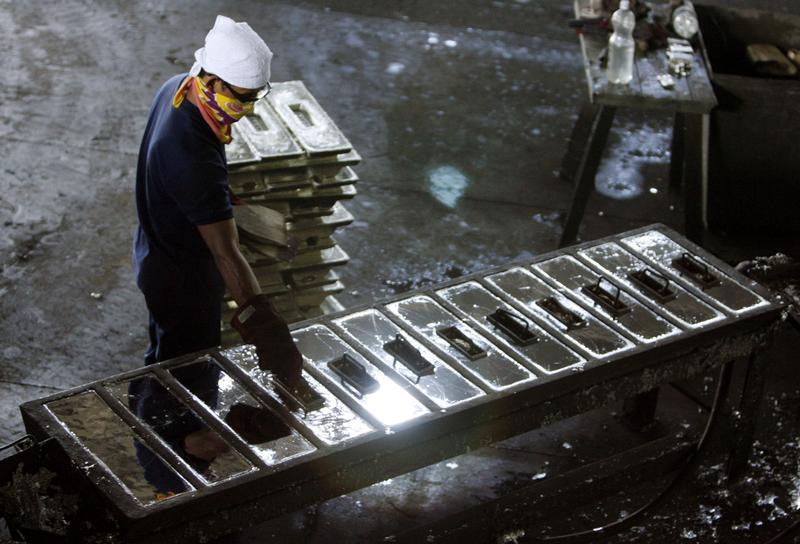
LONDON, May 24 (Reuters) - Copper may have grabbed the headlines this week by making a record nominal high, but tin remains the strongest year-to-date base metals performer. London Metal Exchange (LME) three-month tin is currently trading around $33,500 per metric ton, up by 32% on the start of January, compared with copper's 21% price gain. Tin is a much smaller market but it has attracted its fair share of fund money as investors chase the combination of strong demand profile and structurally challenged supply. Tin ticks both boxes, particularly the latter. One of the world's largest mines in Myanmar has been closed since August and shipments from Indonesia, the world's largest refined metal exporter, have dropped sharply this year. Supply disruption has already seen London tin rally to a near two-year high of $36,050 per ton in April and it almost matched that this week with a Monday high of $35,355. However, there is one element missing from the bull picture. While the price has been rising, global exchange inventory has been rising too. The conflicting signals highlight the disconnect between longer-term bull narrative and current demand reality. SHANGHAI SURGE Stocks registered with the Shanghai Futures Exchange (ShFE) have grown from 6,346 to 17,818 tons since the start of January. Exchange inventory is the highest it's been since the launch of the Shanghai tin contract in 2015 and by some margin. The previous record in 2017 was just 10,964 tons. There was an accelerated seasonal rebuild over the lunar new year holidays but the usual post-holiday decline has been conspicuous by its absence. Stocks have simply climbed further. The scale of increase may reflect a shift in trading patterns by China's massive tin production sector in the form of a movement of off-market inventory to exchange storage. Shanghai tin volumes have grown exponentially in recent years, a record 39 million tons trading in 2023. Speculative flows have played their part but greater trade participation is also likely in the mix. The key take-away, though, is that there is a lot of surplus tin sitting in Shanghai. LME STOCKS STOP FALLING Stocks of tin registered with the LME are much smaller at a current 4,945 tons and they are still down by a significant 36% on the start of the year. However, the downtrend has run its course for now. LME inventory hit a near one-year low of 4,045 tons in the middle of April and has slowly rebuilt since. Significantly, the amount of tin in the system awaiting physical load-out has fallen to just 90 tons from almost 600 tons at the end of April. The flow of metal out of LME warehouses is set to become a trickle in the days ahead. Moreover, LME time-spreads are in healthy contango, suggesting there is good availability of metal. The benchmark cash-to-threes period was valued at a contango of $185 per ton at the Thursday close, compared with a backwardation of $425 on April 23. SUPPLY CONSTRAINTS Tin's supply problems haven't gone away. Exports from Indonesia have been disrupted by a new licensing system introduced at the start of the year. Shipments fell to near zero over January and February and only started picking up in March but they remain below historical averages. Total exports slumped to 6,992 tons in the first four months of this year from 16,778 tons in the same period of 2023. The market has not only been able to absorb the loss of 10,000 tons of Indonesian metal relative to last year but has seen stocks build at the same time. Similarly, Chinese tin smelters appear to have been able to lift run-rates despite much reduced flows of raw materials from the Man Maw mine in Myanmar, which was closed in August for an audit by the United Wa State Army. The Wa authorities have allowed the movement of above-surface stocks but have yet to approve a formal restart of mining operations. Yet China's refined tin production in March was 15,556 tons, up 35.74% from February and up 2.92% year-on-year, according to local data provider Shanghai Metal Market (SMM). SMM expected the pace of yearly growth to pick up to 11% in April. DEMAND GAP The combination of continuing supply disruption and climbing inventory suggests tin's weak demand patch is proving more prolonged than expected. Global tin usage fell by 3.2% in 2022 and was expected to contract another 1.6% in 2023, according to the International Tin Association's annual survey New Tab, opens new tab of consumers conducted in October last year. Semiconductor sales, an important indicator of tin usage in circuit-board soldering, declined sharply over 2022 and early 2023 but have bounced back in the intervening months. However, the recovery is showing signs of losing momentum. First-quarter sales were up an impressive 15.2% on the first quarter of 2023 but were down by 5.7% New Tab, opens new tab on the previous quarter, according to the Semiconductor Industry Association . This year's sharp jump in tin price and the accompanying market volatility are generating a destocking impulse, which is exacerbating the underlying softness in demand. Tin is by no means the only metal seeing such a clash between bullish expectations and not-so-bullish supply-chain reality. But the disconnect is particularly stark and growing ever wider as global inventory keeps building. The opinions expressed here are those of the author, a columnist for Reuters. Sign up here. https://www.reuters.com/markets/commodities/rising-stocks-strike-dissonant-note-tins-bull-party-2024-05-24/
2024-05-26 22:02
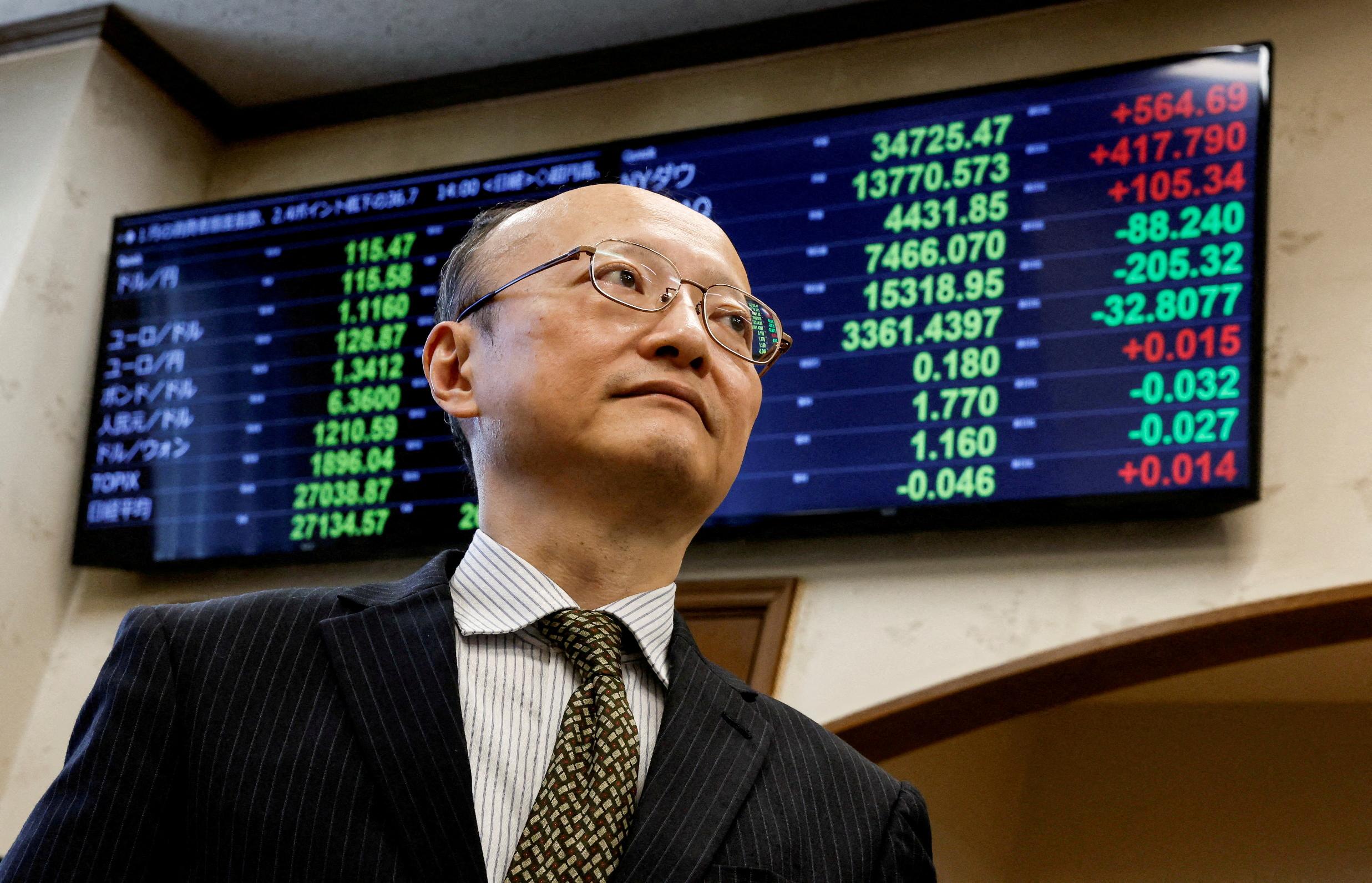
Japan successfully lobbies to have G7 reaffirm FX commitment Top currency diplomat talks up chance of yen intervention BOJ chief upbeat on economy, keeps alive rate hike chance Ueda issues no warning against yield rise to 12-year high Markets focusing on chance of bond tapering at June meeting STRESA, Italy, May 27 (Reuters) - Japan renewed its push to counter excessive yen falls during a weekend gathering of Group of Seven (G7) finance leaders, after a recent rise in bond yields to a 12-year high failed to slow the currency's stubborn decline. The effort by the government and central bank underscores the dilemma policymakers face as they seek to balance the need to arrest sharp yen drops that hurt consumption, while keeping borrowing costs low to underpin a fragile economy. After lobbying by Japan, the G7 finance ministers reaffirmed in a communique issued after their meeting in Italy on Saturday their commitment cautioning against excess volatility in foreign exchange rates. The agreement came after Japan's top currency diplomat Masato Kanda on Friday talked up the chance of renewed currency-market intervention, telling reporters that Tokyo stood ready to act "any time" to counter excessive yen movement. "If there are excessively volatile moves that have an adverse effect on the economy, we need to take action, and doing so would be justified," he said. Bank of Japan (BOJ) Governor Kazuo Ueda, who also attended the G7 meeting, signalled that soft consumption or rising bond yields will not get in the way of normalising monetary policy. Ueda said on Thursday a slump in first-quarter gross domestic product did not change the BOJ's view that Japan's economy was on track for a moderate recovery. Analysts have said the BOJ will likely raise interest rates in coming months if the economy moves in line with its forecasts. He also refrained from speaking against a recent rise in the 10-year bond yield to a 12-year high, that was driven in part by market expectation the BOJ will soon embark on a full-fledged tapering of bond purchases. "Our basic stance is for long-term interest rates to be set by markets," Ueda said on Saturday when asked about recent rises in Japan's long-term rates. The remarks followed a slew of hawkish signals by the BOJ that has heightened market expectation of a near-term hike in interest rates, or a scale-back in its huge bond purchases. Ueda has ruled out using monetary policy to influence yen movement. But he escalated his rhetoric against the impact a weak yen could have on inflation, after the currency's plunge led to suspected yen-buying intervention by the government on April 29 and May 2. A Reuters poll showed many analysts project the BOJ to hike rates either in the third or fourth quarter this year. DATA CLOUDS OUTLOOK Ueda also signalled the BOJ's readiness to slow but steadily raise interest rates, if inflation durably hits its 2% target in coming years as projected. But data so far have not been promising. Consumption is weak as wage hikes have yet to catch up to the rising cost of living. Service-sector inflation, closely watched by the BOJ as a key indicator of underlying price trends, also remains flat. "Services inflation likely peaked out," said Junichi Makino, chief economist at SMBC Nikko Securities. "It doesn't seem like underlying inflation will accelerate towards 2%." Given such weak signs in the economy, some analysts are shifting attention to whether the BOJ will taper its bond-buying as part of efforts to slow the yen's decline. Ueda has ruled out using the BOJ's bond-buying as a monetary policy tool, after having exited its radical monetary stimulus in March. But markets remain fixated on the BOJ's market operations for clues on when it will start to taper. Some analysts expect the BOJ to decide on slashing bond purchases as early as its next policy meeting in June. Market expectations of a near-term tapering helped pushed the benchmark 10-year Japanese government bond yield to a 12-year high of 1.005% on Friday. But the rise in yields has failed to give the yen much boost. It stood at 156.98 to the U.S. dollar on Friday, not far from the more than three-week low of 157.19 touched on Thursday. "While markets seem excited about the chance of a policy shift, the BOJ is probably cool-headed about all this," said Daiwa Securities chief market economist Mari Iwashita, who rules out the chance of a taper decision in June. "Besides, there's no guarantee such action could stop the yen's fall." Sign up here. https://www.reuters.com/world/japan/japan-g7-meet-renews-push-keep-yen-bears-check-2024-05-26/