2024-05-23 04:31
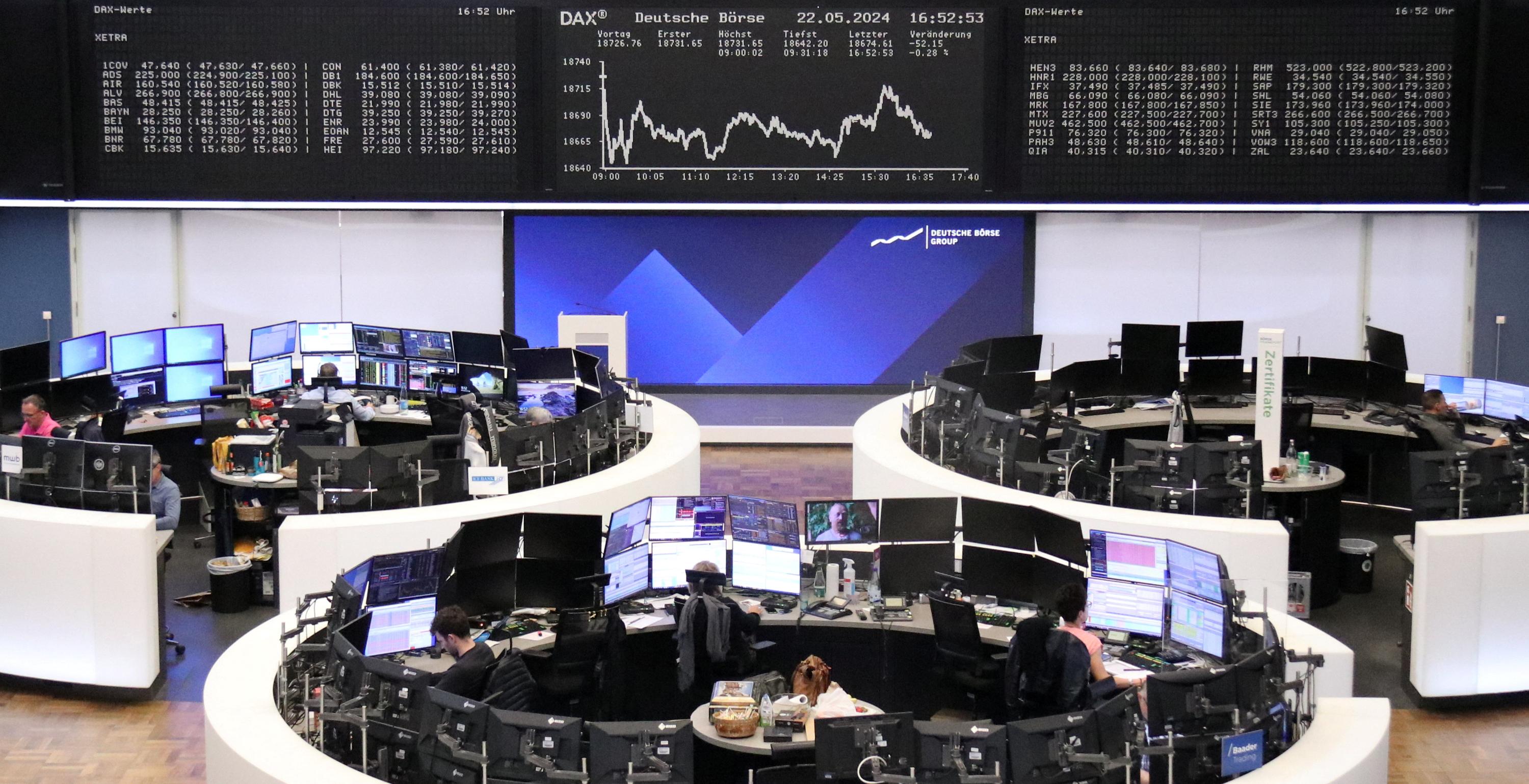
A look at the day ahead in European and global markets from Rae Wee Flash Purchasing Managers Index (PMI) figures in the euro zone, the UK and the United States take centre stage on Thursday, and investors will be on the lookout for whether the global growth narrative is showing signs of change. Strategists at S&P Global Market Intelligence noted that after the composite PMI in the United States came in below its euro zone and UK counterparts last month, May's flash PMI numbers will be eagerly awaited to "gauge whether global growth momentum has shifted" from the U.S. to Europe. Part of that shift could get some momentum on expectations that the Bank of England (BoE) and the European Central Bank(ECB) are likely to cut rates next month, while an easing cycle in the United States is meanwhile still some time away. Bets for an imminent rate cut by the Federal Reserve were again pared after minutes of the central bank's latest policy meeting came in more hawkish than expected, breathing new life into the dollar and keeping U.S. Treasury yields elevated. Patience on rates has reemerged as a theme across central banks globally, with New Zealand's central bank governor Adrian Orr on Thursday expressing disappointment over stubborn domestic inflation. In other news, Taiwan's military mobilised its forces and said it was confident it could protect the island, after China started two days of "punishment" drills around Taiwan on Thursday in what it said was a response to "separatist acts". That kept a lid on risk sentiment in Asia hours, though Taiwan's stock market (.TWII) New Tab, opens new tab seemed to prefer the positive news from AI darling Nvidia's (NVDA.O) New Tab, opens new tab revenue forecasts and surged to a record high. Key developments that could influence markets on Thursday: - Euro zone flash composite PMI (May) - UK flash composite PMI (May) - U.S. flash composite PMI (May) Sign up here. https://www.reuters.com/markets/europe/global-markets-view-europe-2024-05-23/
2024-05-23 04:30
NEW YORK, May 23 (Reuters) - The dollar rose against the euro on Thursday after data showed U.S. business activity accelerated to the highest level in just over two years in May, suggesting that economic growth picked up half-way through the second quarter. S&P Global said that its flash U.S. Composite PMI Output Index, which tracks the manufacturing and services sectors, jumped to 54.4 this month. That was the highest level since April 2022 and followed a final reading of 51.3 in April. A reading above 50 indicates expansion in the private sector. "The currency action shows the market still responds to strong U.S. economic data in the expected way," said Marc Chandler, chief market strategist at Bannockburn Global Forex LLC. "I think the dollar has some more room on the upside," Chandler said. Data on Thursday also showed the number of Americans filing new claims for unemployment benefits fell last week, pointing to underlying strength in the labour market that should continue to support the economy. Federal Reserve officials at their last policy meeting said they still had faith that price pressures would ease at least slowly in coming months, but doubts emerged about whether the current level of interest rates was high enough to guarantee that outcome and "various" officials said they'd be willing to hike borrowing costs again if inflation surged. "Given the FOMC comments the market is still exaggerating the chances of two rate cuts this year," Chandler said, noting that the unwinding of rate cut bets would keep the dollar supported in the near term. The euro was down 0.2% at $1.080525. The common currency rose as high as $1.0861 earlier in the session after the preliminary composite Purchasing Managers' Index for the currency bloc came in above the 50 level separating growth from contraction for the third month in a row, with even struggling manufacturing showing a recovery. Better-than-feared economic data for the past few months helped the euro rally in April and early May, and Thursday's data pushed the currency back towards mid-May's two-month high of $1.0895. "The EU PMI figures took a little pressure off of the stagflation theme, but it still feels a little stagflation 'lite' if you will, and we need to see more on the growth side there," Brad Bechtel, global head of FX at Jefferies, said in a note. The pound slipped 0.2% to $1.2689 against the dollar. Prime Minister Rishi Sunak on Wednesday called a national election, which his Conservatives are widely expected to lose to the opposition Labour Party after 14 years in power. However, sterling options volatility for the period covering the July 4 election did rise. "The market is fairly confident there's going to be a Labour government and it's pretty confident also that the Labour government won't be that different in terms of fiscal policy, than the current Sunak and (finance minister Jeremy) Hunt mix anyway," said Jane Foley, head of FX strategy at Rabobank. The dollar was 0.1% higher against the Japanese currency at 156.91 yen after data showed Japan's factory activity crept into expansion for the first time in a year in May. The corporate sector in Japan has been grappling with the weak yen, and nearly half of Japanese firms find the yen's slide beyond 155 to the dollar harmful to their business, roughly double the percentage of those who see the currency's weakness as a positive, a Reuters survey showed on Thursday. The New Zealand dollar slipped 0.1% to $0.60925 after data released Thursday showed that retail sales volumes in New Zealand unexpectedly rose, its second day of gains after the Reserve Bank of New Zealand surprised markets on Wednesday by lifting its forecasts for peak interest rates and pushing back when it expects to cut. {AUD/] Among cryptocurrencies, ether was up 1% at $3,776, after rising as high as $3945.50 its highest since mid-March. It has been surging amid speculation over the potential approval of U.S. spot exchange-traded funds that would track the world's second-biggest cryptocurrency. Sign up here. https://www.reuters.com/markets/currencies/dollar-hovers-near-highest-week-after-hawkish-fed-minutes-2024-05-23/
2024-05-23 04:25
HSINCHU, Taiwan, May 23 (Reuters) - Taiwanese contract chipmaker TSMC (2330.TW) New Tab, opens new tab, a major supplier to Apple (AAPL.O) New Tab, opens new tab and Nvidia (NVDA.O) New Tab, opens new tab, on Thursday forecast an annual revenue growth of 10% in the global semiconductor industry, excluding memory chips. "This is a new golden age of opportunity with AI," said senior vice-president Cliff Hou, who was speaking at an event in Hsinchu, where the company is headquartered. In April, TSMC lowered its outlook for the global semiconductor industry excluding memory to a growth rate of around 10% from a previous forecast of more than 10%. World Semiconductor Trade Statistics has forecast growth of 13.1% for the global semiconductor market in 2024. TSMC has estimated second-quarter sales may rise as much as 30% as it rides a wave of demand for semiconductors used in artificial intelligence applications (AI). Nvidia forecast on Wednesday its quarterly revenue above estimates and announced a stock split, lifting shares to a record-high territory and impressing investors who have tripled the chipmaker's market value in the past year on AI optimism. Sign up here. https://www.reuters.com/technology/tsmc-expects-semiconductor-industry-growth-over-10-this-year-2024-05-23/

2024-05-23 03:59
SEOUL, May 23 (Reuters) - South Korea's central bank held interest rates at a 15-year high on Thursday and struck a balanced policy tone while reiterating risks around inflationary pressures in the wake of stronger-than-expected economic growth. Governor Rhee Chang-yong said for now the Bank of Korea will continue to keep policy restrictive at the current 3.50% benchmark rate amid sticky inflation and the surprise first-quarter growth performance. "There are expectations for interest rate cuts in the second half, but uncertainties over the timing of it is now even greater," Rhee told a press conference soon after the BOK unanimously held its key rate (KROCRT=ECI) New Tab, opens new tab steady, as expected by all 43 analysts polled by Reuters. "It's not like growth is excessively hot so it is desirable to normalize restrictive interest rates should inflation stabilizes to the target level which we are hoping for." The BOK also raised growth forecast for this year to 2.5% from 2.1% after Asia's fourth biggest economy grew at its quickest pace in two years in the first quarter. The bank kept its February inflation outlook for this year at 2.6%, as the impact from stronger growth "was not seen big enough to alter" the forecast, Rhee said. South Korea’s policy-sensitive three-year treasury bond futures started to rise after the BOK kept its inflation forecast for this year and extended gains to as much as 0.13 points to 104.54 during Rhee’s news conference. "There is some relief in the market that the BOK maintained its inflation outlook, and given that short-term outlook among board members remains the same, expectations the BOK will start cutting rates in the second half is very much alive," said Ahn Jae-kyun, an analyst at Shinhan Securities, who sees a 25 basis-point cut in the fourth quarter. The BOK's tightening cycle began earlier than most global peers in mid-2021, with policy interest rates rising by a cumulative 300 basis points to 3.50%. As with the rest of the world, the central bank is closely monitoring the debate around the timing of the Federal Reserve's interest rate cuts, as any easing in the U.S. could drive up the won and alter inflation dynamics. South Korean Inflation is coming down, as April headline data showed an easing for the first time in three months to 2.9%, but it remains above the BOK's target rate of 2%. Median forecasts show analysts see the benchmark interest rate will remain unchanged through the third quarter before a 50 basis-point cut in the fourth quarter, as some pushed back their timing of cuts after the stronger-than-expected GDP data. In an April survey, the consensus view predicted 25 basis-point cuts each in the third and fourth quarter. Sign up here. https://www.reuters.com/markets/asia/south-korea-extends-rate-pause-raises-growth-outlook-2024-05-23/
2024-05-23 01:06
May 22 (Reuters) - The U.S. House of Representatives on Wednesday passed a bill that aims to create a new legal framework for digital currencies, despite an unusual warning from the U.S. securities regulator it could create new financial risks. The Republican-sponsored Financial Innovation and Technology for the 21st Century Act passed in a bipartisan 279-136 vote. It is not clear if the Senate will take up the measure. The bill's supporters in the U.S. Congress argue that the bill will provide regulatory clarity and help promote the industry's growth. The House approval comes as the U.S. Securities and Exchange Commission (SEC) signals that it will likely approve applications for spot ether exchange-trade funds in a surprising boost to the industry. But SEC Chair Gary Gensler said in a statement that the bill "would create new regulatory gaps and undermine decades of precedent regarding the oversight of investment contracts, putting investors and capital markets at immeasurable risk." The bill was backed by crypto supporters and industry organizations who have long viewed Gensler's SEC as an impediment to the wider adoption of digital assets. Noting high-profile prosecutions, fraud cases, bankruptcies and failures, Gensler has maintained that cryptocurrencies should be subject to the same laws as other assets. In Wednesday's statement, he said under the bill investment contracts recorded on a blockchain would no longer be deemed securities, denying investors protection under securities laws. Among other criticisms, Gensler said the bill would also allow issuers of crypto investment contracts to certify themselves that their own products are digital commodities not subject to SEC oversight, leaving the agency just 60 days to challenge this. Sign up here. https://www.reuters.com/world/us/us-securities-regulator-urges-against-crypto-bill-adoption-2024-05-22/
2024-05-23 00:57
BOGOTA, May 22 (Reuters) - Rating agency Moody's on Wednesday downgraded Colombian majority state-owned energy company Ecopetrol into junk territory, citing increased indebtedness, a boost in dividends and an ambitious investment plan over the next three years. Moody's cut Ecopetrol's long-term issuer rating and senior unsecured ratings to Ba1, considered "junk," from Baa3. Ecopetrol has been taking on more debt to finance its expansion plans, Moody's said, including the purchase of a majority stake in energy conglomerate Interconexion Electrica (ISA). However, increased investments have not turned into similarly increased core earnings, Moody's said. A number of Ecopetrol's planned projects, particularly those involving natural gas, are risky due to their deep-water, offshore conditions, Moody's added. Meanwhile, Ecopetrol's available cash has been used to pay out dividends, the ratings agency said. Ecopetrol downplayed the ratings cut in a statement, saying its share price would likely remain unaffected as its investors "prioritize business performance over rating announcements." The firm added that it was committed to responsible debt management and that it was working to keep costs down. Sign up here. https://www.reuters.com/business/energy/moodys-downgrades-ecopetrol-junk-status-2024-05-23/