2024-05-10 06:40
IAG operating profit at 68 million in Q1, compared to 9 million last year CEO says IAG could scrap Air Europa bid, not at that point yet Shares up 1.4% in early trading European airlines hope for record summer demand LONDON, May 10 (Reuters) - British Airways owner IAG (ICAG.L) New Tab, opens new tab reported a surge in first quarter earnings on Friday helped by rising demand over the Easter holiday and said it was seeing strong summer bookings. Chief Executive Luis Gallego said the group, which also owns Iberia, Aer Lingus and Vueling airlines, had already secured more than 80% of projected bookings for the second quarter and over 40% for the third quarter. IAG's exposure to the Middle East was very small so it hadn't seen a big impact from the conflict there, he said. Shares in IAG rose 1.4% by 0815 GMT after the group said operating profit totalled 68 million euros ($73 million) in January-March. That topped analysts' forecasts of 49 million euros, according to a company-compiled consensus, and compared with a profit of just 9 million euros in the same quarter of last year. "Our transformation initiatives and increased demand, including over the Easter holidays, have delivered another very good set of results with improvement to both revenue and operating profit," Gallego said in a statement. The first quarter is often weak for airlines, with fewer bookings at the start of the year. Investors said IAG's first quarter performance showed the strength of its long-haul traffic and its success in reducing debt built up during the pandemic when airports and borders shut and planes were grounded. RIVALS STRUGGLE European rivals Lufthansa (LHAG.DE) New Tab, opens new tab and Air France-KLM (AIRF.PA) New Tab, opens new tab reported worse than expected first quarters as they struggled with a range of issues. "Lufthansa had strikes which was the big problem. Air France-KLM had some one-offs, but IAG was still better. IAG is the higher-margin group anyway: double digit margins vs single digits at the others in general," Bernstein analyst Alex Irving said. Gallego pointed to the group's smaller exposure to Asia, where traffic has recovered slowly, compared to rival European airline groups and to particularly strong results in its core markets like Southern Europe. However, Gallego also said IAG could pull the plug on its takeover bid for Spain's Air Europa if conditions demanded by regulators prove too cumbersome, but told analysts on a call that the group wasn't yet at that point. EU antitrust regulators warned in April that IAG's bid to secure full control of Air Europa may reduce competition and lead to price increases. In its statement, IAG said it expected slightly higher costs this year, but that it saw 7% growth in passenger capacity in 2024. Airlines have complained that delayed deliveries from planemakers will further constrain capacity and limit their ability to meet record demand this year. IAG said its non-fuel unit costs increased by 3.7% in January-March from a year earlier, driven by investments in the business and the impact of wage settlements agreed in 2023. ($1 = 0.9280 euros) Sign up here. https://www.reuters.com/business/aerospace-defense/ba-owner-iag-reports-better-q1-operating-profit-than-expected-2024-05-10/

2024-05-10 06:03
LONDON, May 10 (Reuters) - Worried about a hawkish Fed, over-valued stocks, teetering debt piles, volatile currencies, cliffhanger elections or rancorous geopolitics? Relax and don't over-think it. For those with long-term savings horizons, the temptation to overtrade and overpay fees for sophisticated investment management, esoteric financial products and expensive hedging may just not be worth it. Despite a never-ending debate about the merits of active or passive investing and the perennial search for index-beating "alpha", the surest, cheapest and least taxing strategy over the long term may be a simple combination of two diversified passive funds. One should track top global stocks and the other equivalent corporate bonds, both hedged to domestic currency. Then just go fishing. So reckons JPMorgan's long-term investment strategists Jan Loeys and Alexander Wise, who dub their favoured approach KISS, or "Keep it Simple, Stupid", after the long-standing design principle on avoiding complexity where possible. "Our main contention is not that KISS investing is absolutely optimal and doing anything else is irrational or a bad investment," Loeys and Wise told clients this week. "Our point is instead that we believe you can achieve most, if not all of your financial objectives by following our KISS approach," they said. "Adding more products or complexity in our mind produces steadily falling extra benefits." The JPMorgan team acknowledges that short-term trading and market timing by hedge funds or other active players are critical to market efficiency and liquidity and can make big killings. But by so quickly arbitraging away market pricing anomalies before most investors can even spot them, there's not much juice left for much of the market. "The lifetime of any new 'alpha' ideas has gotten shorter and shorter," they said. But their main rationale for longer-term savers to keep it simple riffs largely off the fact that any outperformance just doesn't seem to compensate much for the fund manager selection risks, higher fees, transaction taxes and the sheer time spent monitoring more complex or esoteric portfolios. What's more, they reckon the fewer the assets one has in a portfolio, the easier it is to judge risk on them. KISS AND TELL By way of example, Loeys and Wise examine 24 years of monthly hedge fund returns in excess of what that simple global equity/bond portfolio would have delivered, with weights to give the same return volatility on a rolling basis. These have a patchy record over the past 10 years and rarely topped 10% over the past two decades, even though they have been positive post-pandemic. These are mostly complex strategies and often lack transparency, have high fees and significant manager risk. According to HFR hedge fund research, the HFRI Fund Weighted Composite Index (.HFRI5FWC) New Tab, opens new tab has underperformed S&P 500 (.SPX) New Tab, opens new tab total returns in all but one of the last 10 years. Other arguments include how longer-term "value" investors can struggle for years to beat the market, how "undervalued" stocks get whipped away quickly and how many index-leading stocks can remain overvalued for long periods. Just ask Warren Buffett. Despite a stellar 60-year sojourn for his Berkshire Hathaway (BRKa.N) New Tab, opens new tab vehicle's strategy of picking unfashionable and undervalued stocks, he can't find many left these days. Speaking at Berkshire's annual meeting last weekend, Buffett said he expected the conglomerate's cash pile, now a record $189 billion, to keep growing. That's more than half the size of the firm's $335 billion equity portfolio. Acknowledging the pain for stock-picking funds trying to beat passive indexes now dominated by Big Tech megacaps, Boston-based value investor GMO earlier this year showed how almost three quarters of large cap "blend managers" underperformed the S&P 500 last year and 90% of them lagged over the decade. With total returns on MSCI's all-country world index (.MIWD00000PUS) New Tab, opens new tab topping 400% for the past 20 years - a middle ground between the 600% for the S&P 500 and 200% for the euro zone STOXX index (.STOXXE) New Tab, opens new tab - the passive equity ride's been pretty impressive even when you throw in seismic 2008 and 2020 drawdowns. On the bonds part of the two-fund "KISS" portfolio, the JPMorgan strategists stress it should be diversified global corporate debt that excludes sovereign bonds, which they feel are prone to "financial repression" risks from governments forcing institutions to invest and structurally overvaluing them. Total returns on the Bloomberg Global Aggregate bond index that excludes government bonds, for example, have been 50% since the index's inception in 2010. Even with U.S. investment grade corporate debt premia over U.S. Treasuries down to 15-year lows, the JPMorgan analysts say their models suggest there's more than an 80% chance they continue to outperform over the next 10 years. "Keeping things simple in finance, fewer assets, simple valuation rules, simple investment rules, is an underrated strategy," they conclude. The opinions expressed here are those of the author, a columnist for Reuters. Sign up here. https://www.reuters.com/markets/forget-market-angst-just-kiss-make-up-mike-dolan-2024-05-10/

2024-05-10 05:46
May 10 (Reuters) - A Ukraine drone attack set an oil refinery in Russia's Kaluga region on fire, RIA state news agency reported on Friday, citing emergency services sources. Vladislav Shapsha, governor of the Kaluga region which borders the broader Moscow region, said on the Telegram messaging app that the fire was promptly extinguished. He did not say at what facility it took place. RIA reported that three containers with diesel fuel and one with fuel oil were consumed by the fire at the Pervyi Zavod refinery in Kaluga. Shapsha said there were no casualties in the attack. There was no immediate comment from Kyiv. Drone attacks on energy facilities inside Russia's territory have become more frequent in the past few months. Ukraine has said that while its attacks do not target civilians, destroying Russia's military, transport and energy infrastructure undermines Moscow's overall war efforts. Sign up here. https://www.reuters.com/world/europe/ukraine-drone-attack-sparks-fire-refinery-russias-kaluga-ria-reports-2024-05-10/
2024-05-10 05:39
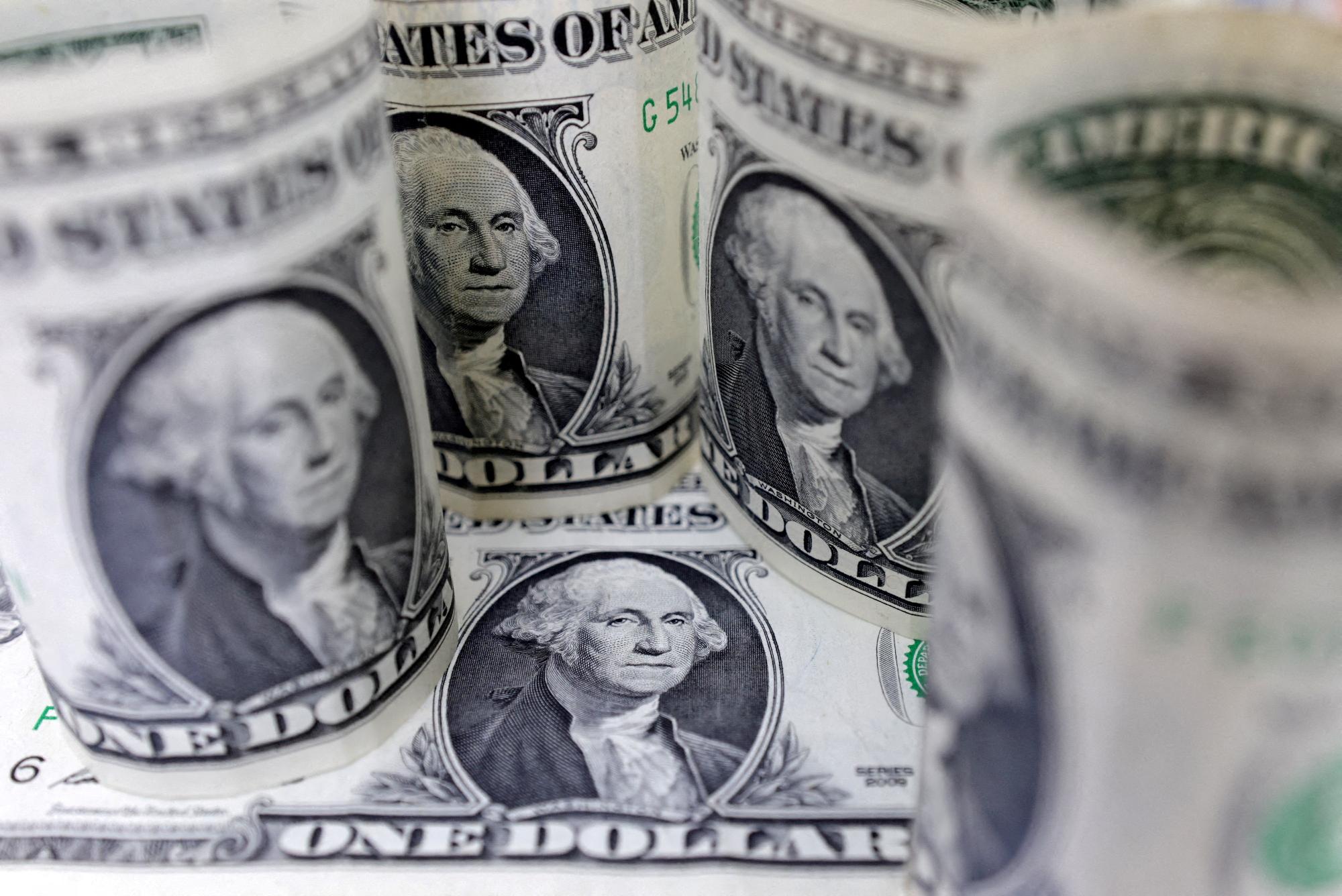
NEW YORK, May 10 (Reuters) - The dollar inched higher on Friday following a reading on U.S. consumer sentiment as investors sorted through a batch of comments from Federal Reserve officials, with the focus beginning to turn toward key inflation readings next week. The greenback pared declines and turned modestly higher after the University of Michigan's preliminary reading on consumer sentiment came in at 67.4 for May, a six-month low and below the 76.0 estimate of economists polled by Reuters. In addition, the one-year inflation expectation climbed to 3.5% from 3.2%. The dollar had weakened on Thursday after a higher than expected reading on initial jobless claims fueled expectations the labor market was loosening, adding to other recent data that indicated the overall economy was slowing. The dollar index , which measures the greenback against a basket of currencies, gained 0.09% to 105.31, with the euro down 0.08% at $1.0772. The dollar was on track for its first weekly gain after two straight weeks of declines. Next week, investors will eye readings on inflation in the form of the consumer price index (CPI) and producer price index (PPI), as well as retail sales data. "The CPI, I don't think it's going to change people's views; the price pressure is still elevated, but it'll be a decline, it will be just a softer year-over-year read," said Marc Chandler, chief market strategist at Bannockburn Global Forex in New York. "So it's not so much the magnitude, but the direction." Also supporting the dollar were comments from Dallas Federal Reserve President Lorie Logan, who said it was not clear whether monetary policy was tight enough to bring inflation down to the U.S. central bank's 2% goal, and it was too soon to be cutting interest rates. That ran counter to earlier comments from Atlanta Federal Reserve President Raphael Bostic, who said the Fed likely remained on track to cut rates this year even if the timing and extent of the policy easing was uncertain. In addition, Chicago Federal Reserve President Austan Goolsbee said he believes U.S. monetary policy is "relatively restrictive." The comments capped off a week of varying opinions among Fed officials as to whether rates are high enough. Following last week's softer than expected U.S. payrolls report and a Fed policy announcement, markets have been pricing in about 50 basis points (bps) of cuts this year, with a 62.2% chance for a cut of at least 25 basis points in September, according to CME's FedWatch Tool New Tab, opens new tab. Against the Japanese yen , the dollar strengthened 0.26% to 155.86 and was up about 1.9% on the week against the Japanese currency after it tumbled 3.4% last week, its biggest weekly percentage drop since early December 2022 after two suspected interventions by the Bank of Japan. Japan's Finance Minister Shunichi Suzuki said on Friday the government would take appropriate action on foreign exchange if needed, echoing recent comments from other officials. Sterling edged up 0.02% to $1.2525 after earlier reaching $1.2541 in the wake of data showing Britain's economy grew by the most in nearly three years in the first quarter of 2024, ending the shallow recession it entered in the second half of last year. Sign up here. https://www.reuters.com/markets/currencies/dollar-nurses-losses-after-another-set-soft-jobs-data-2024-05-10/
2024-05-10 05:31
Household spending down again, raising questions on BOJ exit Weak consumption, global economic outlook underscore challenges Japan's current account surplus hits record in FY2023/24 TOKYO, May 10 (Reuters) - Japan's consumer spending fell for the 13th straight month in March, creating challenges for policymakers who are seeking to drive stronger real wage growth, a prerequisite for additional central bank rate hikes. Household spending fell 1.2% in March from a year earlier, official data released on Friday showed, against economists' median forecast for a 2.4% drop and following a 0.5% decline in February. "Weak consumption will likely keep the Bank of Japan waiting at least until October to confirm a virtuous cycle of wages and prices is in place before raising interest rates," said Takeshi Minami, chief economist at Norinchukin Research Institute. "Unless the currency crisis breaks out to trigger capital flight, the BOJ won't raise rates to defend the yen currency." On a seasonally adjusted, month-on-month basis, spending increased 1.2%, much bigger than an estimated 0.3% contraction and a 1.4% rise in February. The weak figures came a day after labour ministry data showed real wages shrinking two years in a row, as the rising cost of living outpaced nominal wages despite the biggest pay hikes, mainly among major corporations, in about three decades. "Consumption may have hit bottom, but the trend of thrifty consumers remains strong due to rising living costs likely being exacerbated by the yen weakening," Minami said. "As such the private consumption component of the first-quarter GDP data next week probably declined, causing the overall economy to contract at 1.2% annualised in the same period." Weak household consumption is a source of concern for policymakers who want to see sustained economic growth led by strong wage hikes and solid consumer spending. Separate data on Friday showed Japan's current account surplus widened to 3.40 trillion yen ($21.84 billion) in March. That compared with economists' median forecast for a surplus of 3.49 trillion yen in a Reuters poll. For the fiscal year that ended March, Japan's current account surplus was a record 25.339 trillion yen, reflecting a trade surplus, cooling commodity prices and hefty gains in primary income from direct investment overseas. ($1 = 155.7100 yen) Sign up here. https://www.reuters.com/markets/asia/japans-consumer-spending-fell-13th-straight-month-march-2024-05-09/

2024-05-10 05:20
Europe's STOXX 600 index hits fresh record high Dow gains for eighth successive session Dollar, yields edge higher ahead of CPI data next week Gold advances on interest rate cut hopes NEW YORK/LONDON, May 10 (Reuters) - A rally in global equity markets lifted stocks in Europe to record highs on Friday amid strong corporate earnings and hopes central bank interest rate cuts are near, while the dollar edged higher despite signs of slowing U.S. economic growth. European shares posted their biggest weekly gain since late January, with the pan-regional STOXX 600 index (.STOXX) New Tab, opens new tab rising for a sixth straight session, while the FTSE 100 (.FTSE) New Tab, opens new tab in London hit yet another record high. The Dow industrials index (.DJI) New Tab, opens new tab registered its eighth daily advance as the three major Wall Street indexes posted weekly gains but the Nasdaq closed marginally lower on the day. Strong performance on both sides of the Atlantic, along with gains overnight in Tokyo and elsewhere in Asia, pushed MSCI's all-country world index (.MWID00000PUS) New Tab, opens new tab within 0.2% of a record closing high. U.S. equity markets took comfort from earning season as corporate results in aggregate beat expectations, said Dec Mullarkey, managing director of investment strategy and asset allocation at SLC Management in Boston. "It certainly gave some assurance that growth is holding up while companies protect profit margins," Mullarkey said, referring to corporate America. While in Europe, "the prospect of rate cuts is helping drive equity markets across the euro zone as it still looks like a decent value play to global asset allocators," he said. The pan-European STOXX 600 index closed up 0.77%, the FTSE ended 0.63% higher and MSCI's gauge of stocks across the globe (.MIWD00000PUS) New Tab, opens new tab rose 0.31% - just 0.2% from a new closing high. The Dow Jones Industrial Average (.DJI) New Tab, opens new tab rose 0.32%, the S&P 500 (.SPX) New Tab, opens new tab gained 0.17% and the Nasdaq Composite (.IXIC) New Tab, opens new tab eased 0.03%. The dollar pared initial declines and turned modestly higher as investors assessed a reading on U.S. consumer sentiment and sifted through a flurry of comments from Fed officials. The University of Michigan's preliminary reading of consumer sentiment came in at 67.4 for May, a six-month low and below the 76.0 estimate of economists polled by Reuters. In addition, the one-year inflation expectation climbed to 3.5% from 3.2%. "The U.S. exceptionalism trade is fading. We did see a decline yesterday based on the higher-than-expected rise in jobless claims," said Karl Schamotta, chief market strategist at Corpay in Toronto. "The underlying trend here does look as if the dollar's essentially peaking here and then it might decline." The dollar index , which measures the U.S. currency against a basket of six peers, gained 0.07% to 105.29. The euro slid 0.1% to $1.077, while the yen weakened 0.17% to 155.74 per dollar. The pound posted a modest weekly loss after the Bank of England on Thursday paved the way for the start of rate cuts as soon as next month and data showed the British economy exited a mild recession in the first quarter of this year. INFLATION AHEAD Markets await both next week's producer price index and the consumer price index for signs that U.S. inflation has resumed its downward trend toward the Fed's 2% target rate. Hotter-than-expected inflation reports last month had quashed any lingering expectations of near-term U.S. rate cuts. But markets are now fully pricing in a cut only in November, while chances of the Fed moving in September have narrowed. In contrast, markets now imply a 50-50 chance of a BoE cut in June and are almost fully priced for August. They also imply an 88% chance the European Central Bank will ease in June. BOE Governor Andrew Bailey said there could be more reductions than investors expect, the latest sign of the growing divergence between the Europe and U.S. rate outlooks. Traders currently anticipate roughly 42 basis points of cuts this year from the Fed. In comparison, traders are pricing in 55 bps of easing from the BoE this year, while anticipating 68 bps of cuts from the ECB. , , Treasury yields rose as traders waited on next week's key April inflation data to guide expectations of Fed monetary policy. The yield on benchmark 10-year Treasury notes rose 5.1 basis points to 4.5%, while the two-year yield , which typically moves in step with interest rate expectations, rose 6.3 basis points to 4.8698%. Oil prices fell by about $1 a barrel as comments from Fed officials indicated higher-for-longer interest rates, which could hinder demand from the world's largest crude consumers. U.S. crude futures fell $1.00 to settle at $78.26 a barrel and Brent settled down $1.09 at $82.79 a barrel. Gold prices rose, en route to their best week in five, with zero-yield bullion building on momentum fueled by weaker U.S. jobs data this week that reinforced expectations for the Fed to cut rates this year. U.S. gold futures for June delivery settled 1.5% higher at $2,375.00 per ounce. Bitcoin fell 3.19% to $60,613.00. Sign up here. https://www.reuters.com/markets/global-markets-wrapup-1-2024-05-10/