



like_count_tpl like_count_text_tpl
like_tooltip_tpl
comment_count_tpl comment_count_text_tpl
comment_tooltip_tpl
Economic Updates
Why ESG Matters: COP28: Slow progress

Did you know?
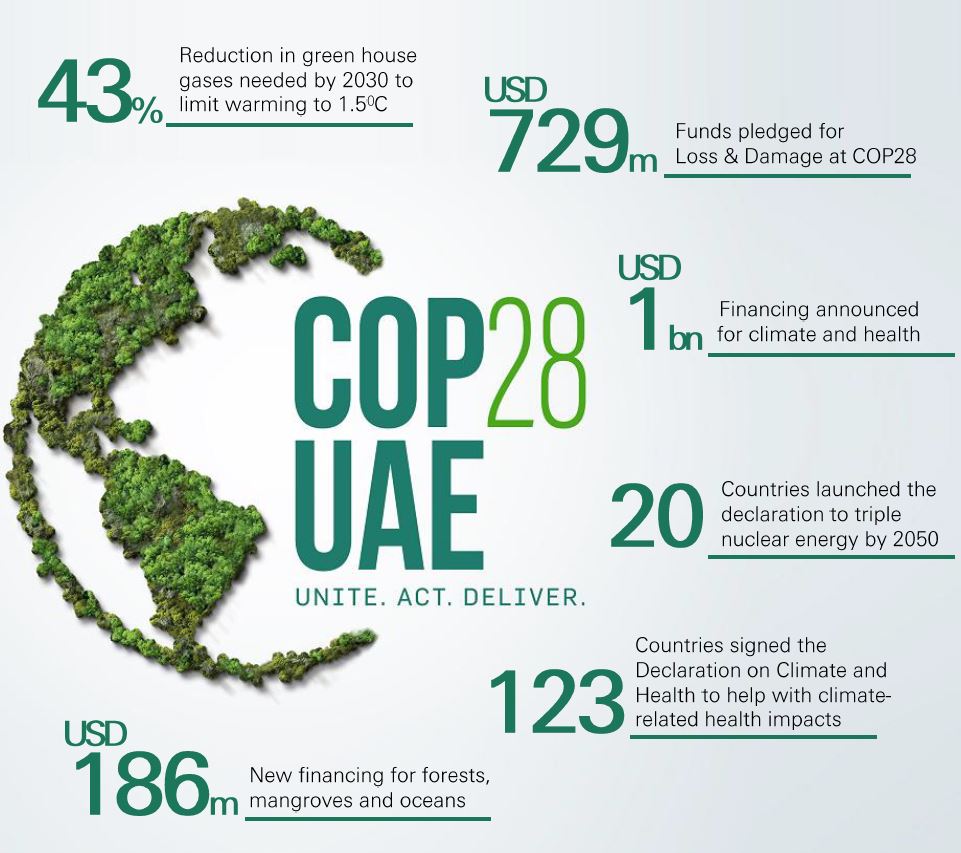
1. More to do
What is success?
COP28 overran significantly as all efforts focused on bridging the divergent views on fossil fuels. After a key win on day one from the operationalisation of the Loss & Damage Fund (a fund set up to pay developing countries for their climate-related loss and damages), discussions stalled on many key issues. If the success of COP28 is determined by whether fossil fuels were mentioned in the text, then there was some success. However, when evaluating the progress of various other climate issues, the outcomes were rather underwhelming.
The beginning of the end
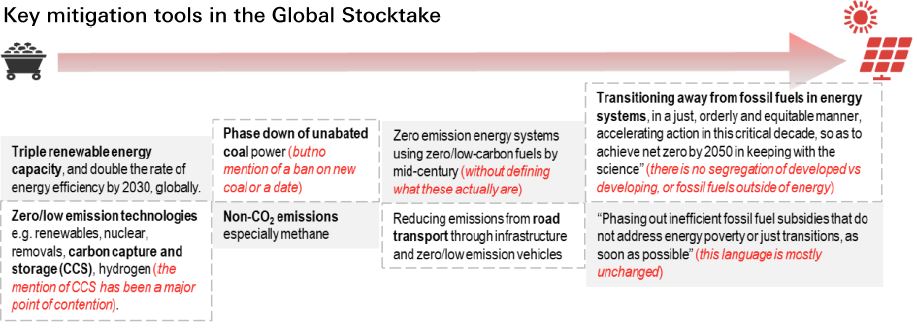
After five drafts and a 36-hour debate, the global stocktake settled on “Transitioning away from fossil fuels in energy systems, in a just, orderly and equitable manner, accelerating action in this critical decade, so as to achieve net zero by 2050 in keeping with the science”. This recognises fossil fuels as the main cause of climate change, yet gives fossil fuels companies leeway to determine how and when they will take part in this transition.
Lacking ambition
The progression in ambition of climate pledges (due early 2025) was not strong. Previous statements were merely repeated without calling for a significant rise in ambition. Adaptation took a backseat at COP28 with a lack of financial support and a weak outcome for the Global Goal on Adaptation (which aims to enhance the world’s adaptive capacity to climate change) that only seemed to set broad collective goals. The support for vulnerable countries was lacking, and many Parties were left disappointed that those most responsible for climate change don’t seemingly have to pay the consequences.
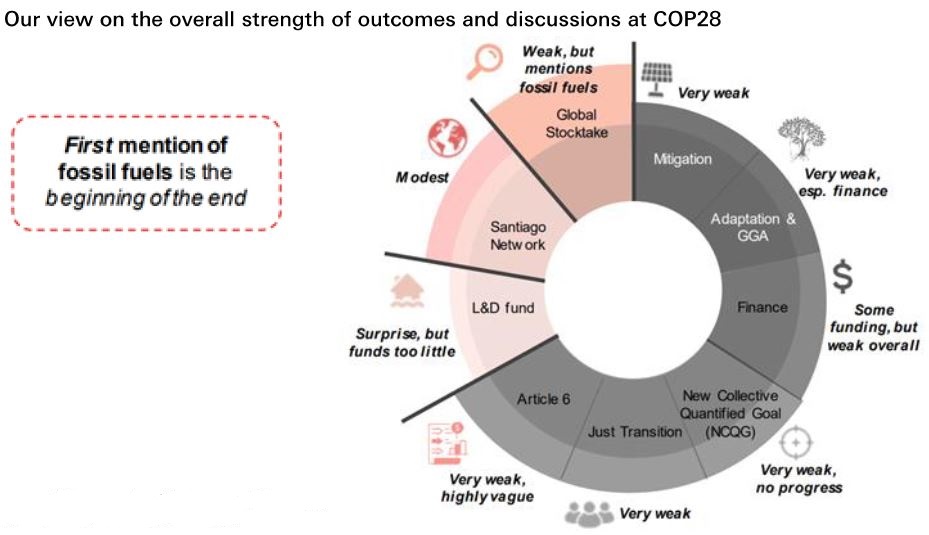
2. Summary of the key outcomes
The key focus of this COP28 was on the Global Stocktake (GST) and the language pertaining to fossil fuels and their potential phase-out. There was an overwhelming sense of relief by many delegations that fossil fuels were mentioned. While this is an important decision, progress elsewhere was overshadowed, possibly overlooked in our view – by the push to get fossil fuels mentioned in the GST.
The first Global Stocktake of the Paris Agreement
The main debate revolved around the inclusion and implementation of a “fossil fuel phase-out/down” within the GST, with various options being considered throughout the fortnight. The GST recognises the need to reduce greenhouse gas emissions by 43% by 2030 and 60% by 2035 in order to limit warming to 1.5oC. However, it’s worth noting that there is no mention of a peak in emissions by 2025. The GST “calls on Parties to contribute to the following global efforts” by accelerating actions or using various tools, as shown below with our comments in red.
Finance
While there were various pledges to the Financial Mechanism, including Green Climate Fund, Global Environment Facility, Adaptation Fund, etc., not all of this finance is new and additional – with some subject to approval in domestic parliaments. In formal finance negotiations, discussion slargely stalled, with little progress to take forward. Indeed, we’re still left with the same ask for developed Parties to fulfill the annual climate finance target of USD100bn to support developing Parties.
The Loss & Damage Fund
The Loss & Damage (L&D) Fund was swiftly passed on day one and will be designated as a Financial Mechanism of both the UN Framework Convention on Climate Change (UNFCCC) and the Paris Agreement.
There will be an annual “high-level dialogue” to review the effectiveness of the fund and discuss how it can be improved. The initial focus will be on “priority gaps within the current landscape of institutions” with further arrangements be approved at COP29 in 2024. Total pledged contribution as of the end of COP28 (according to the Presidency) is an estimated USD792m, although there is uncertainty as to ongoing commitment to the Fund. There were many comments from Parties that the funding is significantly short of what is required, although it’s a start.
Mitigation
The Mitigation Work Programme (MWP) progressed slowly, mainly because negotiators were awaiting the outcome of the GST. Many wanted to use the MWP to scale up ambition, but others just used it as a placeholder – not wanting new targets (at odds with the GST). The MWP is supposed to last until COP 31 in 2026; however but after two weeks of discussion, there was little progress, except a recalling of previous views and encouraging the submission of new views. For example, the final decision even removed the previous text of “highlights the importance of accelerating the just energy transition”.
Adaptation
Adaptation didn’t seem to get the attention that the most vulnerable Parties were looking for. Many delegates were not impressed with the report of the Adaptation Committee, stating that it didn’t engage enough with the science, while discussions didn’t really address the upcoming limits to adaptation (as per Intergovernmental Panel on Climate Change).
The discussion around the Global Goal on Adaptation (GGA), which was established to enhance adaptive capacity to climate change, progressed slowly. However, adaptation finance was recognised in the GGA, with certain important parts reaffirmed. Nevertheless, the request for “developed Parties to provide to developing Parties” was dropped from the final decision.
Article 6 of the Paris Agreement
Article 6 of the Paris Agreement recognises that some Parties choose to pursue voluntary cooperation in the implementation of their nationally determined contributions to allow for higher ambition in their mitigation and adaptation actions and to promote sustainable development and environmental integrity (as per UNFCCC). Overall, we consider the whole of Article 6 to have been weakened by discussions at COP28 with some Parties even calling for the whole moratorium on carbon markets within the Paris Agreement. Notably, no decision was taken on inclusion of emissions avoidance in the mechanism.
3. What’s next in global climate talks?
Implementation of all these initiatives is key. While the track record from previous COP summits hasn’t been great, these initiatives do add to peer pressure, ‘fear of missing out’ and bend the curve. Although they don’t go far enough, they are a starting point and we think the focus for all stakeholders – governments, businesses, financiers and investors as well as civil society – will be to ask for progress and hold signatories to account.
https://www.hsbc.com.my/wealth/insights/esg/why-esg-matters/2024-01-09/

