



like_count_tpl like_count_text_tpl
like_tooltip_tpl
comment_count_tpl comment_count_text_tpl
comment_tooltip_tpl
Economic Updates
Why ESG Matters: Edible insects coming to your table soon

Insect protein plays an important role in future food security, providing rich nutritional content and little environmental impact given their high feed conversion efficiency. We think the insect protein market will grow with the increasing risk of food insecurity driven by extreme weather events.
Did you know?
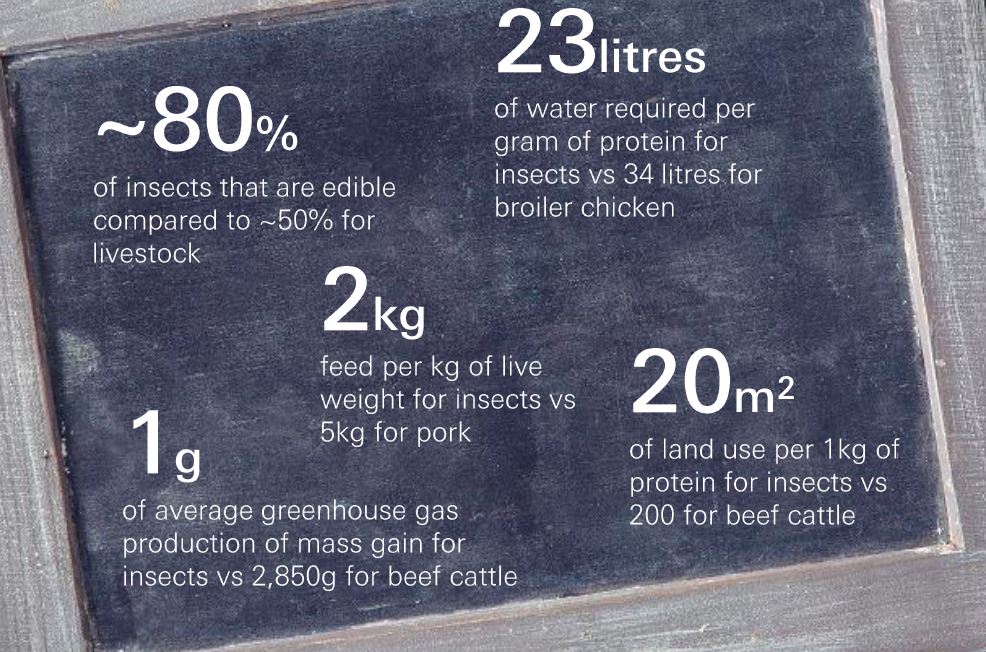
Source: Food and Agriculture Organization of the United Nations
1. The menu: An exclusive edible insect excursion
Welcoming drinks
Insects could be the key to resolving malnutrition and future food insecurity problems exacerbated by climate change. They’re widely available and offer ample macronutrients and micronutrients. In addition, insect farming requires fewer natural resources, while generating less waste and emissions compared to conventional livestock farming.
We think consuming insects as a major protein source, instead of livestock, could help mitigate the environmental impact of the agricultural sector. It also allows the global food system to adapt to changes brought about by climate change.
Main course
Governments are aware of the risks and opportunities that increasing the consumption of insects in diets could bring. Poland is proposing an ‘anti-bug’ law that requires a warning label on food products containing insects, while Italy now requires strict labelling of the use of insect flour in traditional food products such as pasta and pizza. Some places are more receptive: Singapore and the EU, for example, have approved certain insects for human consumption. However, the acceptance of edible insects varies across regions and cultures.
Dessert
The increase in occurrence of extreme weather events will lead to a shrinking supply of animal-based protein. Insect protein can be an alternative. However, the ‘yuck factor’ remains a concern. Researchers have found that when the natural form of insects is hidden in familiar foods, consumers are less resistant to consuming them. For example, cupcakes made with cricket flour tend to be more acceptable than a cricket lollipop.
Percentage of recorded edible insect species per group globally
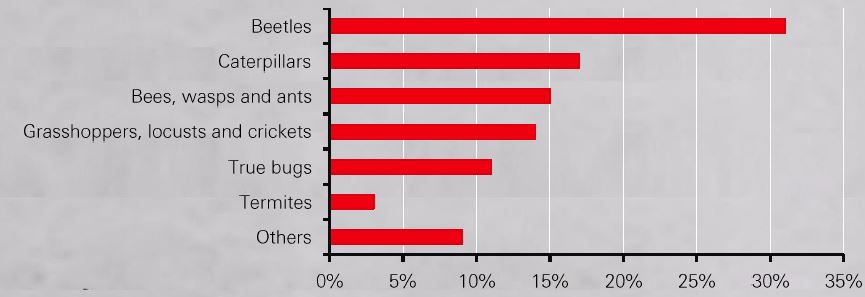
Note: True bugs: a hemiptera is an order of insects commonly called 'true bugs', comprising over 80,000 species within groups such as cicadas, aphids & planthoppers. Source: Food and Agriculture Organization of the United Nations
2. Sustainability in eating insects
Eating insects might be an ideal solution for some of the food insecurity problems we face. For example, extreme weather worsens the severity of swarming locusts and exacerbates food insecurity in Africa. Swarming locusts used to be eaten by humans and animals during locust outbreaks when crops were destroyed.
However, due to extensive use of insecticides, the consumption of locusts is not recommended nowadays. In many developed countries, the safe harvesting of locusts for humans and animals could serve as a more sustainable management method compared to the use of insecticides.
Big edible insect buffet, but tiny livestock ‘amuse bouche’
Animal-based protein is becoming more expensive, largely driven by years of drought conditions and inflation in the cost of feed and fuel. Compared to animal-based protein, insect protein is more efficient and reliable for human consumption, with around 80% of insects being edible vs c50% for livestock. In addition, insects’ energy conversion rate from feed to edible weight is significantly higher than livestock, their abundance is high while their reproduction cycle is shorter than vertebrates. As a result, the supply of insect protein is more scalable.
Nutrition of insects
Insects provide all the essential amino acids for human nutrition. Yet, some insects have high sodium content and high saturated fat. The sodium content of an adult cricket is more than double that of beef or pork. Thus, if insects are to replace conventional livestock to prevent diseases related to over-nutrition in the community, we need to be aware of any downsides.
Edible insects and livestock – nutritional value
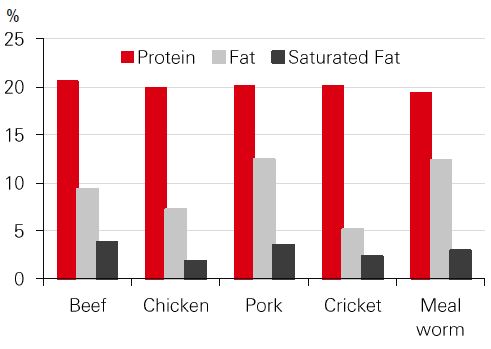
Source: European Journal of Clinal Nutrition
Edible insects and livestock – vitamin and mineral content
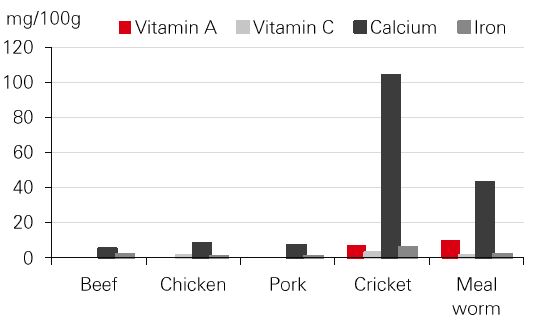
Source: European Journal of Clinal Nutrition
Saviour of food insecurity?
Apart from insects’ high nutritional value, the circularity and resilience of the insect food system make edible insects a means to fight food insecurity. Insects can transform food waste into nutritious biomass, while insect frass can be used as a fertiliser. Farming insects has little dependency on other external factors and the insect food system, making the insect food system highly sustainable.
3. Challenges incorporating edible insects into meals
Farming insects is complicated
Insect farming can lead to negative impacts on the environment if it’s performed inadequately. Some insects aren’t suited to be farmed in a captive and enclosed environment. The living condition of insects should be optimal for their species, otherwise, it might cause fighting and induce stress. Also, farming non-native insect species might harm domestic biodiversity. Regulators should look into species-specific measures to ensure insects’ welfare is protected.
Testing the tolerance level
It would require the elimination of the ‘yuck factor’ towards eating insects to successfully promote them as a common protein source. Many would see insects as a symbol of rot and pestilence. In order to gain broader public acceptance of insect consumption, researchers have been trying out different strategies. For example, edible insects have been served in school meals in four primary schools in Wales as researchers explore young people’s attitudes to alternative proteins.
Also, consumers are found to be more willing to try insects when their natural shape is hidden and they’re incorporated into foods they’re familiar with, such as grounded insects being blended into baked goods or protein shakes. There is growing variety and supply of insect- infused food in the market to cater to different dietary preferences and understand consumer acceptance.
The flavour profile of edible insects

Source: Institute of Culinary Education
Countries are paying more attention to edible insects
Governments are starting to recognise the importance of insect protein in future diets. Regulators are stepping in to oversee the novel food industry and build consumer trust. The Singapore Food Agency, for example, has given approval for 16 species of insects (including crickets, silkworms and grasshoppers) for human consumption from 2H 2023. In the EU, four applications for insects for human consumption have been approved, with eight more applications pending authorisation.
However, there’re still concerns over the safety of directly eating edible insects or eating livestock that are fed by insects. Insects can host microorganisms and some can do harm to humans. Regular updates on regulatory frameworks and controls over production and marketing can drive the expansion of the edible insect market by building consumer confidence.
4. Conclusion
Despite all the environmental benefits of eating insects, it would require a change in consumer psychology for insects to become one of the major protein sources. Concerns mostly revolve around the ‘yuck factor’ of eating insects and food safety. These are just some factors that need to be resolved to promote insects as a mainstream protein. However, we think the growing severity of the climate crisis and food insecurity will push countries to reconsider the food system and pay closer attention to the development of insect protein. We believe insect protein will play a more important role in our diets in the near future.
https://www.hsbc.com.my/wealth/insights/esg/why-esg-matters/2024-06-14/

