



like_count_tpl like_count_text_tpl
like_tooltip_tpl
comment_count_tpl comment_count_text_tpl
comment_tooltip_tpl
Economic Updates
Why ESG Matters: Heat on holidays: tourism in a changing climate

Tourism, as we know it, is changing in the face of rising temperatures and extreme weather events. Particularly in coastal tourism, a stormy future looms as climate impacts, including rising sea levels, put its resilience to the test. We think adaptation measures will play an important role in keeping vulnerable coastal tourism afloat.
In this issue of #WhyESGMatters, we discuss the likely impacts of heat stress on global tourism, with a particular focus on coastal tourism. We also look at various adaptation methods that countries can implement to reduce the impacts from climate change.
Did you know?
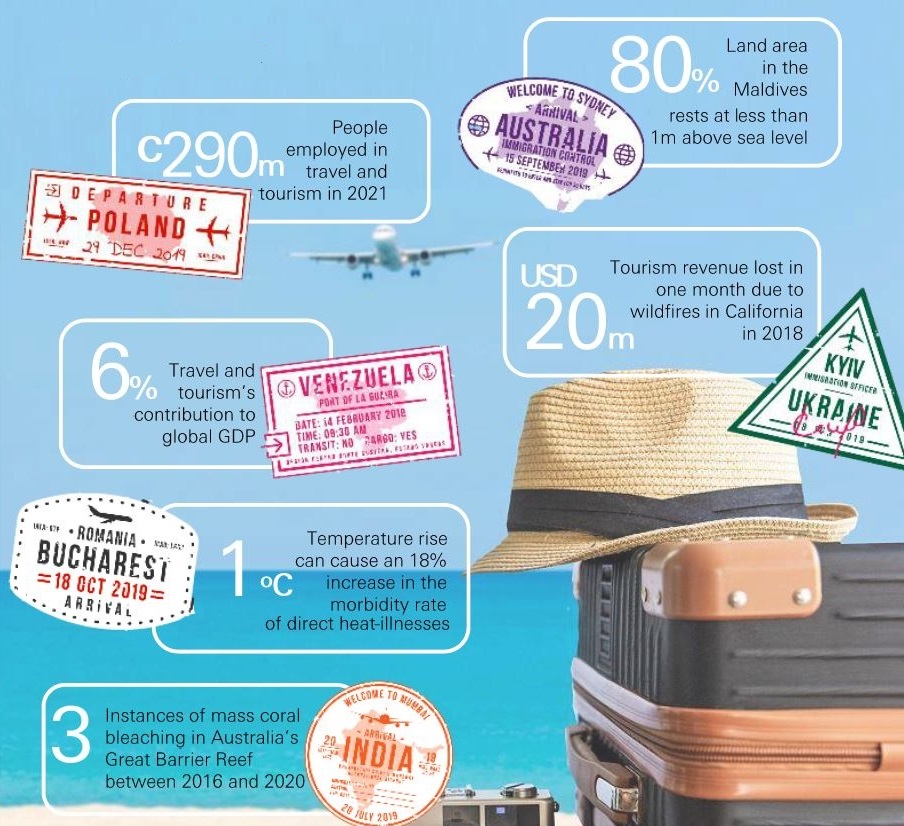
Sources: World Travel & Tourism, World Bank, Great Barrier Reef Marine Park Authority, Visit California
1. Heat changing holidays
The travel and tourism industry, which contributed nearly 6% of global GDP and employed nearly 290m people in 2021 (as per the World Travel & Tourism Council), faces a myriad of challenges due to extreme temperatures (Figure 1). Relentless heatwaves pose serious health risks, such as dehydration and heatstroke, deterring tourists from venturing outdoors and hampering the industry’s usual vibrant activity.
An article published in the journal Science of the Total Environment in 2022 highlights evidence that a 1°C rise in temperature can lead to an 18% increase in direct heat illness morbidity. Further, smaller and less affluent economies may struggle to cope with mounting cooling demand, as travellers seek respite from the scorching heat. The heightened demand for air-conditioned spaces is also likely to cause a sharp increase in energy consumption, putting strain on local energy grids and increasing emissions.
Figure 1. Global warming is likely to increase the number of extreme temperature events
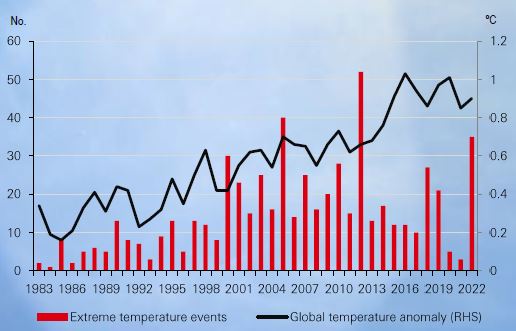
Source: EM-DAT, CRED / UCLouvain, Brussels, Belgium – www.emdat.be, NOAA. Note: Temperature anomaly are with respect to the 20th century average (1901-2000)
On the move
Sweltering weather is affecting travel plans. In July last year, the European Travel Commission (ETC) reported a decline in travel intent in Europe compared to previous years. Additionally, the popularity of Mediterranean destinations was found to have declined by 10% compared to the year before. On the other hand, destinations such as Bulgaria and Denmark are becoming increasingly popular due to their milder temperatures.
Although there is uncertainty about how tourists will respond to the effects of a changing climate, various popular tourist spots are likely to lose their appeal, paving the way for some lesser-known destinations to shine. This shift in traveller sentiment is likely to have a considerable impact on economies that rely heavily on tourism income.
2. Coastal tourism strains
Beaches are popular holiday destinations, accounting for nearly 50% of global tourism. However, coastal tourism is facing an imminent threat due to climate change. The industry is the economic backbone for some of the world’s poorest economies, including the Small Island Developing States (SIDS), which are also among the most vulnerable to climate change.
While extreme weather events, such as cyclones and floods, have already posed immediate risks, it’s rising sea levels and ocean acidification that are setting alarm bells ringing. Moreover, secondary impacts, such as water availability and the spread of diseases, are also a growing concern for coastal communities and travellers alike.
Sea level rise
Many popular tourist spots, such as the Maldives, are at risk of being submerged due to rising sea levels. Indonesia also announced plans in 2019 to relocate its capital from Jakarta in response to the threat posed by rising sea levels. Global sea levels have already risen by 98.5mm since 1993, according to NASA. Furthermore, the average rate of rise is accelerating, tripling from 1.3mm/year between 1901 and 1971 to 3.7mm/year between 2006 and 2018. While the extent of sea level rise depends on emissions and uptake of heat by the oceans, 1bn people could be exposed by 2050. And by 2100, extreme sea level events that previously occurred once per century could strike at least once a year on many coasts.
Unfortunately, even under a low CO2 emissions pathway, the world may lose 53% of its sandy beaches, on average, resulting in a loss of 30% of hotel rooms and a 38% decline in tourism revenue by 2100. The imminent risks of shorelines being eroded, tourism infrastructure being inundated, and an increased likelihood of extreme weather events could lessen the recreational value of popular coastal tourist spots, potentially affecting business operators, such as resorts and hotels, water sports and tour operators (snorkelling and diving), ports and airlines.
Marine heatwaves and ocean acidification
The increased intensity and frequency of marine heatwaves are likely to cause coral reefs to undergo irreversible changes and disrupt marine life, affecting the character of the coastal landscape. For example, a recent marine heatwave that started to emerge in June last year along the coast of Queensland in Australia is raising concerns for the already vulnerable Great Barrier Reef.
The World Economic Forum has estimated that 50% of the world’s coral reefs would be under threat by 2035 in the absence of climate risk mitigation. This presents a daunting challenge for coastal tourism as marine exploration activities, such as scuba diving, rely heavily on these vibrant underwater ecosystems.
Growing risk
Rising temperatures will significantly impact other tourism sub-sectors too:
Eco tourism: A study by the European Commission projected increased diversity of land-bird species in higher latitudes and decrease in diversity in mid-latitudes by 2050, based on a moderate-to-high greenhouse gas emission scenario. Climate-induced shifts in species distribution can affect eco-tourism, such as safari operators, whereby declining animal populations make human interaction more difficult.
Snow-based tourism: Rising temperatures may result in erratic snowfall patterns and shrinking snowpacks, shortening skiing and snowboarding seasons. Several ski resorts across the Alps closed in 2023/24 due to a lack of snowfall. Resorts at lower elevations are likely to be more severely affected, as they have less snowfall and thus have shorter tourism seasons.
Forest-related tourism: Heatwaves and droughts are associated with high risks of wildfires. Between 1979 and 2013, the global burnable area affected by long fire weather seasons experienced a twofold increase, while the average duration of the fire weather season rose by 19%. The increased frequency and intensity of wildfires are likely to negatively affect tourism by limiting recreational opportunities and reducing access to national parks. According to a study conducted by Visit California, wildfires in California in 2018 resulted in an estimated loss of USD20m in tourism revenue in just one month.
3. Rising to the challenge
The COVID-19 pandemic exposed the vulnerability of the tourism sector. Poor countries that heavily rely on tourism are poised to face significant challenges, including social unrest, as the flow of tourists slows due to impacts of a warming climate.
Adaptation measures, better forecasting and early-warning tools, and disaster risk management will play an important role in the tourism sector’s response to the impending risks. Infrastructure, such as seawalls and breakwater structures, and conservation of natural systems, such as mangroves, are important coastal protection measures.
Accommodation strategies, such as elevating key infrastructure and houses, can help reduce the impact of flooding. For instance, elevated houses built 1.5m above ground are subsidised by the government in the Tuamotu Archipelago, which is extremely prone to flooding.
Several regions have also been adopting ecosystem-based measures to respond to climate change. Artificial reefs have been increasingly used to support reef restoration in countries such as Antigua and Grenada. In Vanuatu, tourism businesses have been involved in establishing marine-protected areas to address climate-related risks.
As the impact of climate change continues to escalate, adaptation measures will become increasingly crucial in safeguarding vulnerable regions. However, we think it’s imperative to acknowledge that long-term resilience relies on a broad-based approach, combining adaptation strategies with global efforts to substantially reduce greenhouse gas emissions.
4. Conclusion
Rising emissions and climate change pose additional challenges beyond the immediate heat issues. In this note, we explored a range of other climate change impacts on the tourism sector, with a focus on coastal tourism. We think governments, businesses and investors must plan collaboratively for the long term – assessing exposure and working towards transformational adaptation to safeguard the tourism industry.
https://www.hsbc.com.my/wealth/insights/esg/why-esg-matters/2024-03-28/

