



like_count_tpl like_count_text_tpl
like_tooltip_tpl
comment_count_tpl comment_count_text_tpl
comment_tooltip_tpl
Economic Updates
Why ESG Matters: Aviation on the radar: Please read the safety card

Key takeaways
- Recent turbulence events raised awareness of the impact of climate change on flying – but there are other aspects to it.
- Severe winter storms, heatwaves, and stronger jet streams could impact the operations of the aviation industry, in our view.
- The aviation industry will evolve to deal with climate change and build resilience through investing in adaptation methods.
Air travel is likely to be disrupted by the impact of climate change as more severe winter storms, hotter summer heatwaves and stronger jet streams impact flight operations. In this report, we discuss how aviation-related businesses, including airlines, airports and aircraft manufacturers, need to build resilience through investing in adaptation methods to reduce the incidence of flight delays and cancellations, and the resulting human and financial costs.
Did you know?
- The Arctic blast in January 2024 caused more than 16,000 flight delays in the US
- Recycled aircraft de-icing fluids could cut de-icing emissions by 40-50%
- Incidents of severe turbulence rose by 55% from 1979 to 2020
- More than 50 American Airlines flights were cancelled in Phoenix in June 2017 due to temperatures exceeding 47°C
- The strongest jet streams could speed up by c2% for every 1°C of global warming
- Strong jet streams in winter 2024 propelled commercial aircraft to ground speeds of over 800mph vs. the usual 575mph
- Every 3°C increase in temperature reduces lift by 1%
- 14 passengers were offloaded from British Airways flights at London City Airport during the 2018 heatwaves due to weight restrictions
Source: What causes air turbulence and is the climate crisis making it worse?, Guardian, 21 May 2024, Johnson E. P., Aircraft deicer: Recycling can cut carbon emissions in half, January 2012, Flight Aware.
Travel checklist
The need for adaptation measures
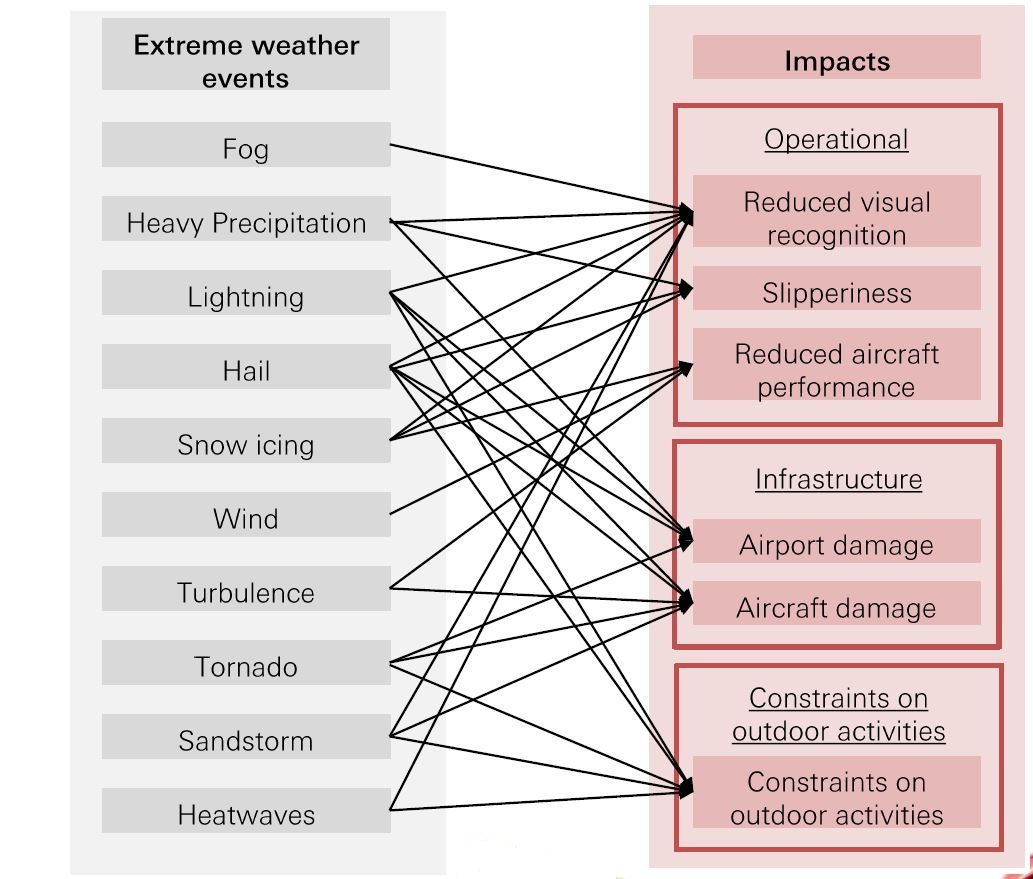
There has been much public discussion about how the aviation industry has intensified climate change, but relatively less that examines the impact of climate change on the aviation industry. For example, some extreme weather events have become more frequent and severe, which could lead to air travel disruptions. Aviation has been, and will need to be, more prepared for the potential changes brought about by climate change.
Impact of extreme weather on the aviation industry
Source: HSBC (based on Kreuz M. et al., Effect of restricted airspace on the ATM systems, July 2016)
Winter travel guide
Winter storms and pre-departure check
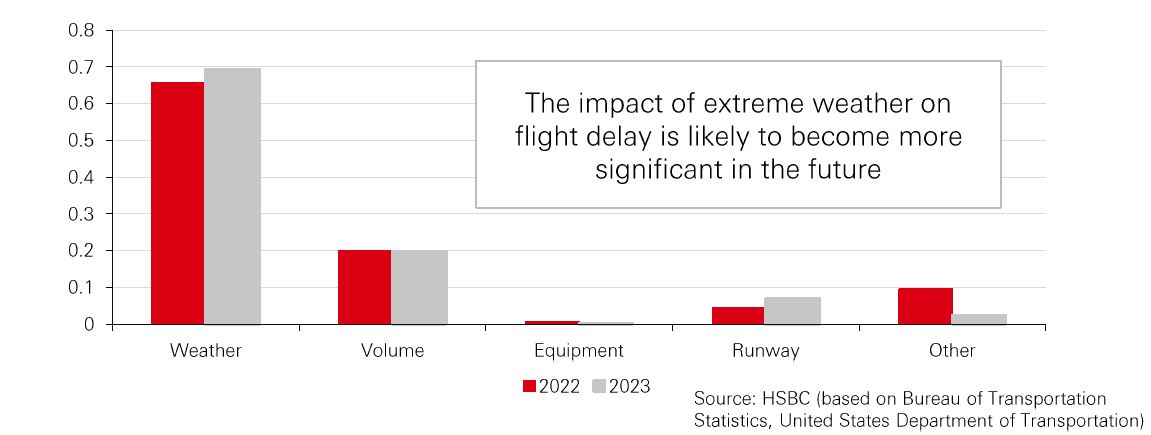
Blizzards, winter storms, snow and reduced visibility are predicted to become more intense, despite shorter winters and rising temperatures. A recent example was the January 2024 Arctic blast that caused thousands of flight cancellations and more than 16,000 flight delays in the US. That said, we think extreme weather events are likely to cause more disruptions to air travel than continuous winter weather conditions in the future.
Carrier flight delays at departure by cause in the United States
Source: HSBC (based on Bureau of Transportation Statistics, United States Department of Transportation)
De-icing infrastructure
Climate change could also increase the incidence of icy conditions, as warmer air, holding more moisture, brings higher levels of rain and snow. Indeed, small amounts of frost and ice on a plane can interfere with takeoff, so we think airlines will need to strengthen their winter infrastructure, including de-icing equipment, workers with de-icing training and aircraft with efficient de-icing technology, to ensure smooth operations. However, these could lead to higher operating costs during the winter and an increase in the financial costs of flight delays.
Airports that aren’t usually affected by icing conditions would also need to be prepared for extreme weather events by upgrading their de-icing infrastructure. A disrupted polar vortex causes cold air to move south and brings unusually cold air to mid-latitudes, while a stable polar vortex would contain the cold air around the North Pole. With climate change likely to result in more frequent polar vortex disruptions, airports would need to prepare for extreme winter conditions in mid-latitude areas, such as Texas and the Gulf Coast.
Summer travel guide
Heatwaves and taking off
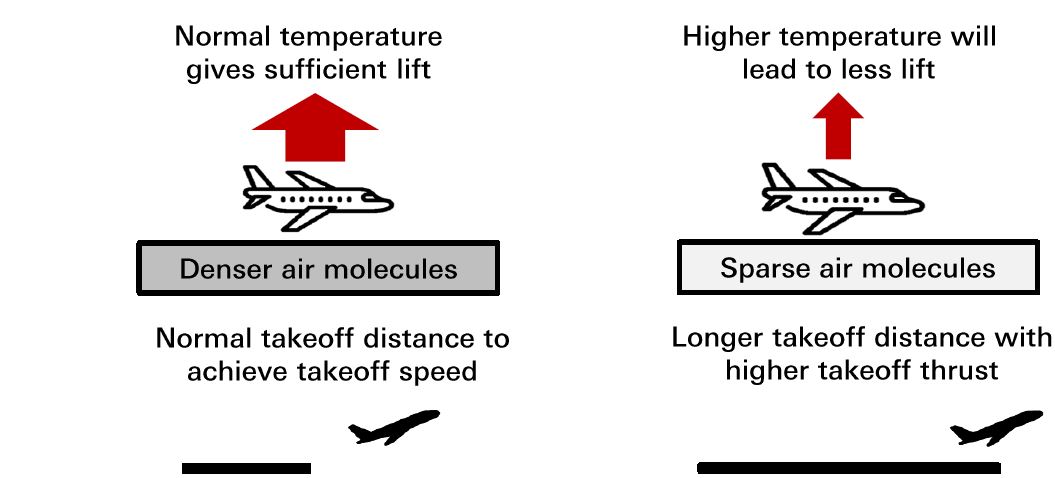
Heatwaves can also impact flight operations, including the lift an aircraft can generate. Air expands when it heats up, meaning its density becomes lower, affecting lift. In general, every lift reduces by 1% for every 3°C increase in temperature. Planes, therefore, would need longer to reach speeds that can generate sufficient lift for takeoff. However, there are several ways to overcome this, including reducing the weight of the plane or extending the runway.
The impact of hot air on flying is, therefore, more significant at airports with short runways. We think airports that fall into this category might need to upgrade their infrastructure (i.e., longer runway distance) to cope with the increase in the number of days with extreme heat. However, some airports have no space to expand due to geographical constraints or dense neighbourhoods in the vicinity. These airports might be disrupted the most.
The impact of air temperature on aircraft lift and take-off
Source: HSBC
Will there be more airports operating 24/7?
Aircraft manufacturers have been looking for ways to make planes lighter and more efficient during hot days. However, further gains are likely to require the invention of revolutionary new materials. Quite simply, the most effective way to avoid the heat is to take early morning and late-night flights, as these are less likely to be affected by the heat.
Another advantage of scheduling more flights during the cooler hours of the day is to avoid airport workers’ exposure to extreme heat. The temperature of taxiways and runways is usually much hotter than the atmosphere around the airport. Airport operators would need to be aware of protections and guidance provided for the workers during hot days.
Frequent travel guide
Jet stream and cruising
Climate change will lead to faster jet stream winds, the strongest projected to speed up by about 2% for every 1°C of global warming and have multiple implications for flying.
Stronger jet streams can speed up flights when travelling in the same direction, as the planes get an additional push from the wind, which increases their relative ground speed. However, the four main jet streams only travel from west to east, so planes flying in the opposite direction are more likely to face stronger headwinds, causing more delays and in some extreme cases, additional or unexpected refuelling stops.
The risk of encountering clear-air turbulence (CAT) - turbulence with lower moisture content that is less detectable by conventional radar - also rises with stronger jet streams. Research shows that changes to the jet stream due to global warming will increase CAT by 113% over North America and as much as 181% over the North Atlantic by 2030 to 2050, and that turbulence may cost US airlines as much as USD500m annually.
Severe turbulence may cause substantial aircraft damage, and we think compensation claims from injured passengers, as well as associated maintenance and repair costs, could grow with more incidents. Advanced development of weather detection and prediction systems is important for pilots to better understand CAT and to enhance the safety and comfort of flying. This can also reduce fuel used to navigate around turbulent air, lowering operating costs.
Conclusion
The aviation industry is vulnerable to the increase in the intensity of extreme weather events, which could become increasingly costly. The industry needs to actively assess potential impacts and take relevant actions to adapt to climate change. In our view, investing in technological advancements in weather detection and forecasting, as well as upgrades to equipment and infrastructure, can help the industry adapt to some of the impacts of climate change in the longer term.
https://www.hsbc.com.my/wealth/insights/esg/why-esg-matters/2024-11-27/

