



like_count_tpl like_count_text_tpl
like_tooltip_tpl
comment_count_tpl comment_count_text_tpl
comment_tooltip_tpl
Economic Updates
Why ESG Matters: AI: Friend or foe for net zero transition?

Key takeaways
- Artificial Intelligence (AI) is transforming the way we live. It links to our potential to deliver a speedy net-zero transition through several channels.
- The emissions associated with energy used help in catalysing funding for the transition. Using technology for monitoring, policing and predicting disruptions to livelihoods are all relevant.
- Taking all of these influences into account, we think the growth of AI is beneficial for delivering and managing net zero positive outcomes.
Artificial intelligence (AI) offers many positives to help speed up the transition to a net zero world. Our main questions are whether it will speed up or slow down emissions control, whether it can help channel capital for low-carbon financing, and how it can help monitor and predict the consequences of warmer temperatures. As we discuss in this report, on balance, we think the growth of AI is a positive for net zero delivery and provides governments with a toolkit to progress net zero ambitions.
Did you know?
- 10x more energy is consumed for AI powered search versus standard keyword search
- AI consumes 1.2% of total power demand, which is additive to the electricity, and therefore emissions, picture
- Data centres use c4.4% of total US electricity, equivalent to the average annual consumption of 14m US households
- China’s power consumption from AI could be c5x higher by 2030 than now, an annual growth rate of c32%
- Global data centre spending is expected to reach over USD1trn by 2029, with half of this attributable to AI
- AI can improve the efficiency of installed wind turbines by up to 20%, their lifespan by up to 10% and reduce costs by up to 15%
Source: de Vries, Alex, The growing energy footprint of artificial intelligence, Joule, 18 October 2023; Powering Intelligence: Analysing Artificial Intelligence and Data Centre Energy Consumption, EPRI, 28 May 2024; ‘Next-Gen Wind Farms: Dell’Oro Group, 2025; Wind Turbine Optimisation with AI’, Datategy, 17 January 2024
Speeding up the net zero transition
AI is experiencing unprecedented traction and is reshaping various industries. It’s enabling smart decision-making by leveraging advances in machine learning, natural language processing and generative modelling. There are several ways in which the growth of AI has read-across for the speed of delivering a net zero economy.
1. Emissions control
The increasing adoption and sophistication of AI models are leading to greater power demand and in turn, impacting emissions levels. Indeed, carbon emissions for the training of more recent AI models have increased significantly, with GPT-3 (released in 2020) emitting 588 tons, GPT-4 (2023) emitting 5,184 tons, and Llama 3.1 405B emitting (2024) 8,930 tons.
On the positive side, AI can help drive the energy transition if new data centres are in places where clean power is already used or can be scaled up. Alternatively, above-forecast power consumption from data centres in areas with more carbon intensive fuel sources (e.g. coal) will likely add more CO2 than expected from business-as-usual pathway assumptions.
Current AI trends would likely add to the emissions picture, given that fossil fuels account for 60% of the global power mix, although this hides the locational aspect of data centres. If the power sector decarbonises faster than the energy demands of advanced AI, this would be a win for the net zero transition. Separately, AI monitoring tools can help manage emissions in the land-use change and forestry sectors, which is a positive for a net zero outcome.
Power use is up 28% in the last 10 years; renewables are growing in share
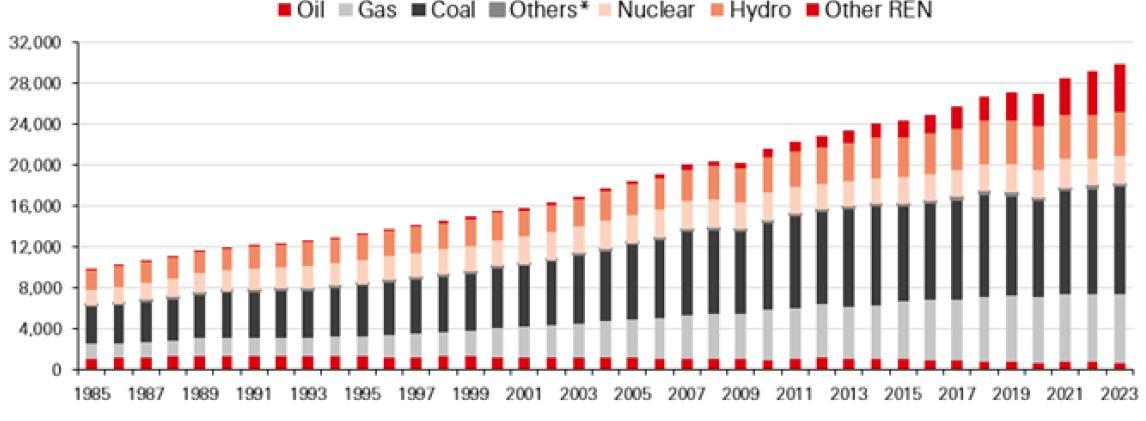
Source: 2024 Energy Institute Statistical Review of World Energy. Others*: Based on gross output that includes uncategorised generation, statistical differences and sources not specified elsewhere, e.g. pumped hydro, non-renewable waste and heat from chemical sources.
In terms of renewables, AI can help reduce emissions by optimising energy integration, storage, distribution and forecasting production. A significant problem faced by the adoption of renewable energy is intermittency; integrating AI helps manage fluctuations, ensuring a stable and reliable supply. Predictive maintenance also helps reduce downtime and repair costs.
2. Financing a net zero future
The Independent High-Level Expert Group on Climate Finance estimates that, by 2030, between USD6.3trn and USD 6.7trn per year will be needed globally to meet climate goals. This includes substantial investments in the clean energy sector, loss and damage, natural capital and just transition. We think there’re three channels through which the growth of AI can help fund the energy transition:
i. Catalysing renewable energy investment: Increased interest in data centre hub locations could spark further grid investment and more efficient processes for streamlining projects. Ireland, for example, recently injected EUR750m into developing its electricity grid to cater to increased AI demand.
ii. Contributing to GDP: Funding for the low-carbon transition will come from a variety of sources, including country public finances and sovereign wealth funds. As AI grows as a sector, it becomes an increasingly important contributor to GDP. PwC estimates that AI could contribute up to USD15.7trn to the global economy by 2030.
iii. Improving access to capital: AI technology can help attract investment into nature-based solutions by providing more robust analysis of projects, such as improving data accuracy, monitoring carbon footprints and optimising project selection, which ensures investments are directed toward impactful initiatives.
By 2030, contribution of AI to GDP by region
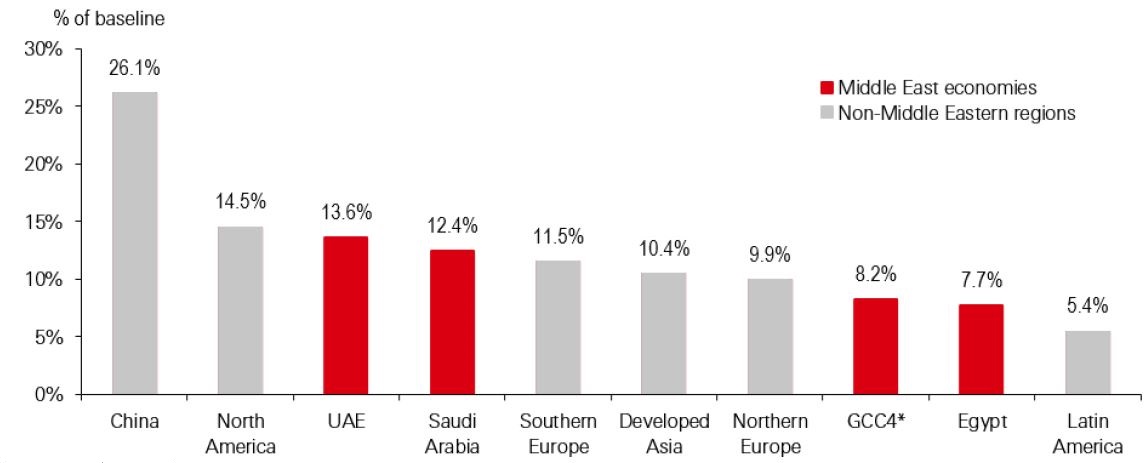
Source: PwC, HSBC
*Note: GCC4 includes Bahrain, Kuwait, Oman and Qatar
3. Building resilience to disruptive impacts
Inclusive resilience relates to productivity, both in terms of people’s ability to find roles in transition sectors and human activities linked to productivity in their jobs. Additionally, within a country, the levels of social equity impact its ability and willingness to transition. We believe AI can be a powerful tool for managing environmental impacts, alongside enhancing economic productivity.
Applications include monitoring and predicting extreme weather events, managing biodiversity conservation, addressing food loss and waste challenges and providing optimal utilisation of resources. This enables labour productivity by minimising work-hour loss due to unforeseen circumstances, such as road closures from flooding that delay employees from getting to and from work.
Governance
We think a lack of data on the precise scale of AI’s environmental impacts hinders policymakers’ and investors’ ability to fully assess risks. Current regulatory initiatives on data centres focus on optimising energy efficiency and mainly set minimum targets or guidelines for firms. Indeed, the European Commission requires data centre operators to report annually on energy and water use, waste heat reuse and renewable energy consumption.
In our view, enhanced disclosure requirements and assessment frameworks across AI supply chains are needed to bring more clarity to investors, governments and other stakeholders. The following aspects should be considered:
- AI compute: The production of, and the end-of-life strategy for, hardware components affect the lifecycle impacts of AI systems
- Infrastructure (e.g. data centres): The location, electricity sources, materials, water and other resources, as well as how facilities are connected, built and managed at the end of their life, are all relevant considerations
- Data and algorithms: Approaches to data collection, transmission, storage and management, as well as model design and training choices, can reduce the energy demands of AI models
- Deployment of AI: The behaviour of end users plays an important role in determining the overall environmental footprint of AI systems.
As some markets are currently developing or looking to implement mandatory reporting requirements for climate-related disclosures in line with the International Sustainability Standards Board’s standards, we think there’s an opportunity for policymakers to determine how these reporting requirements should be applied by AI developers and users, data centre operators and hardware manufacturers.
Conclusion
How emissions are controlled is relevant to investors because country plans and economic rationale define climate goals, which impact the energy system and connect to economic activity. AI is relevant in this context because the increased adoption and sophistication of AI models lead to increased power demand, in turn impacting emissions levels.
The emissions associated with energy used and the use cases for process optimisation, help in catalysing funding for the transition, and using the technology for monitoring, policing and predicting disruption to livelihoods are all relevant. Taking all these influences into account, we think the growth of AI is beneficial for delivering and managing net zero positive outcomes.
https://www.hsbc.com.my/wealth/insights/esg/ai-friend-or-foe-for-net-zero-transition/

