



like_count_tpl like_count_text_tpl
like_tooltip_tpl
comment_count_tpl comment_count_text_tpl
comment_tooltip_tpl
Economic Updates
FX Viewpoint: USD: Further weakness after near-term consolidation

Key takeaways
- Geopolitical risk has receded for now, but could still prompt occasional support for the USD if the situation changes.
- In our view, the USD is likely to consolidate over the next few weeks, but with risks skewed towards additional weakness.
- US trade and fiscal policy uncertainty lingers and structural pressures build, suggesting a weaker USD in the months ahead.
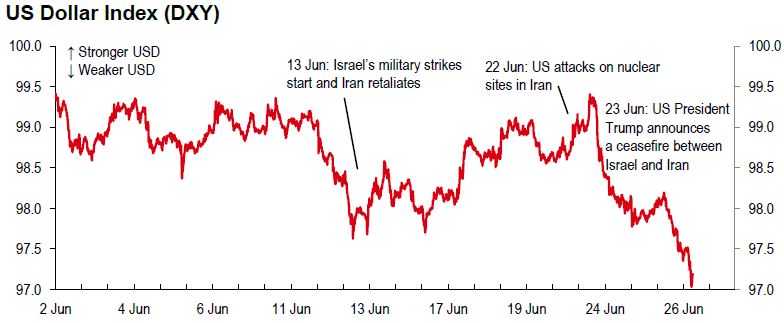
The USD rally during the Israel-Iran military conflict, though short-lived, was revealing insofar as it showed that for all the questions being posed by the FX market about the USD’s merits, it is still where we scramble if geopolitical tensions are rising (see the chart below). If the recently agreed ceasefire between Israel and Iran holds, the USD is likely to consolidate over the coming weeks; but the risk of periodic USD spikes higher remains should the situation change.
Source: Bloomberg, HSBC
The coming weeks could be pivotal in shaping the path for the USD if we get clarity on US trade policy, US budget outlook, and the consequent most likely path of the Federal Reserve’s (Fed) monetary policy. Specifically, we will face a deadline on the tariff pause on 9 July, the final stages of efforts to pass a budget through US Congress, and the run-up to a 29-30 July Federal Open Market Committee (FOMC) meeting.
Clarity on where US trade policy will ultimately land is likely to remain elusive. On this front, US Commerce Secretary, Howard Lutnick, said the US and China finalised a trade understanding reached last month in Geneva, and added that the White House has imminent plans to reach agreements with a set of 10 major trading partners (Bloomberg, 27 June 2025). Structural USD concerns might be alleviated if the US Congress can deliver a budget that does not point to a blowout deficit. However, time is running out to meet the US administration’s aspiration to have an agreed budget in place by 4 July. All this should keep the Fed on the sidelines, despite recent openness from some members to a July cut. Without fresh catalysts, the USD is likely to grind, albeit with downside risks, in the near term.
Going into 2H25, our framework suggests that the USD has room to weaken moderately. The cyclical component is not obviously negative for the USD if both the US and global economies are slowing. However, the policy factor has been weighing on the USD and it may not be calmer going forward when many trade discussions are ongoing and deals are still light on detail. Meanwhile, the structural de-dollarization force is showing signs of growing importance.
https://www.hsbc.com.my/wealth/insights/fx-insights/fx-viewpoint/usd-further-weakness-after-near-term-consolidation/

