



like_count_tpl like_count_text_tpl
like_tooltip_tpl
comment_count_tpl comment_count_text_tpl
comment_tooltip_tpl
Economic Updates
Why ESG Matters: Towards a green day for music

Key takeaways
- Revenues from live music events are on the rise as festivals and concert attendance reaches record highs.
- But stakeholders should note major sustainability risks, such as travel emissions, and increasingly, biodiversity loss.
- Investors should also examine the impact of streamed music on industry emissions and advocate for enhanced practices.
Revenue from live music events is increasing as festival and concert attendance reach record levels. However, as discussed in this report, stakeholders should be mindful of significant sustainability risks, such as travel emissions and biodiversity loss. Investors should also examine the impact of streamed music on industry emissions and advocate for enhanced practices.
Did you know?
- Live music events generated revenue of USD34.84bn in 2024 versus music industry’s trade revenue of USD29.6bn
- Power use accounts for almost 2/3 of a live event’s operational carbon footprint
- Nearly 30 tonnes of waste was collected at Wembley Stadium event, which was attended by 77,000 fans
- Greenhouse gas emissions from the US music industry almost doubled from 200,000 tonnes of CO2 to 350,000 tonnes of CO2 between 1977 and 2016
- Estimates suggest that between 36g CO2 and 77g of CO2 are emitted during every hour of video streaming
- High-intensity noise pollution can reduce the activity of bats by 47%
Sources: Custom Market Insights, Global Live Music Market 2025-2034; The Powerful Thinking Guide: Smart Energy for Festivals and Events, 2017; Brent Council Planning Committee Report, April 7, 2021; 'Ever wondered how we clean up Wembley Stadium after a game?’, The FA, 28 August 2019; The Cost of Music, Kyle Devine, the University of Oslo, Dr Matt Brennan, the University of Glasgow, 2019; G Kamiya, The carbon footprint of streaming video: fact-checking the headlines, IEA, 11 December 2020; J Hoker et al., Assessing the impact of festival music on bat activity, Ecological Solutions and evidence, 30 June 2023.
The greening of live music events
Live music events, including concerts and festivals, are major revenue earners for the music industry. In 2024, these events generated USD34.84bn, surpassing the USD29.6bn from music industry trade revenues, which include streaming, physical products, performance rights, synchronisation, and downloads.
Fan attendance continues to hit new highs, and live event revenues are projected to grow four times faster than overall consumer spending. While this boom benefits local economies, it also brings higher environmental costs, affecting the sustainability of these events in the following ways.
- Transportation – Fans and artists travelling to the venues, whether by road or air, are the biggest contributors to a venue’s carbon footprint (Figure 1).
- Venues – Food wrappers and plastic cups are a usual occurrence on the floors of music venues after events, producing tonnes of waste that requires sorting and disposal.
- Merchandise – Printed artist T-shirts are fan favourites; however, their production and disposal face the same issues as the fashion industry. These items are often cheaply made with low-quality materials that don’t last, adding to the fast fashion problem.
Figure 1: Carbon footprint of a tour
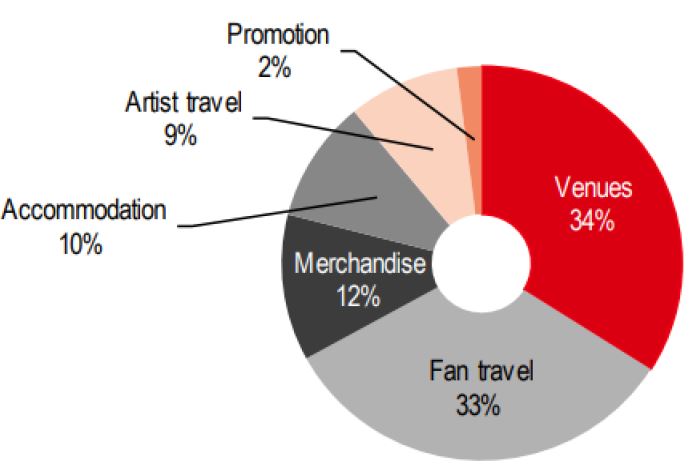
Source: BBC (2019)
Energy – Lighting, sound systems, heating and cooling requirements, instruments and refrigeration are all major contributors to a venue’s energy consumption. Power usage accounts for almost two-thirds of a live event’s operational carbon footprint. Research shows that live events are often inefficient in their power usage.
For example, Netherlands-based Watt-Now monitored 270,000 data points from outdoor events over a two-year period and found that 77% of generators being used had an average load of less than 20%. Generators using hybrid power are becoming best practice in the sector, although some alternative energy sources come with their own sustainability risks.
Music venues, e.g., stadiums – Beginning with design, venues must be adaptive to a changing climate, including rising temperatures and extreme weather events. Additionally, they must be constructed in a sustainable manner, adhering to labour rights and conditions.
Industry stakeholders and researchers have suggested several steps to improve the sustainability of the music industry, which we summarise in Figure 2.
Figure 2. Steps to improve the sustainability of the music industry
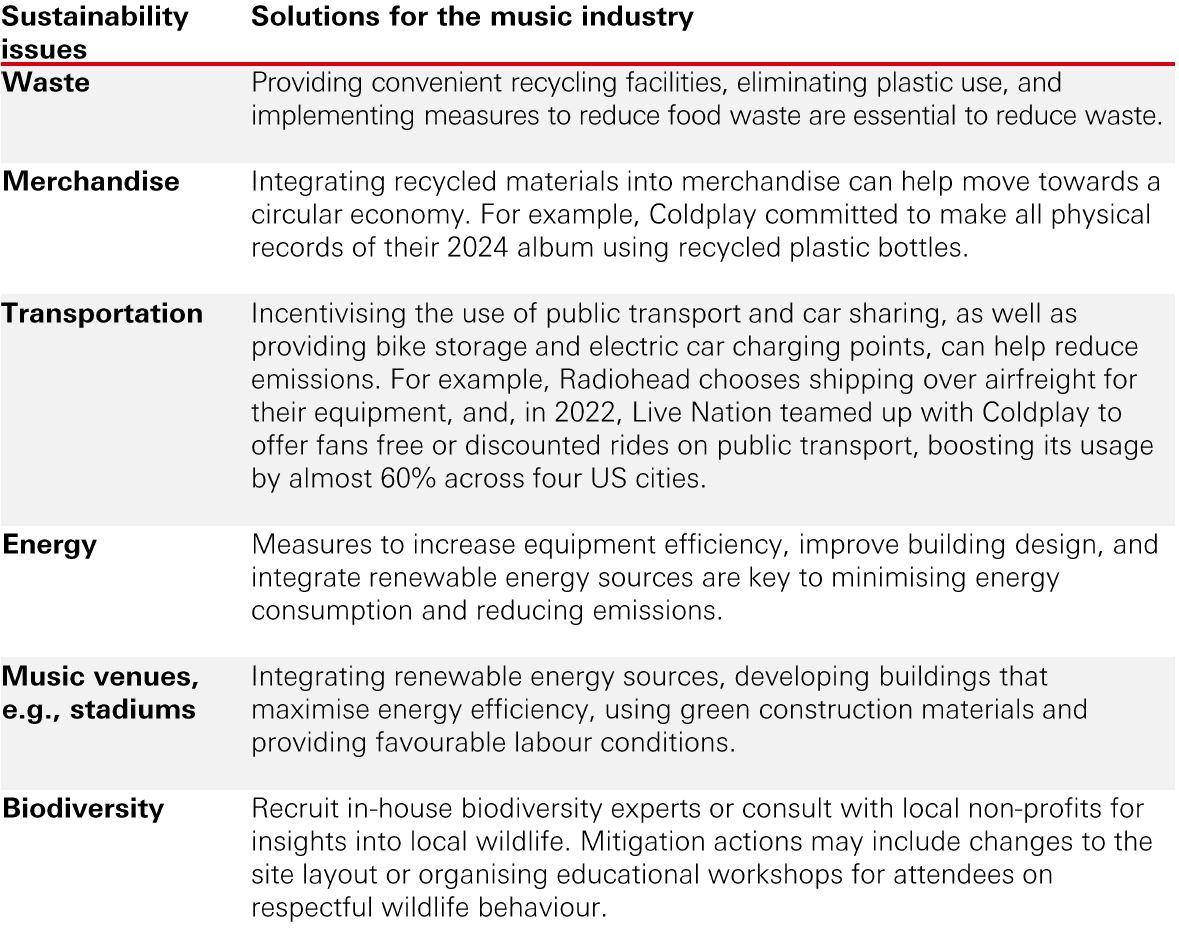
Source: HSBC
Let’s talk about streamed music
Some commentators expect the rise of live streaming, hybrid events and on-demand concerts/videos to lower the music industry’s the carbon footprint. But, in practice, the environmental impact of digital music is hard to evaluate. A joint study by the Universities of Glasgow and Oslo found that the US music industry’s greenhouse gas (GHG) emissions almost doubled between 1977 and 2016, from 200,000 tonnes to 350,000 tonnes of CO2, which has been attributed to the rise in streaming services. However, carbon emissions from streaming have been declining in recent years, despite a rise in total streaming activity.
Streaming of content involves data centres, content delivery networks, Internet transmission, and end-user devices like smartphones, TVs and tablets. Studies suggest that each hour of video streaming emits between 36g and 77g of CO2, but complexities in calculating the various elements involved, such as the energy efficiency of technology or energy/emissions allocation to shared elements, make it difficult to narrow the range to a more precise number.
Assessing global streaming emissions is challenging due varying emissions across markets, influenced by each country’s electrical grid factors. For example, the Carbon Trust notes that video streaming emits 55g of CO2 per hour on average in Europe, 76g in Germany and 32g in Sweden. As countries decarbonise their electricity supply and modernise their grids, reducing data transmission intensity, we expect the climate impact of recorded music to fall globally.
Greening of streaming
Investors are increasingly scrutinising how digital service providers address environmental impacts, especially those related to streaming. Despite efforts, challenges in calculation remain. For example, Spotify aims for net zero emissions by 2030 and has reduced the size of its mobile app, optimised cloud usage and introduced dark mode for TV to cut emissions. However, in 2023, the company excluded Scope 3 Category 11, ‘Use of sold Products’, from reported emissions, highlighting the lack of standardised measurement methodologies for streaming emissions. Stakeholder pressure on firms for more transparency in this area will likely continue to rise.
We think digital platform users should consider how they consume music as user devices make up the largest portion of the carbon footprint of music streaming (at just over 50%). To adopt more climate-friendly practices, music lovers can, for example, play music on smaller devices that emit less CO2, such as mobile phones rather than larger devices like TV, or download favourite songs for offline playback which also uses less battery capacity than streaming.
The industry is responding
Several live music industry participants, such as Live Nation Entertainment, have signed the “Festival Vision: 2025 Pledge”, committing to a 50% reduction in festival-related GHG emissions by 2050. On the music streaming front, major record labels, including Sony Music Group, Universal Music Group and Warner Music Group, joined forces in 2021 to sign a pact aimed at decarbonising the recorded music industry. This agreement requires signatories to either have verified science-based net zero targets or join the UN’s Race to Zero programme. In December 2023, these same record labels launched the Music Industry Climate Collective (“MICC”) to address challenges presented by global climate change.
For publicly listed music companies, investors should carefully evaluate the credibility of their emissions targets and transition plans. We think music can serve as a catalyst to affect cultural and social change and the live music industry can do more to improve its sustainability record.
Conclusion
The live music industry can use its popularity and platform to raise awareness of climate change and sustainability. Investors should also be aware of factors that contribute to the industry’s carbon footprint, especially from concert tours and streaming. On a global scale, the lack of harmonisation standards makes it hard to measure the exact impact of streaming. However, working in concert, all stakeholders can drive the change necessary to help the industry reach its decarbonisation goals.
https://www.hsbc.com.my/wealth/insights/esg/towards-a-green-day-for-music/

