



like_count_tpl like_count_text_tpl
like_tooltip_tpl
comment_count_tpl comment_count_text_tpl
comment_tooltip_tpl
Economic Updates
UK in Focus: Out with 2025, in with a new year

Key takeaways
- UK household and business sentiment ticked higher but not enough to change the fortunes of weak economic data for 2025.
- Slower inflation and an interest rate cut should support a further improvement in activity to start the new year.
- ... but the 2026 outlook is fragile, with risks aplenty.
An ‘it could have been worse’ sentiment lift
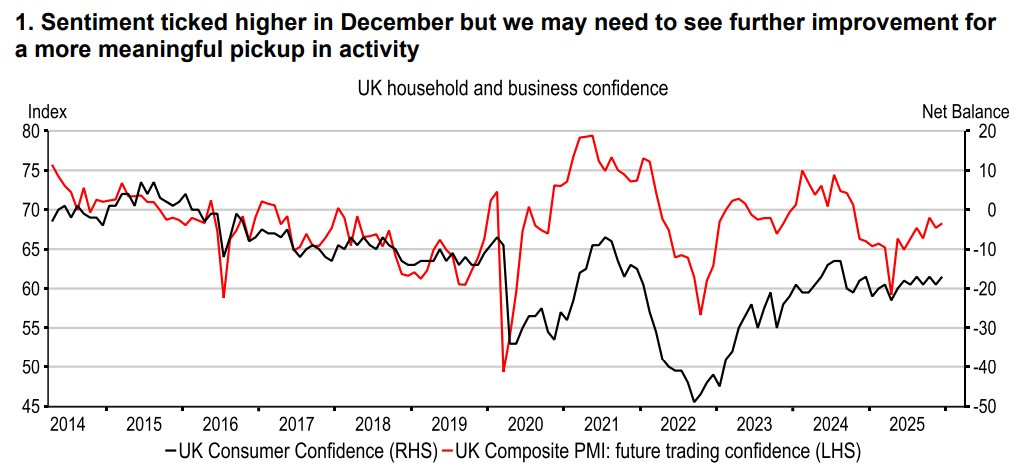
The UK spent much of the second half of 2025 worrying about possible tax rises in the Budget. Now, with worst-case scenarios largely avoided, and the Autumn Budget in the rear-view mirror, hopes turn to an improvement in sentiment and a pickup in economic growth. Early indicators for December showed a mildly more positive environment, consumer confidence rose to -17, up two points from November, but it wasn’t enough to break out of its recent tight range. Similarly, the 0.6pt rise in the PMI business confidence in future trading expectations was modest given the degree of Budget-related uncertainty.
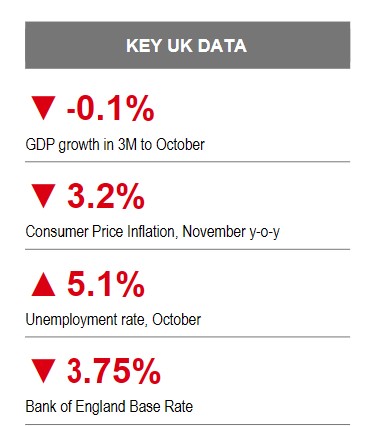
More broadly, the economy has deteriorated: GDP growth was a meagre 0.1% q-o-q in Q3, real disposable income fell 0.8% q-o-q, the rate of unemployment rose to 5.1% in three months to October, and retail sales fell 0.1% m-o-m in November, suggesting a quieter-than-usual Black Friday. So, the small lift in sentiment in December is unlikely to translate into significantly better official data for that month or Q4 and reflects more of an ‘it could have been worse’ boost to sentiment.
Source: HSBC
Out with 2025, in with a new year
We remain relatively optimistic that Q1 2026 will prove better than the prior quarter. Indeed, there was some positivity that could provide a sound platform: the UK inflation rate fell to 3.2% and the Chancellor’s Budget announcements should help see some sub-2% inflation rates in the middle of 2026. That improved inflation outlook coupled with the soft backdrop described above, helped see UK Bank Rate being cut to 3.75% at the Bank of England’s (BoE) December policy meeting. In our view, interest rates will gradually fall further in 2026, which should enable a pickup in consumer spending and some more investment.
That said, our central case for 2026 is a fragile one, households remain cautious, real disposable income growth is meagre, and labour markets are soft. Unemployment could rise further amid subdued demand and further headwinds for businesses including labour costs and higher taxes. And although wage growth is slowing, a further above-inflation rise in the National Living Wage (NLW) in April combined with pockets of recruitment challenges risk the UK’s stagflationary environment persisting, leading to a more uncertain interest rate outlook. We also need no more policy instability and yet one of the biggest risks to the outlook is political, namely the risk of a leadership challenge.
The UK spent much of the second half of 2025 worrying about possible tax rises in the Budget. Now, with worst-case scenarios largely avoided, and the Autumn Budget in the rear-view mirror, hopes turn to an improvement in sentiment and a pickup in economic growth. Early indicators for December showed a mildly more positive environment, consumer confidence rose to -17, up two points from November, but it wasn’t enough to break out of its recent tight range. Similarly, the 0.6pt rise in the PMI business confidence in future trading expectations was modest given the degree of Budget-related uncertainty.
More broadly, the economy has deteriorated: GDP growth was a meagre 0.1% q-o-q in Q3, real disposable income fell 0.8% q-o-q, the rate of unemployment rose to 5.1% in three months to October, and retail sales fell 0.1% m-o-m in November, suggesting a quieter-than-usual Black Friday. So, the small lift in sentiment in December is unlikely to translate into significantly better official data for that month or Q4 and reflects more of an ‘it could have been worse’ boost to sentiment.
Source: Macrobond, GfK, S&P Global, HSBC

Source: Macrobond, ONS, HSBC forecas
https://www.hsbc.com.my/wealth/insights/market-outlook/uk-in-focus/out-with-2025-in-with-a-new-year/

