



like_count_tpl like_count_text_tpl
like_tooltip_tpl
comment_count_tpl comment_count_text_tpl
comment_tooltip_tpl
Economic Updates
FX Viewpoint: AUD, EUR, and GBP: Central banks in focus

Key takeaways
- The RBA raised rates, with the next hike expected in 2H26.
- The BoE’s dovish hold raised near-term rate cut expectations, with the GBP likely lagging the AUD.
- The ECB kept rates steady and downplayed concerns about EUR strength; EUR-GBP may raise over the near term.
On 3 February, the Reserve Bank of Australia (RBA) increased its cash rate by 25bp to 3.85%, in line with market expectations. The RBA also revised its nearterm growth, and inflation forecasts upwards to 2.1% and 4.2% by June 2026 (previously 1.9% and 3.7%), assuming the cash rate reaches 4.2% by end-2026. Our economists view the RBA’s overall stance as fairly hawkish, indicating potential for further tightening, and anticipate an additional 25bp increase in 3Q26.
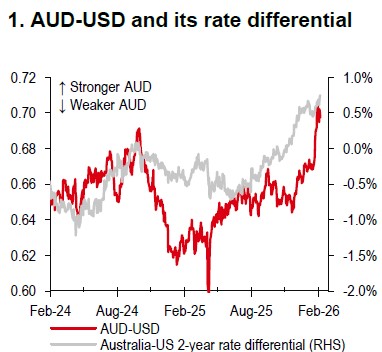
The AUD’s recent rally looks a bit stretched, up c3.5% against the USD year-to-date (Bloomberg, 6 February). Consequently, AUD-USD is likely to consolidate over the coming weeks, with external factors − rather than rate differentials − driving moves over the near term (Chart 1).
Source: Bloomberg, HSBC
Source: Bloomberg, HSBC
The Bank of England (BoE) narrowly voted (5 to 4) to keep rates steady at 3.75% on 5 February, with Swati Dhingra, Alan Taylor, Dave Ramsden, and Sarah Breeden favouring a 25bp cut − more dovish than markets expected. The overall messaging was also dovish, with CPI inflation now forecast to fall to 1.8% in two years. Markets are now almost fully pricing in a 25bp cut for 30 April, with a c60% chance of an earlier move in March (Bloomberg, 5 February). Unsurprisingly, the GBP weakened after the announcement.
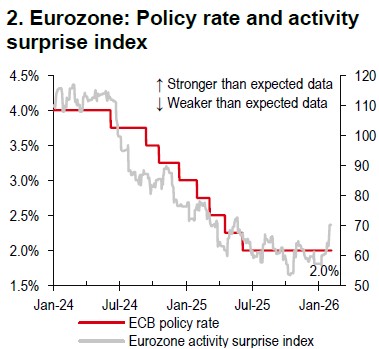
Meanwhile, the European Central Bank (ECB) kept rates unchanged as expected in February, but struck a slightly hawkish tone, highlighting resilient growth (Chart 2). ECB President Christine Lagarde downplayed the recent inflation dip and signalled rates will remain on hold for some time. She also dismissed concerns about EUR strength, noting FX moves are already factored into forecasts and the EUR remains within its average range.
In summary, the BoE’s dovish tilt and the ECB’s comments on the EUR suggest some upside risk for EUR-GBP. The GBP may also lag behind currencies that are in a monetary tightening cycle, like the AUD. However, US factors are likely to drive GBP-USD and EUR-USD higher over the near term.
https://www.hsbc.com.my/wealth/insights/fx-insights/fx-viewpoint/aud-eur-and-gbp-central-banks-in-focus/

