



like_count_tpl like_count_text_tpl
like_tooltip_tpl
comment_count_tpl comment_count_text_tpl
comment_tooltip_tpl
Economic Updates
FX Viewpoint Flash: USD: Middle East conflict

Key takeaways
- Geopolitical events can give confusing signals for currencies, beyond the USD.
- Tensions in the Middle East may bolster the USD over the near term, especially if oil prices and market volatility increase.
- But easing tensions could prompt USD weakness, given unchanged underlying fundamentals.
The conflict in the Middle East is likely to support the USD over the near term, marking a departure from its performance last June when heightened tensions between the US, Iran, and Israel led to only a brief period of USD strength. At that time, ongoing US policy uncertainty quickly eroded the currency’s gains, prompting debate over the USD’s status as a “safe haven” asset. In our assessment, such discussions could be misleading, as geopolitical events often generate mixed signals for currencies, and the impact on the USD is highly dependent on the broader context of uncertainty.
Recent market positioning data indicates that speculative investors are significantly short on the USD, with the latest Commodity Futures Trading Commission (CFTC) figures showing some of the most extreme net short USD positions in recent years. Should oil prices rise sharply and cross-asset volatility increase, the USD could benefit, particularly if there is widespread risk reduction in financial markets. These conditions are typically required for the USD’s “safe haven” characteristics to become more pronounced.
Ultimately, oil price movements will play a critical role in determining currency direction. The Strait of Hormuz, which handles approximately 19% of global oil shipments, represents a key point of sensitivity. Any disruption could have a substantial impact on FX markets, especially for major net oil importers (see the chart below). Conversely, a de-escalation of geopolitical tensions would likely see the USD relinquish recent gains, as the underlying factors supporting a softer USD outlook remain unchanged.
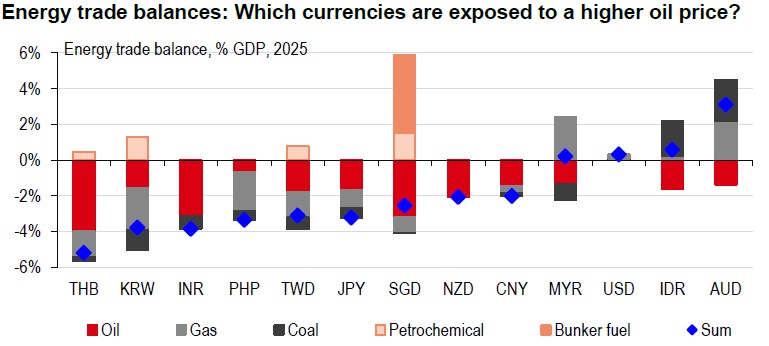
Source: Bloomberg, HSBC
https://www.hsbc.com.my/wealth/insights/fx-insights/fx-viewpoint/usd-middle-east-conflict/

