



like_count_tpl like_count_text_tpl
like_tooltip_tpl
comment_count_tpl comment_count_text_tpl
comment_tooltip_tpl
Economic Updates
FX Viewpoint: “Safe havens” and RMB amid geopolitical uncertainty

Key takeaways
- Geopolitical uncertainty is driving divergence across traditional “safe havens”.
- USD strength persists, but JPY lags while SNB signals it will act to cap CHF strength.
- In Asia, RMB stability stands out versus regional peers.
Given ongoing tensions in the Middle East, the USD’s resilience is unsurprising. In our view, a further rise in oil prices, alongside higher cross-asset volatility, is likely to provide additional support to the USD.
Within the traditional “safe haven” complex (Chart 1), the JPY has not yet benefited from heightened geopolitical risk. Meanwhile, the Swiss National Bank’s (SNB) increased readiness to intervene against CHF strength suggests a floor for G10–CHF pairs. SNB Governing Board member Antoine Martin reiterated this stance, stating that “our willingness to intervene, our readiness to intervene, is higher, given the recent political event” (Bloomberg, 4 March).
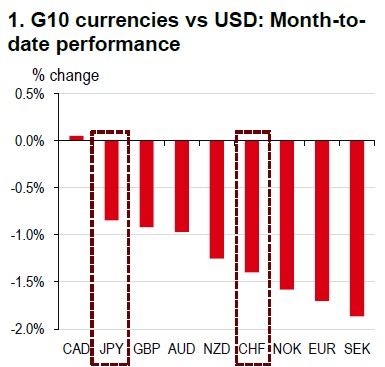
Note: Data as of 5 March 2026 at 20:00 HKT
Source: Bloomberg, HSBC
Source: Bloomberg, HSBC
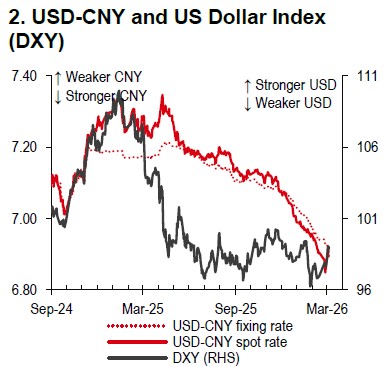
Among Asian currencies, the RMB has remained relatively stable, down only c0.7% month-to-date vs the USD, outperforming most regional peers (Bloomberg, 5 March).
China’s latest government work report has outlined its FX policy priorities for 2026, reaffirming the longstanding objective of maintaining the RMB exchange rate at stable and reasonable levels. Notably, this year’s report places greater emphasis on expanding the use of RMB in cross-border transactions, which is in line with President Xi Jinping’s call for the RMB to become a global reserve currency (FT, 1 February). These priorities, alongside boosting domestic demand, pursuing more balanced trade growth, and upgrading technology, align with the People’s Bank of China’s policy towards gradual diversification away from the USD, reflected in lower USD-CNY fixing rates despite the broader USD rebound (Chart 2).
While geopolitics and positioning may drive near-term USD-RMB volatility, steadily lower fixing rates and consistent domestic messaging should help anchor expectations, supporting RMB outperformance vs regional peers even if the USD strengthens further.
https://www.hsbc.com.my/wealth/insights/fx-insights/fx-viewpoint/safe-havens-and-rmb-amid-geopolitical-uncertainty/

