



like_count_tpl like_count_text_tpl
like_tooltip_tpl
comment_count_tpl comment_count_text_tpl
comment_tooltip_tpl
Economic Updates
China in Focus: NPC Wrap-up: Stimulating domestic demand
Key takeaways
- China’s 4.5-5.0% GDP target supports a strong start to the 15th FYP with room for reform, restructuring, and risk control.
- Fiscal policy remains proactive and front-loaded, focusing on infrastructure investment and improving livelihoods.
- Policies are prioritising technology advancement and capital market reforms, and the unified national market agenda.
China data review (Jan-Feb 2026)
- Fixed Asset Investment grew by 1.8% y-o-y in Jan-Feb supported by a 12% y-o-y rebound in infrastructure investment, driven by accelerated fiscal support from front-loaded government bond issuance. With fiscal policy set to remain robust and the quota for new financing policy tools expanded to RMB800bn, infrastructure should help deliver a strong start to the first year of the 15th Five-Year Plan (FYP).
- Industrial production stayed resilient in Jan-Feb, up 6.3% y-o-y, driven by sustained strength in railway, ship and other transportation equipment (+13.7%), and computer & communications (+14.2%), supported by strong export growth (ships +53%, semiconductors +73%). Meanwhile, domestic policy-driven industrial upgrading and the push for technological self-reliance continued to boost equipment (+9.3%) and high-tech manufacturing (+13.1%).
- Retail sales grew 2.8% y-o-y in Jan-Feb, assisted by a record nine-day CNY holiday, the ongoing rollout of trade-ins, and additional government measures aimed at lifting services consumption. Catering sales were up 4.7%, helped by the longer holidays. Trade-in subsidies had a clear impact on consumer goods demand too. As of 16 March, this year’s trade-in programme generated RMB323bn in sales, up 3.2% y-o-y (source: CCTV, 16 March).
- China’s trade flows have pulled ahead at breakneck speed. Exports soared by 21.8% y-o-y in Jan-Feb as the decline to the US narrowed and other markets, such as the EU, ASEAN, and Belt and Road countries, maintained growth rates above 20%. Imports, meanwhile, were up 19.8% y-o-y supported by the demand for high-tech imports, which rose 28% y-o-y.
- CPI lifted to 1.3% y-o-y in February as services prices accelerated by 1.6% y-o-y, thanks to a record nine-day long CNY holiday; gold prices were also a key driver. Meanwhile, PPI deflation continued to ease, coming in at -0.9%, amidst the transmission from higher global commodities prices.
NPC Wrap-up: Stimulating domestic demand
China’s annual National People’s Congress (NPC) concluded on 12 March, after a week of policy-setting meetings. In addition to the key briefings on the Government Work Report and fiscal budgets, department heads held six press conferences to outline key policy priorities in their respective areas. The headline GDP growth target was set as “4.5% to 5% for 2026, with a commitment to strive for even better results in practice”. We summarise key highlights below.
Fiscal policy remains supportive
China will maintain a proactive fiscal stance, with the central government absorbing a larger share of spending. This shift is a response to ongoing pressures from weakness in the property market, subdued price levels, and slower tax growth, as well as the need to kickstart the 15th FYP. The government is front-loading fiscal support, accelerating bond issuance, and aiming to implement reforms to align local and central fiscal management. Spending priorities are closely tied to long-term goals: boosting domestic demand, advancing technology and industrial upgrading, and safeguarding livelihoods.
Lifting domestic demand via services and infrastructure
The subsidy for the consumer goods trade-in programme has been trimmed to RMB250bn, prioritising green and smart products and offline brick-and-mortar retail. However, a new RMB100bn fiscal-financial coordination fund aims to stimulate consumption and investment, potentially mobilising over RMB1trn in credit. On the services side, the Ministry of Commerce plans to further open up sectors including telecoms, biotechnology, and hospitals. The Government Work Report also highlighted a stronger fiscal commitment to protect livelihoods, raise household incomes, and direct public investment towards welfare-related sectors.
Major projects are set to be the principal catalyst for higher investment. The 15th FYP outlines 109 projects across the “Six Networks” (water, power grids, computing power, communications, pipelines and logistics), as well as transportation, consumption, education, and healthcare infrastructure. These projects are anticipated to drive total investment to over RMB7trn this year, according to the National Development and Reform Commission. Government funding will play a significant supporting role, with this investment projected to surpass RMB5trn in 2026.
Technological innovation and new productive forces
Innovation remains a key pillar for China’s structural transition, and under the 15th FYP the government aims to promote technology and innovation development and greater selfsufficiency, including a target to increase R&D spending by at least 7% per annum on average (in line with the 14th FYP). Officials also highlighted plans to strengthen lifecycle financing support via the National Venture Capital (VC) Guidance Fund and a new national M&A fund to support VC exits, potentially mobilising up to RMB1trn.
For AI, China aims to grow the market to over RMB10trn by the end of the 15th FYP. This is backed by expanding energy capacity and new infrastructure, such as ultra- large-scale computing clusters, and broader integration of AI into existing industries.
Accelerating reforms
Capital market reform: Reforms will support innovative firms through deeper ChiNext reform and improved refinancing. For ChiNext, the authorities plan more targeted listing standards, STAR Market-style IPO pre-review for eligible issuers and flexibility for in-process applicants to raise capital from existing shareholders. Refinancing measures will make rules more flexible and user-friendly (e.g., refined strategic investor criteria to attract long-term funds), while sharpening the “support the best, support tech” approach by accelerating approvals for well-governed, market-recognised firms and extending “light-asset, high-R&D” criteria to the main board.
Reforms to build a unified national market: The Government Work Report said efforts to build a unified national market will focus on reducing fragmentation and strengthening fair competition nationwide. To address involutionary competition and excess capacity, authorities will deploy a mix of capacity controls, standards, price enforcement, and quality supervision. In addition, they said credit allocation would be optimised to curb excessive competition in certain industries, and signalled support for mergers and acquisitions to help resolve involutionary competition.
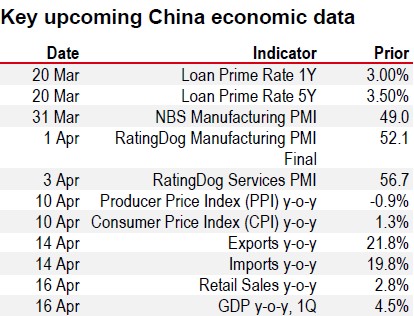
Source: LSEG Eikon
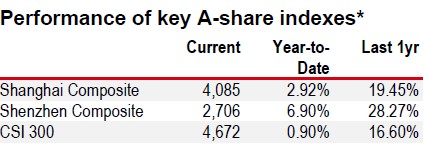
Note: *Past performance is not an indication of future returns. Priced as of 16 March 2026.
Source: LSEG Eikon
https://www.hsbc.com.my/wealth/insights/market-outlook/china-in-focus/npc-wrap-up-stimulating-domestic-demand/

