



like_count_tpl like_count_text_tpl
like_tooltip_tpl
comment_count_tpl comment_count_text_tpl
comment_tooltip_tpl
Economic Updates
FX Viewpoint Flash: USD: Fed pauses amid uncertainty

Key takeaways
- The Fed held rates steady for a second meeting as the Middle East conflict raises uncertainty.
- FX remains driven by energy and risk sentiment, supporting USD strength until geopolitical tensions ease.
- We still look for a softer USD by the end of this year.
For the second meeting in a row in March, the Federal Open Market Committee (FOMC) voted to hold the federal funds rate unchanged at 3.50-3.75%. The vote was 11 to 1, with Fed Governor Stephen Miran dissenting in favour of a 25bp rate cut. At the previous meeting in January, both Governor Miran and Governor Christopher Waller dissented in favour of a 25bp cut.
The key message of the meeting was that policymakers are inclined to wait and see how the Middle East conflict − through its potentially opposing effects on growth and inflation − ultimately plays out. This stance was reflected in the accompanying statement. While it was revised to acknowledge recent geopolitical developments, the forward-looking section offered little clarity on whether policymakers are more concerned about upside inflation risks or a weakening labour market. The implications, it noted, “are uncertain”.
Similarly, the updated “dot plot” did not indicate a meaningful shift in policymakers’ views. The median 2026 policy rate projection, arguably the most relevant horizon for the USD, was unchanged at 3.375%, still consistent with just one cut this year (broadly in line with current market pricing). Our economists still expect the Federal Reserve (Fed) to keep the policy rate steady in 2026 and 2027. The macro projections saw only modest adjustments (see the table below), with the most notable change being an increase in the 2026 PCE inflation forecast to 2.7% (from 2.4%) − an unsurprising move given recent development.
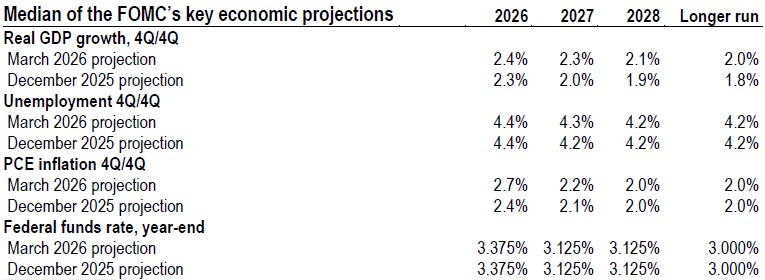
Source: Federal Reserve
Fed Chair Jerome Powell also reinforced the “wait and see” message in his press conference. He leaned more heavily on uncertainty, noting: “We don’t know what the effects of this will be. Really no one does.” Powell has often described policymaking as operating in a fog − now, markets face the fog of war.
As a result, FX markets are likely to remain highly sensitive to energy price dynamics. While the outlook is inherently uncertain, as long as energy prices remain elevated and risk appetite is fragile, the USD is likely to retain the upper hand. We continue to believe that if geopolitical risks fade, much of the USD’s March strength could reverse, leaving scope for a softer USD by year-end. For now, however, with limited visibility on how the conflict evolves, markets − including FX − are likely to remain in a wait-and-see mode.
https://www.hsbc.com.my/wealth/insights/fx-insights/fx-viewpoint/usd-fed-pauses-amid-uncertainty/

