



like_count_tpl like_count_text_tpl
like_tooltip_tpl
comment_count_tpl comment_count_text_tpl
comment_tooltip_tpl
Economic Updates
Investment Weekly: Broadening out continues

Key takeaways
- Market pricing for a September Federal Reserve rate hike has fallen to its lowest level since mid-June. Chair Warsh got the ball rolling in late-July, by reaffirming his commitment to 2% inflation but questioning whether the Personal Consumption Expenditures (PCE) index was the right inflation gauge.
- Asia has delivered a broadly resilient Q2 earnings season, with the region’s AI supply chain doing much of the heavy lifting. South Korea and Taiwan’s major technology-heavy segments have seen very strong profit growth, driven by demand for AI-related memory and hardware.
- Emerging markets are enjoying good news on inflation, with July data revealing downside surprises across Latin America, CEMEA, and EM Asia. With central banks in Brazil, Hungary, and Türkiye already cutting rates, further space for monetary policy easing across the EM complex has the potential to broaden market gains beyond chip-heavy South Korea and Taiwan.
Chart of the week – Broadening out continues
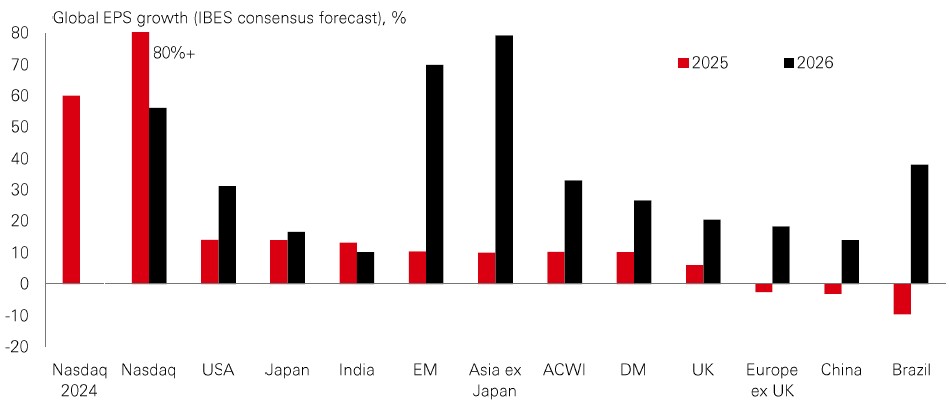
While the US continues to lead global consensus profits growth, an important story this year has been the broadening out of profits and market performance, initially into emerging markets and more recently into parts of Europe.
Much of the broadening has been tied to the AI boom. Market focus has shifted within the AI ecosystem, as well as into sectors such as Industrials, Utilities, and Materials. In emerging markets, Taiwan and South Korea have been key beneficiaries of this build-out (although South Korea has seen recent volatility, see page 2).
In Europe, stocks have managed to keep pace with the US this year despite the region’s subdued GDP growth and a stock market that lacks deep exposure to AI. In part, that’s down to the fact that European earnings are now accelerating after two years of zero growth. In fact, they’re shaping up to be among the strongest in years, with 2026 year-on-year earnings growth at around 18% for MSCI Europe. Revisions are at a five-year high, with upgrades spread across most sectors, and strong profits in Energy, Financials, and Industrials.
With starting expectations and valuations lower, improving profits potentially reinforce Europe as an “anti-bubble” market where a pick-up in previously ignored sectors can give investors a reason to look beyond the US.
Overall, the global opportunity set may be widening. While AI remains a key market driver, firmer earnings momentum in Europe and continued strength in parts of emerging markets is further evidence of broadening out – supporting the case for wider regional exposure in portfolios heading into 2027.
Market Spotlight
In good health
Healthcare stocks have quietly been writing a comeback story. After a tough start to 2026, the sector has performed well during the summer, with its defensive earnings appealing to investors looking for alternatives to episodic volatility in crowded tech and AI trades. That shift has been helped by fading US policy worries around drug pricing and tariffs, plus upbeat mid-year conference sentiment, and strong product development pipelines.
With Washington-driven risks now looking more manageable, earnings visibility is improving and bearish sentiment towards the sector has started to unwind. One underappreciated tailwind is the re-acceleration in pharma dealmaking: around USD60bn has already been deployed in acquisitions year-to-date, which can provide a valuation floor and should provide support to small- and mid-cap biotech stocks via takeovers and partnerships.
Overall, valuations look more compelling after a de-rating (with a forward P/E for the sector of around 17x in the US), and revisions are improving. And while a pullback wouldn’t be surprising after the early summer surge, any dip could be a potential opportunity into the second half of 2026, with healthcare offering both portfolio diversification (helped by its defensive qualities) and a hedge if tech leadership disappoints.
The value of investments and any income from them can go down as well as up and investors may not get back the amount originally invested. The level of yield is not guaranteed and may rise or fall in the future. Past performance does not predict future returns. For informational purposes only and should not be construed as a recommendation to invest in the specific company, country, product, strategy, sector, or security. Diversification does not ensure a profit or protect against loss. Any views expressed were held at the time of preparation and are subject to change without notice. Any forecast, projection or target where provided is indicative only and is not guaranteed in any way. Index returns assume reinvestment of all distributions and do not reflect fees or expenses. You cannot invest directly in an index. Source: HSBC Asset Management, Factset, Bloomberg, Macrobond. Data as at 7.30am UK time 14 August 2026.
Lens on…
Warsh away the worries
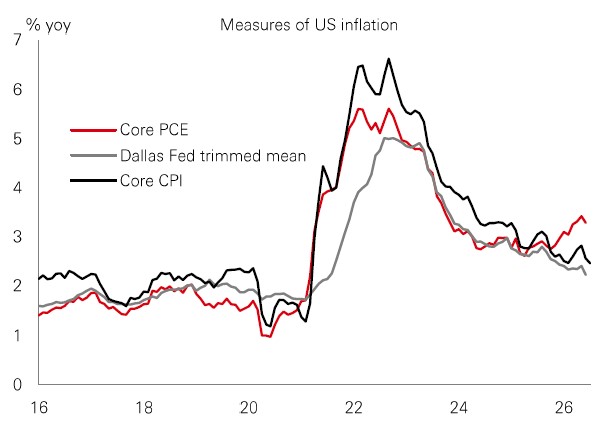
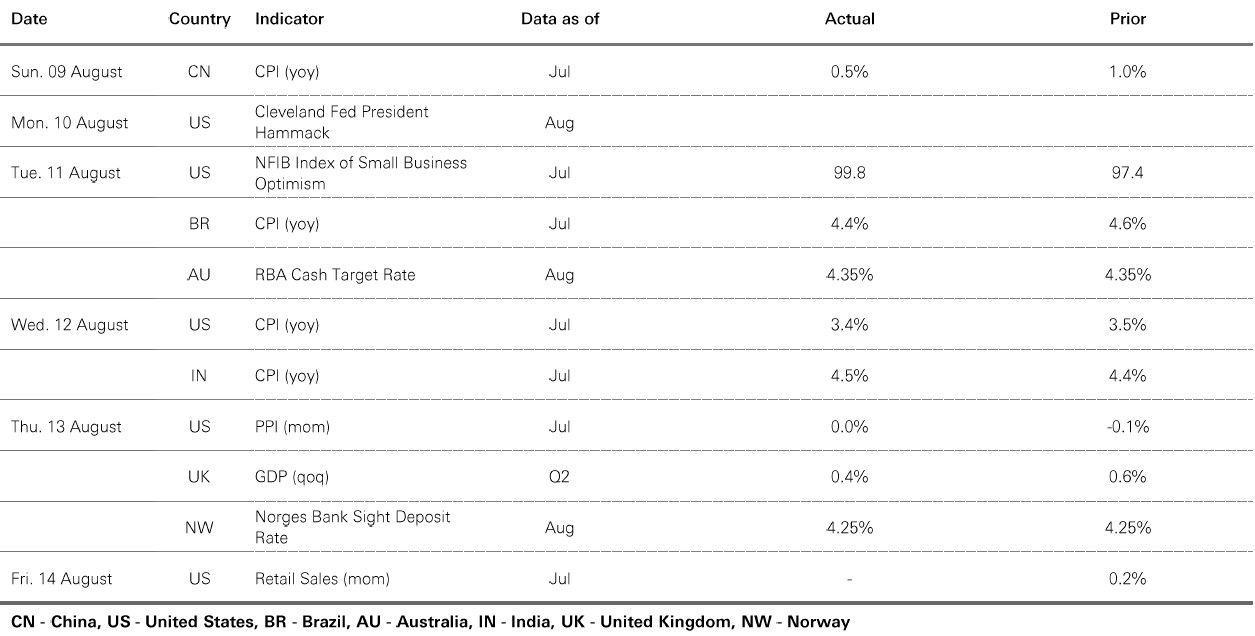
Market pricing for a September Federal Reserve rate hike has fallen to its lowest level since mid-June. Chair Warsh got the ball rolling in late-July, by reaffirming his commitment to 2% inflation but questioning whether the Personal Consumption Expenditures (PCE) index was the right inflation gauge. Investors read this as dovish, as several other measures of underlying inflation are running well below the core PCE rate of 3.3%. The latest consumer price data reinforced that view. Core CPI eased to 2.5% year-on-year, while the three-month annualised rate was just 1.7%.
Wedged between Warsh’s comments and the benign CPI print, a softer labour report has also weighed on rate expectations. Payroll growth undershot forecasts, and while the unemployment rate eased to 4.1% in July, that reflected lower participation. Modest wage gains and weak surveys of job prospects point to more slack than the jobless rate implies.
If August inflation and employment data show more of the same, the Fed is likely to stay on hold in September. For markets, that could help keep volatility subdued, even if a highly complex and uncertain backdrop means that investors shouldn’t get too complacent.
Chips slip, China rips
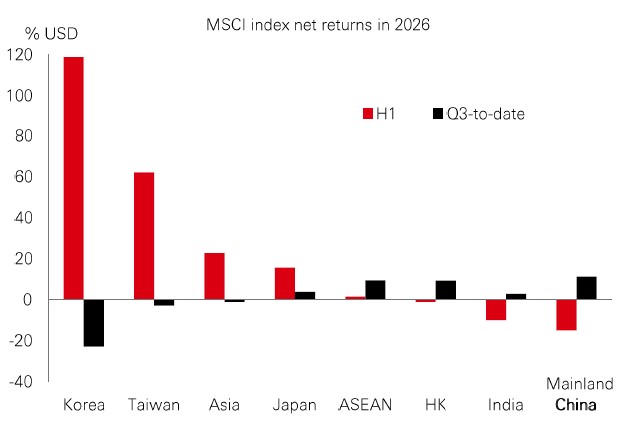
Asia has delivered a broadly resilient Q2 earnings season, with the region’s AI supply chain doing much of the heavy lifting. South Korea and Taiwan’s major technology-heavy segments have seen very strong profit growth, driven by demand for AI-related memory and hardware. Japan has also delivered solid and relatively broad-based earnings, while India’s growth has been more moderate, with divergence across sectors.
In terms of market performance, however, leadership has rotated recently. Despite strong results, semiconductor-led markets have lagged in Q3-to-date – with MSCI Korea still down roughly 20% despite a recent rebound. This reflects some unease about index concentration in a small number of tech heavyweights, and the durability of AI-related capex. Instead, mainland China has outperformed, with around a 10% gain quarter-to-date, supported by rallies in Consumer Discretionary (notably e-commerce), Healthcare, and Materials.
For investors, Asia’s earnings outlook remains supported by AI, but the opportunity set is broader than chips alone – offering, in some markets, more reasonable valuations and potentially attractive yields. In mainland China, upcoming earnings and further innovation in tech and AI could extend the recent rally and, over time, support a re-rating.
A heated outlook
Emerging markets are enjoying good news on inflation, with July data revealing downside surprises across Latin America, CEMEA, and EM Asia. With central banks in Brazil, Hungary, and Türkiye already cutting rates, further space for monetary policy easing across the EM complex has the potential to broaden market gains beyond chip-heavy South Korea and Taiwan.
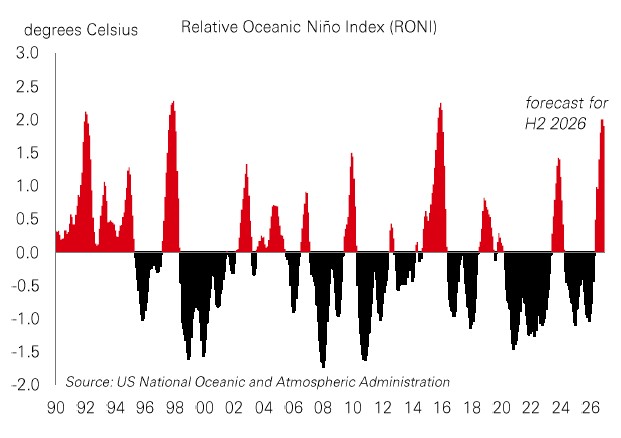
However, investors must remain vigilant. Latest forecasts project a sharp rise in the Relative Oceanic Niño Index for H2 2026, approaching 2°C. This temperature anomaly – measuring how Pacific surface temperatures deviate above historical baselines – signals a very strong El Niño. By disrupting global atmospheric circulation, it could trigger major droughts and floods that strain agricultural output and push food inflation higher.
Although this is not an unprecedented development, the timing is bad. Many EMs are already grappling with Hormuz disruptions, which have sparked risks of gasoline and diesel supply shortages and pushed up global fertiliser prices. It also serves as a stark reminder that in a world of volatile geopolitics, active fiscal policy, and extreme weather, structurally higher inflation pressure and increased macroeconomic volatility is the new normal for investors to contend with.
Past performance does not predict future returns. The level of yield is not guaranteed and may rise or fall in the future. For informational purposes only and should not be construed as a recommendation to invest in the specific country, product, strategy, sector, or security. Diversification does not ensure a profit or protect against loss. Any views expressed were held at the time of preparation and are subject to change without notice. Index returns assume reinvestment of all distributions and do not reflect fees or expenses. You cannot invest directly in an index. Any forecast, projection or target where provided is indicative only and is not guaranteed in any way. Source: HSBC Asset Management. Macrobond, Bloomberg, Refinitiv, FactSet. Data as at 7.30am UK time 14 August 2026.
Key Events and Data Releases
Last week
This week
For informational purposes only and should not be construed as a recommendation to invest in the specific country, product, strategy, sector or security. Any views expressed were held at the time of preparation and are subject to change without notice. Any forecast, projection or target where provided is indicative only and is not guaranteed in any way. Index returns assume reinvestment of all distributions and do not reflect fees or expenses. You cannot invest directly in an index. Source: HSBC Asset Management. Data as at 7.30am UK time 14 August 2026.
Market review
Global equities experienced a mixed start to the week, as persistent geopolitical uncertainty pushed oil prices higher and revived worries over higher-for-longer US rates. However, a softer US CPI inflation print on Wednesday lifted sentiment, alongside further upbeat Q2 earnings results. In the US, the S&P 500 reached a new all-time high, while the equal-weighted index outperformed. European markets were range-bound, while Asian markets were mixed, with semiconductor-heavy bourses leading the gains; South Korean equities staged a notable rebound after recent volatility. In rates, the benign CPI report prompted investors to pare back expectations of an early Fed rate hike, driving a modest steepening of the Treasury yield curve. In FX, the US dollar broadly strengthened against major peers, while emerging market currencies diverged. Gold prices pulled back after their recent strong run.
https://www.hsbc.com.my/wealth/insights/asset-class-views/investment-weekly/

