



like_count_tpl like_count_text_tpl
like_tooltip_tpl
comment_count_tpl comment_count_text_tpl
comment_tooltip_tpl
Economic Updates
FX Viewpoint: USD-JPY: A new and higher range

Key takeaways
- USD-JPY is near the highest level in four decades.
- We think Japan’s Ministry of Finance will likely intervene at some point to support the JPY.
- But USD-JPY may have moved into a new and higher range reflecting both external and domestic reasons.
Continued JPY weakness
USD-JPY is near its highest level in c40 years. Finance Minister Katayama promptly said the authorities would “respond… appropriately at any time” and that “bold actions” are an “option” (Bloomberg). However, her language appeared less forceful than on 30 April when she stated that “we are nearing [the] time to take bold action” (Bloomberg) – comments that were followed by a sharp decline in USD-JPY later that evening.
Underlying assumptions
We changed our broad USD view after the 17 June FOMC meeting and now expect the US Dollar Index (DXY) to trade in a new and higher range. In line with this, we also anticipate further USD strength versus JPY through mid-2027.
Our view assumes the Bank of Japan (BoJ) will avoid rapid, hawkish rate hikes, keeping nominal and real US-Japan rate differentials wide (see chart). We also expect fiscal concerns to persist as authorities use fiscal policy to curb cost of living pressures, boost investment and strengthen defence. In addition, we assume no change in resident capital flow policies, allowing retail equity outflows to continue.
Finally, we think the Ministry of Finance (MoF) will continue resisting unfettered JPY depreciation. A weaker JPY remains unpopular with the Japanese public and raises the risk of renewed “triple sell” episodes across JPY, equities and bonds. That said, the MoF’s tolerance for further weakness appears to have shifted slightly higher.
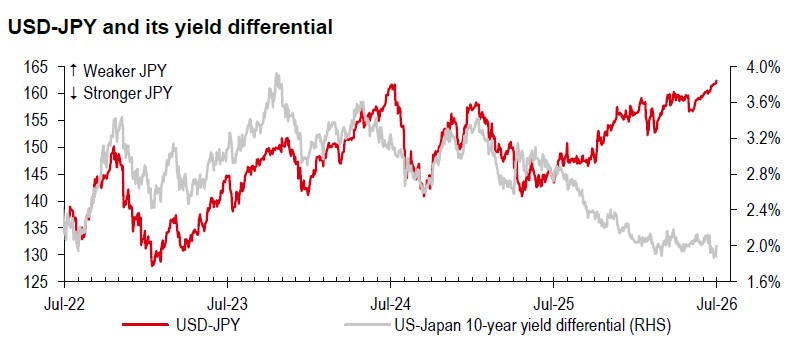
Source: Bloomberg, HSBC
Higher intervention threshold
We see several plausible reasons for this slightly higher bar for intervention. The short-term “fair” value of USD-JPY, based on its correlations with underlying variables including the broad USD trend, has likely shifted higher alongside the recent rise in the DXY.
Lower oil prices also reduce the urgency to curb imported inflation compared to March-May. In addition, the MoF also typically aims to surprise the market, and past episodes suggest subsequent intervention waves can occur at incrementally higher levels (e.g. 1998, 2022 and 2024).
https://www.hsbc.com.my/wealth/insights/fx-insights/fx-viewpoint/usd-jpy-a-new-and-higher-range/

