



like_count_tpl like_count_text_tpl
like_tooltip_tpl
comment_count_tpl comment_count_text_tpl
comment_tooltip_tpl
Economic Updates
FX Viewpoint: USD outperforms; EUR and GBP struggle

Key takeaways
- The US-Iran deal and a shift in Fed messaging ended rangebound moves in many G10 FX pairs.
- Hawkish repricing of US rates, supported by resilient growth, is USD positive.
- The EUR and GBP are likely to face rising headwinds from political uncertainty and growth risks.
USD: From range to rally
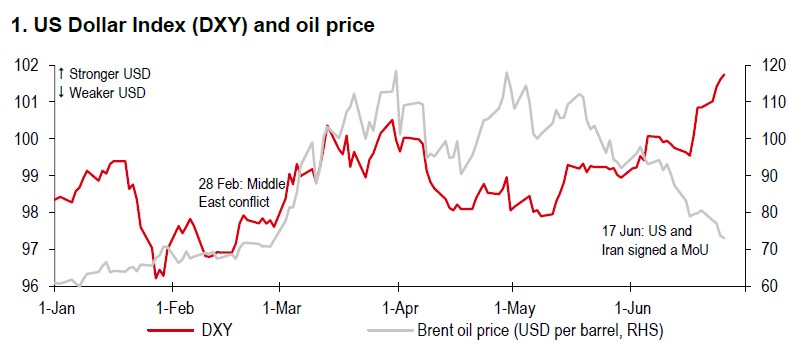
The interim US-Iran peace agreement, alongside a shift in Federal Reserve (Fed) messaging, has disrupted the previously range-bound behaviour across several G10 currencies. The change in the Fed narrative is particularly supportive for the USD, enabling a break-out from long-established trading ranges. Reflecting this, the US Dollar Index (DXY) moved above 101 (Bloomberg, 26 June).
Although easing geopolitical tensions typically reduces demand for the USD as a “safe haven” currency (Chart 1), we expect the increasingly hawkish repricing of US rate expectations to become the main driver, supporting further USD strength over the near term. Importantly, Fed policy appears to be anchored in continued US economic resilience, rather than the stagflation-style trade-offs shaping policy debates elsewhere in G10.
Source: Bloomberg, HSBC
EUR: Rising downside risks
In Europe, dovish remarks from European Central Bank (ECB) President Christine Lagarde on 22 June likely put downward pressure on the EUR. Since the Strait of Hormuz has reopened and oil prices have fallen, our economists now expect the ECB to hold rates in 2026, rather than proceed with the two additional hikes previously anticipated.
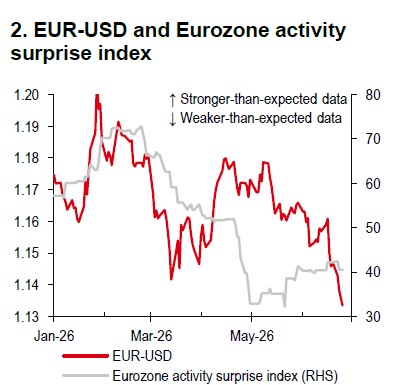
We therefore expect EUR-USD to drift lower over the coming months. While lower energy prices can be supportive for the EUR, they are unlikely to be enough to resolve wider concerns about economic growth in the region (Chart 2). Political risk could also re-emerge, with France’s April 2027 presidential election approaching and centrist parties currently trailing in the polls (Politico, 26 May). Any perceived weakening in fiscal discipline or reform momentum could raise risk premia, slow capital inflows, and add further pressure on the EUR.
Source: Bloomberg, HSBC
Source: Bloomberg, HSBC
GBP: Political uncertainty and a softer macro backdrop
In the UK, Prime Minister Starmer’s resignation has shifted market focus to the leadership contest and the policy direction of the next Prime Minister. With limited clarity, the GBP appears more exposed to downside risks than positioned for upside relief. Candidates must declare by 9 July. If favourite, Andy Burnham (Polymarket, 22 June) is unchallenged, a swift transition could see him in office by 16 July.
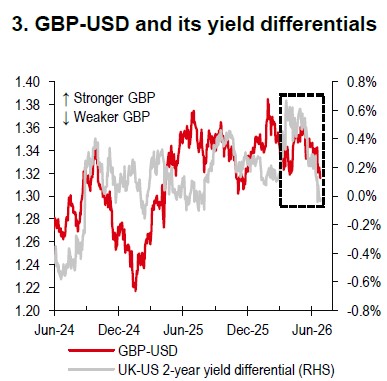
Beyond politics, the macro backdrop is less supportive. UK-US 2-year rate differentials have narrowed sharply, from c66bp in April to roughly 0bp, reducing the carry support that has helped underpin the GBP (Chart 3). This reflects the Fed’s hawkish shift (17 June) versus a cautious Bank of England (BoE) hold at 3.75%, with our economists expecting the BoE to remain on hold through year-end. Fiscal optics have also deteriorated, with government borrowing exceeding the UK Office for Budget Responsibility’s (OBR) forecast for a second consecutive month. All these factors are likely to weigh on GBP in the months ahead.
https://www.hsbc.com.my/wealth/insights/fx-insights/fx-viewpoint/usd-outperforms-eur-and-gbp-struggle/

