



like_count_tpl like_count_text_tpl
like_tooltip_tpl
comment_count_tpl comment_count_text_tpl
comment_tooltip_tpl
Economic Updates
China in Focus: Resilient despite domestic challenges

Key takeaways
- Middle East disruptions persist, but lower oil prices may ease upstream input costs and downstream margin pressure.
- Domestic activity is still soft; reforms are ongoing, with scope for more fiscal stimulus if conditions don’t improve.
- Exports are benefiting from improved China-US relations and could get an additional lift if Middle East tensions ease.
China data review (June & Q2 2026)
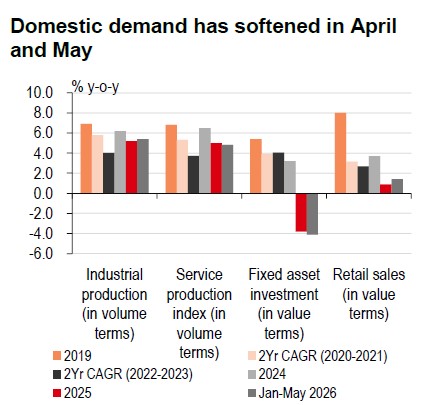
- GDP growth slowed to 4.3% y-o-y in Q2, the softest pace since end-2022. While external sector activity accelerated and provided support for industrial production (5.3% y-o-y in June), domestic demand has slowed.
- Fixed asset investment continued to weigh on growth, -11.2% y-o-y in June, primarily through weak infrastructure (-10.2%) and property (-24.4%) investment. Infrastructure spending has now contracted by double digits for two straight months, partly reflecting local government fiscal constraints, while the property slump deepened despite pockets of improvement in the largest cities.
- Industrial production remained solid in June, rising 5.3% y-o-y, supported by stronger exports linked to the global AI demand cycle and the domestic push for industrial upgrading. Computer and communications equipment output rose 15.7% while computer and electronics manufacturing investment was up 6.5% year-to-date, even as overall manufacturing investment fell.
- Retail sales returned to growth in June, up 1.0% y-o-y, helped by base effects. However, underlying demand remained soft as policy support fades: auto sales fell 16.1% after the halving of auto tax exemptions and household appliance sales dropped 8.7% on a high base from earlier trade-in programs. In contrast, communication appliances were up 16.5%, partly on AI-related price increases.
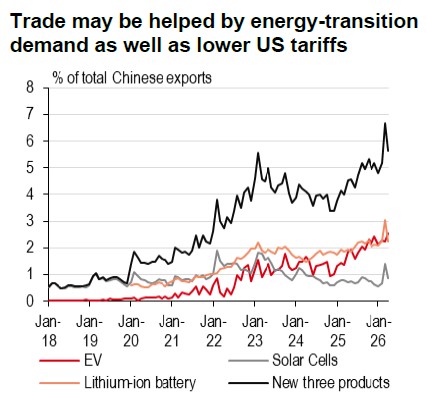
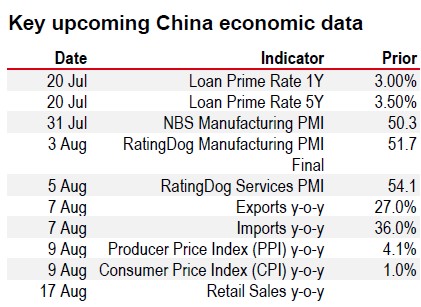
- Exports rose 27% y-o-y in June driven by strong AI-demand (high-tech exports +52%), increased urgency for energy transition and stabilising China-US relations (direct exports to the US +26%). Imports surged 36% y-o-y reflecting increased demand for tech-related components (high-tech imports +58%), imports from the US (+35%) and alternatives to global oil imports.
- China’s June inflation print showed another month of divergence. CPI edged down to 1.0% y-o-y in June amidst lower vehicle fuel prices and softer food prices, particularly for pork (-15.9%). Meanwhile PPI climbed further, to 4.1% yo-y, driven by base effects, the anti-involution campaign and robust global AIrelated capital expenditure which supported price gains in the computer sector.
Resilient despite domestic challenges
The ongoing conflict in the Middle East continues to disrupt global supply chains, although oil prices now have fallen meaningfully from recent highs. For China, this may ease upstream cost pressures and provide some margin relief for midstream and downstream industries that struggled to pass on higher input costs due to the still subdued consumption.
Domestic headwinds
Recent activity data points to persistent challenges, particularly weaker consumption and investment. Policy efforts still lean on structural measures, such as reforms to grant migrants access to public services based on residence rather than household registration (hukou). If momentum does not improve, we expect additional fiscal support, including front-loaded infrastructure investment to advance priority projects identified in the 15th Five Year Plan.
Pockets of resilience
A resolution to the Middle East conflict could lift global demand and provide further support to China’s exports, while reducing petrochemical disruptions and easing margin pressure in downstream industries. Even if the conflict escalates, China may prove relatively resilient due to sizeable oil reserves and coal-to-chemicals production, though it is not fully immune. Primary plastics, which depend on crude oil inputs, fell 12% m-o-m in April; with China suppling around one-third of global primary plastics, extended disruption could affect global supply and pricing.
Export tailwinds
There are also tailwinds emerging, mainly from improving China-US relations. Current discussions include lowering tariffs on non-sensitive goods (worth cUSD30bn) and establishing a Board of Investment to pave the way for China FDI into the US in non-sensitive, non-strategic areas. Strong global AI-related demand and rising demand for energy transition products (e.g. electric vehicles, solar, wind) should underpin China’s exports, with net exports likely to make a significant contribution to China’s GDP growth this year.
However, China’s consumers are still unlikely to shift materially away from cautious spending in the near term. Over the medium term, reforms to improve social safety net coverage and settle migrant workers in urban areas are likely to boost both consumption and investment. Near term, supply chain restructuring linked to the potential tariff reduction – likely focused on consumer goods – should help create jobs and improve consumer confidence.
Source: Wind, HSBC. Note: CAGR = compound annual growth rate
Source: Wind, HSBC
Source: LSEG Eikon
* Past performance is not an indication of future returns
Source: LSEG Eikon. As of 14 July 2026, market close
https://www.hsbc.com.my/wealth/insights/market-outlook/china-in-focus/resilient-despite-domestic-challenges/

