



like_count_tpl like_count_text_tpl
like_tooltip_tpl
comment_count_tpl comment_count_text_tpl
comment_tooltip_tpl
Economic Updates
FX Viewpoint: GBP & EUR: Downside from softer growth

Key takeaways
- We see downward pressure for GBP-USD given easing inflation and weaker labour market data.
- The key risk comes from higher oil and gas prices, which could feed into inflation, over the coming months.
- EUR-USD could move lower without firm central bank commitment to support interest rates.
GBP faces a familiar mix of headwinds. Domestically, the data points to easing inflation pressures and a softening labour market; externally, geopolitics and policy uncertainty maintains the risk premium investors demand to hold UK assets.
With headline CPI down to 2.6% y-o-y, the case for near-term Bank of England (BoE) hikes looks less urgent, even though markets still price tightening through April 2027. Yet, with a softer labour market, HSBC Economics sees a high bar for the BoE to turn decisively more hawkish. GBP has nonetheless held up over the last month supported by higher yields.
The key risk remains geopolitics. The US-Iran conflict has lifted oil and gas prices with the pass-through to CPI typically lagging several months. But, on the political front, the proposed VAT cut on electricity bills and uncertainty over funding shows a core GBP vulnerability. With recent strength in the rear-view mirror, this mix leaves GBP vulnerable, especially if energy risks persist and policy credibility wobbles.
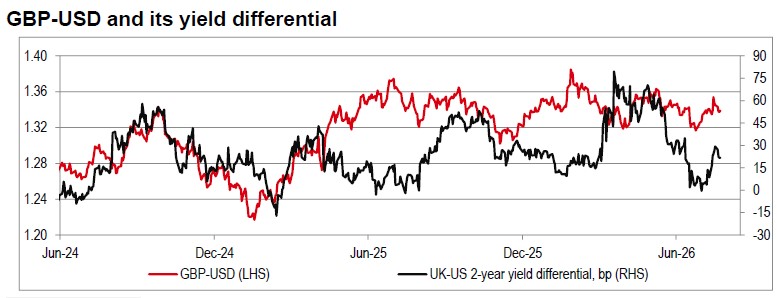
Source: Bloomberg, HSBC
EUR weighed down by cautious tone. On 23 July, the European Central Bank (ECB) held rates at 2.25% and reiterated a data-dependent, meeting-by-meeting stance. President Lagarde highlighted no signs of second-round inflationary effects and therefore, no immediate need to hike rates. This message underwhelms and weakens support for EUR-USD.
EUR-USD has been remarkably stable over the last month propped up by higher yields as markets markup inflation and tightening expectations in response to rising energy prices. But that’s a fragile kind of support and only lasts as long as the ECB is perceived as prepared to deliver.
The challenge is that the eurozone economy is not in great shape and the renewed surge in energy costs risks hitting industry just as green shoots were emerging. Without a firmer commitment to support interest rates, we think EUR-USD is likely weaken as investors refocus on growth downside and terms-of-trade risks.
https://www.hsbc.com.my/wealth/insights/fx-insights/fx-viewpoint/gbp-eur-downside-from-softer-growth/

