



like_count_tpl like_count_text_tpl
like_tooltip_tpl
comment_count_tpl comment_count_text_tpl
comment_tooltip_tpl
Economic Updates
India Economics: On a front-loading high

Key takeaways
- Renewed Middle East tensions and looming US Section 301 tariffs are driving another bout of inventory front-loading.
- June industrial production surprised to the upside; output of select segments like electrical equipment, electronics and plastics strengthened in 2Q.
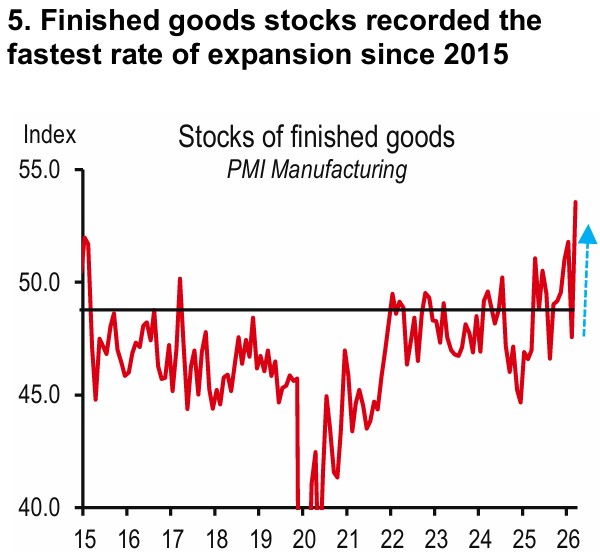
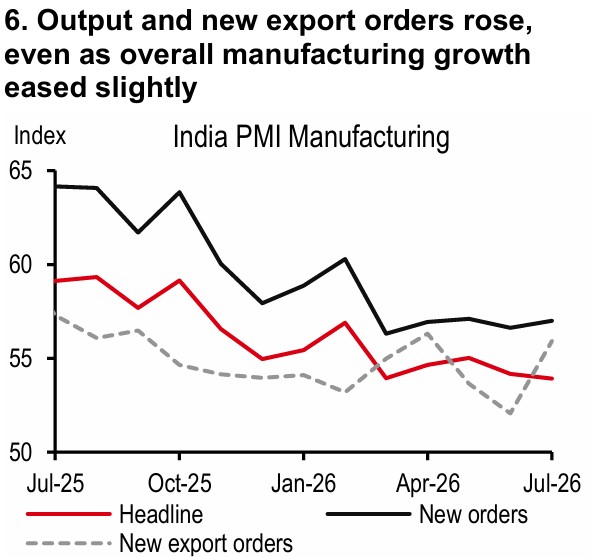
- July PMI, too, points to the fastest finished-goods stock build-up since 2015, alongside rising input inventories; new export orders also picked up.
Renewed tensions in the Middle East have once again prompted firms to build buffers to manage the uncertainties around the longevity of the supply-side shock. At the same time, there were worries around higher tariffs linked to the implementation of Section 301. The government of India estimates that about 55% of exports will attract the additional 10% duty (PIB, 25 July 2026). Back in April-May, manufacturers were building inventories to hedge against the risk of energy-input shortages. We’re now seeing a similar front-loading dynamic in the recently released June industrial production and July Flash PMI data.
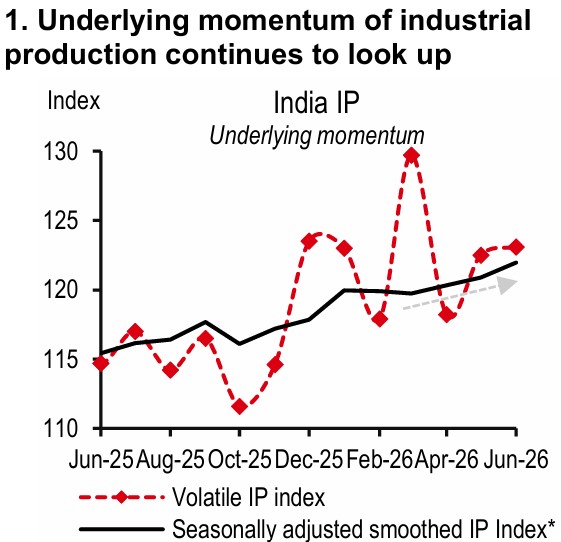
June industrial production rose 7.3% y-o-y, much higher than our aboveconsensus estimate of 6.3%. On a seasonally adjusted basis, the sequential momentum grew by 1.6% m-o-m sa after staying flat in May. The underlying growth momentum continues to look up, underscoring resilient industrial activity.
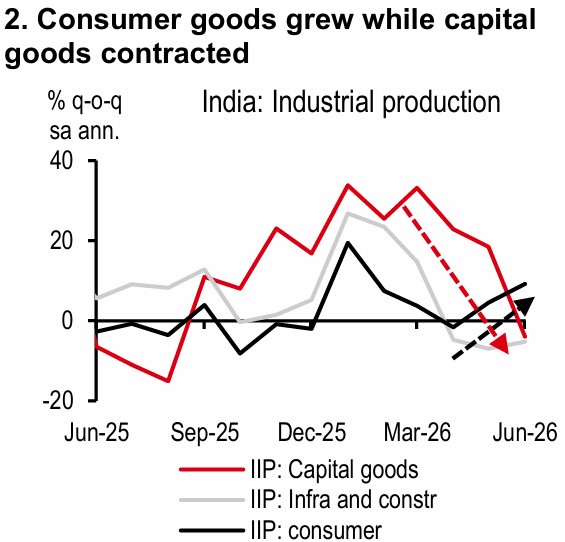
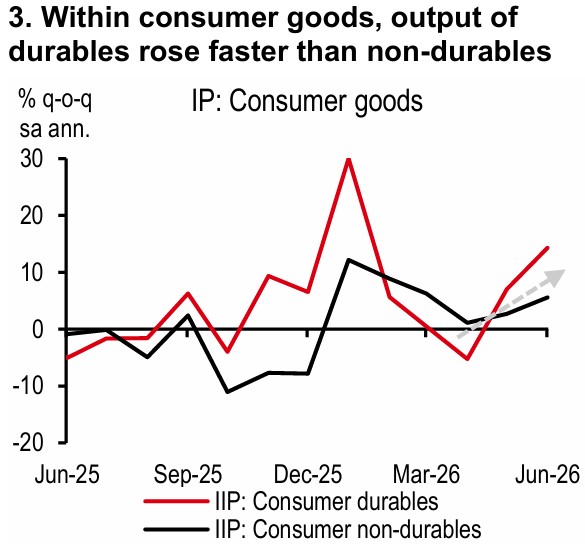
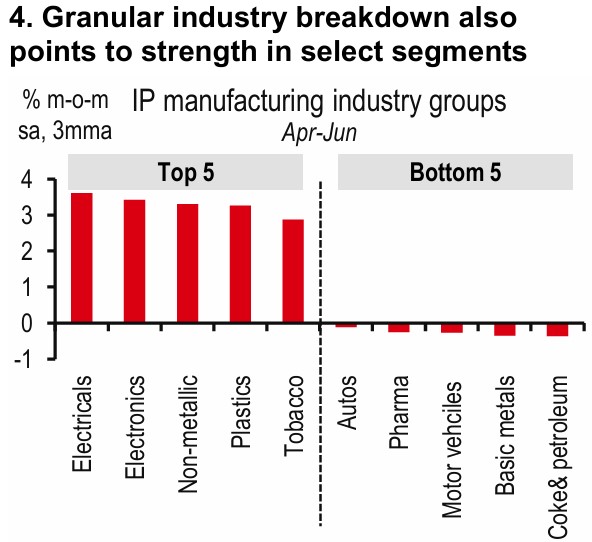
Consumer goods grew while capital goods contracted on a sequential basis. Within consumer goods, output of durables rose faster than non-durables, suggesting that front-loading was concentrated in categories where consumers may prefer to buy ahead of any meaningful retail price increases. A more granular industry breakdown also points to strength in select segments such as electrical equipment, electronics, non-metallic mineral products and plastic, where output rose by an average of c3.5% m-o-m sa in 2Q26.
The July Flash PMI signalled a sharp rise in finished goods stocks – the fastest rate of expansion since 2015 – reversing June’s decline. Input inventories, too, increased alongside a pick-up in purchasing volumes. New export orders also picked up ahead of US tariff implementation, even as overall manufacturing growth eased slightly.
The big question for 2H. With a possible pivot from resilient manufacturing (c20% of GDP) to uncertain agriculture (c20% of GDP), where could growth come from? We look at the remaining 55% of GDP – services. What could help? A possible pullback in oil prices towards pre-war levels should help lift the trade and transport sector (which makes up c15% of GDP). Easier financial conditions on the back of the FX package could help lubricate the financial sector (which makes up c25% of GDP). Even before the package induced capital inflows have started in earnest, yields across a variety of instruments have eased.
https://www.hsbc.com.my/wealth/insights/market-outlook/india-economics/on-a-front-loading-high/

