



like_count_tpl like_count_text_tpl
like_tooltip_tpl
comment_count_tpl comment_count_text_tpl
comment_tooltip_tpl
Economic Updates
FX Viewpoint: USD-JPY: Wider trading range expected

Key takeaways
- USD-JPY dropped sharply after joint Japan-US intervention.
- Coordinated action may be more effective than solo moves but sustained JPY strength requires improving fundamentals.
- We think USD-JPY will trade in a wider range than before and remain cautious about projecting a sustained downtrend.
USD-JPY fell sharply after coordinated interventions to support the JPY on 30 and 31 July by Japan’s Ministry of Finance (MoF) (Nikkei, 1 August) and the US Treasury (FT, 1 August). Both authorities confirmed the joint action on 3 August and said they will not hesitate to do more if needed (Bloomberg, 3 August).
The last joint JPY-buying intervention occurred on 17 June 1998 and we see two lessons relevant for today. First, joint intervention has historically been more effective than unilateral intervention (chart 1). After the MoF’s solo intervention in April-May 2026, USD-JPY took seven weeks to return to pre-intervention levels. We believe the market will now be more cautious to rebuild speculative short JPY positions given the increasing scale of MoF intervention, involvement by the US Treasury and sharper USD-JPY declines.
Second, intervention alone is unlikely to change the underlying trend of USDJPY. A sustained JPY recovery would likely require more attractive real interest rates (i.e., interest rates adjusted for inflation) in Japan and reduced fiscal concerns, while a major shift in residents’ capital flows should also help.
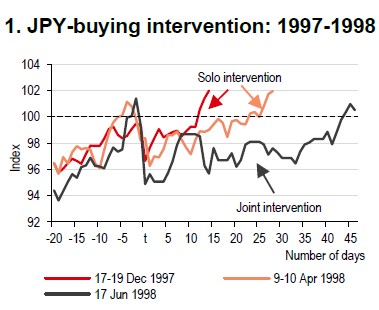
Source: Bloomberg, HSBC
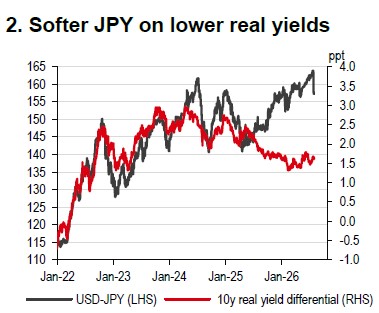
Source: Bloomberg, HSBC
Our base case remains that USD-JPY will be mostly range-bound, capped by periodic MoF intervention but supported by persistently negative real rates in Japan (chart 2). The range may now be wider due to both USD factors (recent softer US data, less predictable Fed communication and persistent geopolitical uncertainty) and JPY factors (joint intervention, potential changes involving the Bank of Japan (BoJ), the Government Pension Investment Fund and tax-exempt savings accounts).
However, unless we see much faster BoJ rate hikes, a clearer government preference for JPY strength (rather than saying that JPY weakness has both positive and negative implications) and a dialling back of fiscal expansion ambitions, we remain cautious about projecting a sustained downtrend for USD-JPY.
https://www.hsbc.com.my/wealth/insights/fx-insights/fx-viewpoint/usd-jpy-wider-trading-range-expected/

