



like_count_tpl like_count_text_tpl
like_tooltip_tpl
comment_count_tpl comment_count_text_tpl
comment_tooltip_tpl
Economic Updates
China in Focus: China Politburo: Steady support now, scope for more

Key takeaways
- No new stimulus, but China has delivered a more proactive tone on countercyclical measures and incremental support.
- Amid rising trade tensions, policymakers signal balanced trade and stronger services to support outbound investment.
- Consumption supports shifts to services, with welfare and livelihood measures supporting more sustainable demand.
China data review (July 2026)
- Retail sales rose 0.6% y-o-y in July (down from +1.0% in June), as auto sales fell 17% y-o-y, weighing on overall growth. The weakness likely reflects payback from earlier trade-in programs and revisions to EV purchase tax exemptions that reduced demand. Communication appliance sales outperformed, rising 20% y-o-y, partly driven by price increases linked to AI-related demand.
- Industrial Production grew 4.5% y-o-y in July, led by high-tech manufacturing (+16.9% y-o-y vs +14.1% in June) on AI-driven demand and the domestic innovation push. Export-oriented sectors also outperformed but weakness in consumer-facing industries and construction-linked materials persisted. Coal mining output also weakened sharply, falling 10.8% y-o-y in July.
- Fixed Asset Investment fell 12.9% y-o-y in July. Manufacturing investment declined 4.4% y-o-y amidst oil-driven cost pressure and muted pricing power among some consumer-facing sectors. Infrastructure investment remained weak (-14.7% y-o-y), partly affected by extreme weather, while property investment plunged 27% despite modest sales improvement in larger cities.
- Headline CPI eased to 0.5% y-o-y in July (from 1.0% in June), driven by softer vehicle fuel prices (+0.8% y-o-y). Durables inflation was mixed: communication appliance prices rose on AI-related cost pass through, while other big-ticket items remained under pressure. PPI moderated to 3.5% y-o-y (from 4.1%), led by oil-linked sectors tracking lower Brent prices.
- Exports rose 23.9% y-o-y in July led by green technology items and semiconductors. ASEAN exports increased by c38% y-o-y on regional AI-supply chain collaboration, while exports to the US grew 17% y-o-y from a low base. Imports stayed strong, rising 27.5% y-o-y, supported by AI-related demand, domestic industrial upgrading and commodity imports.
China Politburo: Steady support now, scope for more
On 30 July, policymakers reviewed the H1 economic performance and set out key economic and policy priorities for H2.
Shifting growth model; more counter-cyclical focus
Policymakers broadly maintained the current policy stance, reiterating “proactive” fiscal policy and a “moderately loose” monetary policy, while noting the economy is increasingly led by new growth drivers. They also flagged continued headwinds and revived calls to “strengthen counter-cyclical” support – wording that was not used during the April meeting – reflecting softer domestic momentum. Exports have helped cushion growth, but pressure for additional policy support is building.
Fiscal policy takes the lead; further support remains possible
The Politburo called for faster spending and greater bond utilisation, starting with the deployment of existing annual quotas. Issuance has lagged versus last year: Special Local Government Bond (SLGB) issuance is 55% year-to-date (Wind) compared with 63% over Jan-July last year, while refinancing bond issuance has reached 84% of the annual quota – highlighting local fiscal constraints and a tilt towards refinancing over new investment.
Meanwhile, the stance around monetary policy suggests less urgency for broad interest rate cuts or reserve requirement ratio (RRR) cuts. Support is more likely via targeted structural tools and liquidity operations (e.g., Open Market Operations and treasury bond purchases).
Infrastructure push via the “six networks”
Accelerated fiscal spending is expected to support investment in the “six networks” – power, water, computing, information and communications technology, urban infrastructure, and logistics – which was also part of the 15th Five-Year Plan. The National Development and Reform Commission (NDRC) has cited over RMB7trn of investment this year (Xinhua, 25 May), though detailed plans are yet to be unveiled. A stronger infrastructure push should provide counter-cyclical support needed to lift domestic demand.
Trade rebalancing to ease external tensions
While exports remain a key growth pillar, trade friction persists, including EU tensions and new US restrictions (e.g., on power inverters and robotics imports). The Politburo’s call for “mutually beneficial international trade” points to a rebalancing towards services and FDI. Stronger innovation capacity is supporting inbound high-tech investment (high-tech FDI +33.2% y-o-y in H1), and continued emphasis on attracting foreign capital may help stabilise external linkages.
Consumption: services-led in the near-term; livelihood support in the medium-term
Policy continues to prioritise domestic consumption, with a focus on services and humancapital investment, consistent with the 15th Five-Year Plan (e.g., tourism, healthcare, sport, elderly care, childcare). This suggests support may be more targeted at services than durable goods (e.g., trade-in programmes) where policy support appears to be fading after earlier frontloading.
Livelihood measures are expected to target key groups – gig worker protections, support for rural elderly, and vocational training. Over the medium term, reforms expanding access to public services based on permanent residence could reduce precautionary savings among ~170 million migrant workers, unlocking consumption potential.
A unified national market remains a priority
Policymakers reiterated plans to advance the “Regulation on Building a Unified National Market” to place local government actions on a more rules-based footing. Green objectives are also being strengthened (e.g., broader carbon market coverage and efficiency upgrades), alongside sector-specific measures aimed at curbing “involution”, particularly in new energy (e.g., EV tax incentives, export VAT rebates, and taxes on batteries/solar panels).
Addressing local protectionism and persistent “triangular debts” in corporate payment chains remain critical to restoring cashflow transmission and improving business confidence. Externally, tackling “involution” may also help reduce trade tensions.
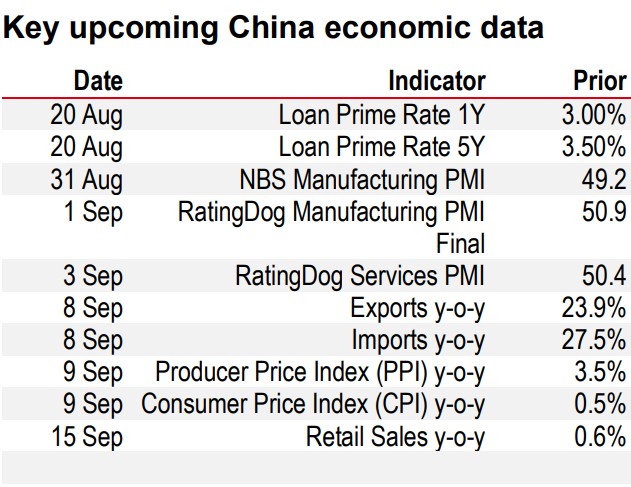
Source: LSEG Eikon
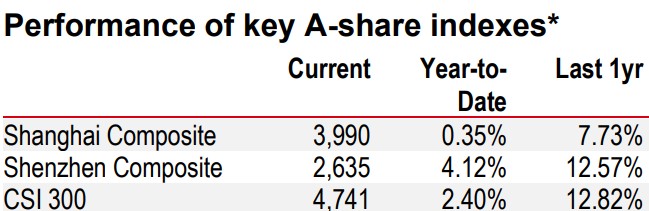
* Past performance is not an indication of future returns
Source: LSEG Eikon. As of 18 August 2026, market close
https://www.hsbc.com.my/wealth/insights/market-outlook/china-in-focus/china-politburo-steady-support-now-scope-for-more/

