2024-10-11 10:39
PARIS, Oct 11 (Reuters) - France should seek more European Union funds for its green transition, Energy Minister Agnes Pannier-Runacher told a news conference, noting that other countries were better at doing so. The French government delivered its 2025 budget on Thursday with plans for 60 billion euros ($65.5 billion) worth of spending cuts and tax hikes on the wealthy and big companies to tackle a spiralling fiscal deficit. Pannier-Runacher said France must avoid making polluting energy solutions cheaper than decarbonized ones, which meant tackling certain historic advantages to fossil energy. This must be done in a balanced way so as not to destabilise the system, she added. Sign up here. https://www.reuters.com/business/energy/france-must-tackle-fossil-energys-advantages-balanced-way-energy-minister-says-2024-10-11/

2024-10-11 10:31
LONDON, Oct 11 (Reuters) - Insured losses for Hurricane Milton are likely to range between $30 billion and $60 billion, Morningstar DBRS analyst Marcos Alvarez said on Friday, below the credit ratings agency's highest estimates before the hurricane hit. Hurricane Milton cut a destructive path across Florida this week, but the Tampa Bay area appeared to sidestep the storm surge. Morningstar DBRS had estimated insured losses could reach $100 billion earlier this week. "The worst-case scenario of a direct hit to Tampa didn’t materialise," Alvarez, managing director in Morningstar DBRS' global financial institution ratings division, told Reuters by email. Alvarez added that a $30-60 billion insured loss "should be manageable for the insurance industry, except for some local Florida carriers that could have material exposure to this market". The hurricane threatens to swamp Florida's troubled property insurance market, potentially pushing prices higher and threatening coverage in a storm-prone region that already has the highest insurance costs in the United States. Ratings agency Fitch said on Thursday that insured losses for Hurricane Milton were likely to be in the $30-50 billion range, the largest insured loss since Hurricane Ian in 2022. Insurance broker Aon (AON.N) , opens new tab on Friday also put insured losses for Milton at "tens of billions of dollars". Sign up here. https://www.reuters.com/business/finance/morningstar-dbrs-cuts-estimate-milton-insured-losses-30-60-billion-2024-10-11/

2024-10-11 10:14
LONDON, Oct 11 (Reuters) - Governments' targets and plans to speed up the use of renewable energy are set to deliver only half of the growth needed to reach a U.N. climate goal to triple capacity by 2030, a report by the International Renewable Energy Agency (IRENA) showed. WHY IT'S IMPORTANT The renewable energy goal set at the COP28 U.N. climate conference last year, as well as a target to double energy efficiency, are seen as crucial to keeping a 1.5 degree Celsius (2.7 Fahrenheit) warming limit this century within reach. Countries have to update their nationally determined contributions (NDCs), or commitments to combat climate change, by February next year. Some are expected to announce them at the COP29 conference in November in Azerbaijan. BY THE NUMBERS The IRENA report tracked the progress of countries towards those goals. To meet the renewables target, installed capacity would have to grow from 3.9 terawatts (TW) today to 11.2 TW by 2030, requiring an additional 7.3 TW in under seven years. But current plans are estimated to leave a gap of 3.8 TW by 2030, falling short of the goal by 34%. Annual investment in renewable capacity needs to triple to $1.5 trillion each year from 2024 to 2030 from $570 billion last year, the report said. The annual energy intensity improvement rate must also increase from 2% in 2022 to 4% between 2023 and 2030. CONTEXT An IEA report this week said renewable energy sources are set to meet nearly half of all electricity demand by the end of the decade but will fall short of the U.N. goal. KEY QUOTE "The COP28 goals of tripling renewables and doubling energy efficiency are key enablers for our global efforts to keep 1.5C within reach but we risk missing them. The next NDCs must mark a turning point and bring the world back on track," said Francesco La Camera, IRENA’s director general. Sign up here. https://www.reuters.com/business/energy/countries-renewable-energy-plans-fall-short-target-says-irena-2024-10-11/

2024-10-11 10:10
A look at the day ahead in U.S. and global markets from Mike Dolan Even though futures pricing had already turned queasy before the sticky September inflation report on Thursday, the prospect of the Federal Reserve skipping another interest rate cut next month has now become part of the mix. An aggravating miss on U.S. consumer price readings for last month, which saw the annual core inflation rate unexpectedly tick higher to 3.3%, was partly offset by a jump in weekly jobless claims amid distortions from recent strikes and storms. But the picture encouraged doubts about whether the Fed will cut again in November, with some Fed officials clearly wavering. The relatively hawkish Atlanta Fed boss Raphael Bostic told the Wall Street Journal he was considering a pause until the data fog lifted a bit. "Maybe we should take a pause in November. I'm definitely open to that." While other Fed officials indicated further easing was still in store, futures remain only just over 80% priced for another quarter point rate cut on November 7. That meeting comes just two days after the U.S. election - coming on a Thursday that week as it was pushed back a day because of the voting. The Fed fervently dismisses any consideration of the political calendar in its deliberations. But with the White House race on a knife edge, and such critical long-term issues on trade, taxes and immigration at stake, it's possible Fed policymakers won't know the final outcome by the time they decide. There's plenty of data to parse in the meantime, including a another reality check on inflation from the producer price report later on Friday - a series that contains some critical components of the Fed's favored PCE inflation gauge. Annual core PPI inflation is expected to have risen to 2.7% from 2.4% last month, even though headline rates should fall further below 2.0%. Ahead of that release, 10-year Treasury yields held off two-month highs hit after the CPI on Thursday but two-year yields fell back below 4%. The dollar index (.DXY) , opens new tab slipped back from near two-month highs too. With weekend nerves around the Middle East conflict keeping energy markets on edge, oil prices remain relatively contained and U.S. crude hovered about $75 per barrel. Storm damage in Florida from Hurricane Milton was being assessed. Wall Street stocks (.SPX) , opens new tab took only a glancing hit from the fresh uncertainty over rates and inflation, pulling back slightly from new records yesterday as the third quarter earnings season now gets underway. Stock futures were marginally in the red first thing on Friday, with banks JPMorgan (JPM.N) , opens new tab, Bank of New York Mellon (BK.N) , opens new tab and Wells Fargo (WFC.N) , opens new tab due to report later alongside asset manager BlackRock (BLK.N) , opens new tab. S&P 500 earnings are estimated to have increased 5.3% over the year-ago quarter, down from a second-quarter gain of 13.2%. Technology (.SPLRCT) , opens new tab and communication services (.SPLRCL) , opens new tab sectors are forecast to have the strongest year-over-year growth with 12-15% advances, but financials are expected to lag with annual growth of less than 2%. Elsewhere, Hong Kong markets were closed for a holiday on Friday but the mainland Chinese index (.CSI300) , opens new tab fell back again ahead of a hotly-anticipated Saturday press conference that's expected to detail fiscal stimulus measures to accompany the recent monetary easing from Beijing. South Korea's won firmed up after the central bank kicked off its easing cycle and delivered what the governor described as a 'hawkish cut' in interest rates - lowering borrowing costs by a quarter point, as expected. Japan's Nikkei advanced (.N225) , opens new tab and Europe's (.STOXXE) , opens new tab held the line. European markets were monitoring fallout from the French budget late on Thursday, after Prime Minister Michel Barnier outlined plans for 60 billion euros ($66 billion) worth of spending cuts and tax hikes. The big question there now is whether the plans can pass through a divided parliament, and rating agency Fitch is due to review its assessment of France's sovereign credit rating later in the day. French government bonds were steady on Friday, and the euro ticked higher against a generally softer dollar. The European Central Bank is widely expected to cut interest rates again next week for the third time this year. Sterling rose slightly after news Britain's economy grew in August after two consecutive months of stagnation, providing some relief to finance minister Rachel Reeves ahead of the new Labour government's first budget later this month. Key developments that should provide more direction to U.S. markets later on Friday: * US September producer price inflation, University of Michigan October sentiment survey; Canada Sept employment report; Mexico Aug industrial output * Dallas Federal Reserve President Lorie Logan, Fed Board Governor Michelle Bowman and Chicago Fed chief Austan Goolsbee all speak * US corporate earnings: JPMorgan, Bank of New York Mellon, BlackRock, Wells Fargo, Fastenal * Ukraine President Volodymyr Zelenskiy meets German Chancellor Olaf Scholz in Berlin. Russian President Vladimir Putin meets Iran's President Masoud Pezeshkian in Ashgabat Sign up here. https://www.reuters.com/markets/us/global-markets-view-usa-pix-2024-10-11/
2024-10-11 09:04
NEW YORK, Oct 11 (Reuters) - A sharp steady rise in overnight repurchase agreements is overwhelming banks that serve as middlemen for such short-term borrowings in U.S. government securities, threatening to fuel major funding pressure at the end of every quarter and year. The market for so-called repos allows banks to borrow money quickly and cheaply when they need cash, and lend with little risk. Hedge funds and Wall Street financial firms rely on the roughly $4 trillion repo market to finance daily trades, and any disruption could force them to cut holdings of bonds, stocks and other securities. Borrowers use Treasuries or other debt securities as collateral, agreeing to repurchase them in the future at a pre-determined price. A typical repo transaction involves a dealer borrowing cash from a money market fund and lending the cash to a client such as a hedge fund. Repo demand has always been high because these transactions are more efficient in mobilizing cheaper and deeper funding for financial intermediaries and borrowers as they reduce dependence on commercial banks. Its volume has surged even higher as trading strategies that depend on them have become more popular, while primary dealers are reluctant to boost capital reserves required to handle more trades. Repo rates jump when banks pull away from acting as middlemen at quarter- and year-ends due to higher balance sheet costs required at those times for reporting purposes. That happened at the end of the third quarter on Sept. 30. The secured overnight financing rate (SOFR), the cost of borrowing short-term cash, soared 13 basis points (bps) over the effective federal funds rate of 4.83%. It was 22 bps higher on Oct. 1. That squeeze harkened back to September 2019 when funding costs soared due to a large drop in bank reserves as corporations tried to meet a tax deadline and make payments for Treasury debt settlements. "It is absolutely the kind of hiccup that needs attention," said Lou Crandall, chief economist at Wrightson ICAP, to a point where the Federal Reserve could address it at one of its meetings. Funding conditions have stabilized, with SOFR at 4.83% and the broad general collateral rate, another repo rate, at 4.82%. But analysts believe this could end up being a systemic issue that creates more volatility in the overnight market, keeping short-term rates elevated. "There is an inelastic demand for repo that exists on a daily basis and that doesn't change whether it's quarter-end, or it's year end," said Jan Nevruzi, U.S. rates strategist at TD Securities. "But when dealers pull away from intermediation like it does during those periods, it creates issues like that." What happened at the end of September was mostly about dealers' inability to meet demand for repo financing, Wrightson's Crandall said. "There was not enough intermediation capacity to ... finance all repo positions. We have been seeing signs ... of the explosive growth of certain segments of the repo market that has been creating congestion on dealer balance sheets and the market in general," Crandall said. SOARING VOLUME, BASIS TRADES Fed data showed SOFR volume soared to a record $2.5 trillion on Sept. 30. from $2.07 trillion the day before. Treasury repos cleared through another platform called the Delivery-versus-Payment (DVP) service also jumped to $1.7 trillion on Sept. 30 and have been in the trillions of dollars the last couple of months. Analysts said one reason for the jump in repo volume was the surge in so-called basis trades, a trading strategy which takes advantage of the difference in price between cash Treasuries and futures. These are financed in the repo market and their size has exploded with record bets against Treasury futures amassed by leveraged funds. Since the Fed launched its hiking cycle in 2022, hedge funds have been buyers of Treasuries, hedging that position by selling futures to asset managers who use these instruments to meet benchmark needs in their portfolios. "There are clear signs of money market sensitivity to shifts in the amount of cash in the system and the amount of collateral in the system, and to dealer balance sheet constraints," said Mark Cabana, head of U.S. rates strategy, at BofA Securities. One sign of primary dealers' balance sheet stress is their record holdings of Treasuries seen a few weeks ago following a global sell-off in risk assets that pushed investors to buy safer U.S. government debt. Their Treasuries positions have eased, but remained elevated. Dealers would rather hold less Treasury debt. As middlemen, primary dealers buy and sell bonds, making money on the difference, or so-called bid-ask spread. The bigger the trading volume, the higher the profits. While repo financing accounts for a large share of dealers' overall balance sheet, analysts said it is not as profitable for them to do it these days, with the SOFR below the interest on reserve balances (IORB) currently at 4.90%, or the rate paid on bank reserves held at the Fed. Dealers would much rather have their funds sit as reserves at a higher rate than lend to hedge funds. Overall, primary dealers have no desire to expand their balance sheet because it entails higher leverage charges that would require more capital, TD's Nevruzi said. Sign up here. https://www.reuters.com/markets/us/surging-us-repo-activity-likely-exacerbating-funding-pressure-2024-10-11/
2024-10-11 09:01
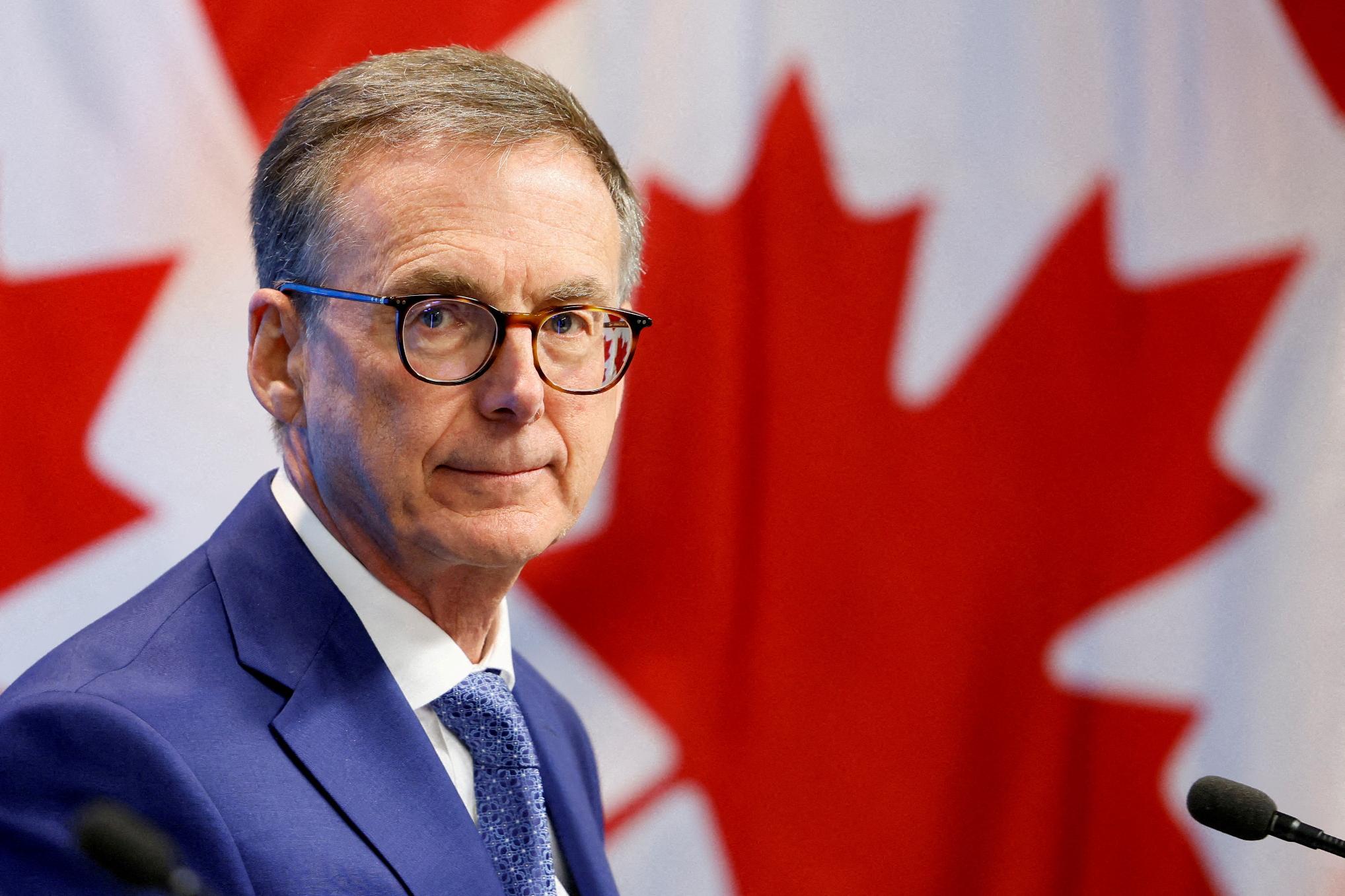
BoC likely to lower rates faster than Fed due to weak Canadian growth Investors expect BoC policy rate to hit neutral setting in less than one year Canadian dollar hits a two-month low amid rate-cut expectations TORONTO, Oct 11 (Reuters) - The Bank of Canada is likely to lower interest rates to a neutral setting that neither restricts nor stimulates its economy more quickly than the U.S. Federal Reserve, said analysts, who see weak Canadian growth raising the risk of a sustained drop in inflation below the central bank's 2% target. The BoC estimates the neutral interest rate - where its policy rate settles when the economy is in equilibrium - to range from 2.25% to 3.25%, with a mid-point of 2.75%. The estimate among Fed officials is similar, at 2.9%, with a central tendency estimate among policymakers in the 2.5%-to-3.5% range. A faster move to the neutral rate could offer relief to heavily indebted Canadians. It could also weigh on the Canadian dollar, which touched a two-month low on Friday at 1.3783 per U.S. dollar, or 72.55 U.S. cents. "The BoC has more reason (than the Fed) to be in a hurry to reach its neutral rate, as slower growth in Canada implies more slack in the economy," said Andrew Kelvin, head of Canadian and global rates strategy at TD Securities. Major central banks are now aligned in cutting interest rates, but in contrast to their unified race to raise rates when inflation was a global threat they now differ in how long and how far to take easing cycles to keep inflation in check and their economies growing. Investors are betting it will take less than one year for the BoC to reduce its benchmark interest rate to 2.75% from the current 4.25% but doubt the U.S. economy will weaken sufficiently for the Fed to lower borrowing costs to the neutral setting in the current easing cycle. Canada's economy has grown more slowly in recent quarters than the roughly 2.4% pace the BoC sees as its potential. That has helped cool inflation, which hit 2% in August, but the central bank says additional economic slack would be unwelcome. Data on Friday showed Canada added 47,000 jobs in September, more than expected, but a BoC survey indicated firms still see weak demand, leaving the market's implied chances of an unusually large half-percentage-point rate cut by the bank at its next policy decision on Oct. 23 largely unchanged at about 50%. INSURANCE POLICY The BoC has stuck with quarter-percentage-point moves in its first three rate cuts but analysts said the Fed's decision to begin lowering borrowing costs in September with a 50-basis-point move raises prospects of the BoC easing in larger steps. "We expect the Bank of Canada will cut rates by 50 basis points this month, with the domestic economy underperforming and significant challenges on the horizon," said Royce Mendes, managing director and head of macro strategy at Desjardins. "Population growth is set to dramatically slow and the worst of the mortgage-renewal wall has yet to be felt." Many Canadians are likely to renew their mortgages in the coming years at much higher interest rates after borrowing heavily and at rock-bottom levels in 2020 and 2021. "Moving faster towards the neutral-rate range would be an insurance policy against inflation sustainably falling below target," Mendes said. The potential for below-target inflation has not been lost on investors, with breakeven rates, the market's measure of expected inflation, falling further below 2% in recent months. "If Canada begins to miss its inflation target to the downside, that is a scenario that would lead to significant currency depreciation because the Bank of Canada would have the green light to cut rates at a time when the U.S. isn't feeling that pressure," said Adam Button, chief currency analyst at ForexLive. Sign up here. https://www.reuters.com/markets/rates-bonds/faster-move-neutral-rate-could-help-bank-canada-fend-off-below-target-inflation-2024-10-11/