2024-10-03 11:05
TSX ends down 0.1% at 23,968.50 Posts second straight modest decline Materials sector loses 1.2% as copper falls Energy rises 2.8%; oil settles 5.2% higher Oct 3 (Reuters) - Canada's main stock index ended lower for a second straight day on Thursday as investors grew cautious ahead of a key U.S. employment report, but gains for energy shares on soaring oil prices helped contain the market's decline. The Toronto Stock Exchange's S&P/TSX composite index (.GSPTSE) , opens new tab ended down 33.05 points, or 0.1%, at 23,968.50, adding to a modest pullback since notching a record closing high on Tuesday. "We've seen investors taking a pause to consider things," said Michael Sprung, president of Sprung Investment Management. "We're waiting for some employment numbers tomorrow ... the market is waiting to see where that shakes out." U.S. nonfarm payrolls data, due on Friday, is expected to show the American economy added 140,000 jobs in September. Investors are anxious for more data on the labor market after the Federal Reserve last month cut its benchmark interest rate by an unusually large 50 basis points. "We've been through a somewhat exuberant market and certainly valuations appear very high," Sprung said. The materials sector, which includes fertilizer companies and metal mining shares, ended 1.2% lower as copper prices declined. Shares of NovaGold Resources (NG.TO) , opens new tab were particularly hard hit, ending down 12.7%, after the company reported quarterly results. The utilities and real estate sectors fell 1.3% and 1.7% respectively as bond yields climbed after the release of strong U.S. services sector data. The Canadian 10-year yield was up 7.3 basis points at 3.100%. The energy sector was one of just three sectors to notch gains. It advanced 2.8% as the price of oil settled 5.2% higher at $73.71 a barrel over concerns that the escalating Middle East conflict could hit crude supply. Sign up here. https://www.reuters.com/markets/tsx-futures-fall-ahead-us-data-middle-east-conflict-adds-uncertainty-2024-10-03/

2024-10-03 10:52
MUMBAI, Oct 3 (Reuters) - The Indian rupee fell for a fourth consecutive session on Thursday, logging its worst day against the dollar in two months, pressured by a decline in regional currencies and an uptick in crude prices amid intensifying Middle East conflict. The rupee ended at 83.9675 against the U.S. dollar, down from 83.82 in the previous session. The domestic currency fell to an intraday low of 83.97 during the session, just shy of its record low of 83.9850, hit last month. "While the 84 level is expected to act as a strong support for the Indian currency, any escalation in geopolitical conflict or a significant surge in oil prices could push the rupee to a new record low," said Sugandha Sachdeva, founder of SS WealthStreet, a New Delhi-based research firm. Significant foreign portfolio outflows from Indian markets have also weighed on the rupee, Sachdeva said. However, the Reserve Bank of India is unlikely to "loosen its grip" and will intervene if the rupee edges past 84 against the dollar, "in quick succession," a trader with a private bank said. Most Asian currencies slipped on Thursday, with the Thai baht, Malaysian ringgit and the Indonesian rupiah down about 1% each versus the dollar. Prospects that the Federal Reserve was not likely to be in a rush to cut interest rates coupled with a volatility in oil prices amid the Middle East conflict lifted the safe-haven dollar's appeal. "Markets are awaiting Israel's retaliation against Iran, which should determine whether oil goes higher," ING Bank said in a note. The dollar is "in a solid position," ING said. U.S. private payrolls increased more than expected last month, spurring expectations for a robust reading on the monthly nonfarm payrolls figures on Friday. The odds of a 50-basis-point U.S. rate cut in November are currently at about 36%. Sign up here. https://www.reuters.com/markets/currencies/rupee-logs-worst-day-2-months-weak-asia-fx-firmer-oil-prices-weigh-2024-10-03/
2024-10-03 10:30
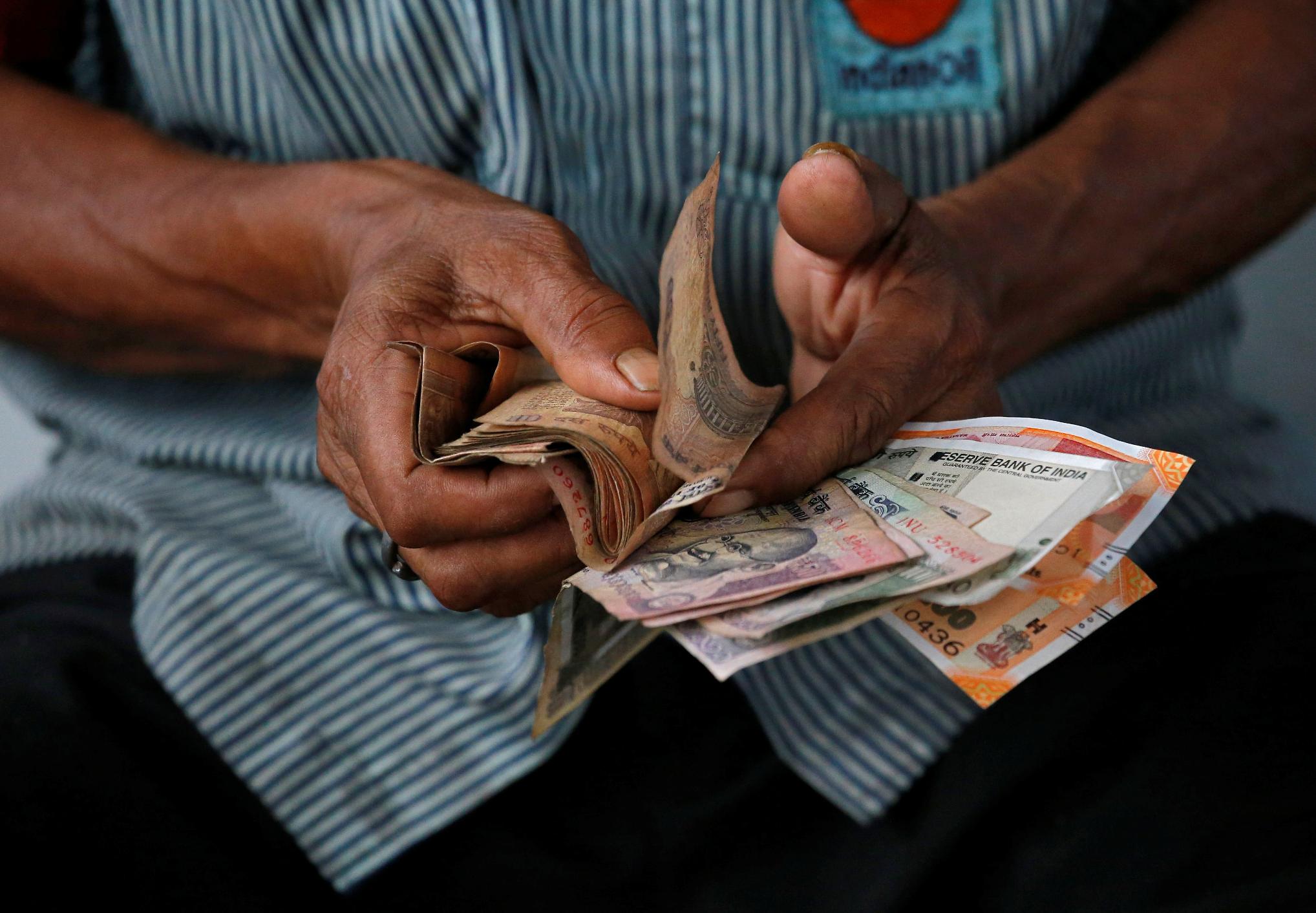
BENGALURU, Oct 3 (Reuters) - The Indian rupee will hold steady against the U.S. dollar over the coming year as the Reserve Bank of India will use its considerable FX reserves to reduce volatility and keep the currency on a tight leash, a Reuters poll found. While most Asian currencies posted gains against the greenback following the Federal Reserve's larger-than-expected 50 basis point rate cut last month, the rupee has traded largely flat with the currency, losing just around 0.8% for the year. That remarkable stability - which is not commonplace among emerging market currencies - was mostly because of the RBI's regular interventions in the foreign exchange market using its $692 billion in forex reserves. The value of the partially convertible rupee is unlikely to change going forward, according to a Reuters poll of 40 FX strategists taken Sept. 30-Oct. 3. It was expected to trade between 83.73 and 83.50 per dollar in the next six months, a 0.2%-0.5% drop from around 83.96/$ on Thursday. The rupee was then forecast to gain about 1% to 83.30/$ in a year. "We see no sign of change in RBI's pursuit of a higher reserves buffer, which would limit the appreciation potential for the rupee," noted Claudio Piron, emerging Asia FI/FX strategist at Bank of America. "However, persistent dollar depreciation may result in a catch-up move in the rupee in the near term, with the potential for the rupee to go toward the recent range's bottom." The rupee's trade-weighted real effective exchange rate stood at 105.45 in August, down from 107.45 in July, according to the RBI's monthly bulletin, suggesting the currency is overvalued by about 5%. (Other stories from the October Reuters foreign exchange poll) Sign up here. https://www.reuters.com/markets/currencies/rbis-strong-grip-set-lock-rupee-place-2024-10-03/

2024-10-03 10:04
A look at the day ahead in U.S. and global markets from Mike Dolan The U.S. dollar (.DXY) , opens new tab is on course for its best week in six months, surging anew on Thursday against the yen, sterling, euro and Swiss franc as central banks around the world appear set to out-dove the Federal Reserve. Partly spurred earlier this week by a "safety bid" surrounding Middle East tensions, dollar gains have really mounted as speculation of another round of interest rate cuts in Europe were twinned with official hesitation at further monetary tightening in Japan - with inflation subsiding everywhere. And with U.S. labor market signals continuing to show brisk job creation, the relative rates picture seems to have shifted back in favor of the greenback - whose 1.5% appreciation this week is the biggest since April. The Bank of England, a recent holdout in the rush to peg back interest rates, was the latest to turn decidedly dovish as BoE boss Andrew Bailey told the Guardian newspaper the central bank could become "a bit more activist" and "a bit more aggressive" in its approach to lowering rates. With a second rate cut of year now fully priced for the BoE's meeting next month, the pound dropped more than a cent on Thursday to three-week lows just above $1.31. The tone has shifted across the European continent too. Hawkish European Central Bank board member Isabel Schnabel underscored forecasts for another ECB rate cut in a fortnight's time by saying on Wednesday: "A sustainable fall of inflation back to our 2% target in a timely manner is becoming more likely." And her ECB colleague Mario Centeno went one further: "Now we face a new risk: undershooting target inflation, which could stifle economic growth," he said. European September business surveys on Thursday confirmed the bloc's private sector activity slipped back into contraction last month. A rapid disinflation scenario was obvious again in Switzerland, which saw monthly deflation on 0.3% last month that dragged annual inflation to as low as 0.8% - well below forecast and increasing pressure on the Swiss National Bank to ease again even with rate there back as low as 1% already. In his first public appearance since taking charge, new chairman Martin Schlegel on Tuesday also said the SNB was not ruling out taking interest rates into negative territory. Over in Asia, it appears the Bank of Japan's moves to 'normalize' its ultra-low policy rates have also been stopped in their tracks and the yen fell to its weakest in six weeks through 147 per dollar. Japanese Prime Minister Shigeru Ishiba completed a backflip from perceived monetary hawk to dove on Wednesday by saying: "I do not believe that we are in an environment that would require us to raise interest rates further." BOJ policymaker Asahi Noguchi, who dissented against a rate hike in July, doubled down on Thursday by saying the central bank must be patient in normalizing policy. The sudden concern around the world about ebbing inflation is partly down to plummeting oil prices - which despite a modest pop on the Israel/Iran standoff this week are still clocking annual losses of more than 20% and have been for more than a month. An OPEC+ meeting on Wednesday did little to offset that, with ministers keeping policy unchanged and including a plan to start raising output from December. And the latest week's data showed U.S. crude oil and gasoline inventories rising. By contrast with Europe, Fed easing hopes cooled somewhat as this week's stream of employment statistics underlined the 'soft landing' thesis there, taking some more heat out of rate cut bets. Private payrolls increased by 143,000 jobs last month after rising by an upwardly revised 103,000 in August, the ADP National Employment Report showed on Wednesday. September updates on layoffs and weekly jobless claims are due later on Thursday alongside updated service sector surveys for last month. Richmond Federal Reserve President Thomas Barkin told Reuters on Wednesday he was still concerned about the "last mile" in getting inflation back to target. "I'm more concerned about inflation than I am about the labor market," he said about the outlook through next year. The upshot was futures pricing for Fed rate cuts through the end of this year ebbing back below 70 basis points and Treasury yields nudging higher, with the 10-year nosing back above 3.80%. Stock markets around the world were more mixed, with European stocks (.STOXXE) , opens new tab in the red on Thursday and Hong Kong (.HSI) , opens new tab stocks taking their first step back since China's frenetic stimulus measures were unveiled last week. Japan's Nikkei (.N225) , opens new tab outperformed with gains of almost 2% on the BOJ soundings and weakening yen. With Wall St stocks (.SPX) , opens new tab flat on Wednesday, held back by disappointing deliveries readings from automaker Tesla (TSLA.O) , opens new tab, index futures were slightly in the red ahead of Thursday's open. Emboldened by "soft landing" hopes, U.S. high-yield junk bond yield spreads over Treasuries have fallen close to their lowest for the year and are testing historic lows on an options-adjusted basis. With the third quarter earnings season about to unfold and parsing a final quarter of political nerves from the Middle East to the U.S. election, the VIX (.VIX) , opens new tab volatility gauge is above historical averages and hovering just shy of 20. Key developments that should provide more direction to U.S. markets later on Thursday: * US September Challenger layoffs, weekly jobless claims, September service sector surveys from ISM and S&P Global, August factory goods orders * Atlanta Federal Reserve President Raphael Bostic and Minneapolis Fed President Neel Kashkari both speak * US corporate earnings: Constellation Brands, AngioDynamics * US Treasury auctions 4-week bills Sign up here. https://www.reuters.com/markets/us/global-markets-view-usa-pix-2024-10-03/

2024-10-03 09:22
KAMPALA, Oct 3 (Reuters) - The Ugandan shilling was firmer on Thursday, boosted by strong dollar inflows from commodity exporters and remittances, traders said. At 0854 GMT, commercial banks quoted the shilling at 3,658/3,668, compared with Wednesday's closing rate of 3,665/3,675. Sign up here. https://www.reuters.com/markets/currencies/ugandan-shilling-firmer-commodity-remittance-dollar-inflows-2024-10-03/

2024-10-03 07:51
EU naval force confirms evolution of new phase in Houthis' tactics Houthis' email campaign targets Greek shipping companies Insurance costs rise, some shipping companies avoid Red Sea Three Greek shippers steer clear of Red Sea or Israel after email threats ATHENS/LONDON, Oct 3 (Reuters) - On a warm spring night in Athens, shortly before midnight, a senior executive at a Greek shipping company noticed an unusual email had landed in his personal inbox. The message, which was also sent to the manager's business email address, warned that one of the company's vessels travelling through the Red Sea was at risk of being attacked by Yemen's Iranian-backed Houthi militia. The Greek-managed ship had violated a Houthi-imposed transit ban by docking at an Israeli port and would be "directly targeted by the Yemeni Armed Forces in any area they deem appropriate," read the message, written in English and reviewed by Reuters. "You bear the responsibility and consequences of including the vessel in the ban list," said the email, signed by the Yemen-based Humanitarian Operations Coordination Center (HOCC), a body set up in February to liaise between Houthi forces and commercial shipping operators. The Houthis have carried out nearly 100 attacks on ships crossing the Red Sea since November, acting in solidarity with Palestinians in Israel's year-long war in Gaza. They have sunk two vessels, seized another and killed at least four seafarers. The email, received at the end of May, warned of "sanctions" for the entire company's fleet if the vessel continued "to violate the ban criteria and enter the ports of the usurping Israeli entity". The executive and the company declined to be named for safety reasons. The warning message was the first of more than a dozen increasingly menacing emails sent to at least six Greek shipping companies since May amid rising geopolitical tension in the Middle East, according to six industry sources with direct knowledge of the emails and two with indirect knowledge. Since last year, the Houthis have been firing missiles, sending armed drones and launching boats laden with explosives at commercial ships with ties to Israeli, U.S. and UK entities. The email campaign, which has not been previously reported, indicates that Houthi rebels are casting their net wider and targeting Greek merchant ships with little or no connection to Israel. The threats were also, for the first time in recent months, directed at entire fleets, increasing the risks for those vessels still trying to cross the Red Sea. "Your ships breached the decision of Yemen Armed Forces," read a separate email sent in June from a Yemeni government web domain to the first company weeks later and to another Greek shipping company, which also declined to be named. "Therefore, punishments will be imposed on all vessels of your company ... Best Regards, Yemen Navy." Yemen, which lies at the entrance to the Red Sea, has been embroiled in years of civil war. In 2014, the Houthis took control of the capital, Sanaa, and ousted the internationally recognized government. In January, the United States put the Houthis back on its list of terrorist groups. Contacted by Reuters, Houthi officials declined to confirm they had sent the emails or provide any additional comment, saying that was classified military information. Reuters could not determine whether the emails had been also sent to other foreign shipping companies. Greek-owned ships, which represent one of the largest fleets in the world, comprise nearly 30% of the attacks carried out by Houthi forces to early September, according to Lloyd's List Intelligence data that did not specify whether those ships had any ties with Israel. In August, the Houthi militia - which is part of Iran's Axis of Resistance alliance of anti-Israel irregular armed groups - attacked the Sounion tanker leaving it on fire for weeks before it could be towed to a safer area. The strikes have prompted many cargoes to take a much longer route around Africa. Traffic through the Suez Canal has fallen from around 2,000 transits per month before November 2023 to around 800 in August, Lloyd's List Intelligence data showed. Tensions in the Middle East reached a new peak on Tuesday as Iran hit Israel with more than 180 missiles in retaliation for the killing of militant leaders in Lebanon, including Hezbollah leader Sayyed Hassan Nasrallah on Friday. NEW PHASE The European Union's naval force Aspides, which has helped more than 200 ships to sail safely through the Red Sea, confirmed the evolution of Houthis' tactics in a closed door meeting with shipping companies in early September, according to a document reviewed by Reuters. In the document, shared with shipping companies, Aspides said the Houthis' decision to extend warnings to entire fleets marked the beginning of the "fourth phase" of their military campaign in the Red Sea. Aspides also urged ship owners to switch off their Automatic Identification System (AIS) transponders, which shows a vessel's position and acts as a navigational aid to nearby ships, saying they had to "shut it off or be shot". Aspides said the Houthis' missile strikes had 75% accuracy when aimed at vessels operating with the AIS tracking system on. But 96% of attacks missed when AIS was off, according to the same briefing. "Aspides are aware of those emails," its operational commander, Rear Admiral Vasileios Gryparis, told Reuters, adding that any response should be carefully considered and that companies are strongly advised to alert their security experts if contacted before sailing. "In particular, for the HOCC, the advice or guidance is not to respond to VHF calls and e-mails from “Yemeni Navy” or the “Humanitarian Operations Command Center” (HOCC)." The Houthis' email campaign began in February with messages sent to shipowners, insurance companies and the main seafarers union from HOCC. These initial emails, two of which were seen by Reuters, alerted the industry the Houthis had imposed a Red Sea travel ban on certain vessels, although they did not explicitly warn companies of an imminent attack. The messages sent after May were more menacing. At least two Greek-operated shipping companies that received email threats have decided to end such journeys via the Red Sea, two sources with direct knowledge told Reuters, declining to identify the companies for security reasons. An executive at a third shipping company, which has also received a letter, said they decided to end business with Israel in order to be able to continue to use the Red Sea route. "If safe transit through the Red Sea cannot be guaranteed, companies have a duty to act – even if that means delaying their delivery windows," said Stephen Cotton, General Secretary of the International Transport Workers' Federation, the leading union organisation for seafarers, which received an email from HOCC in February. "The lives of the seafarers depend on it." The email campaign has increased alarm among shipping companies. Insurance costs for Western ship owners' have already jumped because of the Houthi's attacks, with some insurers suspending cover altogether, the sources told Reuters. Greece-based Conbulk Shipmanagement Corporation stopped Red Sea voyages after its vessel MV Groton was attacked twice in August. "No (Conbulk) vessel is trading in the Red Sea. It mainly has to do with the crew safety. Once the crew is in danger, all the discussion stops," Conbulk Shipmanagement CEO Dimitris Dalakouras told a Capital Link shipping conference in London on Sept. 10. Torben Kolln, managing director of German-based container shipping group Leonhardt & Blumberg, said the Red Sea and wider Gulf of Aden was a "no go" area for their fleet. Contacted by Reuters, the companies did not respond to a request for comment on whether they had been targeted by the Houthi email campaign. Some companies continue to cross the Red Sea due to binding long-term agreements with charterers or because they need to transfer goods in that particular area.The Red Sea remains the fastest way to bring goods to consumers in Europe and Asia. The Houthis have not stopped all traffic and the majority of Chinese and Russian-owned ships - which they do not see as affiliated with Israel - are able to sail through unhindered with lower insurance costs. "We are re-assuring the ships belonging to companies that have no connection with the Israeli enemy that they are safe and have freedom (of movement) and (to) keep the AIS devices going on all the time," according to an audio recording of a Houthi message broadcast to ships in the Red Sea in September shared with Reuters. "Thank you for your cooperation. Out." Sign up here. https://www.reuters.com/world/middle-east/houthis-warn-shipowners-new-phase-red-sea-campaign-prepare-be-attacked-2024-10-03/