2025-10-14 10:18
Recent Dollar rebound driven by repositioning amid disrupted US data and rival currency issues Analysts expect dollar weakness due to US economic concerns and interest rate outlook International developments temporarily boost dollar, but long-term weakening trend remains NEW YORK, Oct 14 (Reuters) - A rebound in the dollar over the past month is unlikely to last given it was largely due to repositioning over temporary factors including the disruption of U.S. economic data due to the U.S. government shutdown and upheaval in the governments of rival currencies. The greenback has climbed about 3% against a basket of currencies (.DXY) , opens new tab since mid-September, recovering from more than three-year lows after falling nearly 11% earlier this year. Sign up here. Speculators' net short bets on the dollar fell to $9.86 billion from a two-year high of $20.96 billion during that period, CFTC data showed before the U.S. government shutdown disrupted releases. Options markets also show the turn in sentiment in favor of the dollar with one- and three-month EUR/USD risk reversals recently hitting their most euro bearish levels since mid-June. Still, analysts are broadly skeptical of the dollar's recovery. "In the three- to six-month view, I think the dollar is going to be falling because I think the U.S. economy is going to weaken and the interest rates are going to come down," said Marc Chandler, chief market strategist at Bannockburn Capital Markets. Much of the dollar's recent rebound can be attributed to investors covering bearish bets on the currency. "What's going on in markets is basically a positioning adjustment," said Jayati Bharadwaj, a global FX strategist at TD Securities. Indeed, some analysts said the dollar rally may be running out of steam. "We've definitely seen a very nice period of dollar strength," said Joel Kruger, market strategist at London-based LMAX Group, which operates multiple global institutional FX exchanges. Kruger sees risks for further dollar weakness in the near term. INTERNATIONAL DEVELOPMENTS BOOST DOLLAR The dollar sold off in the first half of the year on worries over fading U.S. exceptionalism, concerns about a hit to economic growth from President Donald Trump's protectionist trade stance, and the specter of a ballooning U.S. budget and international trade deficits. But given the interruption of U.S. economic releases and political crises outside the United States — in Japan and France — investor attention has swung away from the dollar's travails. The euro snapped a two-month winning streak to trade down about 1.3% for October, while the yen has slipped nearly 3% against the rising greenback . Chaos and uncertainty in France, the euro zone's second-largest economy, have caused the euro to weaken against the greenback, while political shifts in Japan have swayed investor expectations for the Bank of Japan's monetary and fiscal policy, piling pressure on the yen. But investor reaction to recent international developments may have gone too far, analysts said. "The surprising outcome of the LDP (Liberal Democratic Party) leadership election led to significant JPY weakness as investors increasingly position for fiscal expansion and a dovish BoJ," Morgan Stanley strategists said in a note on Friday. "We think such positioning is excessive," the strategists wrote. COUNTER-TREND RALLY An early October Reuters poll of FX strategists showed the dollar weakening against all major currencies over the next three, six and 12 months, against the backdrop of rising U.S. fiscal deficit and worries that the Federal Reserve's independence may come under threat. "The dollar will weaken through time, but there are always these counter trend rallies," Colin Graham, head of multi-asset strategies at Robeco in London, said. "So we're playing dollar from the short side, but we are actively managing how big that position is," Graham said. SHUTDOWN END AS A CATALYST? That said, should U.S. economic growth surprise to the upside and the Fed end up not meeting expectations for rate cuts in coming months, it may help the dollar extend its rally, analysts said. For now, many of the catalysts that drove the dollar's drop this year, including worries about U.S. growth and the outlook for monetary policy, remain in place even though recent developments may have put them on the back burner. "U.S. economic data after the U.S. government reopens could become the catalyst to change this weaker yen trend," Morgan Stanley strategists said, recommending investors stay short the dollar against the yen. With Fed Chair Jerome Powell in the final months of his current term and the Trump administration's ongoing efforts to oust Fed Governor Lisa Cook from the central bank, questions about the Fed's independence and confidence in the dollar are also likely to gain importance in investors' minds. "Investors remain worried about Fed independence and the potential impact on USD. But for now they are focused on other issues," BofA Global Research analysts said in a note on Friday. Meanwhile, the long-awaited resumption of the Fed's rate-cutting cycle is likely to cheapen hedging of dollar exposure for foreign investors, piling more pressure on the buck. "I think that the dollar's big dollar super cycle has ended, and we're in the down part of it," Bannockburn Forex's Chandler said. https://www.reuters.com/world/europe/dollar-gains-rivals-trouble-may-lack-staying-power-2025-10-14/
2025-10-14 09:58
LONDON, Oct 14 (Reuters) - Banks borrowed 6.344 billion pounds ($8.42 billion) from the Bank of England at a weekly indexed long-term repo for six-month funds on Tuesday, the most since March 2020, at the start of the COVID-19 pandemic. The BoE has been seeking to increase usage of the facility as it shifts away from a system of excess reserves in Britain's banking system and unwinds much of the 875 billion pounds of quantitative easing gilt purchases it bought from 2009 to 2021. Sign up here. https://www.reuters.com/business/finance/bank-england-allots-most-6-month-repo-since-2020-2025-10-14/

2025-10-14 07:52
Oct 14 (Reuters) - Shares of Swedish gold trading platform Guldbrev Holding (GULD.ST) , opens new tab opened at 20.5 Swedish crowns ($2.15) per share on their market debut on the Nasdaq First North exchange on Tuesday, slightly above the 20 crowns they had been priced at during the heavily oversubscribed initial public offering (IPO). WHY IT'S IMPORTANT The price of gold reached $4,000 an ounce for the first time ever earlier in October, with investors seeking cover amid geopolitical uncertainty. This has boosted shares of gold miners and other companies trading in the precious metal. Sign up here. Following the IPO, announced in September amid soaring gold prices, Guldbrev plans to distribute 60-80% of its annual net profits to shareholders. CONTEXT Guldbrev is a digital platform mainly active in the Nordic countries that focuses on buying gold jewellery and items from consumers, and then recycling and reselling it. Customers can order an envelope from Guldbrev online, place their items in it and ship it to the company, its website said. Guldbrev then evaluates the gold and pays the customer back for it through a bank transfer or instant payment. The company, which is also present in Germany and the Netherlands, sees expansion into continental Europe as the next step in its strategy to broaden its geographical revenue base and benefit from the scalability of its digital platform. It managed to more than double its revenue between 2022 and 2024, and has said it does not see any major investment needs in its core business. BY THE NUMBERS Guldbrev's IPO was subscribed for about 350 million Swedish crowns ($37 million), corresponding to about 208% of the offering. The high subscription rate resulted in Guldbrev exercising an up-size option, where existing shareholders sold nearly 2.1 million additional shares, bringing the oversubscription rate to 167%. ($1 = 9.5240 Swedish crowns) https://www.reuters.com/business/gold-trading-platform-guldbrev-lists-stockholm-amid-record-high-gold-prices-2025-10-14/

2025-10-14 07:50
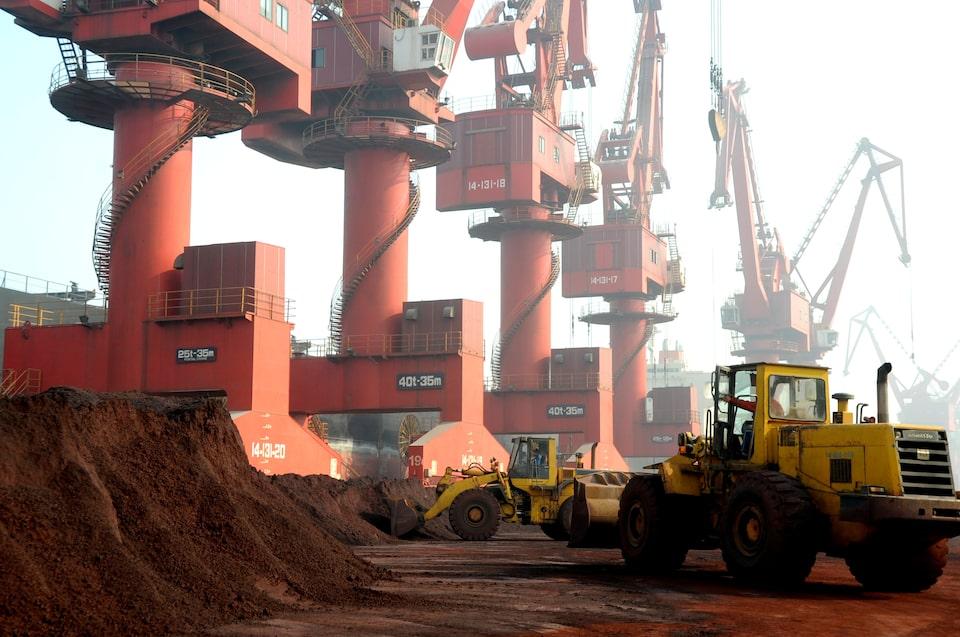
Magnet makers face longer license reviews, sources say Scrutiny is similar to April, at height of U.S.-China trade war China's rare earth exports dropped 31% in September BEIJING, Oct 14 (Reuters) - Chinese rare earth magnet companies have been facing tighter scrutiny on export license applications since September, sources say, even before Beijing's move last week to expand controls over the critical minerals used in magnets. The lengthier reviews magnet makers face raise questions about whether China, the top global supplier, is seeking to throttle back magnet shipments, contrary to its commitment to speed up exports in a trade truce with the U.S. in May, to further tighten its grip on the products essential in military and commercial technology. Sign up here. Starting in September obtaining an export license became harder, according to two sources with knowledge of the matter. Applications are now being returned more often with requests for extra information, said one of the sources. Approvals are taking longer, although generally still within the commerce ministry's 45 business day deadline, said the other, but the scrutiny is now similar to April, at the height of the trade war, when lengthy waits for licenses caused magnet shortages that led to shutdowns at automotive factories. The sources declined to comment on exactly how much longer it is taking to obtain licenses or elaborate on the questions that are being asked. Both spoke on condition of anonymity given the sensitivity of the issue in China. China's commerce ministry did not respond to a Reuters fax request for comment on license approvals. Data released on Monday showed China's rare earth exports dropped by 31% in September. It's unclear how much of that decline was driven by magnets because the data does not distinguish between products. "It's not surprising to see lower exports in September as getting a new license became increasingly difficult last month," said one of the sources. Exports of rare earth magnets fell sharply in April and May but grew in June, July and August. Data for September will be released later this month. China is the world's top supplier of rare earths, a group of 17 elements vital in products ranging from electric vehicles and wind turbines to military radars, and tightly controls the export of many types through its licensing system. Beijing expanded those controls last week, sparking anger in the U.S. where President Donald Trump promised more tariffs and retaliatory export bans, although he later struck a more conciliatory tone. There's been a rush of inquiries since the announcement from foreign clients trying to get orders shipped before the new rules take effect on November 8, according to both sources. Adam Dunnett, Secretary-General of the EU Chamber of Commerce in China, said the number one concern for members was still the bottleneck of rare earth product applications waiting for approval. The chamber had seen both approvals and delays for its members over the past several weeks, he added. "We can't say that we've seen a decrease in the level of anxiety or concern," he said. "Some companies have had their wait extended further without any response as to why that is the case." https://www.reuters.com/world/china/china-is-making-it-harder-get-rare-earth-magnet-export-licenses-sources-say-2025-10-14/
2025-10-14 07:23
Oct 14 (Reuters) - Shell (SHEL.L) , opens new tab said on Tuesday it had taken a final investment decision, together with Sunlink Energies and Resources Ltd, on the HI gas project offshore Nigeria, with production expected to start before the end of this decade. The project, once completed, will supply 350 million standard cubic feet of gas per day at peak production to Nigeria LNG, which produces and exports liquified natural gas (LNG) to global markets. Sign up here. https://www.reuters.com/business/energy/shell-sunlink-greenlight-lng-project-offshore-nigeria-2025-10-14/

2025-10-14 06:54
U.S. and China roll out tit-for-tat port fees IMF upwardly revises global economic outlook Gold sets record above $4,100 per ounce NEW YORK, Oct 14 (Reuters) - Wall Street closed mixed on Tuesday and gold touched a record high as investors weighed upbeat economic sentiment from the International Monetary Fund and Federal Reserve Chair Jerome Powell against revived U.S.-China trade tensions. Stocks lost some momentum late in the session after U.S. President Donald Trump posted on social media that he was considering ending some trade ties with China. Sign up here. The Dow reversed an early selloff to nab modest gains, while crude prices fell and benchmark U.S. Treasury yields eased. The S&P 500 and the Nasdaq finished the session in negative territory. Powell said in a speech on Tuesday that the overall U.S. economy "may be on a somewhat firmer trajectory than expected," while also cautioning that "there is no risk-free path for policy as we navigate the tension between our employment and inflation goals." That echoed an IMF report which raised its global growth outlook as tariff shocks and financial conditions have proven more benign than expected. But the IMF warned that the trade war between the world's two largest economies could significantly slow output. "What we have here is a market that has one ear constantly listening to the trade war rhetoric and then we have the other ear, which is in tune to the fundamentals of the stock market," said Peter Cardillo, chief market economist at Spartan Capital Securities in New York. The U.S. and China began charging tit-for-tat port fees on Tuesday. Bilateral trade tensions, which have rattled world markets this year, flared up late last week after China tightened controls on its rare earth exports. Trump retaliated by threatening to hike tariffs on Chinese imports into the triple digits. BANK EARNINGS KICK OFF EARNINGS SEASON Upbeat quarterly results from high-profile financial firms including JPMorgan Chase (JPM.N) , opens new tab, Goldman Sachs (GS.N) , opens new tab, Citigroup (C.N) , opens new tab and Wells Fargo (WFC.N) , opens new tab kicked off third-quarter earnings season. "If the banks are a guide, it will probably be a good earnings season," Cardillo added. "That's another supportive factor because to a certain degree, it validates the recent market highs." The Dow Jones Industrial Average (.DJI) , opens new tab rose 202.88 points, or 0.44%, to 46,270.46, the S&P 500 (.SPX) , opens new tab fell 10.41 points, or 0.16%, to 6,644.31 and the Nasdaq Composite (.IXIC) , opens new tab fell 172.91 points, or 0.76%, to 22,521.70. European stocks closed lower as renewed U.S.-China trade tensions soured market sentiment, as investors eyed developments in France, where the prime minister appeared set to hold off on a key pension overhaul. MSCI's gauge of stocks across the globe (.MIWD00000PUS) , opens new tab fell 2.45 points, or 0.25%, to 978.64. The pan-European STOXX 600 (.STOXX) , opens new tab index fell 0.37%, while Europe's broad FTSEurofirst 300 index (.FTEU3) , opens new tab fell 7.41 points, or 0.33%. Treasury yields declined but were off earlier lows, following Powell's speech and the IMF's revised growth outlook. The yield on benchmark U.S. 10-year notes fell 2.3 basis points to 4.028%, from 4.051% late on Friday. The 30-year bond yield fell 1.1 basis points to 4.6234% from 4.634% late on Friday. Oil prices dipped on trade war jitters and a report from the International Energy Agency which raised the prospect of increased supplies and dampening demand. U.S. crude fell 1.33% to settle at $58.70 per barrel, while Brent settled at $62.39 per barrel, down 1.47% on the day. The dollar eased while the Swiss franc and Japanese yen firmed due to heightened trade-driven risk. The dollar index , which measures the greenback against a basket of currencies including the yen and the euro, fell 0.26% to 99.04, with the euro up 0.31% at $1.1604. Against the Japanese yen , the dollar weakened 0.37% to 151.71. Gold broke past $4,100, boosted by safe-haven demand arising from the latest salvo in the Washington-Beijing trade spat. Spot gold rose 0.75% to $4,140.97 an ounce. U.S. gold futures rose 0.77% to $4,140.20 an ounce. https://www.reuters.com/world/china/global-markets-wrapup-1-2025-10-14/