2024-02-20 06:57
Feb 20 (Reuters) - French industrial gases firm Air Liquide (AIRP.PA) , opens new tab on Tuesday doubled its 2025 margin target after posting better-than-expected annual operating profit, sending its shares to an all-time high in late morning trading. The supplier of gases such as oxygen, nitrogen and hydrogen to factories and hospitals now targets a 320 basis points (bp) operating margin by 2025, up 100% from the 160 bp it had expected two years ago as part of its ADVANCE strategic plan. "Have we been too conservative? Absolutely not," CEO François Jackow said on a call with journalists, adding that the previous targets were based on historical models. The company did not provide a precise forecast in operating margin for 2024. Jackow said the group's performance came from offering "value-adding" pricing solutions and optimising operational performance. Air Liquide hiked prices by 8% in its industrial merchants business last year. The stock jumped 5.8% by 1101 GMT, hitting a record high of 182.7 euros. Recurring operating income rose 11.4% on a comparable basis to 5.07 billion euros ($5.48 billion) in 2023, above the 5.02 billion euros expected by analysts polled by Vara Research. Air Liquide recorded 5.1% revenue growth in its Gas & Services in North America last year, which accounts for 96% of its business. The French company was chosen in October as a partner for six out of seven planned clean hydrogen hubs by the U.S. Department of Energy, which will allocate $7 billion for the projects within a bipartisan infrastructure law. "These are long-term projects, which will take place over the next 5 or 10 years," Jackow noted, adding that, in the event of a change in the U.S. administration, Air Liquide is "looking at different scenarios, different timetables for the development of these activities". ($1 = 0.9259 euros) https://www.reuters.com/markets/commodities/air-liquide-posts-fy-profit-beat-hits-margin-targets-early-2024-02-20/

2024-02-20 06:55
Nasdaq leads Wall St losses as Nvidia slides U.S. yields dip with market in consolidation mode China slashes mortgage rates; yuan steady European wage growth slows, euro zone bond yields slip NEW YORK/LONDON, Feb 20 (Reuters) - The dollar eased and a gauge of global stock performance fell on Tuesday as fading optimism that central banks will soon cut interest rates dampened sentiment, leaving key pan-European and Japanese stock indices just below their all-time highs. Europe's broad STOXX 600 benchmark (.STOXX) , opens new tab and Japan's Nikkei (.N225) , opens new tab remain about 1% off their peaks, while a weeks-long rally on Wall Street stalled, despite stellar results from Walmart (WMT.N) , opens new tab that lifted its shares to a record high. Hotter-than-expected U.S. inflation data last week pushed back expectations for an imminent start to the Federal Reserve's easing cycle. A rate cut is now expected in June, according to a slim majority of economists polled by Reuters, who also flagged risk of a further delay in the first cut. The call for further deflation has depended on below-trend economic growth, but the structural foundation for that outlook is wrong as there is little slack in the U.S. economy, said Phillip Colmar, global strategist at MRB Partners in New York. "The whole Goldilocks soft-landing scenario was also wrong," he said. "We like Goldilocks. But our experience is she doesn't visit for very long and the risk to the Goldilocks scenario was that we weren't going to have a soft landing with enough slack in the economy building up to bring down inflation." The dollar index , a measure of the U.S. currency against six others, fell 0.24%, while MSCI's gauge of stocks across the globe (.MIWD00000PUS) , opens new tab shed 0.35%. The STOXX 600 index (.STOXX) , opens new tab closed down 0.10% as markets ignored European Central Bank data that showed the annual growth in negotiated wages across the euro area slowing to 4.5% in the fourth quarter last year, down from 4.7% in the prior period. The ECB has pointed to wages as the biggest risk to its 1-1/2 year crusade against inflation. An ECB analysis of salary agreements indicates wage growth will remain high this year, while the number of companies that expect price increases is rising again, Commerzbank's senior economist Marco Wagner said in a note. The tech-heavy Nasdaq led losses on Wall Street as chipmaker Nvidia (NVDA.O) , opens new tab, which reports results after markets close on Wednesday, fell 4.4%. On Wall Street, the Dow Jones Industrial Average (.DJI) , opens new tab fell 0.17%, the S&P 500 (.SPX) , opens new tab lost 0.60% and the Nasdaq Composite (.IXIC) , opens new tab dropped 0.92%. The response to the interest rate outlook from asset classes other than bonds has been muted so far, but U.S. economic growth compared to elsewhere will likely change the lock-step move for central bank expectations, said Marvin Loh, senior global macro strategist at State Street in Boston. Since mid-January the market has reduced rate cut expectations by 60 basis points for the Fed, the same for the Bank of Canada, 37 basis points for the ECB and 57 basis points for the Bank of England, he said. "This change in the U.S. rates market is an economy that is performing in a way that we're not seeing in a lot of the other developed markets. Eventually you're going have to start seeing more separation," Loh said. The two-year Treasury yield, which reflects interest rate expectations, fell 4.8 basis points to 4.608%, while the yield on the benchmark 10-year note was down 2.4 basis points at 4.271%. Germany's 10-year Bund yield, which moves inversely to its price, was down 0.7 basis points at 2.378%, while the euro was 0.29% higher at $1.0811. Germany's rate-sensitive two-year yield has risen about 40 bps year to date. CHINESE RATE CUT China's five-year loan prime rate was lowered by 25 basis points to 3.95%, bigger than the five to 15 bp cuts forecast by economists. The one-year rate was left at 3.45%, helping blue chips (.CSI300) , opens new tab to finish the day up 0.2%, after an earlier fall, and Hong Kong's Hang Seng index (.HIS) , opens new tab to rise 0.6%. The yuan touched its lowest in three months in early trade before steadying at 7.1925. [CNY/] The dollar weakened after China cut rates in a bid to prop up its struggling property market, raising hopes of additional stimulus that would boost global growth. The yen gained but stayed below the 150.88 per dollar level reached last Monday, its weakest in 11 weeks, as investors focus on whether renewed weakness in the Japanese currency is likely to prompt intervention. Oil prices fell more than 1%, with worries about global demand offsetting price support from the Israel-Hamas conflict. Brent futures settled down $1.22 to $82.34 a barrel. The six-month spread for Brent on Tuesday was at its highest since October, a sign of a tighter market. U.S. West Texas Intermediate (WTI) crude for March delivery , which expires Tuesday, settled down $1.01 at $78.18 a barrel. The more actively traded April WTI contract settled down $1.30 at $77.04 a barrel. Gold prices climbed to their highest level in more than a week as the dollar retreated. U.S. gold futures settled 0.8% higher at $2,039.80 an ounce. https://www.reuters.com/markets/global-markets-wrapup-1-2024-02-20/

2024-02-20 06:49
SHANGHAI/SINGAPORE, Feb 20 (Reuters) - China announced its biggest ever reduction in the benchmark mortgage rate on Tuesday, as authorities sought to prop up the struggling property market and broader economy. The 25-basis point cut to the five-year loan prime rate (LPR) was the largest since the reference rate was introduced in 2019 and far more than analysts had expected. "This is the biggest signal. In other words, the largest interest rate cut cycle in history has begun," said Yan Yuejin, analyst at E-House China Research and Development Institution. The cut will directly impact the real estate sector by lowering mortgage costs, he said. The five-year loan prime rate (LPR) was lowered by 25 basis points to 3.95% from 4.20% previously, while the one-year LPR was left unchanged at 3.45%. Most new and outstanding loans in China are based on the one-year LPR, while the five-year rate influences the pricing of mortgages. In a Reuters poll of 27 market watchers conducted this week, 25 expected a reduction to the five-year LPR. They projected a cut of five to 15 basis points. The deeper-than-expected cut also suggests Beijing is no longer as concerned about the negative effects of lower lending rates on the currency or banks as they were last year. A central bank-backed newspaper said on Tuesday that the benchmark mortgage rate cut would not create a negative impact on banks' net interest margins. At the same time, diminished spillover effects from other major economies, particularly the United States where the Federal Reserve is now expected to cut rates, allowed Beijing to provide more monetary policy support. Still, authorities are likely to remain wary of pressure on the yuan from lower domestic rates. The Chinese currency fell to its lowest since Nov. 20 after the LPR announcement but has since trimmed losses. Sources told Reuters that China's major state-owned banks stepped in to the market selling dollars for yuan, in an attempt to arrest weakness. In stock markets, while the property and banking sectors made gains, the rates decision failed to shore up broader investor confidence. China last trimmed the five-year LPR in June 2023 by 10 basis points. Beijing has stepped up efforts to rescue the ailing property sector, but the measures have come in fits and starts, weighing heavily on a sector that drives a quarter of the economy and on the stock market. New home prices saw their worst declines in nine years in 2023, while the stock market (.SSEC) , opens new tab is languishing after hitting five-year lows. Government-backed media last week reported that state banks have boosted lending to residential projects under the "white list" mechanism aimed at injecting liquidity into the crisis-hit sector. Most analysts and investors are waiting for more measures to boost consumption and put a floor under property prices, their hopes higher after authorities replaced the chairman of the market regulator just before the Lunar New Year break. "I think this move is more signal than substance," said Ben Bennett, Asia-Pacific investment strategist at Legal and General Investment Management in Hong Kong. "Most people aren't buying houses because mortgage costs are too high, they're worried about developers going bankrupt and house prices falling." "But it does signal a determination to support the housing market. We need to see if this is followed up with more cash injections into lenders, housing projects and developers." More easing could be coming. Recent deposit rate cuts and the reduction to bank reserves are giving commercial banks space to reduce borrowing costs to support the economy. While the new mortgage reference rate comes into effect immediately, existing mortgage holders will not benefit from any reduction in loan repayments until next year, as mortgage rate repricing is on a yearly basis. The LPR, which banks normally charge their best clients, is set by 20 designated commercial banks who submit proposed rates to the central bank every month. https://www.reuters.com/markets/asia/china-lowers-mortgage-reference-rate-by-25-basis-points-2024-02-20/

2024-02-20 06:48
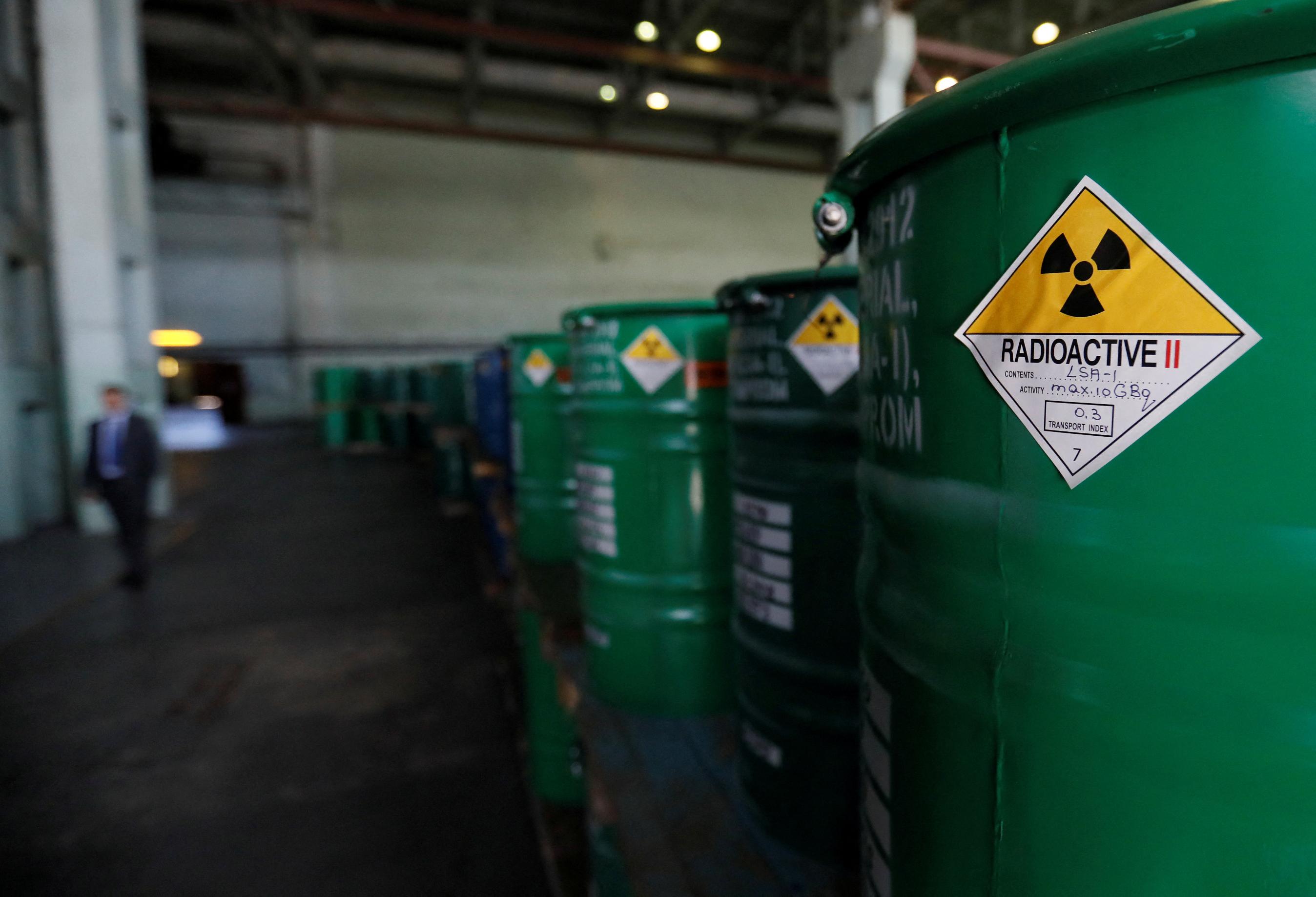
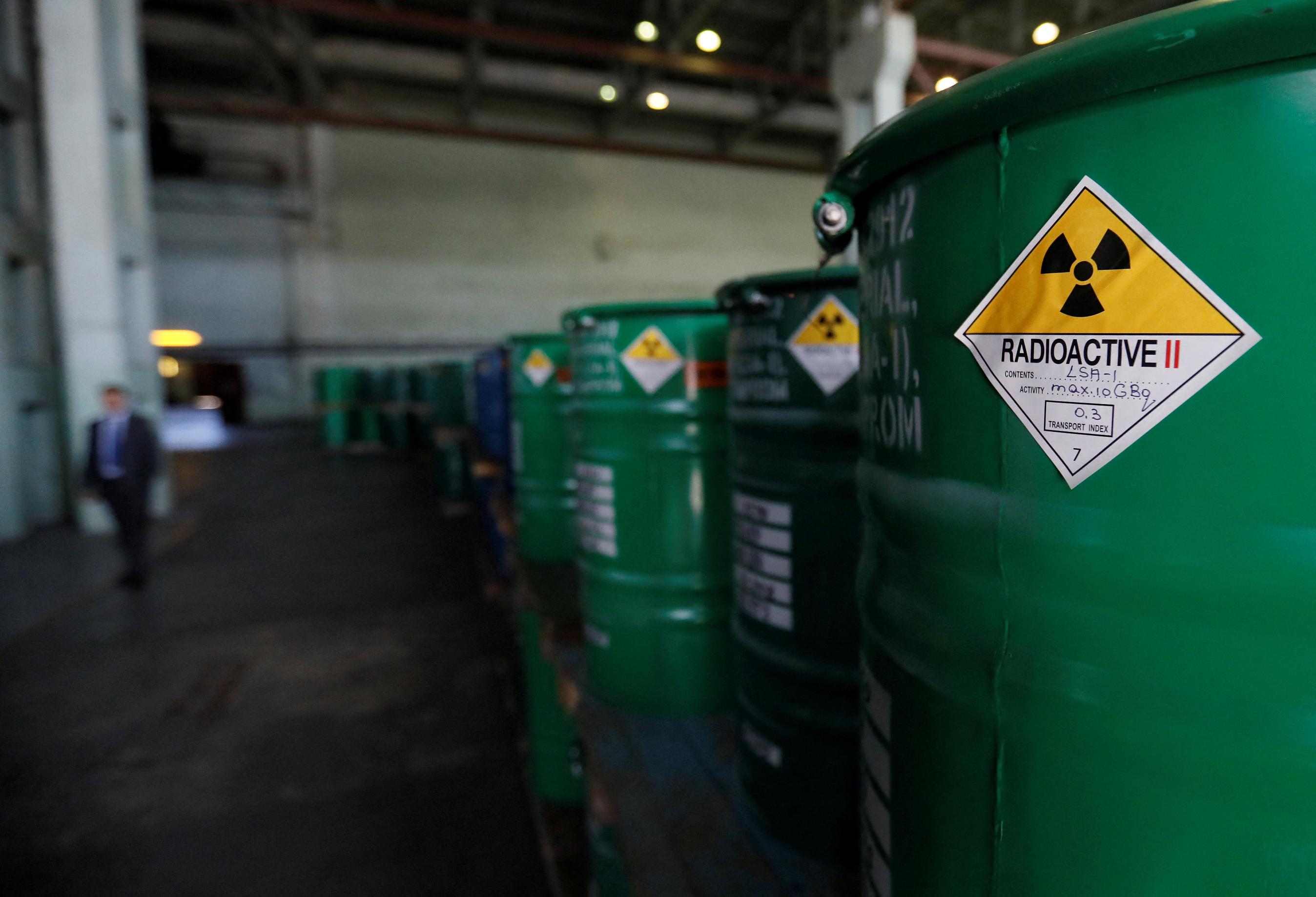
LONDON, Feb 20 (Reuters) - Physical uranium is gaining traction as a traded commodity for investment banks like Goldman Sachs and an investment for hedge funds after prices of the nuclear fuel ingredient soared to 16-year highs. Below are details of the mechanics of how funds source and store physical uranium: Funds that invest in physical uranium buy uranium oxide concentrate (U3O8), or yellowcake, which is created by milling and chemically-processing uranium ore, separating uranium from waste rock. Yellowcake has low radioactivity and needs further processing or enrichment before it can be used as nuclear fuel, but the whole uranium sector is highly regulated as the metal can also be used for weapons. In the West, there are only three licensed storage facilities where investors can store physical uranium: Cameco (CCO.TO) , opens new tab in Canada, ConverDyn in the United States and Orano in France. Financial institutions of all types hold about 113 million pounds of uranium, according to consultancy UxC. This is equivalent to roughly 65% of the current annual global consumption of uranium by nuclear power plants. THE FUNDS: SPROTT PHYSCIAL URANIUM TRUST Canada-based Sprott (U_u.TO) , opens new tab launched in 2021 and is the largest with 63.6 million pounds of uranium. Last year it bought 4 million pounds and in January purchased 400,000 pounds. YELLOW CAKE London-listed Yellow Cake plc (YCA.L) , opens new tab launched in 2018 and has 20.2 million pounds. It has an agreement with the world's biggest uranium producer Kazatomprom (KZAP.KZ) , opens new tab, giving it the option to purchase up to $100 million of uranium each year. ZURICH-INVEST AG The Switzerland-based fund offers its Uranium Actively Managed Certificate, which buys physical uranium. It does not publicly disclose its uranium holdings. ANU ENERGY Kazatomprom was a seed investor in ANU Energy, a privately-owned physical uranium investment fund launched in 2021 that targets Asia and the Middle East. The initial investment was $74 million and other major seed investors were Kazakhstan's sovereign wealth fund and the investment wing of the country's central bank. It is planning a public or private placement of up to $500 million, but has not said when. https://www.reuters.com/markets/commodities/how-investors-boost-exposure-physical-uranium-2024-02-20/
2024-02-20 06:34
Physical uranium buying by investors was 26% of spot mkt in 2023 Goldman writing options on uranium Boosting trading book - industry sources Some hedge funds buying physical uranium, others cautious LONDON, Feb 20 (Reuters) - Investment banks Goldman Sachs (GS.N) , opens new tab and Macquarie (MQG.AX) , opens new tab as well as some hedge funds are positioning themselves to reap the benefits of a newly buoyant uranium sector as prices of the nuclear fuel ingredient spike. While many other investment banks are still avoiding uranium, Goldman and Macquarie are boosting trading in physical uranium and in Goldman's case trading its options as well, five industry and hedge fund sources with knowledge of the deals said. The heightened activity comes as utilities seek new supplies amid shortfalls that have lifted prices to 16-year highs. A few hedge funds are also stepping up involvement in both equities and physical uranium, a sign that the metal is starting to broaden its appeal to financial institutions after a decade in the doldrums following the Fukushima nuclear disaster. "With the headlines and positive momentum in nuclear more generally, hedge funds and other commodity investors are back in the (uranium) sector. A lot of it is done via physical funds, the easiest way to get exposure to uranium prices,” said Bram Vanderelst at trading firm Curzon Uranium. The metal has captured investors' attention after prices doubled over the past year to $102 a pound as top producers Kazatomprom (KZAP.KZ) , opens new tab and Cameco (CCO.TO) , opens new tab cut production guidance because reopened mines that had been mothballed struggled to ramp up production to meet renewed demand. It also comes with the revival of nuclear energy to help countries cut their carbon emissions, which was highlighted in the December 2023 Group of Seven most industrialised nations' statement that envisioned tripling nuclear energy capacity from 2020 to 2050. Goldman Sachs has started writing options on physical uranium for hedge funds, the first time it has created a derivative for the metal. "Goldman has been increasing their visibility, they've been increasing their book steadily," a source who dealt with the bank said, declining to give details of the transactions because they are confidential. Goldman is largely dealing with financial clients like hedge funds while Macquarie's main focus is boosting trading and marketing output from miners, another source who dealt with both banks said, also declining to elaborate because the data is confidential. All five sources Reuters spoke to declined to be named because they did not want to discuss publicly private trading details. Both banks declined to comment. NUFCOR'S URANIUM INVENTORIES Goldman has been involved in the uranium market since 2009, when it bought Nufcor, a London-based nuclear fuel trader. Five years later, however, in the wake of Japan's Fukushima nuclear plant disaster in 2011 when uranium prices plummeted, Goldman aimed to offload Nufcor, but was unable to find a buyer and said it planned to wind down the business. The business never closed and Nufcor held $356 million worth of uranium inventories at the end of 2022, the most recent regulatory filings showed. That is enough uranium to fuel 17 large nuclear reactors for a year, based on Reuters calculations and data from the World Nuclear Association. Investor buying of physical uranium by publicly-traded funds and hedge funds represented nearly 15 million pounds of uranium oxide concentrate (U3O8), or about 26% of the total traded on the spot market in 2023, according to consultancy UxC. This was down from 22 million pounds of investor buying in 2022 as higher prices in 2023 meant each dollar bought fewer pounds of uranium. "We’ve especially seen large volumes purchased by investors in 2021-2023," said Jonathan Hinze, president of UxC. See factbox. U3O8 or yellowcake is a fine powder packaged in steel drums that is produced when uranium ore is chemically processed. While the biggest amount of investor-held physical uranium is by exchange-listed funds, a few hedge funds have been investing in shares of uranium miners and other nuclear-related firms for several years and are also now investing in physical uranium. Sachem Cove Partners, a uranium-focused investment strategy with about $250 million in assets under management, started investing in the sector in 2018 with equities and proxies for physical uranium, like the Sprott Physical Uranium Trust (U_u.TO) , opens new tab. It began buying physical uranium last year. "It gives us a look into both markets, the physical market itself and the equity markets," said Mike Alkin, chief investment officer. https://www.reuters.com/markets/commodities/goldman-hedge-funds-step-up-activity-physical-uranium-prices-spike-2024-02-20/
2024-02-20 06:34
NEW YORK, Feb 20 (Reuters) - The U.S. dollar weakened on Tuesday after China cut interest rates in a bid to prop up its struggling property market, raising hopes of additional stimulus that would boost global growth. The yen gained, meanwhile, but stayed below the 150.88 per dollar level reached last Monday, its weakest in 11 weeks, as investors focus on whether renewed weakness in the Japanese currency is likely to prompt intervention by the Bank of Japan and Ministry of Finance. China cut the five-year loan prime rate (LPR) by 25 basis points, which was the largest since the reference rate was introduced in 2019 and far more than analysts had expected. “The thinking is if China hits the gas pedal then global growth will pick up. Then you start to see dollar selling and money going into emerging markets on the back of that,” said Adam Button, chief currency analyst at ForexLive in Toronto. Bloomberg News on Sunday quoted Chinese Premier Li Qiang calling for "pragmatic and forceful" action to increase China's confidence , opens new tab in the economy. The Australian dollar , which is seen as a proxy for global growth, rose 0.20% to $0.6550, after earlier reaching $0.6579, the highest since Feb. 2. In the offshore market, the yuan strengthened as far as 7.1963 per dollar, the strongest since Feb. 7. Investors are also brushing off higher than expected U.S. consumer and producer price inflation data for January released last week as likely being impacted by seasonal adjustments and not indicating renewed price pressures. That would leave the Federal Reserve on track to begin cutting interest rates in the coming months. “There’s a lingering feeling that the CPI numbers were more of a seasonal adjustment story than a resurgence in inflation story," Button said. "If central banks wait until inflation is dead and buried then we might end up in a situation where risk assets struggle and global growth is crippled." The Fed on Wednesday will release minutes from its Jan. 30 to 31 meeting, which will be evaluated for any new clues on when the U.S. central bank is likely to begin cutting rates. The dollar index was last down 0.21% at 104.08, and earlier reached 103.79, the lowest since Feb. 2. The euro rose 0.25% to $1.0804 and got as high as $1.0839, the highest since Feb. 2. The greenback fell 0.05% to 150.04 Japanese yen , after earlier trading at 150.45. The yen has lost 7% in value in 2024 alone, having weakened past the 150-level against the dollar on Feb. 13. In the past, traders have viewed 150 as a line in the sand for the Bank of Japan and the Ministry of Finance that could trigger intervention, as was the case in late 2022. This time around, the move has been more gradual and volatility has been modest, which suggests little immediate nervousness from either Japanese authorities or currency traders. Japanese finance minister Shunichi Suzuki said on Tuesday authorities were "closely watching FX moves with a high sense of urgency", a phrase he has used previously, and stated the yen exchange rate was set by a number of factors. Sterling gained after Bank of England Governor Andrew Bailey said on Tuesday he was comfortable with investors betting on interest rate cuts this year but pointed to signs that Britain's economy was picking up after falling into recession in late 2023. It was last up 0.20% at $1.2618 and earlier rose to $1.2668, the highest since Feb. 13. The greenback gained 0.24% against the Canadian dollar to $1.3523 loonies . Data on Tuesday showed that Canada's annual inflation rate slowed significantly more than expected to 2.9% in January and core price measures also eased, bringing forward bets for an early interest rate cut. In cryptocurrencies, bitcoin rose 0.33% to $52,076. https://www.reuters.com/markets/currencies/dollar-firms-past-150-yen-us-japan-rates-outlook-diverge-2024-02-20/