2024-08-05 05:35
KOSPI drops 8.8%, biggest since Oct 2008 Tech stocks slump amid U.S. recession fears Circuit breakers activated for first time in four years Authorities vow measures to calm "extreme fear" among investors SEOUL, Aug 5 (Reuters) - South Korea's stock market marked its worst session since the global financial crisis of 2008 on Monday, with trading curbs activated for the first time in four years, as tech stocks slumped amid U.S. recession fears. The benchmark KOSPI stock index (.KS11) , opens new tab ended the session down 8.8% at 2,441.55, its biggest percentage fall since Oct. 24, 2008. During the session, the KOSPI fell as much as 10.8%, triggering circuit breakers for the first time since March 2020, which are trading curbs activated when the index falls or rises more than 8% and halts trading of stocks and derivatives for 20 minutes. The KOSPI was down more than 14% from a six-month peak of 2,860.42 hit in July. Chip heavyweights Samsung Electronics (005930.KS) , opens new tab and SK Hynix (000660.KS) , opens new tab lost 10.3% and 9.9%, respectively, tracking heavy losses on the Philadelphia Semiconductor Index (.SOX) , opens new tab. "The market has entered territory of extreme fear amid a slump in U.S. big tech stocks, worries about a slowing U.S. economy and sharp declines in Asian markets," said Kim Dae-jun, analyst, Korea Investment Securities. In the broader Asian market, the MSCI Asia Pacific ex-Japan Index (.MIAPJ0000PUS) , opens new tab fell more than 2%, while Japan's Nikkei (.N225) , opens new tab dropped 12.4%. Earlier in the day, South Korean authorities issued several comments to calm investor sentiment, with the finance minister vowing to respond to heightened market volatility according to a contingency plan. The U.S. stock futures fell more than 2% in Asian trading hours on Monday, after steep declines last Friday on weak employment data that heightened fears of the labour market deteriorating and potentially making the economy vulnerable to recession. The South Korean won weakened more than 1% on Monday, from a two-month high hit on Friday, as foreigners sold local stocks worth 1.5 trillion won ($1.09 billion) in their biggest sell-off in 2-1/2 years. ($1 = 1,371.8200 won) Sign up here. https://www.reuters.com/markets/asia/skorean-shares-trigger-trading-curb-first-time-since-2020-amid-tech-rout-2024-08-05/

2024-08-05 05:29
LAUNCESTON, Australia, Aug 5 (Reuters) - Gold has been the standout commodity performer so far this year, gaining 18.5% and posting a record high. But the precious metal may become a victim of its own success, with consumer buying at risk from the surge in prices. Spot gold ended at $2,443.29 an ounce on Aug. 2, and it has largely held onto the gains made this year, which saw a sustained rally to an all-time high of $2,483.60 on July 17. The World Gold Council released its quarterly report last week and the industry group reported total demand of 1,258.2 metric tons in the second quarter, the highest on record for a second quarter and some 4% above the same period in 2023. But the breakdown of the demand figures shows some trends that may point to a slowdown in coming quarters. The biggest gain in demand was from what the Council called the Over The Counter (OTC) market, which largely means buying from institutional investors, high net-worth individuals and family offices. OTC demand was 329.2 tons in the second quarter, up 53% from the same quarter in 2023 and a massive jump of 385% from the first quarter. The Council attributed the surge in OTC appetite to "portfolio diversification," which leads to the question as to how sustainable this demand is, given that once these investors have reached the point where they feel they have sufficient gold in their asset mix, they will likely ease back on purchases. The report also showed a strong decline in jewellery consumption, which dropped to 390.6 tons in the second quarter, down 19% from the same period in 2023. Joining jewellery in the losing column was official coins, where demand dropped 38% to 52.7 tons in the second quarter. Both of these signal that consumers may be starting to pull back on purchases because of the strong gain in prices. CHINA, INDIA Of particular concern is jewellery demand in China and India, the two largest buyers of physical gold, which together account for almost half the market. China saw jewellery demand slump 35% in the second quarter to 86.3 tons, while India recorded a 17% fall to 106.5 tons, according to the Council report. A further sign that China's appetite for gold may be waning somewhat was the 18% drop in net imports via Hong Kong in June, with official data showing imports of 21.92 tons, down from 26.72 tons in May. China doesn't disclose gold import volumes, making the Hong Kong data a key proxy for demand in the world's top consumer. India's consumer demand is likely to get a boost in the current quarter after the government cut the import duty to 6% from 15%, but this is also likely to prove to be a one-time sugar hit to demand, rather than a sustainable shift to higher demand. Higher prices also likely weighed on flows into Exchange Traded Funds (ETFs), with the Council figures showing a net drop of 7.2 tons in the second quarter, which followed a decline of 113 tons in the first. Central bank buying also eased in the second quarter, coming in at 183.4 tons, down from the 299.9 tons in the first, although up 6% from the 173.6 tons in the second quarter of 2023. Overall, there are enough factors to suggest that the rise to a record high for gold is starting to crimp some of the more price-sensitive demand. But it's not all bad news, with investor interest likely to be maintained by the ongoing expectation that monetary policy in several key countries is likely to be eased, with a particular focus on likely interest rate cuts by the U.S. Federal Reserve. High geopolitical tensions, with ongoing conflict in the Middle East and Ukraine, as well as political risk surrounding what is shaping to be a tight U.S. presidential election are also likely to keep interest in gold high. The combination of bearish and bullish factors for the yellow metal may end up having the effect of keeping the price in a relatively narrow range for the rest of the year. The opinions expressed here are those of the author, a columnist for Reuters. Sign up here. https://www.reuters.com/markets/commodities/golds-run-record-high-may-crimp-demand-russell-2024-08-05/

2024-08-05 05:24
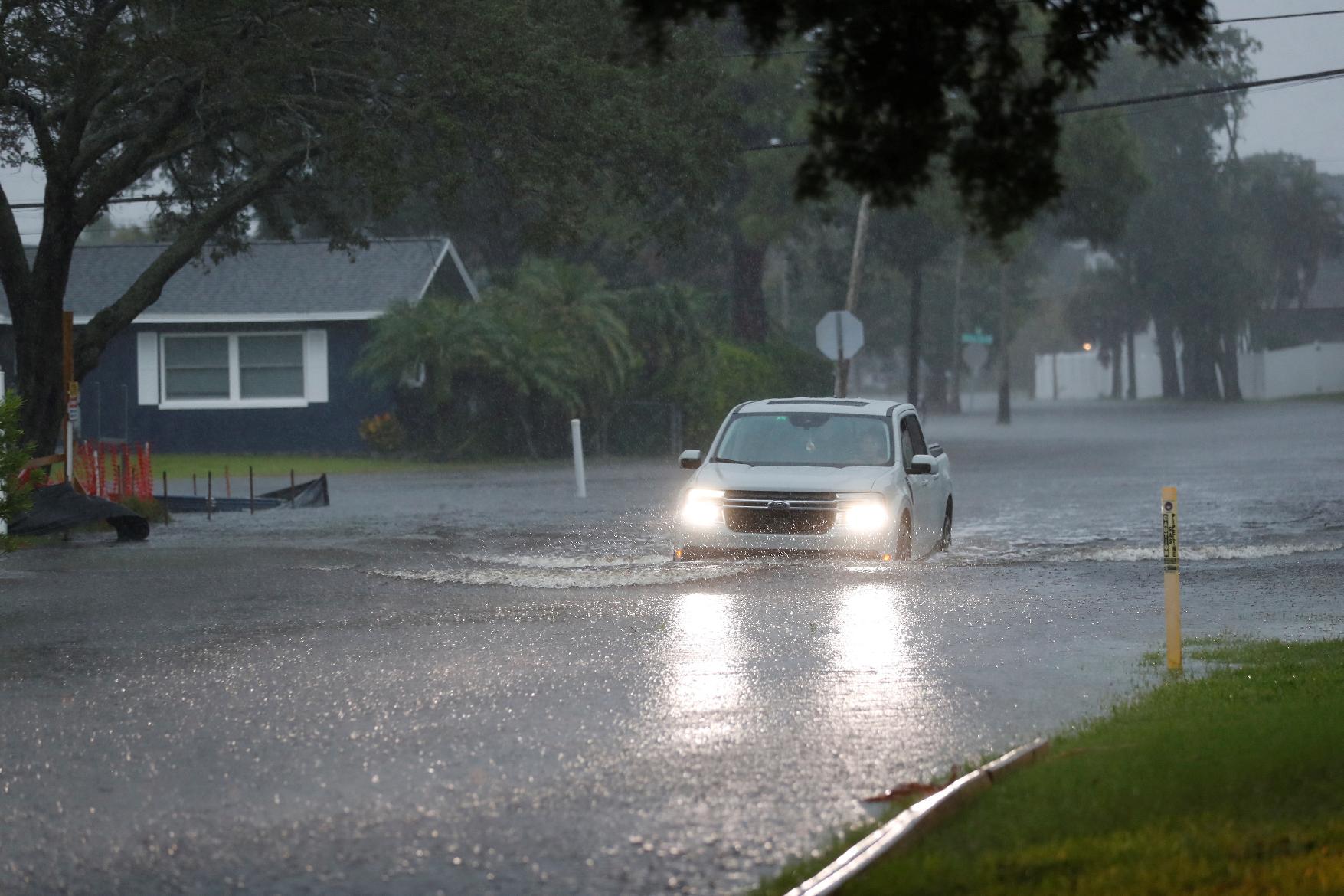
STEINHATCHEE, Florida, Aug 5 (Reuters) - Tropical Storm Debby drenched northern Florida on Monday and killed at least six people as the downgraded hurricane churned toward Georgia and the Carolinas, threatening a week of torrential downpours and flooding across the region. The slow-moving storm plowed into Florida's Gulf Coast around 7 a.m. (1100 GMT) on Monday morning as a Category 1 hurricane, making landfall near Steinhatchee about 70 miles (115 km) southeast of Tallahassee, the National Hurricane Center said. The storm carried hurricane-force winds of up to 80 mph (130 kph) when it struck in the Big Bend region - where the state's Panhandle meets its main north-south Peninsula - but speeds ebbed as Debby pushed over land. Trees felled in the storm killed a 12-year-old girl and a 13-year-old boy in Levy County, officials and law enforcement said. Others killed in the storm included a truck driver who lost control of an 18-wheeler on Interstate 75 and went into the Tampa Bypass Canal, and a 38-year-old woman and her 12-year-old son whose SUV crashed in Dixie County north of Tampa in stormy weather, according to law enforcement. Roughly 240,000 customers were without power in Florida, according to Poweroutage.us, and flight trackers showed hundreds of flights originating from and heading to Florida airports were canceled on Monday. The hurricane center said Debby would cross Georgia and move offshore into the Atlantic Ocean by Tuesday night, then re-strengthen and make a second landfall, probably in South Carolina near Charleston. The storm was near the Florida-Georgia border by early evening on Monday, about 30 miles southeast of Valdosta, Georgia, and crawling at 6 mph northeast with sustained winds of 50 mph, the hurricane center said. The center forecast "catastrophic flooding," with some areas along the Atlantic coast receiving 20 to 30 inches (76 cm) of rain by Friday morning. The governors of Georgia, South Carolina and North Carolina declared states of emergency in anticipation of Debby's damage. By late afternoon on Monday, Debby had already dumped eight to 16 inches of rain in some parts of central Florida, according to local weather reports. "This is going to be an event that is going to be probably here for the next five to seven days, maybe as long as 10 days, depending on how much rainfall we get," said Kevin Guthrie, executive director of the Florida Division of Emergency Management. Officials in Georgia and South Carolina braced for flooding. "It may be the most water we've seen in a long while," South Carolina Governor Henry McMaster said at a briefing. "There may be flooding in areas that never flooded in the past." Savannah Mayor Van Johnson said the city could expect a "once in a thousand year" rain event. "This will literally create islands in the city," Johnson said. SLOW DRENCHING A slow-moving tropical storm as it passed over Cuba, Debby gained strength from exceptionally warm Gulf waters as it paralleled Florida's Gulf Coast on Sunday. Debby bears some of the hallmarks of Hurricane Harvey, which hit Corpus Christi, Texas, in August 2017. Downgraded to a tropical storm as it moved inland, Harvey lingered over Texas, dumping about 50 inches of rain on Houston and causing $125 billion in damage. Climate scientists believe man-made global warming from burning fossil fuels has raised the temperature of the oceans, making storms bigger and more devastating. The last hurricane to make a direct hit on the Big Bend region was Hurricane Idalia, which briefly gained Category 4 strength before making landfall as a Category 3 in August 2023, with winds of more than 125 mph. The National Centers for Environmental Information estimated $3.5 billion in damages. Florida Gov. Ron DeSantis described the initial effects of Debby as "modest" compared with Idalia. Forecasters expect numerous Atlantic hurricanes in the 2024 season, which began on June 1, including four to seven major ones. That would exceed the record-breaking 2005 season that spawned the devastating Katrina and Rita hurricanes. Only one other hurricane, Beryl, has formed in the Atlantic this year. The earliest Category 5 storm on record, it struck the Caribbean and Mexico's Yucatan peninsula before rolling up the Gulf Coast of Texas as a Category 1 storm, with sustained winds up to 95 mph. Sign up here. https://www.reuters.com/world/us/hurricane-debby-takes-aim-floridas-gulf-coast-expected-slog-up-east-coast-2024-08-05/
2024-08-05 05:09
BEIJING, Aug 5 (Reuters) - Eastern China baked under unseasonably high temperatures, with the excessive heat expected to linger in mega coastal cities in the highly industrialised provinces of Jiangsu and Zhejiang for up to 10 more days. In the east and northwest of China, temperatures as high as 43.9 degrees Celsius (111.02 degrees Fahrenheit) have scorched Zhejiang, Jiangsu, Shanghai, Anhui, Xinjiang in recent days, state broadcaster CCTV said. On the coast, Zhejiang's provincial capital Hangzhou recorded a 41.9C historical high on Saturday. The city of 12.5 million people is expected to swelter under temperatures exceeding 40C through Aug. 11. In nearby Shanghai, the maximum load, or demand, on its power grid exceeded 40 million kilowatts for the first time on Friday as 40C temperatures boosted electricity consumption in the city of nearly 25 million people, according to industry news outlet BJX.com. Chinese meteorologists say the record heat this year has been aggravated by high continental temperatures owing to global warming, even as the La Nina weather phenomenon brings cooler-than-average sea surface temperatures in the equatorial Pacific. Earlier this year, China was hit by its warmest spring since 1961 when it started to compile modern-day data. That was followed by the country's hottest May, triggering weeks of drought-like conditions in central China in June, hitting crops and livelihoods of farming communities in the region. With the extreme heat this summer, electricity usage has also risen due to increased demand for air-conditioning. The spike in electricity demand could threaten a supply crunch. Zhejiang's State Grid since last month began recommending electric vehicle owners charge their vehicles late at night to stagger electricity use from daily peak hours. It also advised people to turn off air-conditioning when temperatures were milder. The national weather forecaster on Monday cautioned of potential fire hazards caused by excessive power consumption and excessive electrical loads. In the coming days, many areas around the Yangtze River delta can expect sizzling weather of above 37C after daily maximum temperatures at seven national weather stations breached local historical extremes. Jiangsu's observatory issued a red warning for heat on Sunday after high temperatures which had persisted for more than a week further intensified. The mercury could reach 40C in cities of Wuxi, Changzhou, and Zhenjiang, CCTV said. Hangzhou is expected to see 10 straight days of above 40C weather, breaking its record of eight days in 2013. Sign up here. https://www.reuters.com/world/china/high-temperatures-scorch-china-spiking-power-demand-2024-08-05/

2024-08-05 04:33
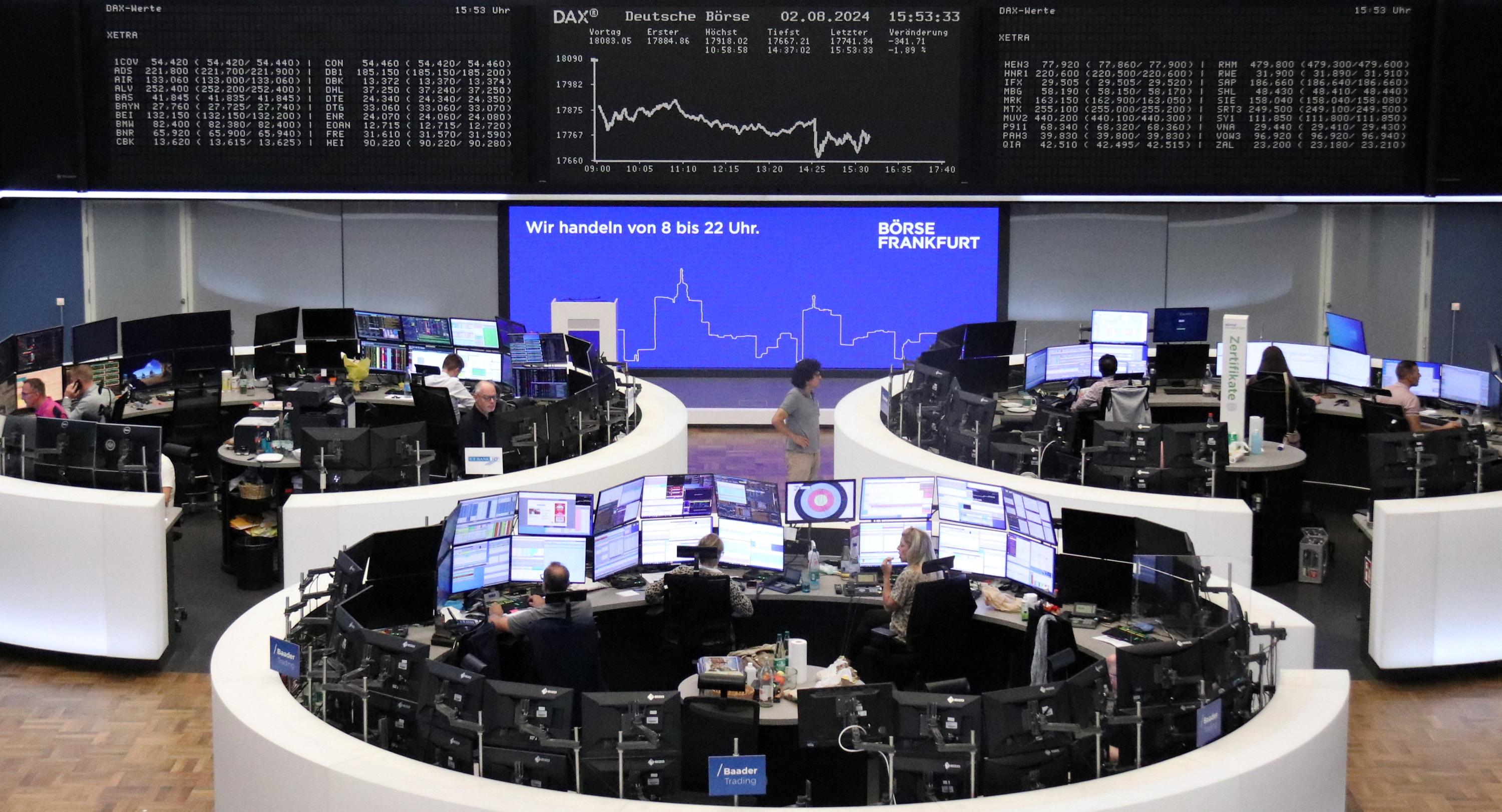
Aug 5 (Reuters) - A look at the day ahead in European and global markets from Wayne Cole. It's a sea of red in Asian share markets as investors flee from risk and a lot of crowded trades unwind in an unruly manner. Popular positions from yen carry trades to crypto are being dumped in a rush to the exits, with volatility spiking and liquidity drying up. There's also talk of investors having to close profitable positions because they need to cover losses elsewhere, which may be one reason gold has struggled. The sprint to sell has seen trading halts triggered in several markets including the Topix and KOSPI, while the Nikkei was down a scary 7% at one stage. The index is now in bear territory having fallen 20% from its peak, which was hit less than a month ago. Investors are hoping central banks will ride to the rescue with a global version of the Fed put. Futures now imply a 73% chance the Fed will cut by 50 basis points in September, and a total 115 basis points by Christmas. Rates are seen near 3% by the end of next year. Markets have priced in another 74 basis points of cuts from the ECB and 47 basis points from the BoE. There are also doubts the Bank of Japan will go ahead and hike again in October, less than a week after it took a turn to the hawkish side. As a result, JGBs recouped all their recent losses sending 10-year yields back to where they were in April. There's even chatter of an inter-meeting easing from the Fed, which seems like wishful thinking from investors in the red. The Fed's Goolsbee played down the impact of the payrolls report on Friday and has a chance to do so again later on Monday, along with San Francisco President Daly. A jobless rate of 4.25% is still pretty low historically and analysts suspect it will come back down in August. Those citing the Sahm rule should remember economics is not actually a science, no matter how much it might like to be. It wasn't that long ago that negative interest rates were considered to be impossible. The U.S. ISM services index is also due and analysts are hoping for a bounce after June's surprising slide. Clearly its jobs index will bear watching given how many workers there are in the sector. The Fed's survey of senior loan officers will get more than its usual attention for any sign of lending stress. It is notable that Treasuries have not extended Friday's huge rally, with 10-year yields back at 3.78% having hit a low of 3.723% earlier. Fed fund futures also pared early gains, particularly in the 2025 contracts. Still, two-year yields are now just eight basis points away from slipping under the 10-year and turning the curve positive for the first time since mid-2022. Such a dis-inversion has sometimes heralded recessions in the past. Goldman Sachs has upped the risk of recession to 25%, while JPMorgan puts it as twice that. Key developments that could influence markets on Monday: - Final global service PMIs, EU producer prices - U.S. ISM services survey for July, Fed releases senior loan officers survey - Federal Reserve Bank of Chicago President Austan Goolsbee speaks, as does Fed San Francisco President Mary Daly Sign up here. https://www.reuters.com/markets/europe/global-markets-view-europe-2024-08-05/
2024-08-05 03:51
MUMBAI, Aug 5 (Reuters) - The Reserve Bank of India was likely selling dollars after the rupee dipped to a lifetime low on Monday amid severe risk aversion, four traders told Reuters. The rupee was at 83.7850 to the U.S. dollar at 9:12 a.m. IST having dipped to an all-time low of 83.80 earlier. "They (the central bank) are definitely there. Acting exactly the way you would think they would," a trader at a bank said. Sign up here. https://www.reuters.com/markets/currencies/indian-central-bank-likely-selling-dollars-around-8380-levels-traders-say-2024-08-05/