2024-04-29 11:23
DUBAI, April 29 (Reuters) - Saudi Arabia's state-oil giant Aramco (2223.SE) New Tab, opens new tab is looking at investments right now in new energies outside of the kingdom, CEO Amin Nasser said on Monday at the sidelines of a World Economic Forum special meeting held in Riyadh. Sign up here. https://www.reuters.com/business/energy/saudi-aramco-is-looking-investment-new-energies-outside-kingdom-ceo-says-2024-04-29/
2024-04-29 11:18
DUBAI/CAIRO, April 30 (Reuters) - Yemen's Houthis said they targeted the MSC Orion container ship in a drone attack in the Indian Ocean as part of their ongoing campaign against international shipping in solidarity with Palestinians against Israel's military actions in Gaza. Portugal-flagged MSC Orion was sailing between the ports in Sines, Portugal and Salalah, Oman and its registered owner is Zodiac Maritime, according to LSEG data. Zodiac is partly owned by Israeli businessman Eyal Ofer. The company did not immediately respond to a request for comment. Iran-aligned Houthi militants have launched repeated drone and missile strikes in the Red Sea, Bab al-Mandab Strait and Gulf of Aden since November, forcing shippers to re-route cargo to longer and more expensive journeys around Southern Africa and stoking fears that the Israel-Hamas war could spread and destabilise the Middle East. In March, the group's leader said the group was expanding its attack area to prevent Israel-linked ships from passing through the Indian Ocean toward the Cape of Good Hope. The Iran-affiliated group also targeted the Cyclades commercial vessel as well as two U.S. destroyers in the Red Sea, its spokesman said in a televised address early on Tuesday. British maritime security firm Ambrey reported earlier that a Malta-flagged container ship on Monday said it was targeted by three missiles while en route from Djibouti to the Saudi city of Jeddah. The Houthis said the Cyclades was on that route when they attacked the vessel. Ambrey assessed that the ship was targeted due to its listed operator's ongoing trade with Israel, it said in an advisory note. The United States and Britain have carried out strikes against Houthi targets in retaliation for their attacks on vessels. Sign up here. https://www.reuters.com/world/middle-east/container-ship-reportedly-targeted-with-missiles-near-yemens-mokha-ambrey-says-2024-04-29/

2024-04-29 11:02
NEW YORK, April 29 (Reuters) - Options on Secured Overnight Financing Rate (SOFR) futures are showing a higher probability that the Federal Reserve could hike interest rates a quarter percentage point this year and next as U.S. inflation and the labor market remain resilient. Bond investors look to SOFR futures, among other indicators, to gauge expectations on Fed policy rates. Options, on the other hand, are widely used to hedge against expected moves, with "vol" or volatility a key input in the price. SOFR, currently at 5.31% , measures the cost of borrowing cash overnight in money markets collateralized by U.S. Treasuries. It is the benchmark rate used to price dollar-denominated derivatives and loans. Odds for a rise in SOFR are low, though not insignificant. Few market participants actually expect the Fed to hike again. It could well be that the Fed cuts rates just once this year or not at all, and hold them higher for longer. Analysts said it would take a full-blown re-acceleration in inflation for the Fed to tighten again. That is not the baseline scenario for most economists. Inflation remains stubborn despite slowing late last year after 15 months of aggressive rate hikes that the Fed halted in July. Data on Thursday showed that core U.S. personal consumption expenditures inflation rose 3.7% in the first quarter, after growing 2% in the fourth. Friday's monthly report on PCE inflation for March showed 0.3% growth, the same as February, while over 12 months inflation rose 2.7%, worse than February's 2.5% and further from the Fed's 2% target. "If you look purely at the data and you did not have the rhetoric coming from central banks, we would be pricing in hikes, not cuts," said Akshay Singal, head of short-term interest rate trading at Citi. "And the fact that central bankers have been of the view that they've done enough is being challenged quite aggressively now." The option-implied probability for SOFR to rise 25 basis points to 5.56% by December has risen to 29%, Barclays estimates showed, from about 26% in early April. The prospect of a no-cut scenario for 2024 is 31%, up from 20% a month ago, BNP Paribas data showed. Chances of the first 25-bp hike in 2025 are at 22%. Volume though is typically thin the further out the curve so that number can change. Gennadiy Goldberg, head of U.S. rates strategy at TD Securities, said the increase in pricing reflects the uncertainty investors face in an environment of strong growth and persistent inflation. "The longer we stay at higher rates and the economy stays strong and inflation sticky, the more investors will question whether the Fed is doing enough," he added. MARKET BIASED TOWARD CUTS Even so, SOFR futures have priced in about 30 basis points in easing for 2024 . "There's a very high threshold to price a shift in Fed policy," said Bruno Braizinha, rates strategist at BofA Securities. "U.S. data needs to improve by a lot for the market to abandon rate cuts and transition to pricing hikes." The rise in implied volatility in interest rate swaps, a corner in the fixed income space investors use to hedge interest rate risk, has accompanied the increase in rate-hike odds with rising uncertainty over Fed outcomes. Rate swaps measure the cost of exchanging fixed-rate cash flows for floating-rate ones, or vice versa. Implied vol is a gauge of how much the option market believes rate swaps will move in either direction over a given time frame. The higher the vol, the greater the perceived instability over a given period. Volatility on shorter-dated swaptions such as one-year at-the-money options on one-year swap rates, that part of the curve in which Fed policy is being priced, rose to a price of 28.62 bps on Thursday , the highest since April 17. So-called receiver swaptions, a type of option that pays off when interest rates fall, are still in demand. In a receiver swaption, the holder of the option chooses to pay a fixed interest rate in exchange for receiving a floating rate. But the price for those receivers have cheapened a bit on shorter maturities, suggesting that demand may be easing as rate cuts are factored out. "The baseline case for now is no-landing," BofA's Braizinha said, referring to a scenario where the U.S. economy avoids recession. And that, he said, does not necessarily warrant a rate hike. Sign up here. https://www.reuters.com/markets/us/inflation-wary-us-rate-options-market-cautiously-prices-2024-fed-hike-2024-04-29/
2024-04-29 10:58
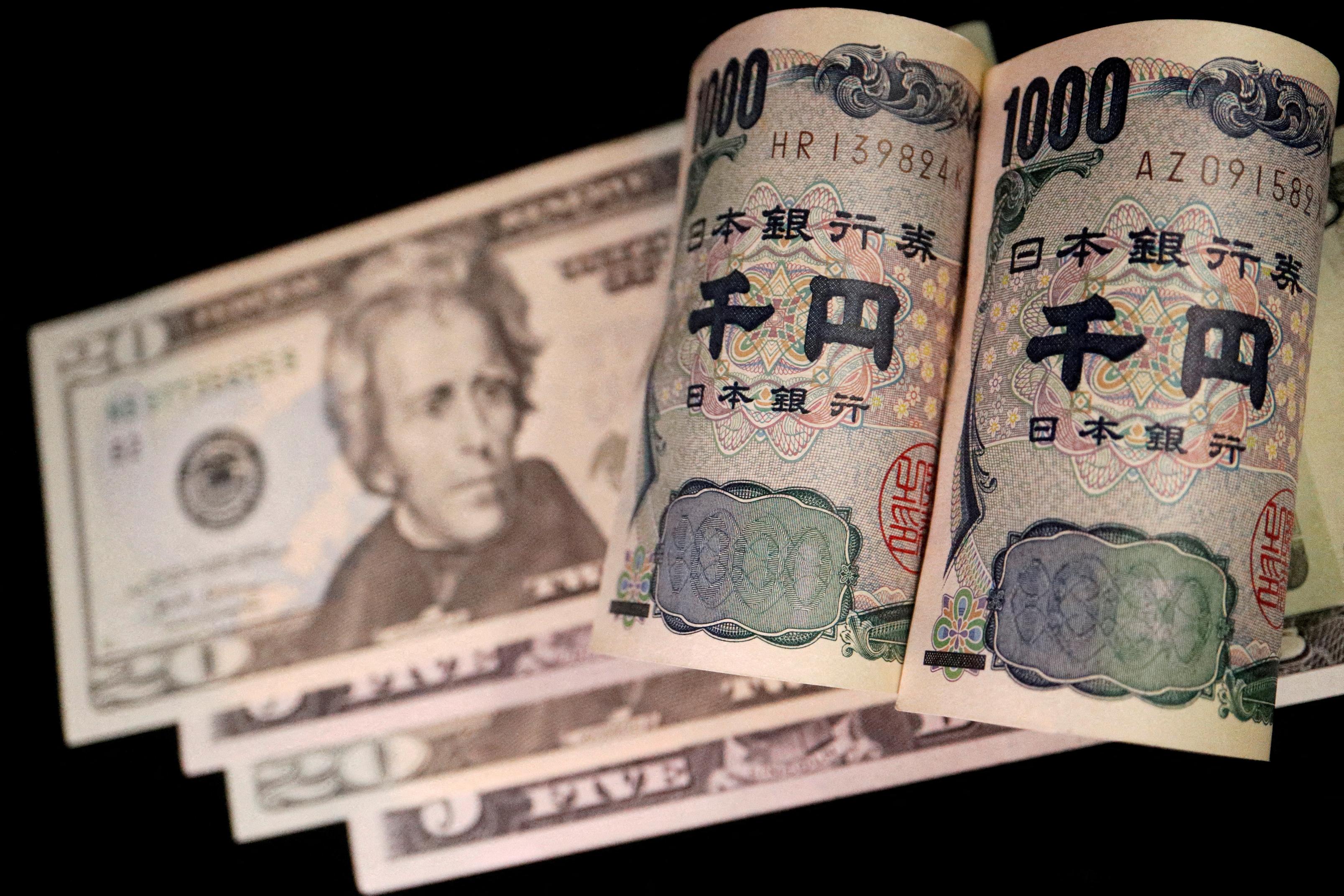
April 29 (Reuters) - The yen jumped against the dollar on Monday, with traders citing yen-buying intervention by Japanese authorities as a trigger for the bounce in a currency languishing at levels last seen over three decades ago. The dollar tumbled to a low of 154.40 yen from as high as 160.245 earlier in the day. Banking sources said Japanese banks were seen selling dollars for yen . The U.S. currency was trading at 156.27 yen at 2127 GMT, down more than 1% from late Friday. The Wall Street Journal on Monday said Japanese financial authorities had intervened in the market, citing people familiar with the matter. Traders had been on edge for weeks for any signs of action from Tokyo to prop up a currency that has lost some 11% against the dollar so far this year, trading at 34-year lows despite the central bank's historic exit from negative interest rates last month. Trading in Asia on Monday was thinner than normal due to Japan's Golden Week holiday. Monday's swings came after the Bank of Japan (BOJ) last week stuck to its guidance on buying government bonds, dashing the hopes of some traders that it could soon taper purchases partly to slow the yen's decline. "Last night’s volatility comes after the central bank opted not to adjust its asset purchase volumes in last week’s decision, keeping rate differentials at spectacularly wide levels and leaving policymakers with few options to arrest the currency’s decline," said Karl Schamotta, chief market strategist at Corpay. He added that the break above 160 clearly amounted to the sort of “disorderly” move that the Ministry of Finance has previously proven willing to tackle. "Algo-driven selling might have continued amid holiday-thinned trading conditions." Currency traders have bet Japanese rates will remain low for some time in contrast to relatively high U.S. interest rates. Japanese government bonds offer yields far below U.S. Treasuries and other foreign sovereigns, which draw a constant flow of Japanese money abroad, keeping the yen under pressure. "Over time with this interest differential between the BoJ and the Fed and the obvious reluctance of the BoJ to do anything about that ... it's tough to build up any momentum for the Japanese yen going the other way to strengthen," said Joseph Trevisani, senior analyst at FX Street in New York. Japan's top currency diplomat Masato Kanda declined to comment when asked if authorities had intervened, but said the current developments in the currency market were "speculative, rapid and abnormal" and could not be overlooked. Japan's Ministry of Finance (MOF) was not immediately available for comment, with markets in the country closed for a holiday on Monday. "Today's move, if it represents intervention by the authorities, is unlikely to be a one-and-done move," said Nicholas Chia, Asia macro strategist at Standard Chartered Bank in Singapore. "We can likely expect more follow through from MOF if the dollar/yen pair travels to 160 again. In a sense, the 160-level represents the pain threshold, or new line in the sand for the authorities." A weaker yen is a boon for Japanese exporters, but a headache for policymakers as it increases import costs, adds to inflationary pressures and squeezes households. BOJ Governor Kazuo Ueda told a press conference after a meeting last week that monetary policy does not directly target currency rates, although exchange-rate volatility could have a significant economic impact. LIMITED OPTIONS The BOJ is not mandated to manage the currency, but a weak yen complicates its objective of achieving sustainable inflation. It cannot raise rates quickly either, for fear of destabilising Japan's heavily indebted government and economy. The suspected intervention happened days ahead of the Federal Reserve's policy review on May 1. Expectations for Fed rates cuts have been pushed back all year as U.S. inflation remained elevated. Policymakers, including Fed Chair Jerome Powell, have emphasised rate changes will be dependent on data. That could mean interventions might help put a floor under the yen only if the central bank policy also shifts. "A combination of BOJ demonstrating urgency to normalise policy and MOF conducting FX intervention may perhaps be more effective than the MOF doing a solo," said Christopher Wong, currency strategist at OCBC in Singapore. Japan intervened in the currency market three times in 2022, selling the dollar to buy yen, first in September and again in October as the yen slid towards 152 to the dollar, a 32-year low at the time. Tokyo is estimated to have spent around $60 billion defending the currency at that time. The United States, Japan and South Korea agreed earlier this month to "consult closely" on currency markets in a rare warning and Tokyo has stepped up its rhetoric against excessive yen moves. On Monday, the Federal Reserve Bank of New York declined to comment on the action in the currency market, as did European Central Bank. The yen has also hit multi-year lows against the euro, the Australian dollar and the Chinese yuan. Some market participants expected the yen's weakness would likely persist for the time being. "Intervention usually reverses the price action for a few days/weeks, buying officials some time," analysts at TD Securities wrote. "Still, it can't offset global macro forces. We need lower US rates or a hawkish BoJ to meaningfully alter (the yen's) fate." Sign up here. https://www.reuters.com/markets/currencies/japans-yen-jumps-against-dollar-suspected-intervention-2024-04-29/
2024-04-29 10:04
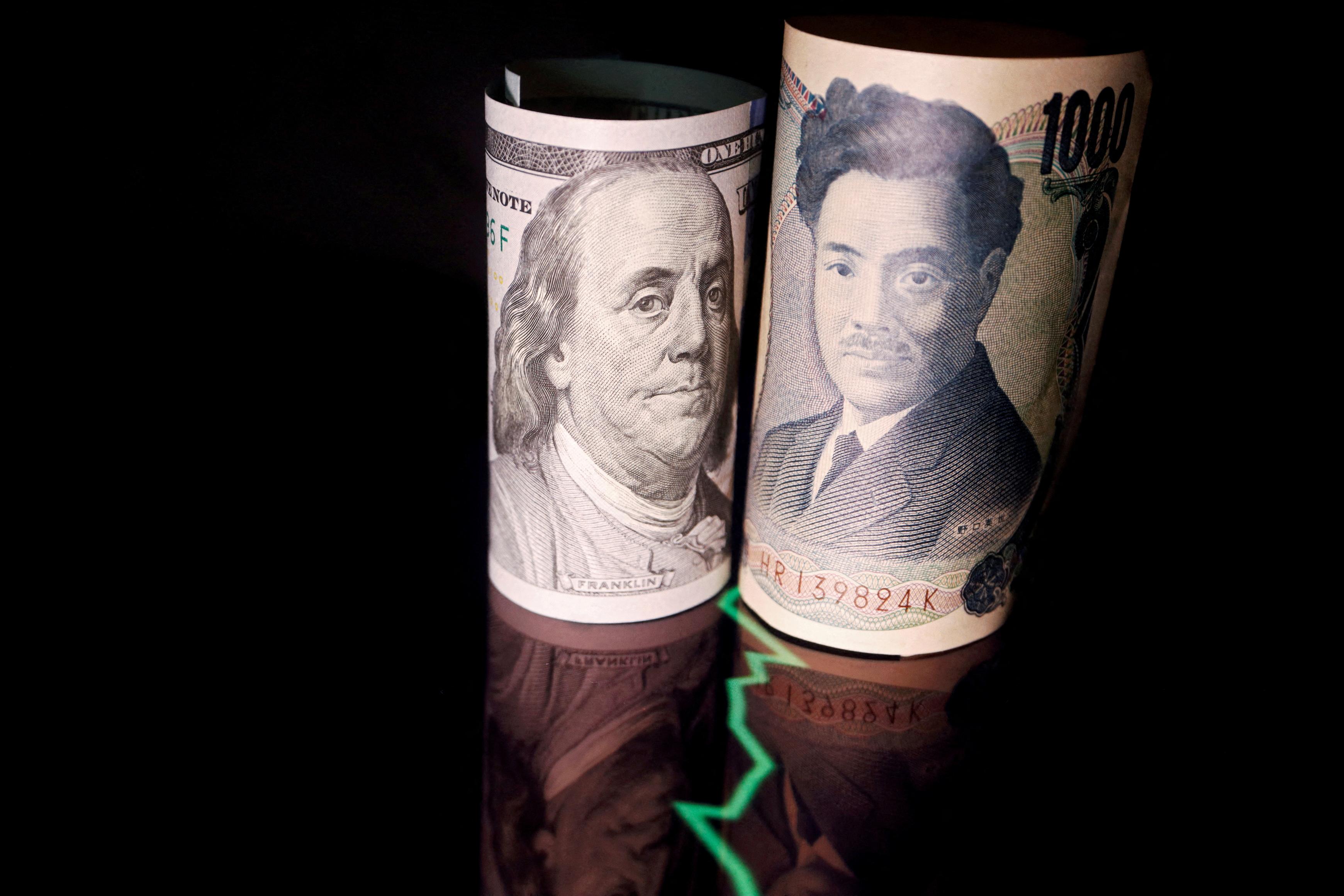
A look at the day ahead in U.S. and global markets from Mike Dolan A week jam-packed with major market events kicked off with some wild action in Japan's yen during a public holiday there, with a withering drop in the currency to 34-year lows of 160 per dollar meeting predictable intervention speculation that triggered an equally eye-watering rebound. With no official yen purchases yet confirmed, market chatter presumed there had been at least some shot across the bow as the currency's fall since Friday's anodyne Bank of Japan meeting threatened to go into tailspin. Japan's top currency diplomat Masato Kanda declined to comment when asked if there had been any action. From Thursday's close, the dollar/yen exchange rate had jumped as much as 2.8% - with implied overnight volatility in the currency options market topping 17% for the first time this year. And even though the yen bounced hard on 160 to sit just under 156 in London, it remains weaker than it was when trading kicked off on Friday. Japan's seeming 'benign neglect' of the currency, as Deutsche Bank described it last week, is understandable given domestic inflation is largely under wraps, the move is largely driven by interest rate fundamentals and it's flattering for Japanese exports and tourism. But its spur to dollar-denominated energy import prices and a potential disturbance of the competitive landscape across Asia's big exporting nations means the Japanese authorities will likely not want this move to get out of hand. And yet this week is dominated by one of the major drivers - an increasingly hawkish Federal Reserve that meets again on Tuesday and Wednesday amid ebbing hopes for more than one U.S. interest rate cut this year. After a series of sticky inflation readings this year, only 35 basis points of Fed easing is now priced for the entire year. The March release of the Fed's favored PCE inflation gauge calmed markets a bit as it came in line with forecasts and showed no further deterioration of early-year price picture. But it's done little to change the policy outlook - with this week's Fed signalling likely to remain non-committal while perhaps nodding to discussions on slowing its balance sheet reduction. That may be welcomed by the increasingly agitated Treasury market - where 10-year yields returned last week to the danger zone of October/November and the so-called 'term premium' demanded by investors for long-term risks also flipped positive for the first time this year. Yields slipped back a touch on Monday, with the Treasury this week publishing refunding plans for the coming quarter and expected on Monday to outline borrowing estimates for the two quarters ahead. Most auction sizes are expected to remain unchanged, as it has already promised, but much of the attention may be on a likely bond buy back program. Elsewhere, the week's dominant economic data sweep will be from the labor market - culminating in Friday's likely still-robust payroll report for this month. In the corporate world, another heavy earnings week will see Wall Street trying to capitalise on what was its best week of the year last week - aided by big gains for megacaps such as Microsoft, Alphabet and Tesla. Amazon on Tuesday and Apple on Thursday top this week's updates. And Wall St futures were higher ahead of the bell, as world stocks continued higher following Friday's gains. The S&P500 earnings season has picked up steam considerably from where it was indicated at the start of the month, with LSEG data showing the blended annual profit gain for the index during the first quarter now back as high as 5.6% - up from the 5.1% forecast on April 1. In company news, Tesla (TSLA.O) New Tab, opens new tab has cleared some key regulatory hurdles that have long hindered it from rolling out its self-driving software in China, paving the way for a favourable result from Elon Musk's surprise visit to the U.S. automaker's second largest market. In Europe, shares of Anglo American (AAL.L) New Tab, opens new tab climbed 2.3% after Reuters reported BHP Deutsche Bank (DBKGn.DE) New Tab, opens new tab dropped nearly 4% as the German lender will make a legal provision over a litigation regarding its takeover of Postbank that will hurt its second-quarter and full-year profitability. Key diary items that may provide direction to U.S. markets later on Monday: * Dallas Fed April manufacturing survey * US Treasury publishes financing estimate for next two quarters; sells 3-, 6-month bills * * US corporate earnings: Paramount Global, Domino's Pizza, Franklin Resources, Everest, Welltower, SBA Communications, F5, ON Semiconductor, Revvity, NXP Semiconductors, Arch Capial * European Central Bank board member Luis De Guindos speaks Sign up here. https://www.reuters.com/markets/us/global-markets-view-usa-2024-04-29/
2024-04-29 07:56
NAPERVILLE, Illinois, April 29 (Reuters) - Speculators have been holding a near record short across Chicago grains and oilseeds for most of this year, but last week they staged their biggest round of short covering since mid-2023 as supply uncertainties creep back in. Wheat was the biggest mover with July futures up 6.7% in the week ended April 23, and money managers reduced their net short position in CBOT wheat futures and options to 76,184 contracts from 96,403 a week earlier. That included funds’ largest round of short covering since December. The new net short is a seven-week low but remains historically large. Money managers have maintained a net short in CBOT wheat since early July 2022, when most-active futures were trading in the $8-per-bushel range. The latest week marks funds’ 95th consecutive week in bearish CBOT wheat territory, approaching the record 100 set between mid-2015 and mid-2017, a period characterized by heavy global supplies and decade-low prices. CBOT wheat added another 3.2% between Wednesday and Friday and finished at $6.22-1/4 per bushel on Friday, the most-active contract’s highest settle since Dec. 29. Wheat has gained 12.5% in this latest, six-session move. Worsening wheat conditions across the U.S. Plains and extended dryness in top exporter Russia have triggered the latest move as have unfavorable weather conditions across parts of Europe. India, recently a major wheat exporter, may have to import wheat for the first time in several years. Money managers still hold extremely bearish positions in Kansas City and Minneapolis wheat futures and options, and they only lightly trimmed these views in the week ended April 23. Big speculative grain shorts ahead of the U.S. growing season are risky, and this, along with wheat’s latest rally, also justified significant short covering in corn. Money managers cut their net short in CBOT corn futures and options to a 15-week low of 238,546 contracts as of April 23 from 279,570 a week earlier. July corn rose 2.2% in that week but fell fractionally in the following three sessions. U.S. corn planting, on schedule for now, will remain a focus for the market in the coming days with an expected wet open to May. OILSEEDS Short covering was prominent through April 23 in CBOT soybeans, where money managers lowered their net short to 149,014 futures and options contracts from 167,875 a week earlier. That is still one of funds’ most bearish soybean views of 2024 so far. July soybeans were up nearly 2% during that week, though gains were limited by Brazil’s strong crop and questionable Chinese demand. For the first time in 17 years, China has no new-crop U.S. cargoes booked as of mid-April. Money managers for the first time since January restored bullishness in CBOT soybean meal, establishing a net long of 19,681 futures and options contracts as of April 23 versus a net short of 10,543 contracts a week earlier. July meal was up nearly 3% in the period. A large, expected supply build in top meal exporter Argentina made funds abandon their super bullish meal bets between November and January, but Argentina’s soy crop has run into some hiccups and may not be as large as originally thought. Unwinding of long oil-short meal spreads have also contributed to meal’s boost. July bean oil reached contract lows in the week ended April 23, though they finished up about 1%. Money managers reduced their heavy net short by about 3,800 contracts to 49,528 futures and options contracts. July soybeans, meal and oil all fell fractionally between Wednesday and Friday. On Saturday, oilseed workers at one of Argentina’s largest ports announced they will begin striking on Monday, potentially hampering meal and oil exports. Karen Braun is a market analyst for Reuters. Views expressed above are her own. Sign up here. https://www.reuters.com/markets/europe/funds-cover-cbot-wheat-shorts-bearish-streak-is-nearing-record-2024-04-29/