2023-11-10 06:07
LONDON, Nov 10 (Reuters) - If a re-emerging risk premium in bonds is down to government debt sustainability worries, central banks may need to lobby their Treasuries that it's undermining their control of credit. U.S. Federal Reserve officials are puzzling over why bond borrowing rates spiked lately even as Fed policy expectations have remained largely unchanged. Whether a resurfacing "term premium'" now demanded to buy and hold longer-term bonds, is responsible is central to the conundrum. If a sustained or even more volatile risk premium tightens or loosens credit beyond what's intended by the central bank, it clearly complicates its policy transmission to the wider economy at a critical juncture. As most economists put the creeping premium down to nervousness around rising mounting public deficits, debts and bond sales - and little prospect of them being reined in soon -central banks may have to start an uncomfortable campaign of publicly warning their political masters. Britain's brief budget and debt shock late last year and the way the Bank of England was forced to react was perhaps a taster. But much hinges on degree to which investors are justified in demanding added compensation for fiscal jitters. Former International Monetary Fund chief economist Olivier Blanchard this week framed the debt sustainability nerves around the relatively simple question of whether interest costs on the debt now exceed economic growth projections - 'r minus g' in budget math algebra. In a piece published by Washington's Peterson Institute for International Economics, Blanchard fretted that a long period of negative 'r-g' that sustained debt piles without much bother may now be ending as surging borrowing costs force economic slowdown and possibly recession. Unless long-term rates sink back again or primary budget deficits that exclude servicing costs are returned to zero, he reckoned rising debt piles as a share of gross domestic product was "inevitable", putting them at risk of "exploding". "Once current debt has been refinanced and the average interest on debt reflects the higher long rates, absent changes in policy, debt ratios will increase," Blanchard wrote. "We must make sure that they do not explode." So much for simple arithmetic. The issue is, as ever, more complicated. Fiscal inertia in the United States and Europe doesn't encourage much optimism on tighter budgets and hopes of ebbing interest rates are likely just that as long as inflation remain above targets. And a durable rise in bond term premiums based on fear of the former may even cut across policy easing optimism. A U.S. primary budget gap of some 4% of GDP makes "the challenge is even stronger," Blanchard wrote. "Given the current budget process dysfunction, one must worry that the adjustment will not take place any time soon." Neither does he think that a sudden draconian bout of austerity, akin to that seen in Europe after the 2008 banking crash, is a solution as it merely damages growth even more - with all the attendant social and political upheaval to boot. DYSFUNCTION AND EXPLOSION There were tinges of optimism though. If major economies at least start to reduce primary deficits toward zero they can still likely sustain debt ratios at higher but stabilising levels, he said. What's more, the impact of higher long-term rates may soon sow the seeds of lower short-term ones to partly offset. "It is not good, but it is not catastrophic," he wrote, but added that simply doing nothing did risk the feared explosion. Like all budget maths, however, there's myriad moving parts. Based on the Congressional Budget Office's June projections and assumptions - before the latest bond yield spike - U.S. debt-to-GDP was forecast to almost double to 180% by 2053. That was based on a 10-year Treasury rate of 3.9% this year rising to 4.5% in 30 years time, with an average rate on all Federal debt rising to 4% from 2.7% this year. But since June, 10-year yields have already risen to 4.5% and the average rate on all Treasury borrowing has topped 3%. The flipside is that U.S. growth too has accelerated beyond forecasts - to an annualised 4.9% in the last quarter. But based on standing IMF forecasts from last month, full year real U.S. GDP growth is still expected to be just 2.1% this year and 1.5% in 2024 - far below both the average interest rate on Federal debt and the current 10-year yield, and with next year's outlook below the current 10-year real rate of 2.1%. So 'r-g' turning positive may well be sounding alarm bells among investors, especially as they've not yet seemed to ring in Congress. The makings of a spiral are clear unless the Fed were to rise the rescue - and yet it may not be in control of all the cards. If it's determined to hang tough on rates until fully quashing inflation and sticking to its balance sheet rundown, the central bank may have to revert to public pressure on fiscal policy - a tricky manoeuvre in an election year. In the meantime, more sanguine bond investors are relying on crumbs of comfort that the Fed seems done tightening at least and U.S. fiscal expansion has peaked at last - at least for now. "We see little reason to expect legislation with a meaningful fiscal impact before the 2024 election," concluded Morgan Stanley in a recent report, adding a "modest fiscal contraction" may even be possible if Congress fails to pass full-year appropriations bills by January. Either way, 2024 seems pivotal and monetary policy is no longer the only game in town. The opinions expressed here are those of the author, a columnist for Reuters https://www.reuters.com/markets/central-banks-need-word-with-budget-masters-mike-dolan-2023-11-10/

2023-11-10 05:33
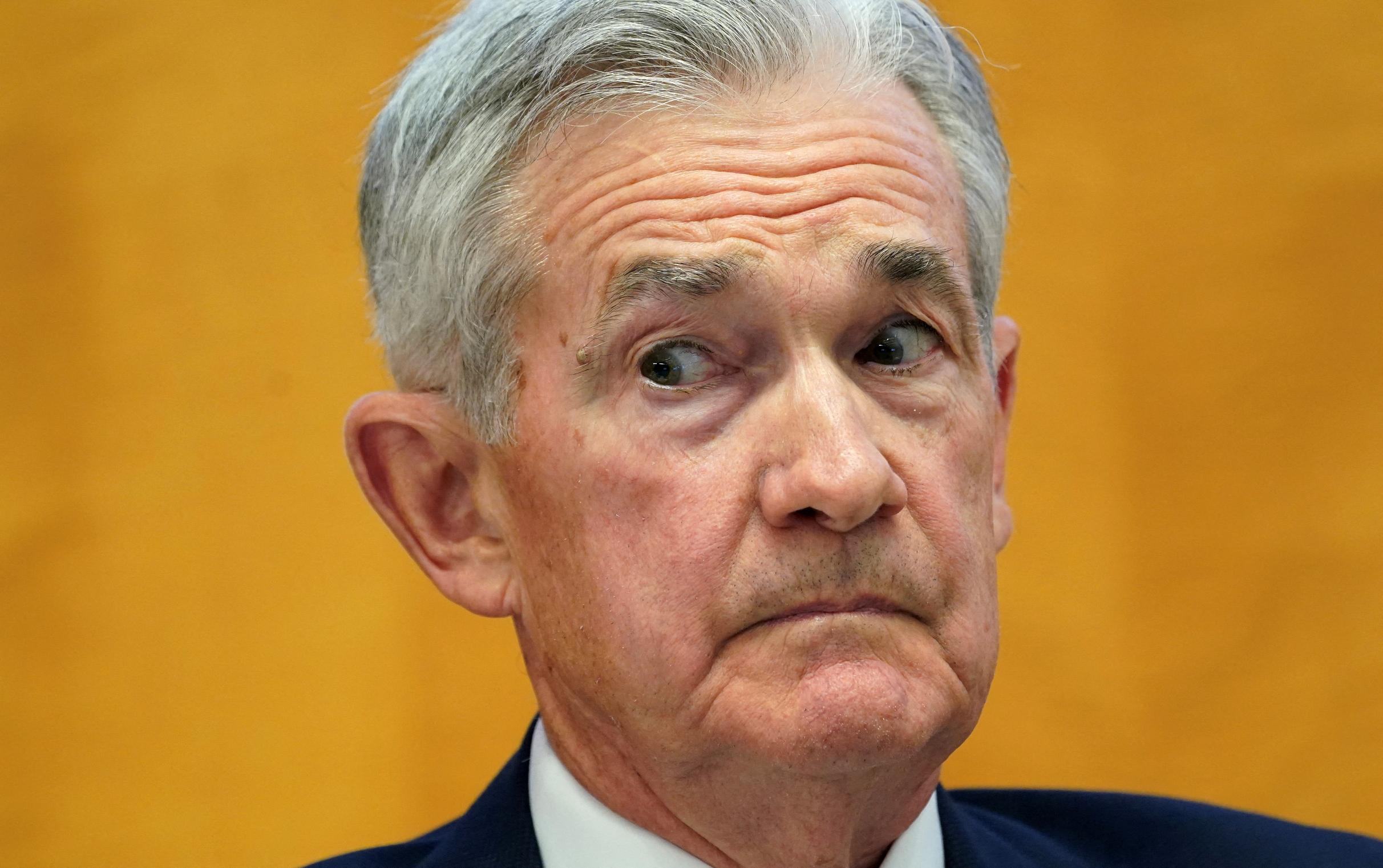
A look at the day ahead in European and global markets from Ankur Banerjee A sea of red awaits Europe as investors gave up any attempt at a rally in risk assets, after Fed Chair Jerome Powell made it clear that tackling inflation remains the central bank's main concern and warned that rate hikes are still on the table. Since the Fed left rates unchanged last week, markets had increasingly grown confident that the peak in U.S. rates was in sight. But up stepped Powell to squash any hopes of an impending rate cut. "[The Fed] is committed to achieving a stance of monetary policy that is sufficiently restrictive to bring inflation down to 2% over time," Powell said. "We are not confident that we have achieved such a stance. If it becomes appropriate to tighten policy further, we will not hesitate to do so." That led stocks lower, with MSCI's broadest index of Asia-Pacific shares outside Japan (.MIAPJ0000PUS) skidding 1% to their lowest in a week. Futures indicated the dark mood was set to continue in European bourses. ECB President Christine Lagarde is due to talk in a fireside chat later in the day and traders will pore over every word. U.S. Treasury yields climbed overnight on Powell's comments, as well as a weak auction of $24 billion in 30-year Treasuries . In Asian hours, the yields remained elevated. The rise in yields boosted the dollar, which is headed for its best week against the yen in three months. U.S. rate futures have priced in a 60% chance of a rate cut at the Fed's June 2024 meeting, according to the CME's FedWatch tool. Those odds were about 70% before Powell spoke. Meanwhile, the Industrial and Commercial Bank of China's U.S. arm was hit by a ransomware attack that disrupted trades in the U.S. Treasury market on Thursday. Movie buffs learned they will have to wait it out for some of their most-anticipated films. Walt Disney (DIS.N) delayed the release of Marvel movie "Blade", a new "Deadpool" instalment and several other films on Thursday as Hollywood studios adjusted schedules following the end of the four-month actors' strike. Key developments that could influence markets on Friday: Economic events: UK September GDP, UK Q3 GDP, Oct CPI data for Norway and Sweden Speakers: ECB President Christine Lagarde, ECB policymaker Joachim Nagel, SNB's Thomas Moser https://www.reuters.com/markets/europe/global-markets-view-europe-2023-11-10/
2023-11-10 03:55
SHANGHAI, Nov 10 (Reuters) - Measures such as the U.S. Inflation Reduction Act are unlikely to stop firms from going abroad, as companies thrive through competition and not through regulation or subsidies, the chairman of Chinese battery maker Gotion High Tech (002074.SZ) said. The U.S. IRA, introduced last year, is a massive anti-inflation measure that makes tax breaks conditional on U.S-manufactured content. It has been praised for spurring clean energy projects but also criticized in Asia and Europe for its protectionist tendencies. Li Zhen, speaking at the Bloomberg New Economy Forum in Singapore on Friday, said he believed U.S. firms would still be committed to going abroad despite the IRA, as was Gotion. The battery maker was committed to globalization with plants it is planning on constructing or had already constructed in the United States, Germany and Morocco, Li said. "I don't think the IRA policy can completely stop companies from going global or to the international market, because companies thrive through competition, not through regulations or subsidies, we have the market to decide on the winner," he said. "In the future we still are very optimistic, if you can put enough effort, if you have the right product, this kind of protectionism is short term." The IRA has prompted global EV battery makers and automakers to eye the North American market for new manufacturing plants as they look to diversify supply chains and attract the act's incentives. Washington has said foreign entities of concern will not be able to receive any government funds, but has yet to define what these entities are. Asked if he was confident that Gotion, as a Chinese company, would escape that definition, Li said he was "very confident". https://www.reuters.com/business/autos-transportation/chinas-gotion-high-tech-us-ira-unlikely-deter-firms-going-abroad-2023-11-10/
2023-11-10 03:44
NEW DELHI, Nov 10 (Reuters) - Overnight rain in New Delhi and its suburbs brought some relief to the Indian capital on Friday morning, where authorities were mulling seeding clouds to improve the toxic air gripping the city. The city, which was the most polluted in the world till Thursday, saw its air quality index (AQI) improve to 127 early on Friday - a welcome change from the "hazardous" 400-500 level seen during the past week, according to Swiss group IQAir. India's weather department has forecast intermittent rain over the city and adjoining areas till early noon on Friday. Light showers are also expected in neighbouring states like Punjab, Haryana, and Rajasthan. On Friday morning, New Delhi was the 10th most polluted city in the world while Kolkata in India's east topped the global chart with an AQI of 303. Meanwhile, air in the financial capital of Mumbai has markedly improved due to showers in nearby coastal areas. This year, attention on the worsening air quality has cast a shadow over the cricket World Cup hosted by India. Scientists and authorities were planning to seed clouds in New Delhi around Nov. 20 to trigger heavy rain, the first such attempt to clean the air. A thick layer of smog envelops the city every year ahead of winter as heavy, cold air traps dust, vehicle emissions and smoke from burning crop stubble in Punjab and Haryana. Friday's rain comes two days before the Diwali festival, when many people defy a ban on firecrackers, causing a spike in air pollution. The local government of the city of 20 million people, spread over roughly 1,500 square kilometres (579 square miles), has already shut all schools, stopped construction activities, and said it will impose restrictions on vehicle use to control pollution. https://www.reuters.com/world/india/indian-capital-gets-breather-rain-brings-respite-smog-2023-11-10/

2023-11-10 02:04
WASHINGTON/BRUSSELS, Nov 9 (Reuters) - More than 60 countries have said they back a deal spearheaded by the European Union, United States and United Arab Emirates to triple renewable energy this decade and shift away from coal, two officials familiar with the matter told Reuters on Thursday. The EU, U.S. and UAE have been rallying support for the pledge ahead of the U.N.'s annual COP28 climate negotiations to be held Nov. 30 to Dec. 12 in Dubai, and will call for its inclusion in the final outcome of a gathering of world leaders on Dec. 2, the officials said. Some major emerging economies like Nigeria, South Africa and Vietnam, developed countries like Australia, Japan and Canada, and others including Peru, Chile, Zambia and Barbados have said they will join the pledge, the officials told Reuters. A draft of the pledge, reviewed by Reuters, would also commit those who sign it to doubling the world's annual rate of improving energy efficiency to 4% per year until 2030. The draft says the greater use of renewables must be accompanied by "the phase down of unabated coal power," including ending the financing of new coal-fired power plants. One of the officials told Reuters negotiations with China and India to join the pledge are "quite advanced," although neither has yet agreed to join. Scientists say both actions - rapidly expanding clean energy and quickly reducing the burning of CO2-emitting fossil fuels in the power sector - are vital if the world is to avert more severe climate change. The officials said an early show of support for tripling renewable energy and moving away from coal will create momentum and set a positive tone ahead of the days of tense negotiations that are expected at the climate conference. https://www.reuters.com/sustainability/climate-energy/over-60-countries-back-deal-triple-renewable-energy-this-decade-officials-2023-11-10/

2023-11-10 01:39
RIO DE JANEIRO, Nov 9 (Reuters) - Brazil's state-run oil company Petrobras (PETR4.SA) raised its projection for oil and gas production this year, after posting a 41.5% decrease in third-quarter profit on Thursday. The firm lifted its 2023 oil and gas output to 2.8 million barrels of oil equivalent per day (boed), from 2.6 million boed previously, taking into the account platform ramp-ups and new wells that will go online in the fourth quarter. The company also lowered its CAPEX estimate to $13 billion, down from $16 billion previously, citing difficulties with suppliers in a "post-pandemic inflationary context." Latin America's top oil producer posted a recurring net profit of 27.2 billion reais ($5.51 billion), while analysts polled by LSEG had expected 28.74 billion reais. Adjusted earnings before interest, taxes, depreciation and amortization (EBITDA) for the period shrank 27.6% to 66.19 billion reais ($13.41 billion). The oil company's sales revenue totaled 124.83 billion reais in the quarter, down 26.6% year-on-year, mainly due to a 14% drop in Brent prices. Petrobras also said it will pay shareholders 1.344365 reais per share, totaling 17.5 billion reais in dividends. The company will pay a first installment to shareholders in February, and a second one in March. Last month, the company reported a 9.6% increase in quarterly crude oil production in the third quarter. It attributed the increase to the ramp-up of two offshore platforms in the Santos Basin and two more in the Campos Basin, in addition to fewer platform maintenance stoppages in the period. ($1 = 4.9342 reais) https://www.reuters.com/business/energy/brazils-petrobras-reports-41-decline-second-quarter-profit-2023-11-09/