2023-11-22 06:08
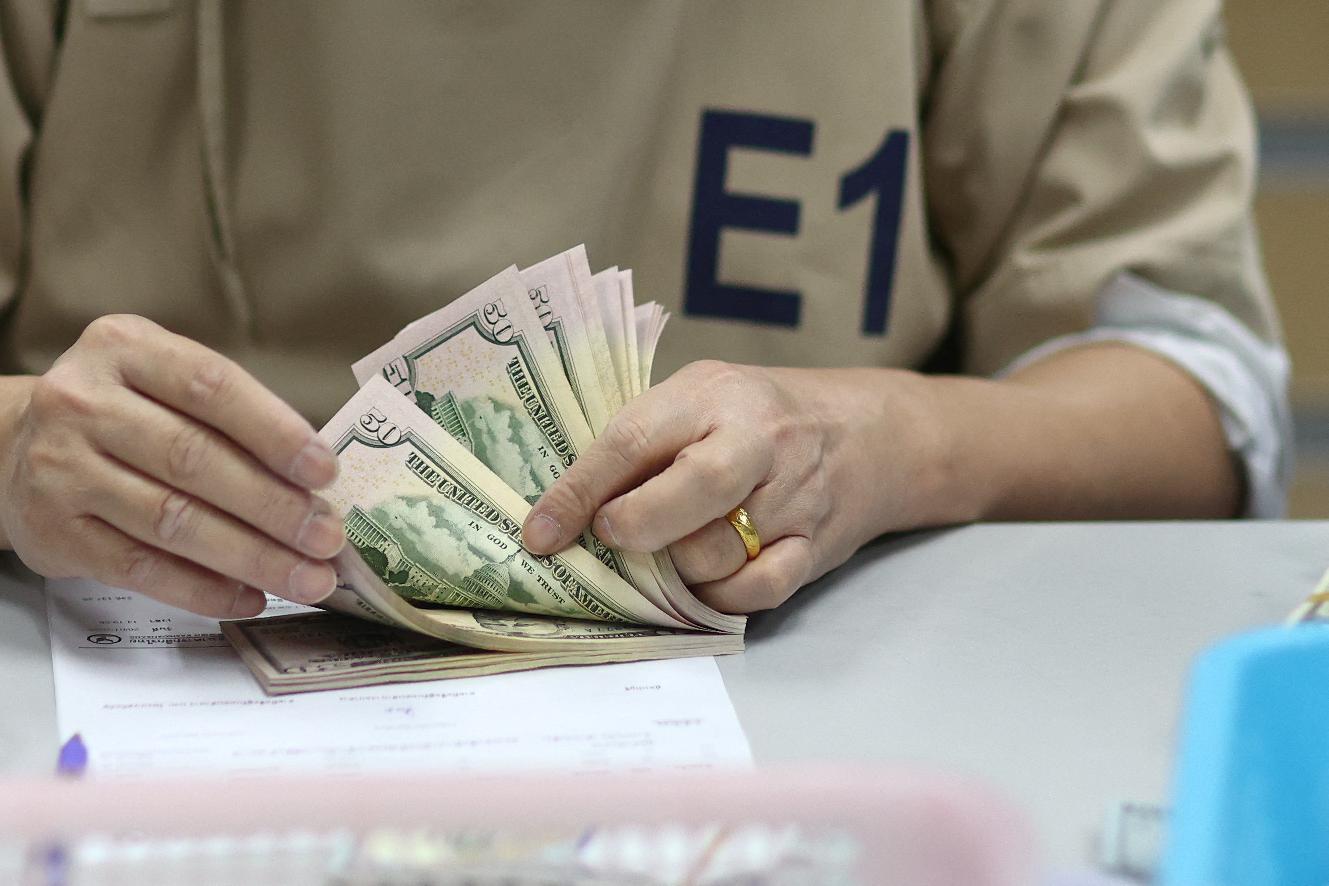
NEW YORK, Nov 22 (Reuters) - The dollar index rose on Wednesday, rebounding from a 2-1/2 month low after economic data showed the number of Americans filing new claims for unemployment benefits fell more than expected last week. Initial claims for state unemployment benefits dropped by 24,000 to a seasonally adjusted 209,000 for the week ended Nov. 18, the Labor Department said on Wednesday, the lowest level in more than a month. Economists polled by Reuters had forecast 226,000 claims for the latest week. Other data, however, showed orders for long-lasting U.S. manufactured goods fell more than expected in October as orders for motor vehicles and parts dropped amid strikes by the United Auto Workers (UAW) union against Detroit's Big Three automakers. "The fact that we are seeing a drop definitely suggests that the labor market is not cooling as quickly as markets or the Fed might have been expecting there," said Karl Schamotta, chief market strategist at Corpay in Toronto. "And then at the same time the fact that we have this slowdown in CapEx investment ... that suggests that underlying momentum in the economy is beginning to fade so, largely still consistent with the soft landing thesis, but labor markets holding up better than expected," Schamotta added. Schamotta also said market participants were maintaining relatively high dollar positions before liquidity dries up before the U.S. Thanksgiving holiday on Thursday. The dollar index had fallen to its lowest level since Aug. 31 on Tuesday before stabilizing after minutes from the Federal Reserve's last meeting indicated the central bank was likely to maintain a restrictive stance on interest rates for some time, even if more rate hikes are unlikely. The Fed minutes showed central bank officials said inflation remained well above their target but noted that rates would need to be raised only if new data showed insufficient progress on reducing price pressures. Markets have essentially ruled out any move in rates by the Fed at its December meeting, while pricing in a better than 50% chance of a rate cut by May, according to CME's FedWatch Tool. The greenback extended gains after the University of Michigan's survey of consumer sentiment showed U.S. consumers' inflation expectations rose for a second straight month in November. The dollar index rose 0.37% to 103.9, on track for its biggest one-day percentage gain since Nov 9. The euro was down 0.24% at $1.0883. European Central Bank (ECB) policymaker Mario Centeno said he expected macroeconomic conditions would lead to a reversal in the bank's recent cycle of rate hikes in the near future while Governing Council member Joachim Nagel said rates in the euro zone are close to their peak in the current cycle or may have already reached it. The Japanese yen weakened 0.82% to 149.61 per dollar, while Sterling was last trading at $1.249, down 0.37% on the day. Sterling was poised to snap a four-session streak of gains after British finance minister Jeremy Hunt announced tax cuts for workers before an expected 2024 election and gave businesses permanent investment incentives in an attempt to speed up the economy. In cryptocurrencies, bitcoin shares rose 0.97% $37,203 a day after falling 1.8% in the wake of Binance chief Changpeng Zhao pleading guilty to breaking U.S. anti-money laundering laws, in a $4.3 billion settlement resolving a years-long probe into the world's largest crypto exchange. Investors have pulled about $956 million from the crypto exchange over the past 24 hours since Zhao stepped down. https://www.reuters.com/markets/currencies/dollar-hovers-near-2-12-month-lows-easing-pressure-yen-2023-11-22/
2023-11-22 06:04
Nov 21 (Reuters) - Chip designer Nvidia (NVDA.O) said on Tuesday it expects a steep drop in fourth-quarter sales in China - a key revenue generator - in the wake of new U.S. rules, but forecast overall revenue above Wall Street targets as supply-chain issues ease. Nvidia, whose graphics processing units (GPUs) dominate the market for AI, is set to take a hit from the vastly expanded U.S. export controls on what the company can sell to China. Sales of the affected chips made up nearly a quarter of Nvidia's datacenter sales in the past few quarters. "Export controls will have a negative effect on our China business, and we do not have good visibility into the magnitude of that impact even over the long term," Chief Financial Officer Colette Kress said during a conference call with analysts. Kress also confirmed reports that the chip giant is developing newly compliant chips for China but those won't materially contribute to fourth- quarter revenue. Nvidia stock, which has climbed more than 240% this year, slipped 1.5% in volatile after-hours trading. The company also faces risks in Israel, whose military is embroiled in a conflict in Gaza and where Nvidia's networking business is headquartered. Sales from that unit, whose gear is used in AI supercomputers, rose 155% from a year ago. Kress said the networking business exceeds a $10 billion annualized run rate. The chipmaker said a significant portion of its employees based in Israel have been called up to active military duty, and if the war continues, their absence could hurt its future operations. Nvidia forecast adjusted gross margins of 75.5% for the fourth quarter, above analyst estimates of 72.64%, according to LSEG data. But the company's China troubles could make those margins hard to maintain. "The company suggested the hit to sales from restrictions would be offset by other regions; however, there were scant details on this. It also begs the question, with margins so extraordinarily high currently, will these offsetting markets support such high margins?" Capital.com analyst Kyle Rodda said. Still, Nvidia said it expects supply for its AI chips to improve as it prepays to make sure it gets factory priority. It outsources manufacturing to contract chipmakers like TSMC (2330.TW). Demand for AI servers has grown rapidly. Research firm TrendForce estimates shipments to rise about 40% this year, thanks to their use in powering products like OpenAI's ChatGPT. BOOMING PROFITS Nvidia forecast current-quarter revenue of $20 billion, plus or minus 2%. Analysts polled by LSEG expect revenue of $17.86 billion. Adjusted third-quarter revenue tripled to $18.12 billion, ahead of an average estimate of $16.18 billion. Data center revenue jumped 41% to $14.51 billion, while gaming revenue rose 15% to $2.86 billion. Excluding items, the company earned $4.02 per share, beating estimates of $3.37 a share. In response to the newest round of U.S. export rules, Nvidia has already come up with three new products for the Chinese market. But those China-focused chips could consume vital research resources at Nvidia and could end up banned just like its first round of China market chips, said Jacob Bourne, analyst at Insider Intelligence. "Nvidia's move to develop specialized chips for the Chinese market, while a strategic response to export restrictions, faces challenges," Bourne said. U.S. officials unveiled a new batch of restrictions in October and said they will continue to update them as needed. Last week, the company also introduced a new AI chip called the H200, which will offer superior performance to Nvidia's current top H100 processor. The H200 includes additional high-bandwidth memory, one of the most expensive parts of the chip, which determines how much data it can crunch quickly. Rival Advanced Micro Devices (AMD.O) had earlier touted the quantity of high-bandwidth memory on one of its competing AI chips. Major tech companies including Alphabet's (GOOGL.O) Google, Amazon.com (AMZN.O) and most recently Microsoft (MSFT.O) have announced AI chips produced by in-house design teams in addition to purchasing Nvidia's hardware for their own data centers. Building custom chips can cost hundreds of millions of dollars and take years, but gives the major cloud companies the ability to include features tied specifically to their AI needs. Microsoft unveiled a duo of custom-designed computing chips earlier this month, one of which can run large language models. Chinese tech company Huawei's (HWT.UL) AI chip is also gaining traction from local firms as U.S. pressure makes it hard to access Nvidia chips. https://www.reuters.com/technology/nvidia-forecasts-fourth-quarter-revenue-above-estimates-2023-11-21/

2023-11-22 06:04
LONDON, Nov 22 (Reuters) - If you were looking for a klaxon to mark the end of the interest rate cycle, a crushing of currency market volatility rings loudly. Deutsche Bank's CVIX (.DBCVIX) - the currency market's version of Wall St's "fear index" of stock volatility and a weighted average of implied "vol" in nine major pairings - has basically imploded. Subdued since mid-year, the CVIX took another sharp leg lower this month and hit its lowest since mid-February 2022 - just before Russia's invasion of Ukraine and the first of the U.S. Federal Reserve's severe five-percentage-point-plus rate rise campaign that March. The index - where the dominant weightings of 3-month implied vol in euro/dollar and dollar/yen exchange rates account for more than 50% - is now exactly half the peaks of September last year and some 1.5 points below its historic average. On the face of it the subsidence of volatility marks the end of "King Dollar's" latest turbulent rule as Fed tightening ceases and easing speculation now lies ahead. By driving short-term dollar cash rates and U.S. bond yields higher over the past 20 months, the Fed basically sucked cash from the wider investment world and supercharged dollar exchange rates everywhere. Now that it looks done, the buck's finally on the back foot - plumbing levels not seen since August. In what ING strategists Chris Turner and Francesco Pesole describe as the dollar's "long goodbye" - 2024 looks set to for a persistent, trending bear market for the greenback that in itself will sap volatility as risk markets reflate on the back of central bank easing hopes. "To speak of 'reflationary' policy right now seems criminal – but the Fed has a dual mandate, and if inflation is coming under control through 2024 it can cut rates to ameliorate the impact on the labour force," the ING team wrote, adding commodity currencies within the G10 were a favourite for 2024. With implied volatility directionally biased, the dollar index and the CVIX are typically well correlated and both peaked in tandem in same month of September last year. That bias is mainly due to the disruptive aspect of dollar strength - which adds to economic, trade and financial stress around the world via inflation of commodity import prices as well as pressuring dollar-denominated debts in many emerging nations. That sensitivity, in turn, creates friction and often leading to extreme more extreme monetary policies or even open market intervention to push back - and making a sharp dollar ascent more noisy along the way. The flipside is more serene for the same reasons in reverse. 'NORTHWEST PASSAGE' Nowhere is that clearer than in Japan, where Fed tightening met a persistent easy money and yield capping policy at the Bank of Japan, sank the yen to 33-year lows and drew at least one bout of intervention as the government and BOJ attempted to draw line under the yen as the dollar powered through 150 yen. But with peak Fed rates meeting trough BOJ ones - and both at least leaning in opposite directions next year, then dollar/yen is finally recoiling in earnest and the two-point premium on dollar/yen over euro/dollar implied vol is dissipating too. For the euro and sterling , the damage of the dollar rise was ameliorated by the parallel tightening at the European Central Bank and Bank of England. And a Fed pivot is most likely to be matched or even pre-empted by them on the downside. While three-month U.S.-Japan interest rate differentials are their widest since 2000 and still at those peaks, U.S.-German and U.S.-British equivalent rate gaps never topped 2018 highs and are both falling again. And while a Fed rate cut is now priced into futures by June, so too is a BOE cut - and an ECB ease is baked into money markets as soon as April. Not much wiggle room for relative currency trades then and volatility is further contained. And of course these moves have a habit of feeding off each other, not least in how a drop in implied vol feeds carry trades to higher interest rate currencies - not only within the G10 space, but to emerging markets and beyond and reversing the Fed vacuum cleaner of the past two years. As the ING team point out, the yen would typically suffer in that regime too as it typically acts as cheapest funding currency. But a likely BoJ policy shift cuts across that. To be sure, the waiting game could see some stasis re-emerge. UBS Global Wealth Management's Solita Marcelli thinks this week's slide may be "overdone" while Fed thinking becomes clearer - though selling dollar rallies probably makes sense in the interim. But the abrasive resurgence of U.S. Treasury yields through October - as a "term premium" on Treasuries resurfaced due to worries about fiscal policy stasis and rising debt levels - may well have kept the dollar higher than volatility levels would otherwise have suggested over the past two months. And so with yields on the wane again and the term premium now slipping back into negative territory after just two months, there may be a case for dollar weakness to play catch up. The alternative take is that the dollar's not done yet and may not give the ghost until the Spring. Morgan Stanley thinks the DXY index could rebound up to 8% from here to some 111 before finally falling back later in 2024. The argument is that near-term direction remains foggy as rate differentials likely continue to favour the buck through the first half of the year while growth and geopolitical risks support keeping a defensive stance in dollar cash. "Much like the Northwest Passage in winter, the pathway toward a weaker dollar this winter is narrow, cloudy, and fraught with risk," Matthew Hornbach and team told clients this weekend. And yet if vol is anything to go by, the clear water is already in sight. The opinions expressed here are those of the author, a columnist for Reuters https://www.reuters.com/markets/crushed-fx-volatility-dollar-finally-subsides-mike-dolan-2023-11-22/

2023-11-22 05:54
HANOI/KUALA LUMPUR, Nov 22 (Reuters) - Electronics worth a year-high $74 million, such as solar panels and microchips mostly from Malaysia and Vietnam, were denied entry in the United States in September or were checked for components from forced labour in China, official data show. Since their introduction in June 2022, tighter U.S. rules on tackling human rights violations in China's Xinjiang region, home to the largely Muslim Uyghur minority, have led to controls on over 6,000 shipments carrying goods worth more than $2 billion through September, the latest month for which U.S. customs data are available. Nearly half of them were rejected or were still pending approval, according to the data which were updated earlier in November. In September alone, $82 million worth of shipments were either refused or were held for checks -- 90% of which were electronics -- a jump from less than $20 million in August. The U.S. customs authority had no immediate comment. Over two-thirds of rejected or held cargoes came from Malaysia or Vietnam, which are major exporters to the United States of solar panels and semiconductors. Vietnam is also a top supplier of textile, footwear and apparel. Xinjiang is a major producer of cotton and polysilicon, which is used in photovoltaic panels and semiconductors. Malaysia and Vietnam have had cargoes worth about $320 million each denied or held for checks since the new rules came into force, nearly three times more than China's. Despite being a tiny portion of trade with Washington - export of semiconductors from the two countries combined was worth over $730 million in August alone. It is unclear whether companies are holding off shipments over compliance headaches. Malaysia's trade ministry and Vietnam's industry ministry did not reply to requests for comment. Industry and government experts in both countries said they were either not aware of the issue or they had not heard any concerns. Washington has accused China of genocide against the Uyghurs, with rights groups denouncing a widespread use of internment camps and forced labour. China has denied all accusations of abuse. Since the introduction of the U.S. Uyghur Forced Labor Protection Act (UFLPA), exporters must demonstrate their products do not include any raw material or component from Xinjiang. https://www.reuters.com/world/asia-pacific/malaysia-vietnam-electronics-face-closer-us-scrutiny-over-china-forced-labour-2023-11-22/
2023-11-22 05:38
A look at the day ahead in European and global markets from Wayne Cole. The early focus was on Nvidia (NVDA.O), which in AI tech terms is the only company selling shovels during a gold rush. Its Q3 earnings handily beat the Street, as did its forecasts for Q4, although the bullish expectations built into this stock are so immense its shares still eased a touch. The company conceded that sales to China would be significantly reduced by Washington's restrictions on tech transfers, but balanced that by saying the drop would be more than offset by strong growth in other regions. This caused some wild swings in after-hours trading, its stock sinking under $475.00 at one stage - quite a move given that each dollar is worth $2.5 billion in market cap for the $1.2 trillion company. Volumes were so large and orders so backlogged that the price was - unusually - still moving erratically hours into the Asian day. The stock was last indicated at $490.75, down 1.7% from the official close of $499.44. The other big tech news was Binance chief Changpeng Zhao pleading guilty to breaking U.S. anti-money laundering laws as part of a whopping $4.3 billion settlement. Zhao stepped down and will pay a $50 million fine, but could also face a prison term. Back in the old world, minutes of the Fed's last meeting didn't really shift the dial on the policy outlook, at least for markets. The FOMC is clearly on hold and it would take an inflation shock to get them to consider another hike. Equally, "all participants" agreed policy would have to stay tight for some time to come. There was a lot of talk about the September-October rout in the bond market having tightened financial conditions, but since that meeting 10-year yields have dropped more than 50 basis points. That would normally add to the case for staying high for longer. But the market apparently doesn't see it exactly that way, with a March rate cut priced at a 29% probability and a May easing at 60%. Futures still imply around 93 bps of cuts for 2024. Treasury 10-year yields were up 1 basis point at 4.41% , but not far from the recent low of 4.397%. Major currencies were also little changed, although China's central bank did set another firm fix for its yuan, suggesting it is serious this time about stopping the decline. Later on Wednesday, Sweden's central bank will meet in what is expected to be a very close call on whether to hike again. A Reuters poll showed 10 of 19 economists looked for a rise, while market pricing is leaning against a move. A steady decision would likely be taken as the end of the cycle and put the crown under pressure, which argues for a hike today. Key developments that could influence markets on Wednesday: - Euro Zone consumer confidence flash for Nov - Riksbank holds monetary policy meeting - British finance minister Hunt releases Autumn Statement - Appearances by ECB's Centeno and board member Elderson - Fed Bank of Cleveland President Mester speaks - Speech by Bank of Canada Governor Macklem https://www.reuters.com/markets/europe/global-markets-view-europe-2023-11-22/

2023-11-22 05:31
OPEC+ meeting delayed to Nov. 30 US crude inventories rose last week - EIA NEW YORK, Nov 22 (Reuters) - Oil prices fell nearly 1% in a volatile session on Wednesday as OPEC+ producers unexpectedly delayed a meeting on production cuts, raising questions about global crude supplies. Brent futures settled 49 cents lower to $81.96 a barrel, after falling more than 4% to a low of $78.41 earlier in the session. U.S. West Texas Intermediate crude settled 67 cents lower at $77.10, after declining more than 5% to a session low of $73.79 earlier in the day. OPEC+ postponed the meeting, originally scheduled for Nov. 26, to Nov.30, it said in a statement, a surprise development that drove prices sharply lower in early trading. The group was expected to discuss whether to expand oil output cuts. Prices bounced back after news that the disagreement was related to African countries, which are among the smaller producers in the group, rather than the top oil exporters. Some traders also pointed to low liquidity ahead of the U.S. Thanksgiving holiday. The OPEC+ meeting, which includes major producers Saudi Arabia, Russia and other allies and members of the Organization of the Petroleum Exporting Countries, had been expected to consider further changes to a deal that already limits supply into 2024, according to analysts and OPEC+ sources. The delay stoked concerns that more production could come online from oil producers in the coming months, said Dennis Kissler, senior vice president of trading at BOK Financial. A rise in inventories also pressured prices lower on Wednesday morning, he said. U.S. crude oil inventories rose by 8.7 million barrels last week on higher imports, the Energy Information Administration (EIA) said. The U.S. dollar (.DXY) bounced back from a 2-1/2-month low after economic data showed lower unemployment claims. A rise in the greenback makes dollar-denominated oil more expensive for buyers in other currencies. Both crude benchmarks have fallen for four straight weeks. To support prices, OPEC and its allies will need to not only extend, but increase cuts, said John Evans of oil broker PVM in a note. Earlier this week, an OPEC technical panel invited a top financial market dealer to give a presentation, seen by Reuters, which painted a bearish outlook for the oil market. Even if the OPEC+ nations extend their cuts into next year, the global oil market will see a slight supply surplus in 2024, the head of the International Energy Agency's oil markets and industry division said on Tuesday. https://www.reuters.com/business/energy/oil-prices-little-changed-ahead-us-stocks-data-potential-opec-cuts-2023-11-22/