2023-11-22 16:51
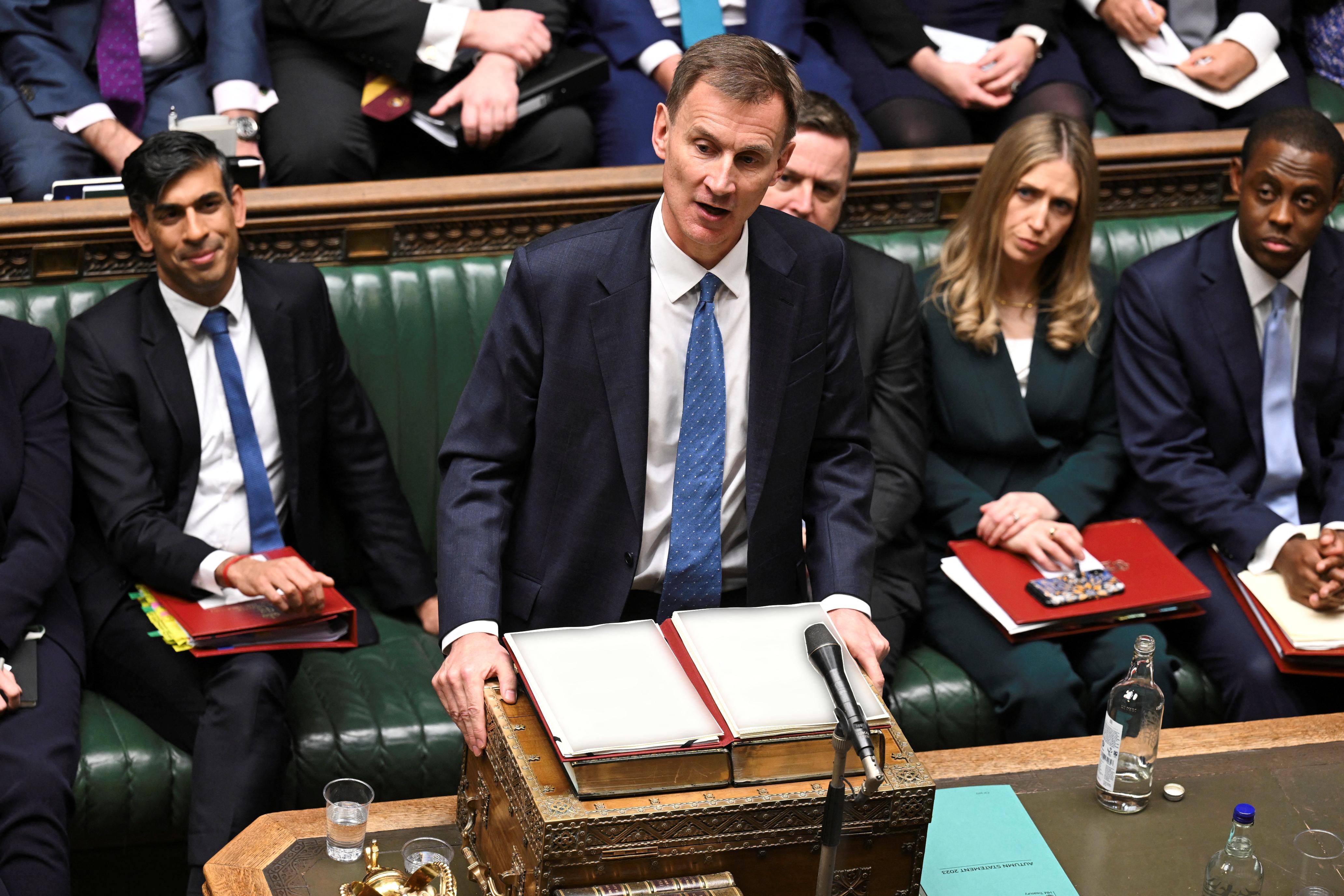
LONDON, Nov 22 (Reuters) - British finance minister Jeremy Hunt announced on Wednesday a bigger-than-expected cut in social security contributions and made incentives for business investment permanent in a bid to speed up the country's sluggish economy. The pound fell against the dollar and the euro, while blue-chip stocks stayed in negative territory, although shares in pubs rallied sharply after Hunt unveiled a plan to freeze duty on alcohol until August next year. UK growth is forecast to reach 0.7% in 2024, Hunt said, citing the latest projections from the Office for Budget Responsibility (OBR), far below a forecast in March for an expansion of 1.8% next year. MARKET REACTION: STOCKS: FTSE 100 (.FTSE) was down 0.4% on the day. Shares in pub owners FULLER'S (FSTA.L), Marston (MARS.L) and JD Wetherspoon (JDW.L) jumped, rising between 0.5-2.2%. FOREX: Sterling fell 0.5% to $1.247, compared with $1.2543 before Hunt's speech. FIXED INCOME: Benchmark 10-year gilt yields were last up 4 basis points on the day at 4.142%, having reversed an earlier decline after Britain's Debt Management Office surprised investors with only a tiny cut to its bond issuance plans. COMMENTS: CHARLES HEPWORTH, INVESTMENT DIRECTOR, GAM INVESTMENTS, LONDON: "The OBR have downgraded UK GDP growth by some margin for next year from 1.8% (in their March estimate) to 0.7%. A stagnant labour force post Brexit is clearly impacting their assessment. Given growth is directed by the size of labour and its productivity, there is only one part of that equation Hunt can try to tweak - an increase in productivity. But that is the age-old problem across many economies that remains elusive." THOMAS MCGARRITY, HEAD OF EQUITIES, RBC WEALTH MANAGEMENT, LONDON: "Ultimately, the budget does not change our view that the UK economy faces a high risk of stagflation, which keeps us cautious and highly selective on UK domestic stocks. While we remain neutral overall on UK equities, we continue to have a bias for more globally diverse businesses, many of which trade at a notable valuation discount versus their international peers listed in other markets. We view this unwarranted "UK market discount" on these global companies as an opportunity for long-term investors in these stocks." MATTHEW RYAN, HEAD OF MARKET STRATEGY, EBURY, LONDON: "We’ve seen a rather limited reaction in markets to today’s budget announcement - a far cry from the wild gyrations we witnessed when UK tax cuts were last unveiled by Liz Truss’ government a little over a year ago." "All in all, most of the policy tweaks announced, including the increases in the state pension and (universal credit) and disability benefits, were either fully expected or seen as having minimal impact on the economic outlook. This can explain the mild reaction in both equity markets and the pound this afternoon." MICHAEL FIELD, EUROPEAN MARKET STRATEGIST, MORNINGSTAR, AMSTERDAM: "From a macro-economic perspective, the autumn statement provided little in the way of good news. GDP growth forecasts were slashed for both 2024 and 2025, while inflation forecasts were increased, a double-whammy of negativity." "For consumers, today’s budget will be taken mildly positively, with national insurance rates falling and benefits rising by a higher rate than expected. With inflation now forecasted to remain higher for longer, this could go some way to offsetting the likely cutbacks that households will have to make in order to make ends meet, which is also good news for consumer facing businesses.” OLI CREASEY, PROPERTY EQUITY ANALYST, QUILTER CHEVIOT, LONDON: "There were a few bits and pieces that were aimed at increasing planning outcomes and unlocking the bottlenecks in the planning system." "This doesn't feel like it's the sort of thing that's going to move the needle right now." "It's not planning that's stopping (developers) from selling homes right now, it's affordability. Inflation dropping and the prospect of a peak in interest rate is perhaps more impactful for the housing market." PHILIP SHAW, CHIEF ECONOMIST UK AT INVESTEC, LONDON: "Early days to make a very informed comment, but in overall terms this is a meaningful fiscal stimulus - 14 billion pounds of measures next year is equivalent to 0.5% of GDP. This will help to buttress demand but the question is what effect this has on monetary policy. It may be excessive to think that it will trigger higher interest rates, but potentially it could delay the point next year when the MPC (Bank of England Monetary Policy Committee) moves to bring rates down. Full expensing should be a major lift to UK industry and to the longer term-macro outlook where improving the UK’s woeful pace of productivity growth is critical." JATIN ONDHIA, CEO, SHOJIN PROPERTY PARTNERS, LONDON: "Housing could not be overlooked today, not after Labour had made such a point of championing housebuilding as a key part of its election campaign. Hunt struck some positive notes, such as plans to make it easier for councils to fast-track applications for infrastructure projects, and potentially making it easier for houses to be converted into flats. But overall, this was a lacklustre statement for the property sector, with little of substance to excite those building, buying and investing in UK real estate." MARC VON GRUNDHERR, DIRECTOR, BENHAM AND REEVES, LONDON: "Another underwhelming autumn statement where the housing market is concerned. Much like unwrapping a pair of socks on Christmas Day, it lacked imagination and left us feeling largely disappointed. It’s clear they have run out of ideas when it comes to addressing the current issues plaguing the property market. Hardly surprising when we have housing ministers coming and going more frequently than the postman." https://www.reuters.com/world/uk/view-uk-markets-sapped-by-hunts-budget-2023-11-22/
2023-11-22 16:41
NEW YORK, Nov 22 (Reuters) - The recent rally that has lifted U.S. stocks and bonds is more of a year-end rebound than a turning point, according to big money managers, who see fiscal and monetary policies, next year's presidential election and recession fears as likely to start weighing on markets. Since late October, the S&P 500 (.SPX) has rallied roughly 10% and the Nasdaq (.IXIC) has surged 13%, as investors increased bets that the Federal Reserve's tightening cycle is over after signs of cooling inflation and job growth and a better-than-expected third-quarter earnings season. Ten-year Treasury yields hit a 16-year high of 5.021% in late October, but have fallen back to 4.414%. Lower yields have driven a technology-fueled equities rally. Some big investors and advisers believe, however, that reasons to cheer are short-lived and growing concerns over the economy will start weighting on asset prices early next year. "We've started seeing some signs that things are a little weaker than what people may believe," Ryan Israel, chief investment officer of Bill Ackman's Pershing Square Capital Management, told clients last week, adding the main focus now is where the economy is heading. Markets may have “gone too far in extrapolating” rate cuts in early 2024 from recent data suggesting that consumer inflation is falling and the U.S. labor market is weakening, said Mohamed El-Erian, an adviser to financial services firm Allianz SE (ALVG.DE). While inflation has become less front-and-center after U.S. consumer prices were unchanged in October, on investors' minds is the fallout from the Fed's 525 basis points in total interest rate hikes since March 2022 coupled with the central bank's efforts to reduce its balance sheet, under its so-called quantitative tightening. Overall, growth in the global economy is expected to slow in 2024, hit by elevated interest rates, higher energy prices and cooler growth in the world's two largest economies, the U.S. and China. Most economists, however, believe the world will avoid a recession. "I don't think that the market is going to dodge a very aggressive Fed tightening cycle and then continued quantitative tightening environment without a little bit of damage coming sometime next year," said Peter van Dooijeweert, head of defensive and tactical alpha at Man Group's Solutions unit, which creates portfolios for clients. His focus now is more on earnings, credit markets and broader economic data for signs of a potential slowdown. The U.S. presidential race next year is also a concern because it could be a source of more market instability. "As we get into 2024, with a general election that's going to be extremely contested, I think we're going to see more risks there," said Max Gokhman, head of MosaiQ investment strategy at Franklin Templeton. MAGNIFICENT SEVEN One of the biggest sources of uncertainty for investors is the performance of the so-called Magnificent Seven group of very large companies, which have driven stock indexes this year. Bill Gross, the co-founder of bond giant Pimco who now manages his own money and that of his foundation, told Reuters in an email that the drop in yields has largely benefited technology stocks, which are also riding investor enthusiasm for artificial intelligence. But he sees little room for the 10-year Treasury yield to move lower at 4.45%. "Do not look for yields to be a contributing factor in the future," he said. For a new boost in market performance, tech stocks will depend more on showing how AI can lift results, investors said. Last month, Microsoft (MSFT.O) quarterly results beat Wall Street sales estimates, with its cloud computing and PC businesses growing as customers anticipated using its AI offerings. "The market might be too optimistic about how much of the AI boom is really going to contribute to the bottom line of earnings of the Magnificent Seven," said van Dooijeweert. A Reuters poll on Tuesday showed that strategists estimate the S&P 500 will end next year only about 3% higher than its current level, as they fear an economic slowdown or recession. "I think it would be important to hold your convictions quite loosely as you go past New Year's Eve," said Gokhman, of Franklin Templeton. https://www.reuters.com/markets/us/big-investors-say-us-markets-rally-could-prove-short-lived-2023-11-22/
2023-11-22 16:08
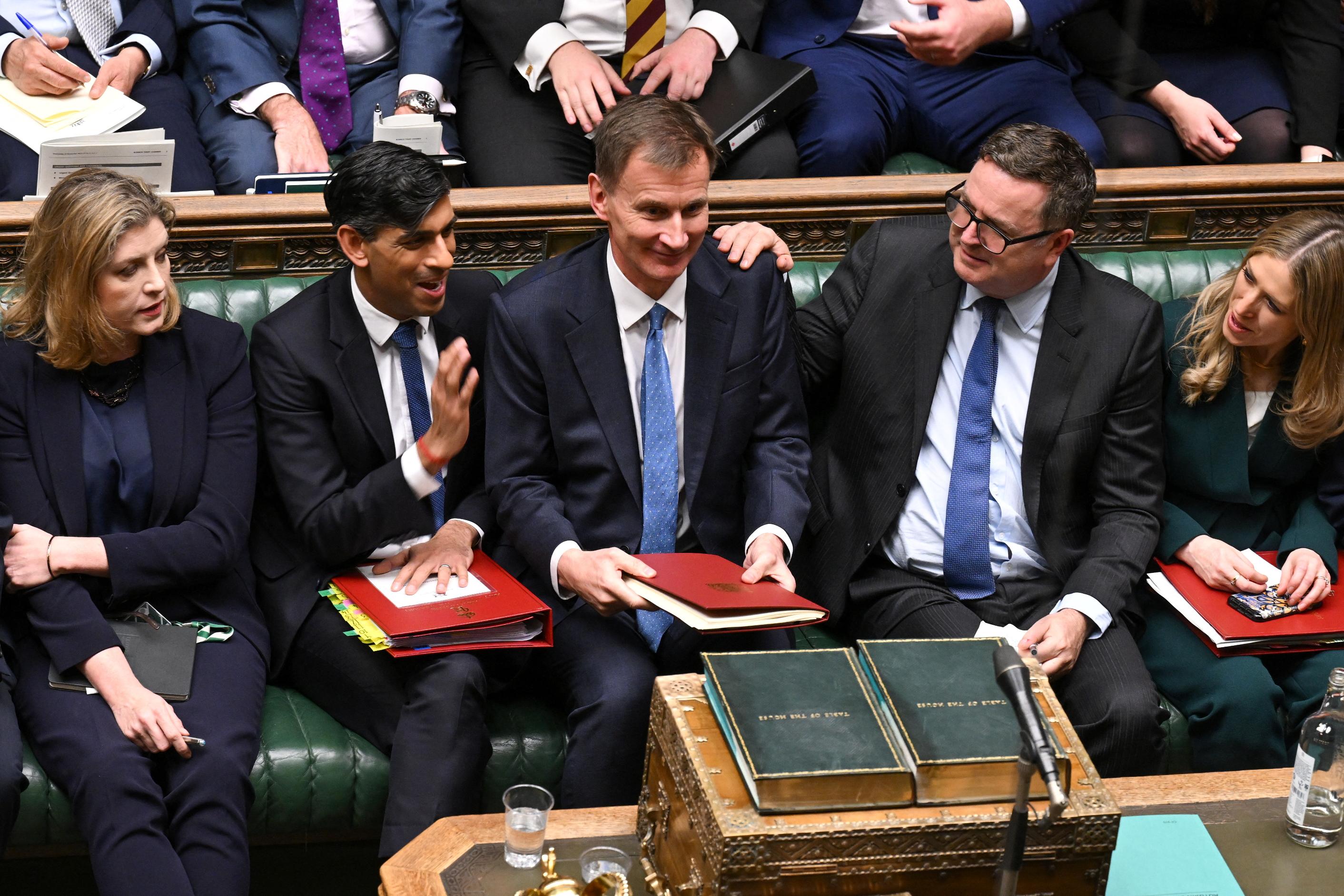
UK business investment has lagged since Brexit "Largest business tax cut" in modern history-Hunt Tax break costs 11 bln stg a year OBR forecasts 3 bln stg a year investment boost LONDON, Nov 22 (Reuters) - Britain's finance minister Jeremy Hunt made a tax break for business investment permanent on Wednesday, aiming to kickstart growth in the country's sluggish economy. Britain has suffered from weak business investment since the Brexit vote in 2016, and economists blame the lack of corporate investment for the country's anaemic growth rate in recent years. Hunt hopes that by making permanent the tax break known as "full expensing", companies will spend more on new kit and technology, lifting productivity. "I will today make full expensing permanent. This is the largest business tax cut in modern British history," Hunt said in his Autumn Statement on Wednesday. The move would boost annual business investment by around 3 billion pounds ($3.7 billion) a year, forecasts from the Office for Budget Responsibility (OBR) said. More investment would help close the productivity gap with other major economies, the finance minister said, helping drive growth and raise living standards. BT (BT.L), a beneficiary of the tax break as it is investing billions in building a new fibre network, welcomed Hunt's move. "It gives businesses like ours long-term certainty as we plan and build the country's digital infrastructure, and shifts the investment environment in Britain from good to great," Chief Executive Philip Jansen said. The opposition Labour party, which is ahead of Hunt's Conservatives in the polls before an election expected in 2024, said it supported the move. BREXIT DRAG Full expensing is a capital allowance scheme that allows companies to deduct 100% of the cost of qualifying plant and machinery from their taxable profits. Hunt said that the tax break costs the government 11 billion pounds a year. It was brought in earlier this year and had been due to expire in 2026, but the country's improved finances meant it could now be made permanent, Hunt said. British business investment has trailed that of other developed economies, according to research from the International Monetary Fund. In 2022, British business investment was slightly lower than its level in 2016, a contrast with other Group of Seven economies that experienced a 14% average increase during the period. As well as the uncertainty caused by the 2016 Brexit vote, Britain has had four different prime ministers in seven years, creating a further headache for companies as they consider long-term decisions. Manufacturing and engineering business group Make UK said Hunt's move was positive for business. "The biggest factor that companies want when planning investment decisions is certainty in policy and this has now been provided by making full expensing permanent," Make UK boss Stephen Phipson said. But the boss of car dealership chain Vertu Motors (VTU.L) was less convinced. "For many British businesses they're just trying to keep going. They're not investing heavily in plant and machinery," Vertu CEO Robert Forrester told BBC Radio earlier on Wednesday. "I don't think that's a massive, massive thing for most businesses." ($1 = 0.8025 pounds) https://www.reuters.com/world/uk/uks-hunt-makes-business-investment-tax-break-permanent-growth-quest-2023-11-22/
2023-11-22 14:13
WASHINGTON, Nov 22 (Reuters) - Orders for long-lasting U.S. manufactured goods fell more than expected in October as orders for motor vehicles and parts dropped amid strikes by the United Auto Workers (UAW) union against Detroit's "Big Three" automakers. The Commerce Department's Census Bureau said on Wednesday that orders for durable goods, items ranging from toasters to aircraft meant to last three years or more, dropped 5.4% last month, also weighed down by declines in bookings for civilian aircraft. Data for September was revised lower to show orders for these goods rising 4.0% instead of the previously reported 4.6%. Economists polled by Reuters had forecast durable goods orders would decline 3.1%. Durable goods orders rose 4.0% on a year-over-year basis in October. Manufacturing, which makes up 11.1% of the economy, is shuffling along as higher interest rates cool demand. Since March 2022, the U.S. central bank has raised its benchmark overnight interest rate by 525 basis points to the current 5.25%-5.50% range. Transportation equipment orders plunged 14.8% last month after increasing 11.6% in September. Motor vehicle and parts orders fell 3.8%, likely because of shortages caused by the UAW's strikes at a number of U.S. factories owned by General Motors (GM.N), Ford (F.N) and Chrysler parent Stellantis (STLAM.MI). The industrial action has since ended. Civilian aircraft orders tumbled 49.6%. Boeing (BA.N) reported on its website that it had received 123 orders for civilian aircraft, compared to 224 in September. There were increases in orders for computers and electronic products as well as fabricated metal products. But orders for electrical equipment, appliances and components fell. Machinery orders were unchanged. Non-defense capital goods orders excluding aircraft, a closely watched proxy for business spending plans, dipped 0.1% after slipping by a downwardly revised 0.2% in the prior month. These so-called core capital goods orders were previously reported to have risen 0.5% in September. Core capital goods shipments were unchanged for a second straight month. Shipments of non-defense capital goods dropped 0.3% following a 0.2% decline in the prior month. These shipments feed into the calculation of equipment spending in the gross domestic product report. Business spending on equipment spending contracted in the third quarter. The economy grew at a 4.9% annualized rate last quarter. https://www.reuters.com/markets/us/us-durable-goods-orders-fall-weakness-transportation-equipment-sector-2023-11-22/

2023-11-22 12:03
Nov 22 (Reuters) - Senior Cuban officials have over several weeks provided an increasingly dire snapshot of a deepening economic crisis in a series of televised prime-time appearances, revealing the extent of the downturn in unprecedented detail. Minister after minister have delivered the bad news as the import-dependent Communist-run country weathers a fourth year of crisis, scraping by with a minimum of foreign exchange as output plummets. Food production, the supply of phamaceuticals and transportation are down by at least 50% since 2018, the top officials said, and continued to decline this year in large part due to chronic fuel shortages and power outages. Cuba imports most of the food and fuel it consumes, but revenues have plunged following the pandemic, hampered by stiff U.S. sanctions and floundering tourism, once a mainstay of the Caribbean island economy. "The ministers provided new information revealing just how serious the crisis is and that growth this year is very doubtful," Cuban economist Omar Everleny said. Production of pork, rice and beans - all staples on the Cuban dinner plate - are down by more than 80% this year over pre-crisis levels and eggs 50%, Agriculture Minister Ydael Jesus Perez said. "It has only been possible to acquire 40% of the fuel, 4% of the fertilizer and 20% of the animal feed required," the minister explained. Hospitals, short on basic supplies such as sutures, cotton and gauze, have done 30% fewer surgical procedures compared with 2019, according to data shared on state-run TV during a presentation by First Deputy Health Minister Tania Margarita Cruz. Nearly 68% of basic pharmaceuticals are not available or in short supply. Public transportation, vital in a country where few have vehicles, has also been hobbled by fuel shortages and difficulties in obtaining spare parts. If before the collapse of former benefactor the Soviet Union "there were 2,500 buses operating in Havana ... today there are just 300 compared with 600 four years ago," Transportation Minister Eduardo Rodríguez Davila said. The ministers revealed domestic freight traffic continues to decline and is half of what it was in 2019. Industry is operating at 35% of capacity. Cuba's government has acknowledged its state-run economy needs reform. Local authorities, increasingly under pressure as the problems and tension ratchet up, have launched programs to contain hunger, build homes and improve the flow of transportation, but remain hamstrung by a lack of funds, they have said. https://www.reuters.com/world/americas/cuban-ministers-reveal-details-food-fuel-shortages-amid-economic-crisis-2023-11-22/

2023-11-22 12:02
DUBAI, Nov 22 (Reuters) - As global temperatures and emissions climb, people are increasingly turning to courtrooms to challenge fossil fuel companies' activities, leading to wins on issues like "climate-washing" but also backlash as companies file countersuits. In the last five years, the number of climate-related court cases that have been filed around the world more than doubled, according to a 2023 report by the U.N. Environment Programme (UNEP) and New York's Columbia University, from 884 filed by 2017 to nearly 2,500 as of today. A lawsuit "holds companies to account in a way that just protests or campaigns cannot do," said Joana Setzer, a climate litigation researcher at the London School of Economics and Political Science (LSE). Analysts say the strategy appears to be working, with more than half of cases with judicial outcomes leaning toward stronger climate action, according to a 2023 report from LSE. "We have seen more ambition and more action from governments thanks to litigation," Setzer said. Here are some key trends in climate litigation: WHERE CASES ARE BEING FILED Most of today's climate lawsuits have been filed in the United States, including 20 filed by U.S. cities or states against major fossil fuel companies that are likely to go to trial. Some U.S. cases, however, feature right-wing states challenging federal rules for requiring companies to disclose their environmental impacts. About 17% of cases since 2017 have been filed in developing countries, while European courts are hearing several cases that experts say could set new legal precedents. 'CLIMATE-WASHING' IN FOCUS Companies of all kinds are being challenged over alleged "climate-washing," or misleading plans and statements related to tackling emissions. Delta Air Lines (DAL.N) is facing a proposed class action lawsuit over allegedly violating California consumer protection laws by advertising itself as carbon-neutral. "Climate litigation has really widened from large fossil fuel companies to this aspect of accountability and transparency," Setzer said. "If you are able to make statements about 'net zero' or 'carbon neutral', then really these should be proven." In 2021 and 2022, more than 50 climate-washing cases were filed globally against companies, up sharply from just 15 in the previous two years, the LSE report found. COMPANIES STRIKE BACK Companies are not only on the defense. They are also filing their own cases against governments with the aim to delay or dismantle regulations on climate action, the UNEP report said. These so-called backlash cases include one filed by 26 Republican-led states, an oil drilling company and an oil and gas trade group, challenging a Biden administration rule allowing employee retirement plans to consider environmental, social or governance issues in their investment decisions. Not all challenges succeed, though. After a judge in September upheld the rule, the plaintiff's coalition said in October it would appeal. In Europe, a court denied energy companies RWE and Uniper compensation for lost revenues from the Dutch government, after the Netherlands decided to close coal-fired energy plants by 2030. Oil majors also have targeted climate protesters following a government crackdown on direct action in Europe, while Britain has made it illegal to lock or glue oneself to property as a protest stunt. This month, Shell filed a suit against Greenpeace seeking $2.1 million in damages after protesters in January boarded the company's oil production vessel near the Canary Islands. OTHER CASES TO WATCH DUARTE AGOSTINHO AND OTHERS V. PORTUGAL AND 32 OTHER STATES Six Portuguese youth are suing 33 European countries for allegedly failing to avert catastrophic climate change that they say now threatens their right to life. The case — among the first to be heard at the European Court of Human Rights — does not ask for financial compensation, but for governments to cut emissions more drastically. The case was heard in Strasbourg in September 2023. A ruling is expected in the first half of 2024. LUCIANO LLIUYA V. RWE AG Peruvian farmer Saul Luciano Lliuya is suing German energy utility RWE for about $20,000. He says the company's emissions have contributed to the melting of Andean glaciers, swelling a lake above his hometown to dangerous levels. "It's a nominal amount, but a significant precedent," said Joe Snape, an associate at law firm Leigh Day. The argument rests on attribution science — can the plaintiff prove the company's emissions are responsible for worsening climate change, and to what extent? Following a May 2022 expedition to Peru to gather evidence, the case will be heard early next year in Hamm, Germany. PEOPLE OF THE STATE OF CALIFORNIA V. BIG OIL In September, the U.S. state of California launched a lawsuit against oil companies Exxon Mobil, Shell, ConocoPhillips, BP and Chevron. The suit accuses the companies of deceiving the public by downplaying fossil fuel risks and argues they are responsible for tens of billions of dollars in climate-related damage. The lawsuit is seeking a compensation fund to pay for future climate-related damages in the state. Ambitious in scope, the case is "an amalgamation of strategies," Setzer said. "It's not just a compensation case, but also a deception case, which makes it stronger." https://www.reuters.com/sustainability/climate-energy/climate-activists-companies-lawyer-up-courtroom-battles-2023-11-22/