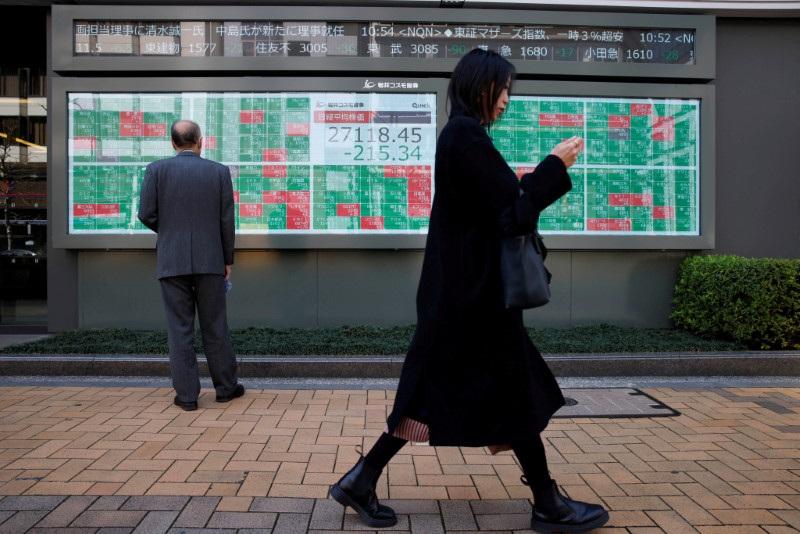
2023-11-08 11:00
ZURICH, Nov 8 (Reuters) - The Swiss National Bank responded on Wednesday to the U.S. Treasury removing Switzerland from its monitoring list of countries that appeared to be manipulating their currencies. The SNB said it noted the decision, which came in the Treasury's semi-annual report into the currency policies of the United States' major trading partners. "Together with the Swiss authorities, the SNB remains in contact with the US authorities to explain Switzerland's economic situation and monetary policy," the SNB said in a statement on Wednesday. "We welcome these ongoing discussions." Switzerland had run into trouble with the U.S. after the SNB's massive purchase of foreign currencies, designed to weaken the safe haven franc as it surged in value. The SNB has since changed course, allowing the franc to weaken as a tool to dampen imported inflation. In its November 2022 report, the Treasury had found that Switzerland had exceeded all three thresholds for possible manipulation, but refrained from branding it as a manipulator. But in June, the Treasury downgraded its view of Switzerland, ending "enhanced analysis" of the country. On Wednesday, Switzerland and South Korea were taken off the monitoring list after meeting one criterion for two periods in a row. For a country to qualify, they had to exceed two of three thresholds: a trade surplus with the U.S. above $15 billion, a high global current account surplus above 3% of gross domestic product (GDP), and persistent net foreign currency purchases exceeding 2% of GDP over a year. The designation had sparked intensive discussions between Swiss and U.S. officials, with Switzerland explaining its policies were not designed to gain a trade advantage but rather to reduce the damaging impact of the strong Swiss franc on Switzerland's export-orientated economy. https://www.reuters.com/markets/currencies/swiss-respond-removal-us-currency-manipulation-list-2023-11-08/

2023-11-08 09:44
BEIJING/SHANGHAI, Nov 8 (Reuters) - China's car sales are expected to jump by more than 20% in November, the China Passenger Car Association (CPCA) said on Wednesday, citing increased confidence among carmakers striving to deliver annual sales goals in the world's top auto market. Car sales totalled 2.05 million units in October, up 9.9% from a year earlier, extending gains to a third month. Sales in the first 10 months of 2023 rose 3% year-on-year to 17.46 million units. The October figures came on the back of a 2.2% increase in August and a 4.7% rise in September. New energy vehicle (NEV) sales rose by 37.5% in October year-on-year, accounting for 37.4% of total car sales. NEV sales growth picked up from a 22.1% increase in September, amid signs that an economic recovery was gaining traction. Demand for electric vehicles, however, has weakened in China as consumers favour more economical plug-in hybrids, helping carmakers such as Li Auto (2015.HK) and BYD (002594.SZ) gain market share. BYD sold 301,095 passenger cars, including its Dynasty and Ocean series and Denza brand in October, up 38.4% year-on-year, with more than 10% exported, according to the company. It offered limited-time discounts for November on some of its best-selling models as the company strives to meet its annual sales target of 3 million units. BYD had sold year-to-date 2.38 million new energy vehicles of both pure electric and plug-in hybrids. U.S. EV giant Tesla (TSLA.O), in comparison with its Chinese rivals, saw lower sales, with October deliveries of China-made EVs down 2.6% from a month earlier and just 0.6% higher year-on- year. Tesla exported 43,489 China-made EVs last month, up 42.3% from 30,566 in September, CPCA data showed, when the passenger vehicle export growth cooled slightly to 49% from 50% in September. A price war started by Tesla at the beginning of the year is dragging down profitability of companies that only make EVs, and these firms have stepped up efforts to prune costs and build partnerships to survive. "The auto sector has already been in a very miserable state, with profit margins at absolutely historical lows of merely 4.5% in September," CPCA Secretary General Cui Dongshu said, referring only to figures for September. Leapmotor (9863.HK) just struck a deal with European legacy conglomerate Stellantis (STLAM.MI) to gain a European foothold. Nio (9866.HK) plans to trim its workforce by 10% this month as it tries to improve efficiency and reduce costs in the face of growing competition, the Chinese EV upstart said on Friday. https://www.reuters.com/world/china/china-car-sales-rise-almost-10-yryr-oct-third-month-gains-2023-11-08/

2023-11-08 06:45
API shows large 12 mln bbl build in US crude stockpiles -sources OPEC export estimates remain high -Goldman Sachs China's exports extend declines Russia considers lifting gasoline export ban - Interfax NEW YORK, Nov 8 (Reuters) - Oil prices slid over 2% on Wednesday to their lowest in more than three months on concerns over waning demand in the U.S. and China. Brent crude futures settled down $2.07, or 2.5%, to $79.54 a barrel. U.S. crude lost $2.04, or 2.6%, to $75.33. Both benchmarks hit their lowest since mid-July. "The market is clearly less concerned about the potential for Middle Eastern supply disruptions and is instead focused on an easing in the balance," ING analysts Warren Patterson and Ewa Manthey said in a note to clients, referring to crude supply conditions. Also weighing on prices, U.S. crude oil stocks rose by almost 12 million barrels last week, market sources said late on Tuesday, citing American Petroleum Institute figures. If confirmed, that would be biggest build since February. However, the U.S. Energy Information Administration (EIA) has delayed release of weekly oil inventory data, usually on Wednesdays, until Nov. 15 to complete a systems upgrade. U.S. crude production will rise this year by slightly less than expected but petroleum consumption will fall by 300,000 barrels per day (bpd), the EIA said on Tuesday, reversing its previous forecast of a 100,000-bpd increase. Data from China, the world's biggest crude oil importer, showed its total exports of goods and services contracted faster than expected, feeding worries about the energy demand outlook. In the euro zone, data showing falling retail sales also highlighted weak consumer demand and the prospect of recession. "The meltdown we've seen in prices is reflecting two things: concerns about the global economy hitting a brick wall based on data out of China and also a sense of confidence that the war in Israel and the Gaza Strip is not going to impact supply," said Phil Flynn, analyst at Price Futures Group. Still, China's October crude oil imports showed robust growth and its central bank governor said the world's second-biggest economy is expected to hit its gross domestic product growth target this year. Beijing has set a target of about 5% growth. Analysts from Goldman Sachs estimated seaborne net oil exports by six countries from oil producer group OPEC will remain only 600,000 bpd below April levels. OPEC has announced cumulative production cuts amounting to 2 million bpd since April 2023. Russia, a part of the producer groups known as OPEC+, is considering lifting an export ban on some grades of gasoline, Interfax news agency quoted Energy Minister Nikolai Shulginov as saying. Moscow introduced a ban on fuel exports on Sept. 21 to tackle high domestic prices and shortages. The government eased restrictions on Oct. 6, allowing diesel exports by pipeline, but kept measures on gasoline exports. Barclays lowered its 2024 Brent crude price forecast by $4 to $93 a barrel. https://www.reuters.com/markets/commodities/oil-prices-fall-over-3-month-low-signs-higher-supply-2023-11-08/

2023-11-08 06:40
SEOUL, Nov 8 (Reuters) - Korea Electric Power Corp (KEPCO) (015760.KS) said on Wednesday it plans to raise the industrial electricity price for larger companies and sell off more assets after its debt hit 201 trillion won ($154 billion) at the end of June. However, the South Korean state utility said that it will keep electricity prices unchanged for the public and smaller companies. Analysts said such a partial measure falls short of hikes needed to bring KEPCO's debts down to a sustainable level, and is likely driven by political considerations before South Korea holds general elections in April. Although energy prices soared last year after Russia's invasion of Ukraine, South Korea's government was slow to pass on higher costs to consumers and businesses grappling with inflation. As of June, KEPCO had reported nine consecutive quarterly operating losses of 47 trillion won combined. Although a profit is forecasted in the July-September quarter due to a recent dip in global energy prices, analysts expect a swing to losses again in the fourth quarter on volatile oil prices. "KEPCO's financial crisis, which began with soaring international energy prices, has reached a limit financially that is difficult for a company to withstand," CEO Kim Dong-cheol said in a statement. State-backed KEPCO, which has issued about 80 trillion won in bonds to help plug snowballing losses, said it plans an average hike of 10.6 won per kilowatt hour (kWh) for the industrial electricity price for larger companies starting on Thursday. Industrial electricity accounted for about 49% of total electricity usage in 2022. But such a hike is still not enough to fully return KEPCO's finances to a manageable level, and at this rate KEPCO may exceed its bond issuance limit next year, analysts said. KEPCO calculated electricity bills should rise by 45.3 won per kWh this year, up 38% from the 2022 average of 120.51 won per kWh, to help return its balance sheet to health. But the government only approved less than half of that, or 19.4 won per KWh combined, during the first half of this year. KEPCO also said it plans to sell a 20% stake in unit KEPCO KDN, its 38% stake in a solar power plant in the Philippines and real estate in Seoul, on top of existing plans to cut costs and sell assets to save more than 25 trillion won by 2026. ($1 = 1,304.4500 won) https://www.reuters.com/business/energy/kepco-hike-industrial-electricity-price-sell-assets-debt-hits-154-bln-2023-11-08/
2023-11-08 06:22
NEW YORK, Nov 8 (Reuters) - The dollar was steady against the euro on Wednesday and gained against the yen as it consolidated after a sharp selloff last week on rising confidence that the Federal Reserve has ended its interest rate-hiking cycle. Traders also remained on alert for potential intervention in the Japanese currency as it rose above the 151 level against the dollar, its weakest level in a week. Many economists and analysts expect the U.S. economy to slow in the fourth quarter, which makes further rate hikes less likely and will dent the appeal of the greenback, which has benefited from the relative strength of the United States compared to other major economies. “The dollar is vulnerable to weaker data going forward," said Shaun Osborne, chief foreign exchange strategist at Scotiabank in Toronto. "We’re transitioning to a sort of sell dollar rallies environment, after the buy dollar dips trend that we’ve seen really since the middle of the year." That said, the dollar may continue to gain in the short-term as it recovers from last week’s selloff, which was viewed by some as overdone. “Essentially it’s a period of consolidation for the U.S. dollar generally... That probably will continue for a little bit longer,” said Osborne. The greenback suffered after Fed Chair Jerome Powell was interpreted as striking a dovish tone at the conclusion of the Fed’s two-day meeting last Wednesday, when it left interest rates unchanged. Powell did not comment on monetary policy in a speech on Wednesday. He is also due to speak on Thursday. Futures point to a roughly 17% chance of another hike by January, but are pricing in an 18% chance that rate cuts could come as early as March, according to the CME FedWatch Tool. The dollar index was last up 0.05% at 105.58. It fell 1.4% last week, its steepest weekly decline since mid-July. Weaker-than-expected jobs data for October on Friday added to last week's selloff. The next major U.S. economic releases will be consumer price inflation and retail sales data due next week. The euro edged up 0.02% to $1.0702. The single currency was hurt earlier on Wednesday by data showing that retail sales in September fell 0.3% month-on-month in the bloc. "The mixed outlook for consumer and investment spending leaves the euro zone very close to recession," said Wells Fargo Economist Nick Bennenbroek. The dollar gained 0.41% to 151.03 Japanese yen , heading back towards levels that have investors on watch for currency intervention. It hit a one-year high of 151.74 last week. "It's clear we are back in the intervention space," said ING FX strategist Francesco Pesole. "The rate of change has been rather substantial in the last two sessions. If we see dollar-yen rising by another substantial amount today then intervention alarm bells will start ringing very loudly." In the FX options market, however, positions are more tilted towards expectations that the yen will strengthen from here. One-month dollar/yen risk reversals , which are used to gauge bullish or bearish sentiment in currency markets, on Wednesday showed a preponderance of puts -- a bet that the pair would fall -- over calls, currently at -0.65. That's the highest level since September 2022. A negative risk reversal means the volatility of put options is greater than the volatility of similar call options. The British pound , which earlier in the week hit a seven-week top against the dollar above $1.24, was last down 0.12% at $1.2283. The Australian dollar fell another 0.57% to $0.6400, having slid 0.8% in the previous session - its largest daily decline in about a month. The Reserve Bank of Australia (RBA) on Tuesday raised interest rates to a 12-year high, ending four months of steady policy, but watered down its tightening bias to make it more conditional on incoming data. ======================================================== Currency bid prices at 3:00PM (2000 GMT) https://www.reuters.com/markets/currencies/dollar-licks-its-wounds-ahead-fed-chair-powells-remarks-2023-11-08/
2023-11-08 06:20
S&P 500, Nasdaq extend winning streaks U.S. long-dated yields fall as 10-year auction ends well Oil slips over 2% on demand fears, lowest settlement in 3 months NEW YORK, Nov 8 (Reuters) - World stock markets sputtered on Wednesday and the dollar eased as some investors accepted the notion that interest rates will stay higher for longer even though the Federal Reserve may have halted hiking them. Yields across the Treasury curve mostly fell as the auction of benchmark 10-year notes fared modestly better than expected, and on the view that the Fed has likely ended its hiking cycle. The dollar has rebounded from last week's sharp sell-off on rising confidence the Fed has ended raising rates, though there is less agreement on whether a rate cut is on the horizon with inflation still above the U.S. central bank's 2% target. "The Fed not necessarily hiking anymore might get people a little bit more excited, but does that mean we're going to start cutting aggressively? It's too early to say that," said Marvin Loh, senior global macro strategist at State Street in Boston. "A lot of the questions that we were asking that drove yields higher we're still asking," he said, referring to the bond rally that raised the 10-year yield above 5% two weeks ago. Bond prices move inversely to their yield. Fed Chair Jerome Powell did not comment on monetary policy or the economic outlook in prepared remarks at a U.S. central bank statistic conference on Wednesday. Investors have ramped up bets for Fed rate cuts next year, though the timing is unclear. Markets are pricing in an almost 50% chance of a rate cut of at least 25 basis points as soon as May, according to the CME Group's FedWatch Tool, up from about 41% a week earlier. But futures also call for the Fed's overnight lending rate to remain above 5% through next June. MSCI's all-country world stock index (.MIWD00000PUS) closed flat, rising just 0.01 point, after last week posting its biggest weekly jump in almost a year. Europe's broad STOXX 600 index (.STOXX) closed up 0.28%. On Wall Street, the S&P 500 (.SPX) rose 0.10% and the Nasdaq Composite (.IXIC) added 0.08% to extend their winning streaks to eight and nine consecutive sessions, respectfully. The Dow Jones Industrial Average (.DJI) fell 0.12%, "The market has it right that rates have peaked," said Rhys Williams, chief strategist at Sprouting Rock Asset Management in Bryn Mawr, Pennsylvania, but since the Fed has "been so macho about higher for longer," a rate cut is unlikely to come soon. European shares rose, supported by gains in healthcare stocks and strong earnings reports, while investors assessed a slew of economic data and comments from central bankers for cues on the European Central Bank's rate hike path. Data showed euro zone retail sales fell roughly in line with expectations in September, while another survey showed euro zone consumers have raised their inflation expectations over the next 12 months to 4%. The two-year Treasury yield, which reflects interest rate expectations, rose 2 basis points to 4.938%, while the yield on the benchmark 10-year note slid 6.2 basis points to just above 4.50% - a level some see as a new bottom. The dollar index fell 0.01% at 105.51, after earlier being on track for a third straight day of gains, while the euro rose 0.07% to $1.0707. The majority of FX strategists in a Reuters poll expect the dollar to remain weak for the rest of the year, amid a building consensus that the Fed's tightening cycle is done, also signaling a peak in U.S. yields. MSCI's broadest index of Asia-Pacific shares (.MIAP00000PUS) overnight slipped 0.3% and Japan's Nikkei 225 (.N225) closed lower after Bank of Japan Governor Kazuo Ueda told parliament the central bank need not wait until real wages turn positive before exiting stimulus. Hong Kong's Hang Seng fell and an index of mainland blue chips (.CSI300) lost 0.24%. Chinese authorities have asked Ping An Insurance Group to take a controlling stake in embattled Country Garden (2007.HK), the nation's biggest private property developer, four people familiar with the plan said. A spokesperson for Ping An (601318.SS) said the company had not been approached by the government and denied the information reported by Reuters. Oil prices slid to more than three-month lows on concern over waning U.S. and Chinese demand, while gold prices retreated for a third straight session as yields on the short end of Treasuries rose and on longer-dated notes fell. Brent crude futures settled down $2.07 at $79.54 a barrel and U.S. crude lost $2.04 to settle at $75.33. U.S. gold futures settled 0.8% lower at $1,957.80 an ounce. https://www.reuters.com/markets/global-markets-wrapup-1-2023-11-08/