2023-11-07 22:57
PARAMARIBO, Nov 7 (Reuters) - Companies from India, China and the Middle East have informally expressed interest in participating in a bauxite project in the jungle of western Suriname that could attract billions in investment, a Surinamese official said on Tuesday. The South American country hopes to have awarded a concession for bauxite - the world's main source of aluminum - by this time next year, after decades of attempts to develop the ore. "There's 324 million tons of bauxite there," Daniel Lachman, the chair of the presidential commission created to evaluate bids for the Bakhuis region, said in an interview. He was citing proven reserves, but deposits could be larger. Investment, potentially also from bidders from other regions, would be significant, he said. "You are easily talking about $10 billion to $12 billion, but over a period of say around 10 years or a little longer. That's my rough estimate," Lachman said. "The bauxite we have is service level bauxite. You don't have to create a mine. You just dig from the top," he added. Companies will be able to formally express interest from Thursday through Jan. 29 next year. Those who pass muster will be short-listed and asked to provide detailed plans, including how they would power a project, ahead of a planned awarding of the concession by November 2024. The Suriname and Courantyne rivers could be dredged or cleared of rock formations to accommodate large ships, Lachman added. Suriname's west is largely pristine jungle. The commission is working to assess biodiversity risks, Lachman said, and proposals will be graded on how well they follow guidelines laid out by environmental regulators and the forestry management agency. "I think we have to look beyond government revenue... to other things that are much more important," Lachman said. Community approval, local employment and infrastructure development are important factors for the commission, which will not approve any project that does not take into account communities, he said. https://www.reuters.com/markets/commodities/suriname-bauxite-project-may-attract-interest-indian-chinese-companies-2023-11-07/

2023-11-07 22:56
PANAMA CITY, Nov 7 (Reuters) - Two people taking part in an anti-government protest in Panama were shot dead on Tuesday by an unknown assailant, authorities said, aggravating social tension that has welled up since anger over a lucrative mining contract sparked demonstrations. The deaths come as street protests by thousands of Panamanians during the past weeks over a new mining contract signed with Canadian mining firm First Quantum Minerals (FM.TO) spilled into wider discontent with the government. One person has been arrested in connection with the deaths, state prosecutors said in a post on social media platform X, without giving further information about the individual. Road blocks set up by protesters have caused up to $80 million in daily losses to businesses, according to Panama's association of company executives, with schools closed nationwide for over a week and more than 150,000 medical appointments missed. The Association of Teachers of Panama (ASOPROF) said on X that the perpetrator of the shooting is a U.S. citizen, though this could not immediately be confirmed by the authorities. Officials have urged people to end the protests, though construction workers' and teachers' unions have vowed to continue taking to the streets until the First Quantum contract is annulled. The new contract, agreed on Oct. 20, was signed into law by Panama's government, and provides First Quantum a 20-year mining right with an option to extend for another 20 years, in return for $375 million in annual revenue to Panama. While the government has said the new contract offers better terms than the previous one, protesters disagree. https://www.reuters.com/world/americas/two-killed-panama-protest-anti-government-tensions-rise-2023-11-07/
2023-11-07 22:49
BOGOTA, Nov 7 (Reuters) - Colombia's majority state-owned oil firm Ecopetrol (ECO.CN) on Tuesday posted third-quarter net profit that was down 47% from a year earlier, citing crude prices that lagged behind 2022 highs while output kept growing. Ecopetrol, which pumps the bulk of Colombia's oil, a key national export, reported a 5.09 trillion peso ($1.28 billion) profit from July to September. Revenues fell 19% from a year ago to 35.1 trillion pesos. Results were in line with company forecasts of a quarterly profit of 5 trillion to 6 trillion pesos from revenues of 32 trillion to 36 trillion pesos. Third-quarter earnings before interest, taxes, depreciation and amortization (EBITDA) landed at 16.04 trillion pesos, at the high end of a 14 trillion peso to 16.5 trillion peso forecast. Production in the quarter rose 2.8% to an average of 740,8000 barrels of oil equivalent per day (boed), the company said. Average production for the year through Sept. 30 rose 3.3% to 729,500 boed. Ecopetrol's average crude prices fell 16% from a year earlier to $77.8 per barrel, while Brent crude, a global benchmark, fell 12% to $85.9 per barrel. Crude oil exports during the three-month period dipped 2.7% to an average of 406,500 barrels per day (bpd). But petroleum product shipments during the period rose by more than a quarter to reach 114,900 bpd, according to the company's report. Weighed by lower crude prices as well as higher borrowing costs and fears of economic slowdown, Ecopetrol's earnings have slumped from the records notched in 2022, while remaining well above levels reached in previous years. Colombia is among Latin America's larger oil producers, pumping fewer barrels than regional heavyweights Brazil and Mexico, but more than Argentina or Ecuador. Mexican peer Pemex (PEMX.UL) posted a $4.5 billion quarterly loss late last month. read more ($1 = 3,975.09 Colombian pesos) https://www.reuters.com/markets/commodities/third-quarter-profit-colombias-ecopetrol-falls-47-2023-11-07/
2023-11-07 22:30
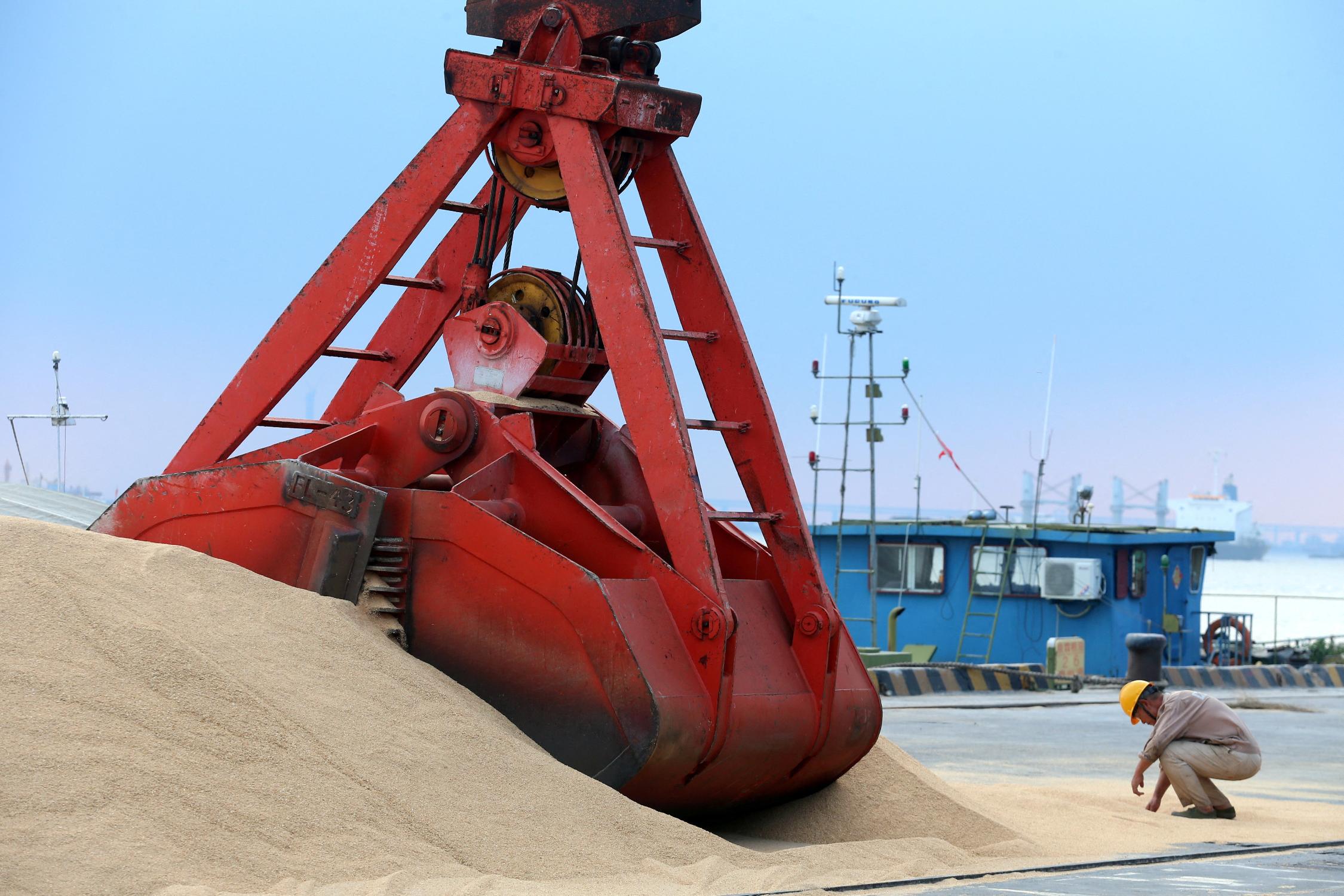
CHICAGO, Nov 7 (Reuters) - China booked its largest single-day U.S. soybean purchases in at least three months on Tuesday, traders said, offering a glimmer of hope for the most valuable U.S. farm export after overseas sales of the 2023 harvest had fallen well behind the normal pace. Chinese importers bought around 10 cargoes of soybeans, or about 600,000 metric tons, for shipment from Gulf Coast and Pacific Northwest export terminals between December and March, trade sources said. The sales would be a relief to U.S. farmers, who have seen Brazil dominate the global export market for soy as well as corn for longer than normal this year. If confirmed, Tuesday's sales would be the largest single-day soybean purchases by the world's top soy importer since late July, according to U.S. Department of Agriculture (USDA) daily sales data. They were the latest in a series of soy import deals since late last week by Sinograin, China's state-owned importer, according to three export traders with knowledge of the deals. Total purchases over that time were estimated at as much as 20 to 25 cargoes, two traders said. Cash premiums for U.S. soybeans at Gulf Coast terminals , jumped by as much as 10 cents a bushel on Tuesday as exporters scrambled to source supplies, traders said. High U.S. prices due to barge shipping disruptions and stiff export market competition from Brazil, which harvested a record soy crop this year, have hampered U.S. sales in the season so far. Confirmed sales to China as of late October were down 35% from a year ago, and sales to all destinations were down 28%. The USDA is currently projecting a 12% year-on-year export decline. But U.S. prices have become more competitive for shipments from December through March, when Brazil's next harvest will be available. The USDA has confirmed private sales totaling 236,000 metric tons of U.S. soybeans over the past two days via the agency's daily reporting system. Traders expect additional "flash sales" following the deals on Tuesday. https://www.reuters.com/markets/asia/china-makes-largest-us-soy-purchases-months-traders-2023-11-07/
2023-11-07 21:58
WASHINGTON, Nov 7 (Reuters) - The U.S. Treasury on Tuesday said no major trading partners appeared to be manipulating their currencies, but it put Vietnam back onto a foreign exchange "monitoring list," while removing Switzerland and South Korea from the same scrutiny. The Treasury's semi-annual currency report for the four quarters ended June 2023 showed that Vietnam, China, Germany, Malaysia, Singapore, and Taiwan were included on its monitoring list. These countries exceeded two of three thresholds: a trade surplus with the U.S. above $15 billion, a high global current account surplus above 3% of gross domestic product, and persistent net foreign currency purchases exceeding 2% of GDP over a year. The Treasury said Vietnam was returned to the monitoring list after its global current account surplus shot up to 4.7% of GDP during the monitoring period. Vietnam's exports have grown rapidly in recent years as companies shift some production to the fast-growing Southeast Asian country from China. Vietnam's central bank said in a statement on Wednesday it will maintain close contact with, and establish regular and effective dialogues with the U.S. Treasury to "address arising issues in a timely manner." Switzerland and South Korea were taken off the monitoring list after they met only one criterion for two monitoring periods in a row. Former U.S. President Donald Trump's administration at the end of 2020 declared both Vietnam and Switzerland as currency manipulators due to their currency interventions, a move that launched intensive engagement between the U.S. Treasury and Swiss and Vietnamese authorities. A U.S. Treasury official said that Vietnam does not appear to be "slipping" in its foreign exchange practices nor in its engagement with U.S. authorities on currency issues. There have been some interventions in the foreign exchange markets, notably by Japan, but the Treasury official said these have been aimed at propping up currency values against the dollar, rather than pushing them down for an export advantage. The official said China remains on the monitoring list due to lack of transparency for its foreign exchange practices, including on the methods and manner of interventions in its yuan currency. The Treasury has estimated China intervened to support the yuan in the latest monitoring period, but not to levels that would trigger any thresholds. https://www.reuters.com/markets/currencies/us-finds-no-major-trade-partners-manipulated-currencies-2023-11-07/
2023-11-07 21:57
Nov 8 (Reuters) - A look at the day ahead in Asian markets from Jamie McGeever, financial markets columnist. Asian markets on Wednesday should be well-placed to bounce back from the previous day's declines, supported by another positive showing on Wall Street that secured the S&P 500's and Nasdaq's longest winning streak in two years. Tuesday's slide in U.S. Treasury yields will also support risk appetite in Asia, although some of that could be tempered by the dollar's resilience. With little on the regional economic data and policy events calendar to give markets a steer, investors will probably take their cue from Wall Street. If so, a positive open to Wednesday's session is in the cards. The Nasdaq rose for the eighth day in a row and the S&P 500 rose for a seventh, both marking their best runs in two years. But investors won't be getting too carried away. The Nasdaq peaked in November 2021 and the S&P 500's high watermark came a few weeks later. Between then and October last year, the Nasdaq lost as much as 35% of its value and the S&P 500 shed nearly 30%. The mostly cautious tone from U.S. policymakers on Tuesday should also help support sentiment in Asia on Wednesday. That said, no Fed official is closing the door to further rate hikes, so a good degree of two-way risk should be factored into emerging and Asian markets. Perhaps surprisingly, given the ongoing violence and tension in the Middle East, oil prices are now back at their lowest levels since July. Year-on-year, oil is down 15% - the inflationary burst of September has completely reversed. The news for investors in China over the last 24 hours, meanwhile, was fairly positive. The International Monetary Fund upgraded China's growth outlook, and Beijing reported a surprise increase in imports last month. Although the IMF's move can perhaps be seen as just lagging the private sector, it does come only a few weeks after it released its World Economic Outlook. The IMF now expects China's economy to grow 5.4% this year and 4.6% next year, up from 5.0% and 4.2%, respectively. In currency markets, the yen has fallen back below the key 150.00 per dollar mark, while the biggest loser overnight was the Aussie dollar, down 0.9% for its biggest fall in a month. The Reserve Bank of Australia raised rates to a 12-year high, as expected, but left it open on whether further tightening would be needed to bring inflation to heel. On the corporate front, perhaps the most interesting of all Japanese corporate earnings reports on Wednesday will be technology group Softbank, after WeWork filed for bankruptcy. Softbank held a 60% stake in the flexible office space provider. Here are key developments that could provide more direction to markets on Wednesday: - Fed's Powell, Williams, Barr, Jefferson, Cook all speak - Japan tankan manufacturing, services indexes (November) - Japan FX reserves (October) https://www.reuters.com/markets/asia/global-markets-view-asia-graphics-pix-2023-11-07/